
Part of Hip osteoarthritis
Hip arthritis treatment without surgery: what actually helps
Warning signs, and when to get help
Can hip arthritis be treated without surgery?
Yes. Non-surgical care is where every guideline begins, and none of them treats it as a consolation prize. Before the menu, though, pin down what treated means, because a lot of disappointment comes from that word doing two jobs.
Non-surgical treatment for hip osteoarthritis targets symptoms and function: how much the hip hurts, how stiff it is, how far you can walk, whether you sleep, whether you can get your shoes on. It does not repair cartilage and nothing on this page is offered on the basis that it will. If your question is whether a treatment can make the joint new again, the answer is no, from any of the sources here.
If your question is whether you can live well with the hip you have, that is a different question and the answer is much better. AAOS puts it plainly: there is no cure for osteoarthritis, and there are many treatment options to help you manage pain and stay active. So what are those options, and in what order do they come?
A grade on an X-ray is not the thing being treated, and it does not set your treatment. The mismatch between what a hip film shows and how much a hip hurts is wide in both directions (Kim and colleagues, 2015), and stages of hip arthritis and how fast it progresses sets that out properly.
What the guidelines put first
NICE names therapeutic exercise and weight management, with information and support, as the core treatments for osteoarthritis. It recommends exercise tailored to the person, local muscle strengthening alongside general aerobic fitness, for everyone with the condition. And it adds the sentence that gets ignored most often: sticking with an exercise plan over the long term increases its benefits.
OARSI, the international osteoarthritis society, reached the same place for the hip from a different direction. Its 2019 guideline named arthritis education and structured land-based exercise programs as the core treatments for hip and polyarticular osteoarthritis (Bannuru and colleagues, 2019). Note the word structured. Not a sheet of four exercises, not advice to keep active, but a program with a dose and a progression.
Weight management belongs in the core where it applies. NICE also recommends general aerobic exercise alongside strength work. Walking, cycling and swimming are common choices. If you carry extra weight, NICE advises that losing weight will improve your quality of life and physical function and reduce pain, and that any amount of weight loss is likely to be beneficial, while losing 10 percent of your body weight is likely to be better than losing 5 percent. Both halves of that matter: more loss buys more, and the benefit does not wait for a target to be hit.
Education is the part people skip, and it earns its place in the core. A flare is a change in symptoms, not a reading of the joint. A sore hip the day after exercise is usually acceptable, while a hip that is worse the next morning is not. Stiffness after sitting is the condition itself, not a sign of damage.
Knowing that much changes what people do with their week. Hip arthritis flare ups is that half of it.
How much does exercise actually help?
The latest Cochrane review of land-based exercise for hip osteoarthritis found that, compared with no exercise or usual care, exercise probably reduces pain and improves physical function slightly. The authors judged these average changes unlikely to be big enough to make a clear difference, and exercise probably made little difference to quality of life. Only 2 small trials compared exercise with a placebo treatment, so that question is still open (Hall and colleagues, 2026). Those are the review's own terms, used here because summarizing them is how this finding gets inflated.
That is a modest finding, and a few things sit alongside it. It is an average across trials that used very different programs and doses, with very different amounts of supervision, and an average that includes under-dosed programs tells you about the average program rather than about a well-run one. The comparison in most of those trials is usual care, which is itself not nothing, so the gap between a good program and no care at all is wider than the gap the review measured.
Exercise is also the treatment with the fewest downsides on the whole list, although the review was clear that the trials recorded side effects too poorly for it to be certain of that (Hall and colleagues, 2026), and it buys things the review did not measure, including leg strength, balance and confidence on stairs. For older adults, those matter in their own right: balance and falls prevention and strength for older adults cover that side.
Whether it changes the joint itself is a separate question, and these trials did not measure it. No exercise program on this site is offered as something that slows arthritis, preserves cartilage or prevents an operation, because that is not what was tested.
Before you try the exercises
These come before the exercise set, not after it.
While you exercise, stop straight away if you have any of these: chest pain or pressure, dizziness or feeling faint, a racing or irregular heartbeat, or being far more out of breath than the effort should cause. What to do next is in the warning signs below. If you have high blood pressure, breathe steadily through every repetition and never hold your breath.
If you have fallen in the past year, feel unsteady on your feet, or take medicines that make you dizzy, keep a hand on a kitchen counter or the back of a sturdy chair for the whole of the standing exercises, practice only when someone else is at home, and ask your doctor or physio about a falls check. If you live alone, that rule still stands, so plan around it rather than ignoring it. Do the exercises that ask for someone to be at home at your physio appointments or in a class instead, keep to the seated starting point and the supported versions when you are on your own, and ask your physio which of the standing exercises you may do alone. Keep your phone in a pocket rather than in another room, so you can reach it from the floor, and ask about an alarm you wear.
If you do fall and cannot get up, or you think you may have hurt your head, neck, back or hip, stay where you are, keep warm and call emergency services, or get someone to call for you. Do not let anyone haul you up first. That line and the rest of the fall routes, including what to do if you got up fine and only hurt later, are in the warning signs below.
Check with your doctor before you start if you have a heart or lung condition, or blood pressure that is not under control. If you have had a hip replacement, get the go-ahead from your surgeon or physio before you try these, and follow the program your surgical team and physio gave you rather than this page. Some operations limit this kind of work for the first months, so the timing depends on your surgery. Two of these exercises are worth asking about by name: standing up from a chair without using your hands, and the mini squat. Both fold the hip further than the seat height alone decides, because rising or squatting without hand support means leaning further forward, and if your hip was replaced through the back of the joint you may have been given a limit on how far it may bend. How comfortable a movement feels is not a safe guide to that limit, so get it from your own team. If you have had a hip fracture, the same applies: work from your own team's plan.
Exercises that can help
These three give you the shape of a hip program, not the program itself: a functional movement, a side-of-hip strength exercise and a small loaded bend. The full staged version lives on the hip osteoarthritis page, and the seated starting point is on the older adults page. As a rough guide, many programs use 2 to 3 sets of 10 to 15 repetitions for the hip and squat work, the hip work on each leg, and 2 to 3 sets of 5 to 10 for sit to stand, with the harder standing work done 2 to 3 days a week rather than daily so the muscles can recover between sessions. Set up before the first one: a chair that will not slide, tip or fold, ideally with its back against a wall, a kitchen counter or that chair back within reach of your hand for the standing work, flat shoes that grip rather than socks, and the floor clear of rugs, cables and anything you have put down. Use a higher chair for sit to stand if a normal one is too hard, and in the mini squat only bend as far as feels comfortable. Read the checks just above this list before your first session. Each exercise page gives its own numbers, and your physio will adjust this.
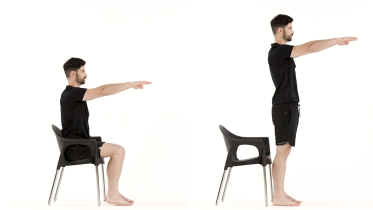 Sit to stand
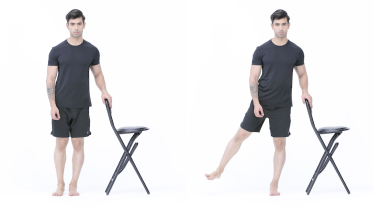 Standing hip abduction
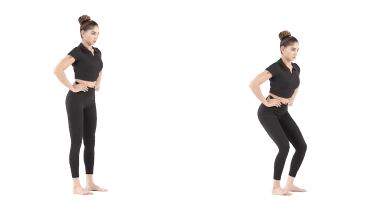 Mini squat
The full staged version is the hip osteoarthritis program. If standing exercise is not where you can start, seated and standing exercises for older adults is the entry point with the support built in.
Pain relief, injections and the things people ask about
This section stays at guideline level on purpose. No drug names, no doses, no injection schedules, and nothing about how long any of it lasts. Those belong to the doctor or pharmacist who knows what else you take, and you should never stop or change a prescribed medicine on your own.
Here is what the guidelines say, with the hip and the knee kept apart, because that distinction gets lost.
OARSI strongly recommended topical anti-inflammatory medicines for knee osteoarthritis, at its strongest recommendation level. That recommendation was for the knee. It does not transfer to the hip, and the reason is anatomical as much as evidential: the hip joint sits far deeper under muscle than the knee does.
Injections into the joint are the ones people ask about most. OARSI made steroid and hyaluronic acid injections conditional recommendations for knee osteoarthritis, dependent on other health conditions, and did not recommend them for hip or polyarticular osteoarthritis (Bannuru and colleagues, 2019). Read not recommended carefully: in that framework it means the panel did not recommend the treatment for that group, which is not the same as advising against it. AAOS, writing for patients in the United States, does list corticosteroid injections among the non-surgical options for hip arthritis. So two reputable sources differ, which is exactly the situation where the decision belongs with the clinician examining your hip rather than with a website.
One timing point belongs to a surgeon rather than to whoever is offering the injection, and it is easy to miss because the two conversations usually happen in different rooms. If a hip replacement is already being considered for you, say so before you agree to a steroid injection into the joint. Pooled results from studies of people who went on to have a hip replacement found more infections around the new joint in those who had had a steroid injection into that hip first, and the risk was higher again when the injection was within 3 months of the operation, which is why the authors advise surgeons to leave at least that gap (Albanese and colleagues, 2023). The same analysis found no such link for knee replacement, so this is a hip point specifically. It is a reason to get the order of the two decisions right, with both clinicians knowing the plan, not a reason to turn down an injection you need.
On opioid painkillers, OARSI strongly advised against the oral and skin-patch forms, at its strongest level (Bannuru and colleagues, 2019). That is a clear position, not a cautious one.
Supplements come next, and neither the OARSI guideline nor the AAOS patient page lists one among the treatments they recommend for hip osteoarthritis. This page does not recommend any, and it does not tell you one is harmful either.
Aquatic exercise sits in this section rather than under exercise, because OARSI grouped it with the injections in the same sentence of its guideline: a conditional recommendation for the knee, depending on other health conditions, and not recommended for hip or polyarticular osteoarthritis (Bannuru and colleagues, 2019). Read that the way the panel meant it. It is a vote on aquatic exercise as a treatment program for hip osteoarthritis, in the same framework where not recommended means the panel did not recommend it rather than advised against it, and it is not advice to stop swimming. NICE recommends general aerobic exercise alongside strength work and AAOS names swimming and cycling among lower-impact choices, so if the pool is how you get your aerobic exercise, keep it and do your strength work on land.
Shockwave, platelet-rich plasma and stem cell treatments are advertised for hip arthritis. None of the sources on this page recommends any of them for it, so there is nothing here to pass on. Before paying for any of them, ask what the treatment is claimed to do and what evidence sits behind that claim.
One operation belongs in this list, because it is sometimes put forward as the lesser alternative to a replacement. NICE advises that arthroscopic lavage and debridement, the keyhole washout or clean out of a joint, should not be offered to people with osteoarthritis. So it is not a middle step on the way to a replacement. Keyhole hip surgery is done for other problems, a torn labrum or impingement among them, so if someone is discussing it with you, ask what it is meant to treat in your hip and what they expect it to change.
Walking aids, shoes and taking load off the hip
A stick comes first on this list, which is the unglamorous half of the treatment and often the fastest-acting. NICE advises that a walking aid such as a stick can be considered for some people with hip or knee osteoarthritis, and AAOS names canes among assistive devices. It goes in the hand opposite the sore hip, so it shares the load at the moment you step onto that leg, and the height needs setting, which a physio does in two minutes. Plenty of people use one for long walks and bad days only, which is a reasonable way to use it and not a halfway step to using it always.
Every low chair is a repetition of the hardest movement in your day, performed from the worst position, which is why seat height is the next thing to look at. A firm cushion changes more than most people expect, and so does a dining chair instead of the sofa, or a chair with arms you can push up from. The NHS advises against sitting in low chairs, which put extra pressure on the hip.
For aerobic work, AAOS names swimming and cycling as lower-impact choices, and in the clinic a stationary bike with a high enough saddle is usually comfortable earlier than a long walk is.
Splitting the day's load matters more than it sounds. The same total walking, broken into three, is often tolerated when one long walk is not. Same for gardening, shopping and housework.
Shoes get asked about, and there is nothing sourced to offer beyond the obvious: something cushioned and stable that you can get on without a struggle. There is no shoe that treats hip osteoarthritis, and nobody on this site will tell you which brand to buy.
Weight, where it applies, belongs in this section as much as in the first one, because what it changes is how much load crosses the joint with every step. NICE's framing is the useful one, that any amount of loss is likely to help, rather than a target that has to be reached first.
What to do if it is not working, and when a replacement is worth discussing
Before concluding that non-surgical treatment has failed, check whether it was actually done. In practice the commonest reasons a hip program has not worked are that it was too light, too short, or stopped when the pain eased. Months, not weeks, and a program that gets harder as you get stronger. If you have done 6 to 8 weeks of regular exercise with no change at all, that is a reason for a physio to reassess the diagnosis and the dose rather than a reason to stop.
Check too that the diagnosis is the hip joint. Pain on the outside of the hip that is tender to press behaves differently and is treated differently: hip arthritis or bursitis separates them.
When all of that has had a real run and the hip is still dominating your life, the surgical conversation is a reasonable next step and not a defeat. NICE advises that joint replacement is worth discussing when your hip symptoms have a big effect on your quality of life and treatment without surgery, such as exercise, weight loss and pain relief, has not worked or is not suitable. NICE also advises deciding on referral from a clinical assessment rather than from systems that score how severe the disease is.
One more NICE line matters before that appointment, because people are often told otherwise. NICE advises that people with osteoarthritis should not be excluded from referral for joint replacement because of their age, sex or gender, smoking, other health conditions, or being overweight or obese, including on measurements such as body mass index. That is not a reason to put weight management aside, since it helps the symptoms in its own right, but it is not a gate you have to pass to be referred.
The same guideline puts a second instruction next to that one, and leaving it out is how the first one gets misread. When referral is being discussed, NICE says the person should have it explained to them that the risks of joint replacement can vary depending on those same factors. Both halves hold at once: none of those things shuts you out of an assessment, and several of them change the risks of the operation itself. That is a conversation to have with the surgeon, with honest answers about smoking, weight and your other conditions, rather than a reason not to be seen.
And be clear what a referral is. It is an assessment and a discussion, not a booking. You can be referred, hear what is involved, and decide against it or decide to wait, and most surgeons will tell you that is a legitimate answer. If you are already on a waiting list, the advice from your own surgical team and physio comes before this page, and being listed is not in itself a reason to stop or start anything, so ask them before you change what you are doing.
Holding out until the hip is at its worst, though, is not a strategy with evidence behind it. In an observational study of 222 people having a hip or knee replaced for osteoarthritis, those who arrived at surgery with worse pain and function did not catch up afterwards with those who arrived in better shape. The authors found that most clearly for knee replacement and said it possibly applied to the hip as well (Fortin and colleagues, 1999). Nobody was allocated to wait in that study, so it cannot prove that operating earlier would have changed anyone's result, and it is not a reason to feel rushed.
The belief that does most of the waiting is that an implant has to be saved for later life, and it is weaker than it sounds. Pooling national registry data on people who had a hip replaced for osteoarthritis, around 58 percent of those replacements were still in place at 25 years, which the authors judged the less biased of the two estimates they produced (Evans and colleagues, 2019). None of that says what you should do. It says the decision is made on your symptoms, with a surgeon who has examined your hip, and not on a rule about waiting or on your age.
Past that point this page stops, deliberately. It does not describe how the operation is done, what the implant is made of, what the recovery involves or what the risks are in your case, because those are questions for a surgeon and for a page written and reviewed for them. Hip replacement rehab covers the rehabilitation side, and if your knees are in the same conversation, when to consider surgery for knee arthritis covers that decision for the knee.
If you have already had a hip replaced, your surgical team's plan comes before anything here. The warning signs below include the dislocation and late infection signs that need acting on at once, and the slower one that people sit on for months: pain in a replaced hip that had settled and has come back, or that is building month by month, which needs a review rather than a home exercise program.
When to see a physio or doctor
Book a routine appointment with a doctor or physio if hip pain is stopping you sleeping or doing normal activities, if it is getting worse or keeps coming back, or if your hip is stiff for more than 30 minutes after waking. New hip pain that has not improved after 2 weeks of looking after it at home is worth getting checked (NHS). If you already have a program and 6 to 8 weeks of doing it regularly has changed nothing, ask for a review of both the diagnosis and the dose.
A physio can do what a page cannot: confirm the hip joint is the source, set a dose that is actually hard enough, and progress it as you change. That is the difference between the structured program the guidelines recommend and a list of exercises.
Some signs need help faster, from an emergency visit to a doctor within a few days. They are listed under the warning signs below.
Related exercise programs
Warning signs
Get emergency help now
- Emergency: if chest pain, pressure or tightness does not ease quickly when you rest, spreads to your arm, neck, jaw, stomach or back, or comes with sweating, feeling sick, feeling light-headed or being short of breath, call emergency services straight away, as this can be a heart attack. If it eases quickly and none of these happen, get medical advice the same day, and do not exercise again until you have been checked.
- Emergency: a racing, pounding, fluttering or irregular heartbeat that does not settle when you rest, or that comes with dizziness, feeling faint or fainting, chest pain or shortness of breath. Call emergency services straight away. If it has already stopped, get medical advice the same day.
- Emergency: you have just fallen and cannot get up, or you think you may have hurt your head, neck, back or hip. Stay where you are, keep warm and call emergency services, or get someone to call for you. If you got up and walked without trouble and only notice pain later, use the same-day lines in this list instead.
- Emergency: you fell and cannot remember the fall or how it happened. Go to an emergency department straight away, and do not drive yourself. You may have blacked out or hit your head without knowing it.
- Emergency: you have had a fall or an injury and now have severe hip pain, or you cannot walk or put weight on the leg. Call emergency services or go to an emergency department. This can be a sign of a broken hip (hip fracture).
- Emergency: after a knock to the head, being very drowsy or finding it hard to keep your eyes open, confusion, a fit (seizure), new weakness or numbness anywhere in your body, new trouble understanding, speaking, walking or keeping your balance, new problems seeing or hearing, clear fluid coming from your ears or nose, bleeding from your ears or bruising behind them, a black eye when your eye was not hit, a dent in your head or a wound with something stuck in it, or a change in behavior. Call emergency services straight away. These can be signs of an injury to the brain.
- Emergency: after a knock to the head, you were knocked out, even for a moment, you cannot remember what happened just before or after, you have had a headache ever since, or you are being sick (vomiting). The same applies, even if you feel fine, if you take medicine that thins your blood, other than aspirin on its own, have a bleeding or clotting condition, have had brain surgery in the past, or had been drinking alcohol or taking drugs when it happened. Go to an emergency department straight away, and do not drive yourself.
- Emergency: tingling or loss of feeling in the hip or leg after a fall or injury. Call emergency services or go to an emergency department.
- Emergency: you have had a hip replacement and have sudden severe pain in your hip or groin, sometimes with a clunk or pop, and you cannot move the leg or put weight on it, or the leg suddenly looks shorter or turned in or out. Do not try to walk on it or push it back into place. Keep still and call emergency services or go to an emergency department, and do not drive yourself. Your new hip may have come out of its socket (dislocated), and a medical team needs to put it back.
- Emergency: your operated leg looks shorter than it did, or its foot turns in or out more than before, or the hip moves in an unusual way, even if the pain is not severe. Keep your weight off it and go to an emergency department straight away, and do not drive yourself. If you are in severe pain or cannot move the leg, call emergency services.
- Emergency: since your operation, you suddenly become short of breath, you get chest pain or pain in your upper back that may be worse when you breathe in, you cough up blood, your heart is beating very fast, or you faint. Call emergency services straight away, even if your leg looks normal. These can be signs of a blood clot in the lungs (pulmonary embolism).
- Emergency: pain, tingling, numbness or weakness in both legs, numbness or altered feeling around your genitals or bottom, or new trouble peeing or controlling your bladder or bowels. The same applies if you lose feeling in one leg. Call emergency services or go to an emergency department straight away. These can be signs of pressure on the nerves at the base of the spine (cauda equina syndrome).
Get help today
- Same day: the hip is hot and swollen, or the skin over it has changed color, or you have hip pain with a high temperature or feel hot, cold or shivery. Get medical help the same day, and go to an emergency department if you feel very unwell. A joint infection needs treatment quickly. If you have a very high or very low temperature, shivering you cannot control, you are breathing very fast or finding it hard to breathe, you are confused or your speech is slurred, your skin, lips or tongue look blue, gray, pale or blotchy (on brown or black skin this can be easier to see on the palms of the hands or soles of the feet), or you have a rash that does not fade when you press it, call emergency services, as this can be sepsis.
- Same day: at any time after your operation, even years later, new pain in your new hip along with a high temperature or feeling hot, cold or shivery, or a hip that becomes hot, red or swollen, which counts on its own, with or without pain and with or without a temperature. Contact your surgical team or get medical advice the same day. A new joint can become infected long after the operation, and that needs treating quickly. A normal temperature is not an all clear: OrthoInfo says fever is no longer considered a sign of an infection after a joint replacement, that the signs can be as little as mild redness and swelling and sometimes there are none at all, and that increased pain or stiffness in a joint that had been working well is one of them. So do not wait for a temperature before you report new or increasing pain in your new hip to your surgical team.
- Same day: you have had a hip replacement and your hip clunks and feels as if it partly slipped out of place and went back, even if it settles straight away and your leg looks normal. Stop the exercises, avoid the movement that brought it on, go back to your crutches or frame, and keep away from deep bending, crossing your legs and twisting on that leg until you have been seen. Contact your surgical team or get medical advice the same day. If the leg then looks shorter or turned, or you cannot move it or put weight on it, call emergency services.
- Same day: severe hip pain that came on suddenly without a fall, or pain that is getting worse quickly over a few days. Get medical advice the same day.
- Same day: you have had a hip replacement and, after a fall or a knock, even a small one, your hip, groin or thigh is newly painful, bruised or swollen, even if you can still walk and your leg looks normal. Stop the exercises, go back to your crutches or frame and keep your full weight off that leg, and contact your surgical team or get medical advice the same day. A break in the bone around a new hip is not always obvious at first, and walking normally on one can move the broken ends apart.
- Same day: new hip or groin pain after a fall, even a small one, if you are older, have low bone density (osteoporosis) or have taken steroid tablets for a long time, even if you can still walk. Get medical advice the same day. A broken hip is not always obvious at first.
- Same day: after a fall, you are in pain, have hurt yourself or feel unwell, or you were on the floor for an hour or more, without any of the emergency signs above. Get medical advice the same day, even if you managed to get up.
- Same day: a leg or foot that is getting weaker, for example your foot drags, catches on the ground or slaps down when you walk (foot drop). Get medical advice the same day. If the weakness is getting worse by the hour, go to an emergency department.
- Same day: a calf or thigh that is newly swollen or getting more swollen, warm, tender, red or darker than usual, has swollen veins that are sore to touch, or has a throbbing or cramping pain that does not fit your injury or condition, or that feels different from normal muscle soreness after exercise. This can be a sign of a blood clot (deep vein thrombosis), especially after surgery, an injury, time in a cast or boot, a long trip or a spell of being much less mobile than usual. Get medical advice the same day. If you are also short of breath or have chest pain, call emergency services.
- Same day: you blacked out or fainted, even for a moment. Get medical advice the same day. Call emergency services instead if the person is not breathing, cannot be woken within 1 minute, has not fully recovered or has trouble speaking or moving, has chest pain or a pounding, fluttering or irregular heartbeat, fainted while exercising or lying down, is shaking or jerking, or was badly hurt.
- Same day: dizziness, lightheadedness, blurred vision or feeling faint when you stand up that is new for you, does not pass within a minute or two, keeps happening, or has made you fall. Sit or lie down, and get medical advice the same day. This can be a drop in blood pressure on standing (postural hypotension), a type of low blood pressure, which the NHS lists among the causes of falls, and your doctor can check it. Tell them about your medicines, because some can cause it. If it does not settle within a few minutes of sitting or lying still, call emergency services. If you faint, use the fainting line above.
- Same day: dizziness or feeling faint during or after exercise, other than the brief lightheadedness as you stand up covered in the line above, without any of the emergency signs above. Stop the exercises and get medical advice the same day. If you faint, it does not settle within a few minutes of sitting still, or you cannot stand or walk steadily, call emergency services.
- Same day: a child or teenager has sudden pain in the hip, thigh or knee, is limping, or cannot put weight on one leg. Get an urgent appointment with a doctor the same day. If they have a high temperature or seem very unwell, go to an emergency department. This page is for adults, and hip pain in children has different causes.
- Same day: hip or groin pain that is worse at night or does not ease with rest, and keeps getting worse. If you are being treated for cancer now, contact your cancer team the same day.
Book an appointment
- Within a day or two: hip or groin pain that is worse at night or does not ease with rest, and keeps getting worse. If you have had cancer, now or in the past, or are losing weight without trying, see your doctor sooner, within a day or two, and mention it. This applies even if the pain is not getting worse.
- Within a few days: hip or groin pain that is worse at night or does not ease with rest, and keeps getting worse. See your doctor within a few days.
- Within a few days: new groin or hip pain and you take steroid tablets long term, or have in the past, or you regularly drink a lot of alcohol. This can be a sign of a problem with the blood supply to the top of the thighbone (avascular necrosis). Book an appointment with your doctor within a few days and mention the steroids or alcohol.
- Routine: pain in your new hip that had settled and has come back, or pain that is getting worse month by month, for example in the groin or thigh when you first stand up and start to walk. This is not an emergency, but ask your surgical team for a review, as the parts of a new joint can loosen or wear over the years. Get medical advice the same day instead, not a routine appointment, if the hip also becomes hot, red or swollen, or you have a high temperature or feel hot, cold or shivery, or the pain is building week by week rather than month by month. A new joint can become infected years after the operation, and the two can feel similar at first.
Common questions
Can hip arthritis be treated without surgery?
Yes, in the sense that matters day to day. Every major guideline starts with non-surgical care, and OARSI names arthritis education and structured land-based exercise as the core treatments for hip osteoarthritis (Bannuru and colleagues, 2019). What those treatments change is pain, stiffness and function. None of them repairs the joint, and this page makes no claim that any of them does.
What is the best treatment for hip arthritis without surgery?
A structured exercise program with proper information about the condition, run for months, not weeks. That is first in NICE and first in OARSI, and everything else is arranged around it. NICE advises that sticking with an exercise plan over the long term increases its benefits, so the program you will actually keep doing beats the ideal one you will drop.
How long before exercise helps?
Give it several weeks. The GLA:D program, for example, runs 12 supervised exercise sessions, twice a week for 6 weeks. People with hip osteoarthritis in it reported less pain on average at their 3-month check (Skou and Roos 2017). That report had no comparison group, so it cannot show how much of the change was due to the program itself.
Do injections help hip arthritis?
The guidelines are more cautious about the hip than about the knee, and that surprises people. OARSI made injections into the joint, both steroid and hyaluronic acid, conditional recommendations for knee osteoarthritis but did not recommend them for hip or polyarticular osteoarthritis (Bannuru and colleagues, 2019). AAOS does list corticosteroid injections among non-surgical options for hip arthritis. Where guidelines differ, the decision belongs with the doctor assessing your hip, and this page gives no schedule, no number of injections and no figure for how long one lasts. One timing point matters if a hip replacement is already being discussed for you: say so before you agree to a steroid injection into the joint, because pooled studies of people who went on to have a hip replaced found more infections around the new joint in those who had had an injection into that hip first, and more again when it was within 3 months of the operation (Albanese and colleagues, 2023).
Do glucosamine or supplements help?
Neither the OARSI guideline nor the AAOS patient information lists a supplement among the treatments they recommend for hip osteoarthritis. That is not the same as a trial showing harm, and it is not nutritional advice, which is outside what this page covers. If you want to try one, the question to ask a pharmacist is whether it interacts with anything you already take.
Can you avoid a hip replacement?
Nobody can predict that for an individual, and a page that promises it is selling you something. What the guidelines frame is a decision about symptoms rather than a race against the X-ray. NICE advises that joint replacement is worth discussing when your hip symptoms have a big effect on your quality of life and treatment without surgery, such as exercise, weight loss and pain relief, has not worked or is not suitable. Plenty of people stay well below that bar for years. Holding out as long as humanly possible is not a goal in its own right, though: the decision is made on your symptoms, with a surgeon who has examined your hip, rather than on your age or on a rule about waiting.
When is it time to talk about a replacement?
When non-surgical treatment has had a real run and your hip is still having a big effect on your life. A real run means months of a properly dosed exercise program, not a sheet of exercises done for three weeks. NICE also advises deciding on referral from a clinical assessment rather than from systems that score how severe the disease is, so the grade on an X-ray report is not what sets the timing.
References
- Bannuru RR, Osani MC, Vaysbrot EE, et al. OARSI guidelines for the non-surgical management of knee, hip, and polyarticular osteoarthritis. Osteoarthritis and Cartilage. 2019;27(11):1578-1589. https://doi.org/10.1016/j.joca.2019.06.011
- Hall M, Lawford BJ, Hinman RS, et al. Exercise for osteoarthritis of the hip. Cochrane Database of Systematic Reviews. 2026;(7):CD007912. https://doi.org/10.1002/14651858.CD007912.pub3
- Skou ST, Roos EM. Good Life with osteoArthritis in Denmark (GLA:D): evidence-based education and supervised neuromuscular exercise delivered by certified physiotherapists nationwide. BMC Musculoskeletal Disorders. 2017;18:72. https://doi.org/10.1186/s12891-017-1439-y
- Kim C, Nevitt MC, Niu J, et al. Association of hip pain with radiographic evidence of hip osteoarthritis: diagnostic test study. BMJ. 2015;351:h5983. https://doi.org/10.1136/bmj.h5983
- Albanese J, Feltri P, Boffa A, et al. Infection risk increases after total hip arthroplasty within 3 months following intra-articular corticosteroid injection. A meta-analysis on knee and hip arthroplasty. Journal of Arthroplasty. 2023;38(6):1184-1193. https://doi.org/10.1016/j.arth.2022.12.038
- Fortin PR, Clarke AE, Joseph L, et al. Outcomes of total hip and knee replacement: preoperative functional status predicts outcomes at six months after surgery. Arthritis and Rheumatism. 1999;42(8):1722-1728. https://pubmed.ncbi.nlm.nih.gov/10446873/
- Evans JT, Evans JP, Walker RW, et al. How long does a hip replacement last? A systematic review and meta-analysis of case series and national registry reports with more than 15 years of follow-up. The Lancet. 2019;393(10172):647-654. https://doi.org/10.1016/S0140-6736(18)31665-9
- National Institute for Health and Care Excellence. Osteoarthritis in over 16s: diagnosis and management (NG226). 2022. https://www.nice.org.uk/guidance/ng226
- American Academy of Orthopaedic Surgeons. Osteoarthritis of the hip. OrthoInfo. https://www.orthoinfo.org/en/diseases--conditions/osteoarthritis-of-the-hip/
- NHS. Osteoarthritis. https://www.nhs.uk/conditions/osteoarthritis/
- NHS. Hip pain in adults. https://www.nhs.uk/symptoms/hip-pain/
- NHS. Head injury and concussion. https://www.nhs.uk/conditions/head-injury-and-concussion/
- NHS. Complications of a hip replacement. Page last reviewed 6 March 2024. https://www.nhs.uk/tests-and-treatments/hip-replacement/complications-of-a-hip-replacement/
- NHS. Low blood pressure (hypotension). Page last reviewed 11 July 2023. https://www.nhs.uk/conditions/low-blood-pressure-hypotension/
Written and checked by the PocketPhysio editorial team. Last updated 2026-10-18.
This page is general education, not a diagnosis or a personal treatment plan. See a physiotherapist or doctor for advice about your own situation.