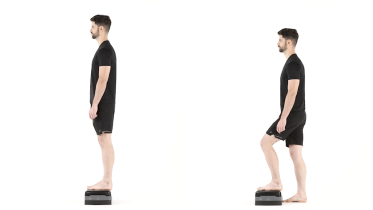
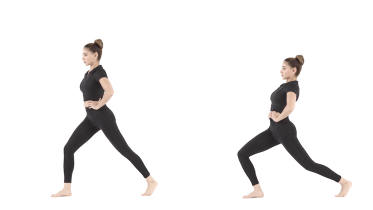
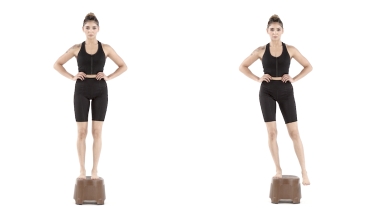
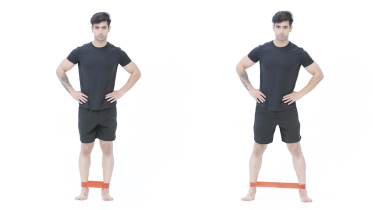
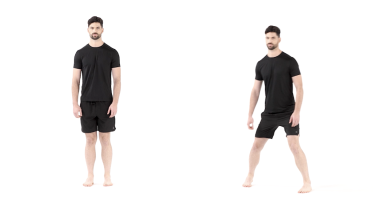
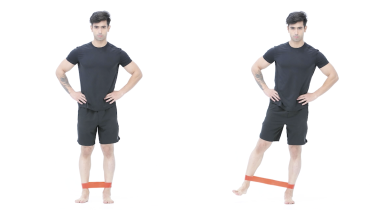
Standing hip abduction
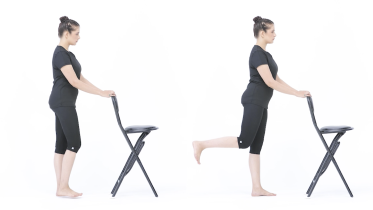
In standing hip abduction you lift one straight leg out to the side, holding a chair for balance. It works the muscles at the side of your hip (gluteus medius and minimus). The leg you stand on is busy too, because it has to keep your pelvis level. That is one reason the exercise turns up in so many programs for the hip and knee, and for balance.
How to do the standing hip abduction
- Stand tall beside a sturdy chair or a counter and rest the nearer hand on it. Keep your feet close together with the toes pointing forward.
- Shift your weight onto the leg nearest the chair. That is your standing leg.
- Keep the other leg straight, kneecap and toes facing forward, and slowly lift it out to the side.
- Lift only as far as you can without leaning your body or hitching your hip up toward your ribs. For many people that is a small movement.
- Bring the leg back to the start with control, touch down lightly and repeat. Then turn around and work the other side.
What you should feel
Work at the side of the hip on the leg that lifts, and often in the buttock of the leg you stand on. Not in the lower back.
Common mistakes
- Leaning the upper body away from the moving leg to get it higher.
- Hitching the hip. The leg rises because your waist shortens, not because the hip moves.
- Turning the toes up toward the ceiling. The muscles at the front of the hip then take over.
- Swinging the leg out and letting it drop back.
How often
Many programs start with 2 to 3 sets of 10 to 15 on each leg, once a day. Your physio will adjust the numbers and may add a band or ankle weight later.
Stop and check with your physio if
- You feel sharp pain at the side of the hip, in the groin or in the lower back.
- You feel dizzy, lightheaded, faint or sick, or the room seems to spin. Hold your support, sit down and get medical advice the same day before you practice again. If you faint, it does not settle within a few minutes of sitting still, your vision suddenly blurs or goes double, or you cannot stand or walk steadily, call emergency services.
- You feel unsteady, even with the chair.
- Pain, numbness or tingling runs down the leg.
- Your calf or thigh is getting more swollen, or becomes warm, tender, red or darker than usual, or has a new throbbing or cramping pain. This can be a blood clot, especially after an operation, an injury, time in a cast, boot or brace, or a spell of being much less mobile than usual, and after an operation it can also be an infection. Stop and contact your medical team or get medical advice the same day. If you are also short of breath or have chest pain, call emergency services.
- Chest pain or pressure, dizziness or feeling faint, a racing or irregular heartbeat, or being far more out of breath than the effort should cause.
From the clinic
The hard part is staying tall. Try it once in front of a mirror: your shoulders should stay level and your body should not tip toward the chair. If it tips, lift the leg less.
A hand's width of lift with a straight body works the right muscles. Go for a big lift with a lean and your trunk ends up doing much of the work.
Keep a hand on the chair the whole time, especially if your balance is not what it was. Still unsteady? Hold a kitchen counter with both hands instead. If you have had a hip replacement, get the go-ahead from your surgeon or physio before you try standing hip abduction. Some operations limit this kind of work for the first months, so the timing depends on your surgery. Your surgical team will also tell you how far to lift.
Once this feels easy, side lying hip abduction works the same muscles lying down and usually feels harder for the leg that lifts. The clamshell is a gentler option for the side of the hip.
If chest pain, pressure or tightness does not ease quickly when you rest, spreads to your arm, neck, jaw, stomach or back, or comes with sweating, feeling sick, feeling light-headed or being short of breath, call emergency services straight away, as this can be a heart attack. If it eases quickly and none of these happen, get medical advice the same day, and do not exercise again until you have been checked.
Written and checked by the PocketPhysio editorial team. Last updated 2026-09-28.
This page is general education, not a diagnosis or a personal treatment plan. If you have pain, an injury or a health condition, see a physiotherapist or doctor before starting new exercises.