
Cardiac rehab exercises and physiotherapy
What is cardiac rehab?
Cardiac rehabilitation, usually called cardiac rehab, is a program of exercise and education to help you recover and live as fully as you can after a heart problem (BHF). It is offered after a heart attack or a hospital stay with angina, after a stent (angioplasty) or heart surgery such as bypass or valve surgery, and to people with heart failure (Heart Foundation Australia). The NHS says everyone diagnosed with heart failure should be offered it. You will usually meet doctors, nurses, dietitians and physical therapists (physiotherapists), among others. Exercise is only one part: the program also covers diet, smoking, medicines and stress (Heart Foundation Australia, BHF).
Rehab often begins in hospital. After a heart attack, NICE says the first rehab session should take place within 10 days of leaving hospital. After an angioplasty, the NHS says you should be invited back for a session within about 4 to 8 weeks. Many programs let you join from home by video call, app, website or phone instead of going in (BHF).
Why exercise-based cardiac rehab is worth doing
For coronary heart disease the evidence is strong. The Cochrane review by Dibben and colleagues (2021) covered 85 trials and 23,430 people. Those who did exercise-based rehab had fewer heart attacks and a large drop in hospital admissions over the next 6 to 12 months, and likely a small drop in deaths from any cause. Over longer follow-up, it may also lower deaths from heart disease.
Heart failure has its own Cochrane review, 60 trials with 8,728 people. Exercise-based rehab likely reduces hospital admissions in the first year and likely gives a worthwhile improvement in quality of life. It made no clear difference to deaths over that time (Molloy 2024). NICE recommends offering everyone with heart failure a personal, exercise-based rehab program, after an assessment to check it suits them.
How this page fits with your rehab program
This page is not a cardiac rehab program, and it does not replace one. Your cardiac rehab team's plan always comes first: where it differs from this page, follow your team. Use stages 2 and 3 only after your cardiac rehab team has assessed you, as part of the program they set.
The BHF sets the same rule for its own home exercise videos: they are for people who have had a cardiac rehab assessment and started or finished a program. The assessment is one of the core components of cardiac rehab (Brown 2024). It is where the team agrees goals with you and finds a safe level to start from (BHF).
If you have not been offered cardiac rehab, ask your cardiologist, heart failure nurse or family doctor to refer you. Until then, stick to the short walks and gentle movement your hospital team advised. Stage 1 covers just that. After your program ends, the later stages can help you keep going.
If a lung condition is what limits you most, see the COPD breathing and exercise program. For general strength work in later life without a recent heart problem, see strength training for older adults.
How hard should you work?
Most of your exercise should be at a moderate effort. The BHF describes this as feeling a little warm and a little out of breath, but still able to have a conversation. A position statement on exercise in cardiac rehab calls this the talk test: you keep going at a level where you can still talk comfortably in full sentences (Hansen 2022). Only a few words at a time? Slow down.
Many rehab teams also use a rating of perceived exertion, a score for how hard the effort feels. On the 6 to 20 Borg scale, the same statement puts moderate effort at about 12 to 13 (Hansen 2022). Your team will tell you which scale they use and what number to aim for.
Heart rate targets need care. Beta blockers affect your heart rate and can make you feel more tired (BHF), so a target worked out from your age alone can mislead you. The target heart rate calculator explains how heart rate zones work, but with heart disease, your rehab team should set any heart rate target. If they give you one and your beta blocker dose then changes, ask them to check it again (Hansen 2022).
Warm-up, cool-down and pacing
A long warm-up lets your heart rate rise slowly, so your heart does not face a sudden jump in workload. For people with a heart condition, the BHF says a warm-up should last at least 15 minutes and a cool-down at least 10 minutes, and that older adults may need 15 to 20 minutes. Start with slow walking or marching on the spot, and finish the same way. In the first weeks, when the whole walk is easy anyway, set off slowly and speed up only a little. The full warm-up and cool-down come in once you are working at a moderate effort.
Pacing means spreading effort through the day and the week instead of doing a lot in one go. Build up in small steps, and add time before speed. Resting partway through is fine; carry on when you are ready. In very hot or very cold weather your heart may be under more strain (BHF), so go easier or exercise indoors.
Breathing and strength work
Breathe out as you lift, push or stand up, and breathe in as you return to the start. That stops you holding your breath as you strain (the Valsalva maneuver), which is best avoided (Hansen 2022). If you have high blood pressure, breathe steadily through every repetition and never hold your breath.
Most programs include strength work (Brown 2024), but it starts light. Check with your doctor before any resistance training, as the BHF points out it may not suit some heart conditions. Programs usually begin with a light band or weight you could lift many more times than you do, and build up slowly (Hansen 2022).
After heart surgery: protecting your breastbone
After open heart surgery through the breastbone (a sternotomy), the bone needs time to heal. Hospitals give different rules on how much you may lift, push or pull with your arms, and for how long, so follow the ones your surgeon gave you. For bypass surgery, the NHS says no heavy lifting for 3 months. In one trial of 72 people, less strict arm rules that used pain as the limit gave similar recovery to the usual strict rules (Katijjahbe 2018), which is one reason the advice varies. If your team has asked you not to push up from a chair with your hands, stand up with your arms held out in front, as the sit to stand video shows.
After an angioplasty or stent, the NHS advises avoiding heavy lifting and strenuous activity for about a week, or until the wound has healed. If the stent was put in during a heart attack, recovery usually takes longer, so follow the timing your rehab team gives you. After a pacemaker is fitted, the NHS says no heavy carrying or vigorous exercise, and not lifting your elbow above shoulder height, for 4 to 6 weeks, so check with your care team before the arm exercises. Check your wounds as they heal. The warning signs below say what to look out for.
Heart failure
With heart failure, weigh yourself regularly, because a build-up of fluid can cause sudden weight gain and may need treatment (NHS). Heart Failure Matters, the European heart failure patient site, suggests doing it every day at the same time, and telling your doctor or nurse if your weight goes up by more than 2 kg (about 4 lb) in 3 days. The American Heart Association also names a gain of more than 2 to 3 lb (about 1 kg) in a day or more than 5 lb (about 2.3 kg) in a week. If your heart failure team gave you a different limit, use theirs.
If you notice new swelling, sudden weight gain or worse breathlessness, pause your program until you have been checked. The warning signs below give the details.
How to use this program
Start at stage 1 unless your rehab team has placed you further on. Move up a stage when the current one feels comfortable at a moderate effort and you have recovered well by the next day. Feeling a bit tired after a new exercise is normal. Feeling wiped out for the rest of the day, or worse the next morning, means you did too much.
The exercise pages give typical starting doses and how often to do them. As a rough guide, walking often starts at 10 to 20 minutes on most days, including a few minutes of slow walking at each end. The strength exercises often start at 2 to 3 sets of 5 to 15 repetitions, and work with weights is often done 2 to 3 days a week, with a rest day in between. The BACPR standards describe a structured exercise program at least 2 to 3 times a week (Cowie 2019).
After a heart attack, NICE advises building up to 20 to 30 minutes of activity a day, to the point of being slightly out of breath, and over time the BHF recommends at least 150 minutes of moderate exercise a week. Your physio and rehab team will adjust all of this to you.
Do not start a session if you feel unwell, have a high temperature, or already have chest pain or an irregular heartbeat (BHF). While you exercise, stop straight away if you have any of these: chest pain or pressure, dizziness or feeling faint, a racing or irregular heartbeat, or being far more out of breath than the effort should cause. The warning signs below say what to do next. If you faint while exercising, call emergency services, even if you feel fine again quickly.
The exercise program
Stage 1: Early days, gentle movement and short walks
For the first weeks at home, or while you wait for your rehab program to start, and only as your hospital team advised. Walk around the house and then outside for short spells on the flat, building up a little each day, with rests in between. On the days you spend mostly sitting or resting, the seated leg exercises and ankle pumps keep your legs working, and slow breathing helps you settle. Everything here should be easy enough to chat through.
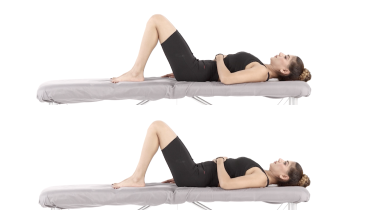 Diaphragmatic breathing
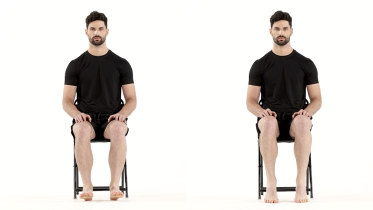 Ankle pumps
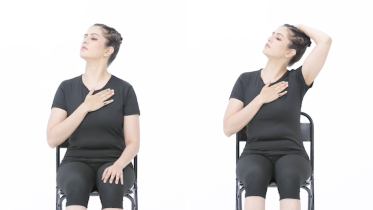 Seated hip flexion
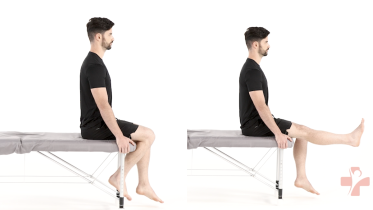 Seated knee extension
Stage 2: Build up walking and leg strength
Once your cardiac rehab team has assessed you and set your level. Marching on the spot can be part of your warm-up, or your exercise on days you cannot get outside. Brisk walking builds how long you can keep going at a moderate effort. Sit to stand, calf raises and standing hip abduction strengthen the legs you use to get out of a chair and walk. Do them at a steady pace rather than fast, holding a kitchen counter for balance, and breathe out as you stand up or lift. Add time before you add speed, and add repetitions before anything harder.
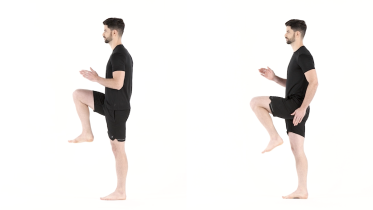 Marching on the spot
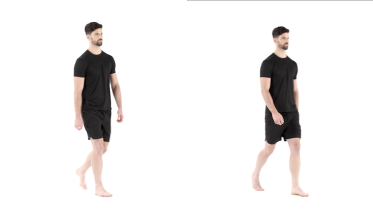 Brisk walking
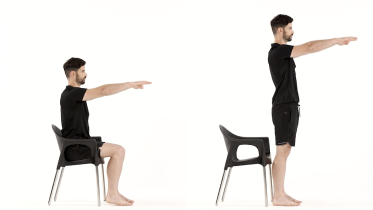 Sit to stand
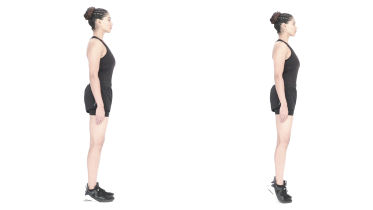 Calf raises
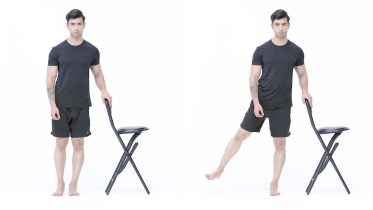 Standing hip abduction
Stage 3: Stairs and light strength for the arms and legs
When stage 2 feels comfortable at a moderate effort and your rehab team agrees you are ready for strength work. Step ups and stair practice get you ready for hills and stairs; keep a rail or counter to hold. Start the band row and biceps curl with a light band or weight you could lift many more times than you do, and keep wall push-ups just as easy. After open heart surgery, leave the arm exercises out until your surgeon or rehab team says your breastbone has healed enough. After a pacemaker or ICD has been fitted, check with your care team before the arm exercises. Breathe out as you lift or push, and never hold your breath.
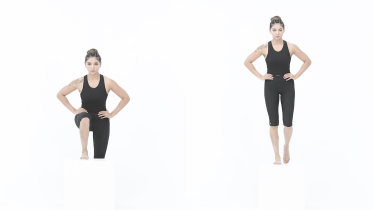 Step up
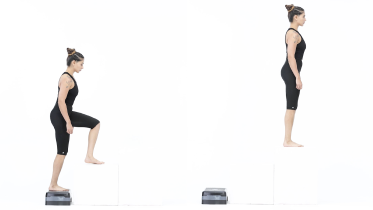 Stair climbing
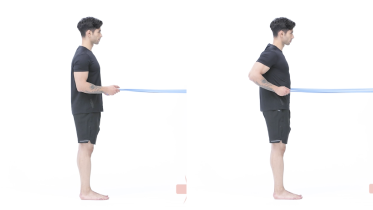 Resistance band row
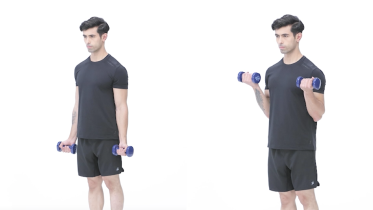 Biceps curl
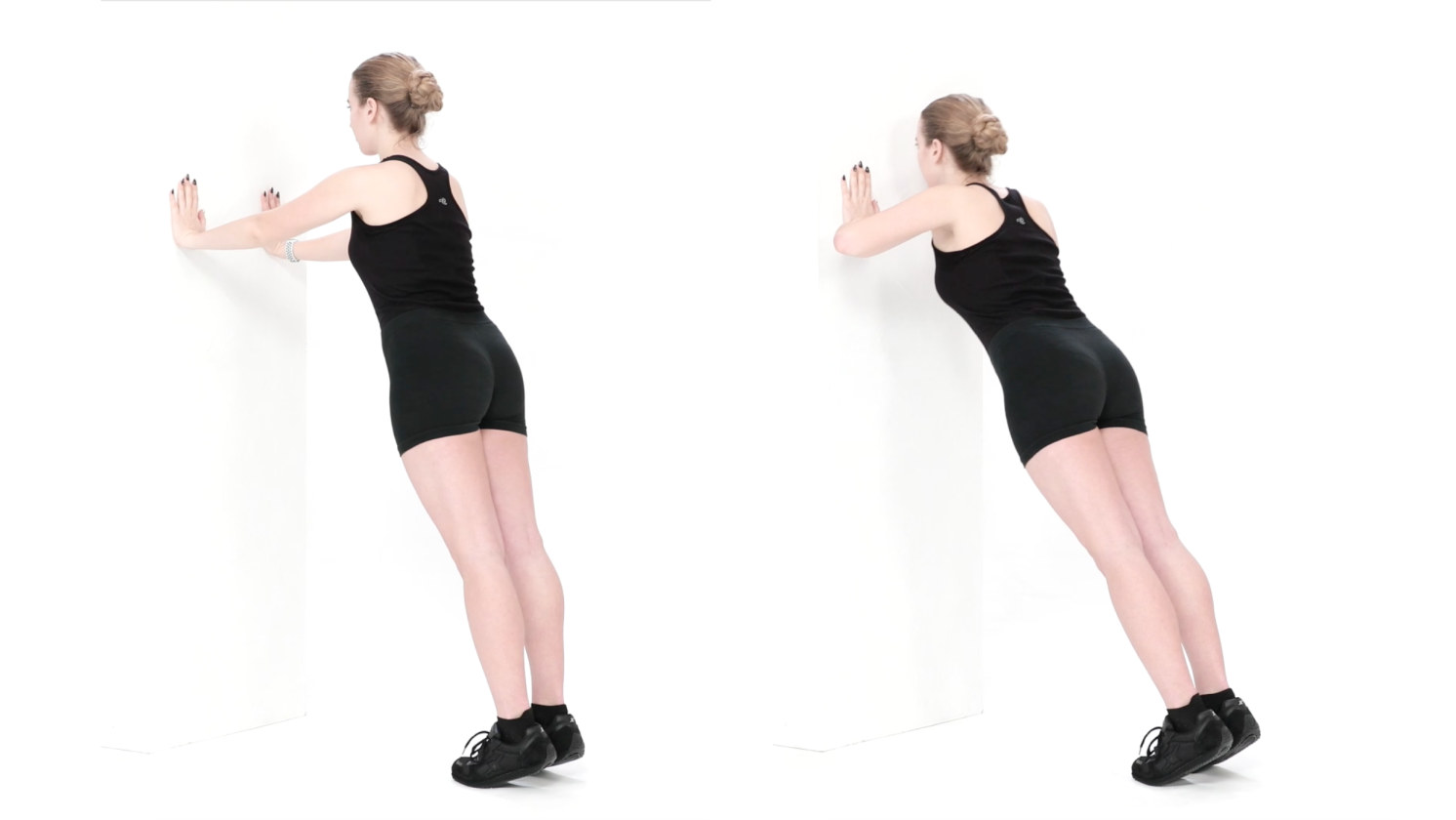 Wall push-ups
What to avoid or change
Skip heavy lifting and straining, and never go into a hard effort without warming up first. If you have angina and have been prescribed a GTN spray, keep it with you when you exercise (NHS), and ask your doctor or pharmacist how to use it (BHF). If angina comes on, stop and sit down, then use your spray as you were shown. The chest pain warning sign below still applies: if the pain does not ease quickly, call emergency services, and take a second dose while you wait only if your plan includes one.
If you have a pacemaker or an implanted defibrillator (ICD), your doctor should tell you about any limits, which often means sticking to moderate exercise and avoiding contact sports (BHF). If you have an ICD, ask your team for a plan for what to do if it gives you a shock. If it does, stop exercising, follow that plan, and do not exercise again until your team has checked you (Sharp Dimitri 2026). More than one shock, or feeling unwell after a shock, means calling emergency services (Royal Free London; Cleveland Clinic). If you have diabetes, exercise can change your blood sugar (BHF), so ask your team how to check it around your sessions.
Unsteady on your feet, or had a fall in the past year? Stand next to a kitchen counter for the standing exercises, and plan walks with somewhere to sit down along the way. Wear flat shoes that fit well and grip the floor, not socks, tights or bare feet.
When to see a physio or doctor
Ask for a referral to cardiac rehab if you have had a heart attack, a stent or heart surgery, or have heart failure, and nobody has offered it. Contact your rehab team if exercise leaves you feeling worse, or you are stuck and not sure which stage suits you. Tell them about any change in your medicines, especially your blood pressure or heart medicines. Some signs need help faster, from an emergency call to advice the same day. You will find them in the warning signs below.
For physiotherapists
This page is a patient-facing framework for home exercise inside a supervised cardiac rehab program, not a substitute for assessment and risk stratification. The 2024 AHA and AACVPR statement lists patient assessment, aerobic exercise training, strength training and physical activity counseling among the core components, and covers virtual and remote delivery (Brown 2024). The BACPR 2017 standards prioritize acute coronary syndrome, coronary revascularization and heart failure, and call for an individualized, structured exercise program at least 2 to 3 times a week, with evidence-based home programs as an option (Cowie 2019). A 4th edition followed in 2023.
NICE NG185 recommends offering cardiac rehab with an exercise component to everyone after an MI regardless of age, starting within 10 days of discharge, and notes that stable patients with reduced left ventricular ejection fraction can safely be offered the exercise component. NG106 recommends a personalized, exercise-based program for heart failure, preceded by an assessment of suitability.
Hansen 2022 classes moderate aerobic intensity as 40 to 69% of heart rate reserve, 55 to 74% of maximum heart rate or RPE 12 to 13, and suggests initial resistance loads of about 30% of 1RM for the upper body and 40% for the lower body, for 12 to 15 repetitions. It notes that beta blocker changes complicate heart rate targets and that the talk test is a practical adjunct, not a replacement for objective methods. In the SMART trial, modified sternal precautions using pain as the limit gave similar physical function, pain and quality of life to standard restrictive precautions at 4 and 12 weeks (Katijjahbe 2018), but local surgical protocols still apply. Fainting at any time is listed as an emergency on this page because the 2018 ESC syncope guideline classes syncope with structural or coronary heart disease, heart failure or previous MI as high risk (Brignole 2018).
McDonagh 2023 (24 trials, 3,046 participants) found no evidence of a difference between home-based and center-based rehab in mortality, exercise capacity or most quality of life measures, when home programs were formally supported by staff. The six-minute walk test calculator can help track functional capacity across a program.
See a doctor promptly if
- If chest pain, pressure or tightness does not ease quickly when you rest, spreads to your arm, neck, jaw, stomach or back, or comes with sweating, feeling sick, feeling light-headed or being short of breath, call emergency services straight away, as this can be a heart attack. If it eases quickly and none of these happen, get medical advice the same day, and do not exercise again until you have been checked.
- Same day: angina or chest tightness that now comes on with less effort than before, happens more often, lasts longer or comes on while you are resting, even if it settles. Get medical advice the same day, and do not exercise again until you have been checked. If an episode does not ease quickly when you rest, call emergency services, as in the line above.
- Emergency: any sign of a stroke, even if it goes away. That means a face that droops on one side, an arm you cannot lift or keep up, slurred or muddled speech, weakness or numbness on one side of your body or face, sudden blurred vision, double vision or loss of sight, trouble swallowing, sudden dizziness with unsteadiness or falling over, a sudden severe headache, or a sudden fall where your legs give way but you do not black out (a drop attack). Call emergency services straight away.
- If you faint while exercising, call emergency services, even if you feel fine again quickly.
- Emergency: with a heart condition, you faint or black out at any other time, even for a moment and even if you feel fine again quickly. Call emergency services. In people with heart disease, fainting can be a sign of a heart rhythm problem.
- Same day: dizziness or feeling faint during or after exercise, without any of the emergency signs above. Stop the exercises and get medical advice the same day. If you faint, it does not settle within a few minutes of sitting still, or you cannot stand or walk steadily, call emergency services.
- Emergency: your heart is racing, pounding, fluttering or beating irregularly and it does not settle when you stop and rest, or it comes with chest pain, shortness of breath, feeling faint or fainting. Call emergency services. If it settles quickly with rest and none of these happen, get medical advice the same day, and do not exercise again until you have been checked.
- Emergency: severe difficulty breathing, where you are gasping, choking or cannot get your words out, your breathing does not go back to normal once you have stopped and rested, your chest feels tight or heavy, you have pain that spreads to your arms, back, neck or jaw, your lips or skin are turning very pale, blue or gray, or you feel suddenly confused or very drowsy. On brown or black skin, the color change may be easier to see on the palms of the hands. Call emergency services straight away.
- Same day: breathlessness that is new or worse than usual, for example you get out of breath with everyday activities that were fine before, or when you lie down. With heart failure, the same applies if your ankles, legs or tummy are more swollen than usual, you have put on weight quickly, for example more than 1 kg (about 2 lb) in a day, 2 kg (about 4 lb) in 3 days or 2.3 kg (5 lb) in a week, or more than the limit your heart failure team gave you, or you cough up frothy pink phlegm. A build-up of fluid can cause sudden weight gain and may need a change in your treatment. Contact your heart failure nurse or rehab team, or get medical advice, the same day, and do not exercise until you have been checked.
- Same day: since heart surgery, the wound on your chest, or on your leg or arm where a blood vessel was taken, becomes more red, hot, swollen or painful, starts to leak or ooze, has pus coming out of it or its edges start to come apart, your breastbone clicks, grinds or feels as if it moves when you cough or move, or you have a high temperature or feel hot, cold or shivery. Contact your surgical team or get medical advice the same day. Redness can be harder to see on brown or black skin. If you feel very unwell, go to an emergency department. If you have a very high or very low temperature, shivering you cannot control, you are breathing very fast or finding it hard to breathe, you are confused or your speech is slurred, your skin, lips or tongue look blue, gray, pale or blotchy (on brown or black skin this can be easier to see on the palms of the hands or soles of the feet), or you have a rash that does not fade when you press it, call emergency services, as this can be sepsis.
- Same day: since a pacemaker or ICD was fitted, the wound gets more swollen, tender or red, blood, pus or clear fluid leaks from it, you have a high temperature or feel hot, cold or shivery, or symptoms you had before it was fitted, such as dizziness or breathlessness, come back or get worse. Contact your pacemaker clinic or get medical advice the same day, and do not exercise until you have been checked. Redness can be harder to see on brown or black skin. If you feel very unwell, go to an emergency department. If you faint, call emergency services.
- Emergency: your ICD gives you more than one shock, or you feel unwell after a shock, for example with chest pain, breathlessness, a racing heartbeat or feeling faint. Call emergency services. After a single shock, if you feel well, stop exercising, follow the plan your team gave you and contact your ICD clinic the same day, and do not exercise again until they have checked you.
- Emergency: after an angioplasty or stent, bleeding from the wound in your wrist or groin that does not stop, or starts again, after you have pressed on it for 10 minutes, or the arm or leg on that side turns cold, numb, pale, blue or changes color. Call emergency services, and do not drive yourself. If the pain or swelling around that wound keeps increasing, or you have a high temperature, get medical advice the same day.
- Emergency: you suddenly become short of breath, you get chest pain or pain in your upper back that may be worse when you breathe in, you cough up blood, your heart is beating very fast, or you faint. Call emergency services straight away, even if your leg looks normal. These can be signs of a blood clot in the lungs (pulmonary embolism).
- Same day: a calf or thigh that is newly swollen, warm, tender, red or darker than usual, has swollen veins that are sore to touch, or has a throbbing or cramping pain that does not fit your injury or condition, or that feels different from normal muscle soreness after exercise. This can be a sign of a blood clot (deep vein thrombosis), especially after surgery, an injury, time in a cast or boot, a long trip or a spell of being much less mobile than usual. Get medical advice the same day. If you are also short of breath or have chest pain, call emergency services.
Common questions
How soon can I start exercising after a heart attack?
It depends on your heart attack, the treatment you had and how you are recovering, so your hospital team sets the timing. Most people start with short, easy walks at home. Rehab usually begins in hospital, and NICE wants the first session after a heart attack to happen within 10 days of you going home, though timings differ between programs and countries. From there, your rehab assessment sets how hard and how long you exercise. Recovery takes several weeks for some people and months or years for others (NHS).
What exercises should I avoid after a heart attack or heart surgery?
Early on, avoid heavy lifting and anything that makes you strain or hold your breath. The NHS advises no heavy lifting for 3 months after bypass surgery, and avoiding heavy lifting and strenuous activity for about a week after a planned angioplasty, or until the wound has healed. After a heart attack, recovery takes longer. After open heart surgery, follow your surgeon's rules for using your arms. The BHF advises checking with your doctor before any resistance training, and not exercising when you feel unwell or have symptoms.
What heart rate should I exercise at if I take beta blockers?
Beta blockers affect your heart rate (BHF), so a heart rate target worked out from your age alone can mislead you. Many rehab programs use the talk test and an effort scale instead: you should feel warm and a little out of breath but still be able to talk in full sentences. If your team gives you a heart rate target, use theirs, and ask them to check it again if your beta blocker dose changes (Hansen 2022).
Is cardiac rehab worth doing?
Yes, for most people. In coronary heart disease, a Cochrane review pooling 85 trials and 23,430 people found fewer heart attacks and a large drop in hospital admissions over 6 to 12 months with exercise-based rehab, and likely a small drop in deaths (Dibben 2021). For heart failure, the Cochrane review covers 60 trials: rehab likely means fewer hospital admissions and a better quality of life in the first year, with no clear difference in deaths over that time (Molloy 2024).
Can I do cardiac rehab at home?
Often, yes. A Cochrane review of 24 trials found that home-based and center-based cardiac rehab, when formally supported by healthcare staff, seem to work about as well as each other (McDonagh 2023). Many programs now run by video call, app or phone as well as in person (BHF). Home rehab still starts with an assessment by the rehab team, and the BHF home exercise videos are meant only for people who have had one.
References
- Dibben G, Faulkner J, Oldridge N, Rees K, Thompson DR, Zwisler AD, Taylor RS. Exercise-based cardiac rehabilitation for coronary heart disease. Cochrane Database of Systematic Reviews. 2021;(11):CD001800. https://doi.org/10.1002/14651858.CD001800.pub4
- Molloy C, Long L, Mordi IR, et al. Exercise-based cardiac rehabilitation for adults with heart failure. Cochrane Database of Systematic Reviews. 2024;3(3):CD003331. https://doi.org/10.1002/14651858.CD003331.pub6
- McDonagh ST, Dalal H, Moore S, et al. Home-based versus centre-based cardiac rehabilitation. Cochrane Database of Systematic Reviews. 2023;(10):CD007130. https://doi.org/10.1002/14651858.CD007130.pub5
- Brown TM, Pack QR, Aberegg E, et al. Core components of cardiac rehabilitation programs: 2024 update: a scientific statement from the American Heart Association and the American Association of Cardiovascular and Pulmonary Rehabilitation. Circulation. 2024;150(18):e328-e347. https://doi.org/10.1161/CIR.0000000000001289
- Cowie A, Buckley J, Doherty P, et al. Standards and core components for cardiovascular disease prevention and rehabilitation. Heart. 2019;105(7):510-515. https://doi.org/10.1136/heartjnl-2018-314206
- British Association for Cardiovascular Prevention and Rehabilitation. The BACPR standards and core components for cardiovascular disease prevention and rehabilitation 2023 (4th edition). https://www.bacpr.org/resources/publications
- Hansen D, Abreu A, Ambrosetti M, et al. Exercise intensity assessment and prescription in cardiovascular rehabilitation and beyond: why and how. A position statement from the Secondary Prevention and Rehabilitation Section of the European Association of Preventive Cardiology. European Journal of Preventive Cardiology. 2022;29(1):230-245. https://doi.org/10.1093/eurjpc/zwab007
- Katijjahbe MA, Granger CL, Denehy L, et al. Standard restrictive sternal precautions and modified sternal precautions had similar effects in people after cardiac surgery via median sternotomy ('SMART' Trial): a randomised trial. Journal of Physiotherapy. 2018;64(2):97-106. https://doi.org/10.1016/j.jphys.2018.02.013
- Sharp Dimitri D, Prutkin JM. Athletes with implantable cardioverter-defibrillators: a practical framework for device selection, programming, and return-to-sport risk mitigation. Journal of Clinical Medicine. 2026;15(18):7103. https://doi.org/10.3390/jcm15187103
- Cleveland Clinic. Implantable cardioverter defibrillator (ICD). Last updated 10 October 2025. https://my.clevelandclinic.org/health/treatments/17123-implantable-cardioverter-defibrillator-icd
- Royal Free London NHS Foundation Trust. Information on having an implanted cardioverter defibrillator (ICD). Patient information. https://www.royalfree.nhs.uk/patients-and-visitors/patient-information-leaflets/information-on-having-an-implanted-cardioverter-defibrillator-icd
- Brignole M, Moya A, de Lange FJ, et al. 2018 ESC Guidelines for the diagnosis and management of syncope. European Heart Journal. 2018;39(21):1883-1948. https://doi.org/10.1093/eurheartj/ehy037
- NICE. Acute coronary syndromes. NICE guideline NG185. Published 18 November 2020. https://www.nice.org.uk/guidance/ng185
- NICE. Chronic heart failure in adults: diagnosis and management. NICE guideline NG106. Published 12 September 2018, last updated 3 September 2025. https://www.nice.org.uk/guidance/ng106
- British Heart Foundation. What is cardiac rehabilitation. Updated 1 October 2023. https://www.bhf.org.uk/informationsupport/support/cardiac-rehabilitation/what-is-cardiac-rehab
- British Heart Foundation. At home BHF cardiac rehab exercises. https://www.bhf.org.uk/informationsupport/support/cardiac-rehabilitation/at-home-bhf-cardiac-rehab-exercises
- British Heart Foundation. Staying active. Updated 15 June 2025. https://www.bhf.org.uk/informationsupport/support/healthy-living/staying-active
- British Heart Foundation. Exercising when you have health issues. 25 February 2022. https://www.bhf.org.uk/informationsupport/heart-matters-magazine/activity/exercising-with-health-issues
- Heart Foundation (Australia). What is cardiac rehab? Last updated 14 October 2025. https://www.heartfoundation.org.au/recovery-and-support/cardiac-rehabilitation
- Heart Failure Association of the European Society of Cardiology. Rapid weight gain: a key sign of fluid retention. Heart Failure Matters. https://www.heartfailurematters.org/warning-signs/rapid-weight-gain/
- American Heart Association. Managing heart failure symptoms. Last reviewed 29 May 2025. https://www.heart.org/en/health-topics/heart-failure/warning-signs-of-heart-failure/managing-heart-failure-symptoms
- NHS. Heart attack. Page last reviewed 31 March 2026. https://www.nhs.uk/conditions/heart-attack/
- NHS. Coronary angioplasty and stent insertion: recovery. Page last reviewed 4 October 2022. https://www.nhs.uk/tests-and-treatments/coronary-angioplasty/recovery/
- NHS. Recovering from a coronary artery bypass graft. Page last reviewed 3 July 2025. https://www.nhs.uk/tests-and-treatments/coronary-artery-bypass-graft/recovery/
- NHS. Complications of a coronary artery bypass graft. Page last reviewed 3 July 2025. https://www.nhs.uk/tests-and-treatments/coronary-artery-bypass-graft/complications/
- NHS. Heart failure. Page last reviewed 26 June 2026. https://www.nhs.uk/conditions/heart-failure/
- NHS. Angina. Page last reviewed 18 March 2025. https://www.nhs.uk/conditions/angina/
- NHS. Heart palpitations. Page last reviewed 17 March 2026. https://www.nhs.uk/symptoms/heart-palpitations/
- NHS. Shortness of breath. Page last reviewed 30 January 2024. https://www.nhs.uk/symptoms/shortness-of-breath/
- NHS. Chest pain. Page last reviewed 8 August 2023. https://www.nhs.uk/symptoms/chest-pain/
- NHS. Fainting. Page last reviewed 17 August 2026. https://www.nhs.uk/conditions/fainting/
- NHS. Pacemakers. Page last reviewed 30 March 2026. https://www.nhs.uk/tests-and-treatments/pacemaker-implantation/
- NHS. Symptoms of a stroke. Page last reviewed 12 September 2024. https://www.nhs.uk/conditions/stroke/symptoms/
- NHS. Deep vein thrombosis (DVT). Page last reviewed 30 April 2026. https://www.nhs.uk/conditions/deep-vein-thrombosis-dvt/
- NHS. Pulmonary embolism. Page last reviewed 25 May 2023. https://www.nhs.uk/conditions/pulmonary-embolism/
- NHS. Sepsis. Page last reviewed 14 May 2026. https://www.nhs.uk/conditions/sepsis/
Written and checked by the PocketPhysio editorial team. Last updated 2026-09-29.
This page is general education, not a diagnosis or a personal treatment plan. See a physiotherapist or doctor for advice about your own situation.