
COPD breathing exercises and physiotherapy
What is COPD?
Chronic obstructive pulmonary disease (COPD) is the name for a group of lung conditions that cause breathing difficulties, including emphysema and chronic bronchitis (NHS). It happens when the lungs become inflamed and damaged and the airways narrow. Smoking is the main cause. Long-term exposure to fumes or dust, and rarely genetic factors, can also play a part.
The usual symptoms are breathlessness when you are active and a chesty cough with phlegm that does not go away. Many people also wheeze or get frequent chest infections. Symptoms tend to get slowly worse over time, with spells when they suddenly get worse, called flare-ups or exacerbations (NHS).
This page is for adults who have been diagnosed with COPD. If you are breathless and have not been checked, or you have been coughing for 3 weeks or more, see a GP first (NHS).
Is it safe to get out of breath?
Feeling a little out of breath when you are active is expected with COPD. The NHS says exercising until you are a little breathless is not dangerous, but not to push yourself too far. Breathlessness can be frightening, though. Asthma + Lung UK notes that a worrying thought can make you anxious and more breathless.
Breathing control helps when you are short of breath or feeling anxious (Asthma + Lung UK). Practice it when you are relaxed, so the technique is ready when you need it.
Pulmonary rehabilitation: the recommended route
Pulmonary rehabilitation (often called pulmonary rehab or PR) is a course of exercise and education for people whose lung condition makes them breathless. Physios, nurse specialists, dietitians and other health professionals run it. It includes exercise tailored to you, such as walking, cycling and strength work, plus education about your condition, advice on eating and support with how you feel (NHS). Programs usually involve 2 or more group sessions a week for at least 6 weeks (NHS). Asthma + Lung UK describes sessions of about 2 hours, often held in local hospitals and health centers, community halls or leisure centers.
The evidence behind it is strong. A Cochrane review of 65 trials with 3,822 people found that pulmonary rehab eased breathlessness and fatigue, helped people feel better emotionally and more in control of their condition, and increased how far they could walk. The authors described the gains as moderately large and clinically significant (McCarthy 2015). NICE recommends offering it to people who feel their COPD limits what they can do, including people who have recently been in hospital with a flare-up (NICE NG115).
After a hospital stay for a flare-up, it is worth starting soon. The British Thoracic Society guideline advises offering rehab when you leave hospital, to start within a month (Bolton 2013), and its 2026 quality standard says people referred after a flare-up should start within 30 days of discharge (Singh 2026). A Cochrane review found that rehab after a flare-up improves quality of life and exercise capacity, and it probably lowers the chance of going back into hospital, although the trials varied (Puhan 2016).
To get referred, ask your GP, practice nurse or respiratory team whether pulmonary rehab is right for you and what is available locally (Asthma + Lung UK). If you are in hospital with a flare-up, ask about it before you go home. If you cannot get to a group, the British Thoracic Society standard says you should be offered another proven option, such as home-based rehab supported by a manual or an app, or rehab by video (Singh 2026). Outside the UK, ask your doctor or a respiratory physio what is available where you live.
The home program on this page is a place to start while you wait, or a way to keep going afterward. It does not replace pulmonary rehab. If your pulmonary rehab or respiratory team has given you a plan, it always comes first: where it differs from this page, follow your team.
Breathing techniques for breathlessness
Breathing control means breathing gently, using the least effort, with your shoulders relaxed and supported (NHS). Sit supported and let your shoulders drop. Breathe in gently through your nose and out through your mouth, and slowly let each breath out take a little longer than the breath in (Asthma + Lung UK).
For pursed lip breathing, breathe in gently through your nose, then breathe out through lips pursed as if you were blowing out a candle. Blow out for as long as is comfortable, without forcing your lungs to empty (Asthma + Lung UK). Blow as you go means breathing in before an effort and breathing out while you do the hard part, such as standing up or lifting, so you do not hold your breath. Paced breathing matches your breath to your steps, for example in for one step and out for two, and the same idea works on stairs (Asthma + Lung UK).
Some positions make it easier to get your breath back. Asthma + Lung UK suggests sitting and leaning forward with your elbows on your knees, sitting at a table with your head and arms resting on pillows, or leaning back or sideways against a wall with your hands loose by your sides. Use whichever feels easiest, with breathing control, until your breath settles. Some people also find that a small handheld fan held near the face helps them feel less breathless (Asthma + Lung UK).
Belly breathing (diaphragmatic breathing) is in stage 1, but it does not suit everyone with COPD. In a small study of 7 people with severe COPD, breathlessness tended to increase during diaphragmatic breathing (Gosselink 1995). If it makes you more out of breath, go back to gentle breathing control and ask your physio. A Cochrane review found that breathing exercises improved how far people could walk but did not consistently ease breathlessness or improve quality of life (Holland 2012). The authors saw them mainly as an option for people who cannot do exercise training, so treat them as one part of your program, not a replacement for being active.
Clearing phlegm
Many people with COPD have a chesty cough with phlegm. Airway clearance techniques are ways to loosen and clear it from your chest. The active cycle of breathing technique involves changing your breathing and gently huffing, a big breath out through an open mouth instead of a forceful cough, which moves phlegm up your airways in a controlled way (Asthma + Lung UK). The NHS says you may be taught it if you have a chesty cough that brings up a lot of phlegm. NICE's COPD guideline says people with a lot of phlegm should be taught the active cycle of breathing technique and how to use a positive expiratory pressure device, a handheld device you breathe out through (NICE NG115; CSP 2018).
Autogenic drainage is another technique, and it is in stage 2. Learn it, like any airway clearance technique, from a respiratory physio before you try it on your own. Asthma + Lung UK warns that doing airway clearance wrongly can irritate your lungs. A Cochrane review found airway clearance techniques safe for people with COPD, with small benefits on some outcomes (Osadnik 2012).
Staying active and pacing
The NHS says regular exercise can improve COPD symptoms and quality of life. If your symptoms are severe or you have not exercised in a while, it advises speaking to a GP before you start a new exercise program. Walking is the simplest place to begin. Start slowly and build up gradually (Asthma + Lung UK).
To judge your pace, Asthma + Lung UK suggests a talk test: if you need to pause for breath partway through a sentence, you are working at about the right level, and if you can only get out one word at a time, slow down. Stop to use your breathing control whenever you need to.
Pacing means doing tasks at a steady speed and spreading them out, rather than rushing and then needing a long rest. Asthma + Lung UK suggests planning your day so you have plenty of time to rest, and breaking bigger jobs into smaller parts. Use blow as you go and paced breathing for the hard parts, such as stairs or carrying shopping.
Keep using your inhalers as prescribed, and if you have a reliever inhaler, keep it with you when you exercise (Asthma + Lung UK). If you smoke, stopping can help slow down or prevent further damage to your lungs, and your GP or a stop smoking service can help (NHS).
How to use this program
Start with stage 1, even if you are fairly active, so the breathing techniques are familiar before you need them. Stage 2 adds breathing with movement and, if you bring up phlegm, a clearance technique. Stage 3 works on the leg strength and walking that pulmonary rehab programs center on.
Each exercise page gives a typical starting dose. As a rough guide, many programs use 5 to 10 slow breaths, or a few minutes, of the breathing exercises, 1 to 3 times a day. The strength exercises often start with 2 to 3 sets of 5 to 10 repetitions on most days. Walking often starts at 10 to 20 minutes on most days, split into shorter walks if you need to, adding time before speed. Your physio will adjust this to your breathing and your plan.
Breathe out on the effort, for example as you stand up. If you have high blood pressure, breathe steadily through every repetition and never hold your breath.
Stop and rest if you are far more out of breath than the effort should cause, or you get chest pain, pressure or tightness, dizziness or feeling faint, a racing or irregular heartbeat, more wheezing than usual, or you feel sick, clammy or very cold. Use breathing control and a position that eases your breathing while you rest. Get advice from your doctor, physio or respiratory team before you exercise again (Asthma + Lung UK), and get medical advice the same day for dizziness, feeling faint or a racing or irregular heartbeat that settles quickly with rest.
Call emergency services if your breathing does not go back to normal once you have stopped, rested and used your breathing control, or you suddenly become short of breath (Asthma + Lung UK). Do the same if a racing or irregular heartbeat does not settle when you rest, or comes with chest pain, shortness of breath or feeling faint (NHS).
If chest pain, pressure or tightness does not ease quickly when you rest, spreads to your arm, neck, jaw, stomach or back, or comes with sweating, feeling sick, feeling light-headed or being short of breath, call emergency services straight away, as this can be a heart attack. If it eases quickly and none of these happen, get medical advice the same day, and do not exercise again until you have been checked. If you faint while exercising, call emergency services, even if you feel fine again quickly.
The exercise program
Stage 1: Breathing control and relaxation
Start here whatever your level, and come back to it on bad days or during a flare-up. Practice breathing control and pursed lip breathing, described above, alongside diaphragmatic breathing. The video shows diaphragmatic breathing lying down, but you can do it sitting upright if lying down makes you more breathless. If belly breathing leaves you more out of breath, stay with gentle breathing control and pursed lips, and tell your physio. The body scan and facial muscle relaxation help you let go of tension in your shoulders and face. Keep breathing gently through the face squeeze instead of holding your breath.
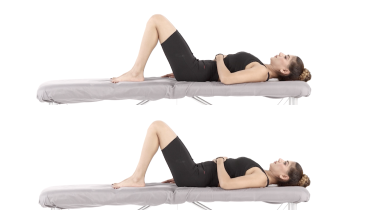 Diaphragmatic breathing
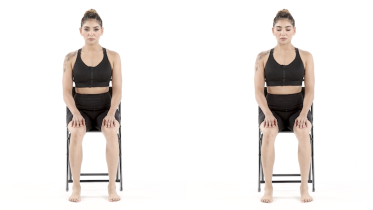 Body scan relaxation
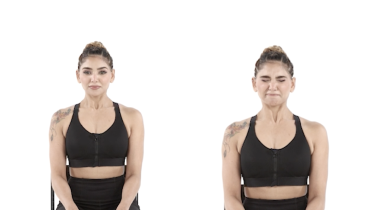 Facial muscle relaxation
Stage 2: Breathing with movement and clearing phlegm
Move on when the stage 1 techniques feel familiar and you can use them without thinking hard. Breathing with arm raises and breathing with shoulder blade movement link a slow breath to gentle upper body movement. This gets you used to breathing steadily while your arms work. Raise your arms only as high as your breathing allows. Autogenic drainage is for people who bring up phlegm. Learn it from a respiratory physio before you use the video on its own. Keep the pace slow, and rest with breathing control between sets.
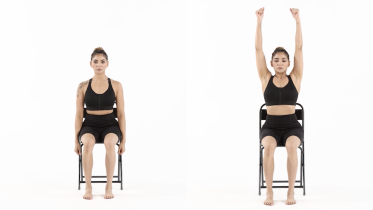 Breathing with arm raises
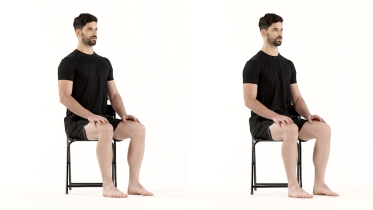 Breathing with shoulder blade movement
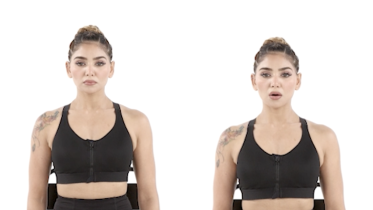 Autogenic drainage breathing
Stage 3: Stay active with leg strength and walking
Most people can start this stage alongside stage 2, because walking and strength work are at the center of pulmonary rehab exercise. Sit to stand using armrests comes first, then sit to stand without your hands. Breathe in before you stand and blow out as you rise. Marching on the spot works indoors on days you cannot get out, and brisk walking at your own pace builds up how far you can go. Stop to recover your breath whenever you need to, then carry on.
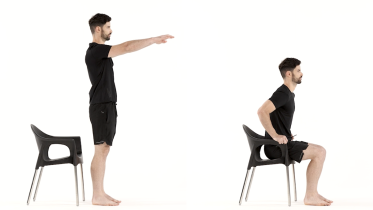 Sit to stand using armrests
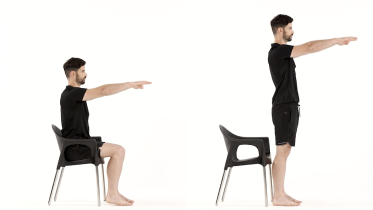 Sit to stand
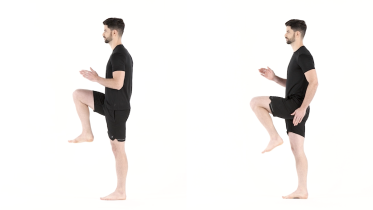 Marching on the spot
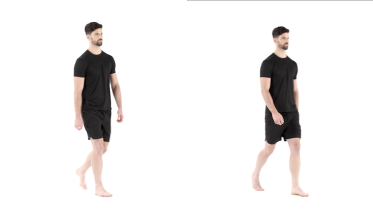 Brisk walking
What to avoid or change
During a flare-up, follow your self-management plan. Finding it harder to be active is one of the signs of a flare-up (Asthma + Lung UK), so drop back to the stage 1 breathing techniques and your usual moving around the home until it settles. Then start again slowly and build up gradually. After a hospital stay for a flare-up, ask about pulmonary rehab (Bolton 2013). Asthma + Lung UK says flare-ups usually last 7 to 10 days, and that most people recover within 4 to 6 weeks.
To lower the chance of a flare-up, the NHS advises avoiding dusty places, fumes, smoke, air fresheners, strong cleaning products, hairspray and perfume. If you have fallen in the past year or feel unsteady, do the standing exercises next to a kitchen counter, and choose a walking route with places to sit and rest. Wear flat shoes that fit well and grip the floor, not socks, tights or bare feet.
Check with your doctor before you start if you also have a heart condition or blood pressure that is not under control. If you have had a heart attack recently, or chest pain on effort that has recently changed or come on more easily, see your doctor before you start any exercise program. NICE and Asthma + Lung UK both say pulmonary rehab may not suit people who have had a recent heart attack or whose heart problems, such as unstable angina, are not under control. If you use oxygen when you are active, use it at your usual setting when you exercise, make sure you have enough for the whole session, and ask your oxygen team if you have any concerns (Asthma + Lung UK). After lung or chest surgery, follow the program from your surgical team and physio instead of this one.
When to see a physio or doctor
Ask your GP, practice nurse or respiratory team about pulmonary rehab if breathlessness limits what you can do, and ask to be taught airway clearance if phlegm is a daily problem. If you do not have a self-management plan, ask for one. It tells you what to do if you think you are having a flare-up (Asthma + Lung UK).
The NHS advises contacting your GP or care team if your symptoms get suddenly worse or you develop new symptoms between check-ups. After a flare-up, Asthma + Lung UK advises a follow-up appointment with your GP once you feel better. The warning signs below say how quickly to get help.
For physiotherapists
This page gives patients with stable COPD a starting framework and points them toward pulmonary rehabilitation. NICE NG115 recommends offering PR to people who consider themselves functionally disabled by COPD (usually MRC grade 3 and above), including after a recent hospital admission for an exacerbation, and notes that it is not suitable for people who are unable to walk, have unstable angina or have had a recent myocardial infarction. The 2026 BTS quality standard asks that people with severe disability (MRC 5) are not excluded, that post-exacerbation referrals are enrolled within 30 days of discharge, and that center-based programs run for at least 6 weeks with twice-weekly supervised sessions. It also asks that people finishing PR leave with a written, individualized maintenance plan (Singh 2026).
McCarthy 2015 (65 trials, 3,822 participants) found improvements above the minimal important difference in all four CRQ domains (dyspnea, fatigue, emotional function and mastery) and a mean 6MWD gain of about 44 m. Puhan 2016 found high-quality evidence of moderate to large effects on health-related quality of life and exercise capacity after an exacerbation (6MWD about 62 m), with moderate-quality evidence of fewer readmissions and heterogeneity between trials. Holland 2012 (16 trials, 1,233 participants) found that breathing exercises over 4 to 15 weeks improved functional exercise capacity without consistent effects on dyspnea or quality of life. Osadnik 2012 (28 studies, 907 participants) found airway clearance techniques safe, with small short-term reductions in the need for increased ventilatory assistance and in hospital length of stay during exacerbations.
Gosselink 1995 found reduced mechanical efficiency and a trend toward more dyspnea during diaphragmatic breathing in 7 people with severe COPD, so check how each patient responds before keeping it in their program. Teach and review airway clearance in person rather than relying on the video alone. Before progressing exercise, screen for signs of an exacerbation, and for pulmonary embolism or cardiac chest pain.
See a doctor promptly if
- Severe difficulty breathing: you are gasping, choking or cannot get your words out, your breathing does not go back to normal once you have stopped, rested and used your breathing control, your chest feels tight or heavy, you have pain that spreads to your arms, back, neck or jaw, your lips or skin are turning very pale, blue or gray, or you feel suddenly confused or very drowsy. On brown or black skin, the color change may be easier to see on the palms of the hands. Call emergency services straight away. Do not wait to see whether your breathing techniques help.
- If chest pain, pressure or tightness does not ease quickly when you rest, spreads to your arm, neck, jaw, stomach or back, or comes with sweating, feeling sick, feeling light-headed or being short of breath, call emergency services straight away, as this can be a heart attack. If it eases quickly and none of these happen, get medical advice the same day, and do not exercise again until you have been checked.
- Breathlessness that comes on suddenly and feels different from your usual COPD or your usual flare-ups. Call emergency services straight away. This can be a sign of a blood clot in the lungs (pulmonary embolism) or another serious problem, especially if it comes with chest pain or pain in your upper back, coughing up blood, a very fast heartbeat, fainting, or a leg that is newly swollen or painful.
- A calf or thigh that is newly swollen, warm, tender, red or darker than usual, has swollen veins that are sore to touch, or has a throbbing or cramping pain that does not fit your injury or condition, or that feels different from normal muscle soreness after exercise. This can be a sign of a blood clot (deep vein thrombosis), especially after surgery, an injury, time in a cast or boot, a long trip or a spell of being much less mobile than usual. Get medical advice the same day. If you are also short of breath or have chest pain, call emergency services.
- A flare-up that is not settling: you are more out of breath than usual, coughing more, or bringing up more phlegm or phlegm that has changed color, and the steps in your self-management plan are not helping, or you do not have a plan. Contact your GP, practice nurse or respiratory team, or get medical advice, the same day. Do the same, even if your plan seems to be working, if your ankles swell more than usual or you become too breathless or unwell to get around your home. If any of the emergency signs above appear, call emergency services.
- Coughing up a few small spots, flecks or streaks of blood, or blood in your phlegm. Get medical advice the same day. If you cough up more than a few spots or streaks, or you cough up blood and find it hard to breathe, have a very fast heartbeat or have pain in your chest or upper back, call emergency services.
- Emergency: your heart is racing, pounding, fluttering or beating irregularly and it does not settle when you stop and rest, or it comes with chest pain, shortness of breath, feeling faint or fainting. Call emergency services. If it settles quickly with rest and none of these happen, get medical advice the same day, and do not exercise again until you have been checked.
- You feel sick or are being sick along with your breathlessness. Get medical advice the same day. If any of the emergency signs above appear, call emergency services.
- If you faint while exercising, call emergency services, even if you feel fine again quickly.
- Same day: you blacked out or fainted, even for a moment. Get medical advice the same day. Call emergency services instead if the person cannot be woken within 1 minute, has not fully recovered or has trouble speaking or moving, has chest pain or a pounding, fluttering or irregular heartbeat, fainted while exercising or lying down, is shaking or jerking, or was badly hurt.
- Breathlessness that is slowly getting worse over weeks during your normal activities, breathlessness that is worse when you lie down, or swelling in both ankles that has built up slowly, along with breathlessness. See your doctor within a few days. Ankles that swell during a flare-up need medical advice the same day, as in the flare-up sign above. A leg that is swollen on one side only is different and is covered by the blood clot sign above.
Common questions
What is the best breathing exercise for COPD?
There is no single best one. The NHS and Asthma + Lung UK both describe breathing control and pursed lip breathing for breathlessness, and blow as you go for efforts such as standing up or climbing stairs. A Cochrane review found that breathing exercises improved how far people could walk, but did not consistently ease breathlessness or improve quality of life (Holland 2012). Pulmonary rehabilitation teaches these techniques alongside exercise and education, and a Cochrane review found clear benefits for breathlessness, fatigue and walking distance (McCarthy 2015).
Is it safe to exercise with COPD if I get out of breath?
For most people, yes. The NHS says exercising until you are a little breathless is not dangerous, but advises not pushing yourself too far. If your symptoms are severe or you have not exercised in a while, it advises speaking to a GP before you start a new exercise program. Stop and rest if you are far more out of breath than the effort should cause, or you get chest pain or tightness, dizziness or a racing heartbeat, and check the warning signs on this page.
How do I get referred for pulmonary rehabilitation?
Ask your GP, practice nurse or respiratory team, who can refer you (Asthma + Lung UK). If you are in hospital with a flare-up, ask about it before you go home. The British Thoracic Society standard says people referred after a hospital stay for a flare-up should start within 30 days of leaving hospital (Singh 2026). If you cannot get to a group, ask about home-based or video options.
How can I clear mucus from my lungs with COPD?
Airway clearance techniques are ways to loosen phlegm and clear it from your chest. The active cycle of breathing technique involves changing your breathing and gently huffing, which is a big breath out through an open mouth instead of a forceful cough (Asthma + Lung UK). A respiratory physio can teach you, and may suggest a handheld device. NICE advises that people with a lot of phlegm are taught these techniques (NICE NG115). Asthma + Lung UK advises speaking to a respiratory physio before you try airway clearance for the first time, as doing it wrongly can irritate your lungs.
Is walking good for COPD?
Yes, for most people. The NHS says regular exercise can improve COPD symptoms and quality of life, and walking is one of the exercises pulmonary rehab programs use. Start with a distance you can manage, use pursed lip or paced breathing as you go, and stop to recover your breath whenever you need to. Build up slowly, adding a little time before you try to walk faster.
References
- National Institute for Health and Care Excellence. Chronic obstructive pulmonary disease in over 16s: diagnosis and management (NG115). 2018. https://www.nice.org.uk/guidance/ng115
- NHS. Chronic obstructive pulmonary disease (COPD). Page last reviewed 11 April 2023. https://www.nhs.uk/conditions/chronic-obstructive-pulmonary-disease-copd/
- NHS. COPD: treatment. Page last reviewed 11 April 2023. https://www.nhs.uk/conditions/chronic-obstructive-pulmonary-disease-copd/treatment/
- NHS. COPD: living with. Page last reviewed 11 April 2023. https://www.nhs.uk/conditions/chronic-obstructive-pulmonary-disease-copd/living-with/
- NHS. Shortness of breath. Page last reviewed 30 January 2024. https://www.nhs.uk/symptoms/shortness-of-breath/
- NHS. Coughing up blood. Page last reviewed 13 June 2024. https://www.nhs.uk/symptoms/coughing-up-blood/
- NHS. Pulmonary embolism. Page last reviewed 25 May 2023. https://www.nhs.uk/conditions/pulmonary-embolism/
- NHS. Deep vein thrombosis (DVT). Page last reviewed 30 April 2026. https://www.nhs.uk/conditions/deep-vein-thrombosis-dvt/
- NHS. Chest pain. Page last reviewed 8 August 2023. https://www.nhs.uk/symptoms/chest-pain/
- NHS. Fainting. Page last reviewed 17 August 2026. https://www.nhs.uk/conditions/fainting/
- NHS. Heart palpitations. Page last reviewed 17 March 2026. https://www.nhs.uk/symptoms/heart-palpitations/
- Asthma + Lung UK. How can I manage my breathlessness? Last reviewed 31 March 2024. https://www.asthmaandlung.org.uk/symptoms-tests-treatments/symptoms/breathlessness/how-can-i-manage-my-breathlessness
- Asthma + Lung UK. Pulmonary rehabilitation (PR). Last reviewed 28 February 2023. https://www.asthmaandlung.org.uk/living-with/keeping-active/pulmonary-rehabilitation
- Asthma + Lung UK. Treatments and medicines for COPD. Last reviewed 14 August 2026. https://www.asthmaandlung.org.uk/conditions/copd-chronic-obstructive-pulmonary-disease/what-are-treatments-copd
- Asthma + Lung UK. What is a COPD flare-up (exacerbation)? Last reviewed 29 May 2025. https://www.asthmaandlung.org.uk/conditions/copd-chronic-obstructive-pulmonary-disease/managing-copd-flare-ups
- Asthma + Lung UK. How is bronchiectasis treated? Last reviewed 14 August 2026. https://www.asthmaandlung.org.uk/conditions/bronchiectasis/how-bronchiectasis-treated
- Asthma + Lung UK. Living well with breathlessness. Last reviewed 31 March 2024. https://www.asthmaandlung.org.uk/symptoms-tests-treatments/symptoms/breathlessness/breathlessness/living-well-breathlessness
- Asthma + Lung UK. Physical activity and your lungs. Last reviewed 28 February 2023. https://www.asthmaandlung.org.uk/living-with/keeping-active/physical-activity
- Asthma + Lung UK. Keep Active programme: safety advice. Last reviewed 1 June 2024. https://www.asthmaandlung.org.uk/living-with/keeping-active/keep-active-programme/exercising-safely
- Bolton CE, Bevan-Smith EF, Blakey JD, et al. British Thoracic Society guideline on pulmonary rehabilitation in adults: accredited by NICE. Thorax. 2013;68(Suppl 2):ii1-ii30. https://doi.org/10.1136/thoraxjnl-2013-203808
- Singh SJ, Buxton M, Daynes E, et al. British Thoracic Society quality standard for pulmonary rehabilitation. BMJ Open Respiratory Research. 2026;13(1):e003872. https://doi.org/10.1136/bmjresp-2025-003872
- McCarthy B, Casey D, Devane D, Murphy K, Murphy E, Lacasse Y. Pulmonary rehabilitation for chronic obstructive pulmonary disease. Cochrane Database of Systematic Reviews. 2015;(2):CD003793. https://doi.org/10.1002/14651858.CD003793.pub3
- Puhan MA, Gimeno-Santos E, Cates CJ, Troosters T. Pulmonary rehabilitation following exacerbations of chronic obstructive pulmonary disease. Cochrane Database of Systematic Reviews. 2016;(12):CD005305. https://doi.org/10.1002/14651858.CD005305.pub4
- Holland AE, Hill CJ, Jones AY, McDonald CF. Breathing exercises for chronic obstructive pulmonary disease. Cochrane Database of Systematic Reviews. 2012;(10):CD008250. https://doi.org/10.1002/14651858.CD008250.pub2
- Osadnik CR, McDonald CF, Jones AP, Holland AE. Airway clearance techniques for chronic obstructive pulmonary disease. Cochrane Database of Systematic Reviews. 2012;(3):CD008328. https://doi.org/10.1002/14651858.CD008328.pub2
- Gosselink RA, Wagenaar RC, Rijswijk H, Sargeant AJ, Decramer ML. Diaphragmatic breathing reduces efficiency of breathing in patients with chronic obstructive pulmonary disease. American Journal of Respiratory and Critical Care Medicine. 1995;151(4):1136-1142. https://doi.org/10.1164/ajrccm.151.4.7697243
- Chartered Society of Physiotherapy. NICE puts physios centre stage in COPD management. 12 December 2018. https://www.csp.org.uk/news/2018-12-12-nice-puts-physios-centre-stage-copd-management
Written and checked by the PocketPhysio editorial team. Last updated 2026-09-29.
This page is general education, not a diagnosis or a personal treatment plan. See a physiotherapist or doctor for advice about your own situation.