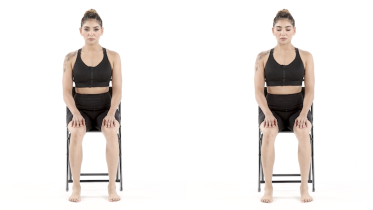
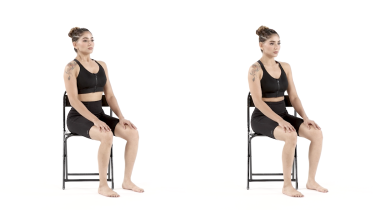
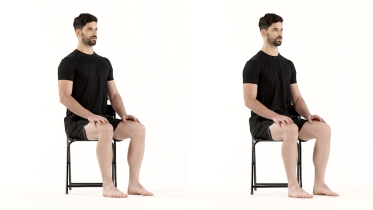
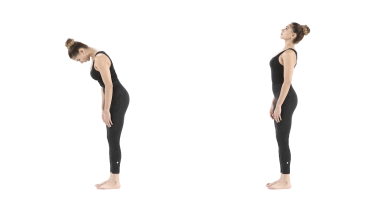
Facial muscle relaxation
Facial muscle relaxation is a tense and relax exercise for the face. Sitting on a chair, you breathe in, scrunch up your face by squeezing your eyes shut and closing your jaw firmly, hold for a few seconds, then breathe out and let every muscle go. Feeling the difference between tight and loose helps you notice when your face and jaw are tense, and let that tension go. It is the face part of progressive muscle relaxation.
How to do the facial muscle relaxation
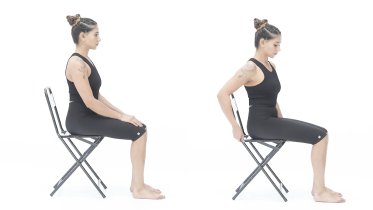
- Sit upright on a chair, feet on the floor, and rest your hands on your thighs.
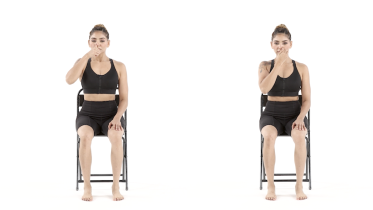
- Breathe in slowly, no deeper than feels comfortable.
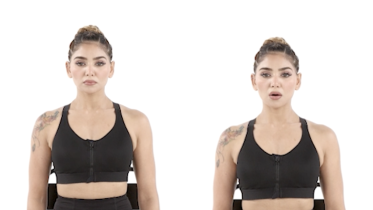
- Squeeze your eyes shut, close your jaw firmly and scrunch up your whole face, as if you had tasted something very sour.
- Hold the squeeze for about 5 to 10 seconds. Keep breathing gently through your nose, without straining or bearing down.
- Breathe out and let your face go loose all at once: eyes open softly, jaw drops slightly, forehead smooth. Notice how different it feels.
- Rest for 10 to 20 seconds, breathing normally, before you repeat.
What you should feel
A firm but comfortable squeeze around your eyes, cheeks and jaw. As you let go, your face may feel warm or heavy. It should never hurt.
Common mistakes
- Clenching your teeth hard enough to hurt your jaw or teeth.
- Holding your breath and straining while you squeeze.
- Shrugging your shoulders or making fists at the same time.
- Going straight into the next squeeze without resting.
How often
Many people do 3 to 5 squeezes, once or twice a day or whenever they notice tension, often as part of a longer relaxation routine. Your physio will adjust this.
Stop and check with your physio if
- Pain in your jaw, face, teeth, ear or eyes, or the jaw clicks painfully, catches or locks. Stop. If the pain or clicking does not settle soon after you stop, you cannot open your mouth fully, the jaw stays stuck or the pain stops you eating or drinking, get medical or dental advice the same day.
- Your mouth gets stuck open and will not close, or your jaw feels out of place and your teeth no longer meet as they did. Go to an emergency department straight away, supporting your jaw gently with your hand, and do not drive yourself. Call emergency services if you also find it hard to breathe.
- Things look double, your vision suddenly blurs or goes, your speech slurs or becomes muddled, swallowing becomes hard, your face or lips go numb, one side of your face droops or one side of your body goes weak or numb, you suddenly become so dizzy or unsteady that you fall or cannot stand or walk, your legs suddenly give way but you do not black out (a drop attack), or you get a sudden severe headache. Stop and call emergency services, even if it goes away.
- Jaw, neck, shoulder or arm pain that comes with chest pain or tightness, sweating, feeling sick, feeling light-headed or being short of breath, or that comes on when you exert yourself, feel stressed or go out in the cold and does not ease within a few minutes of rest. Call emergency services straight away, as this can be a heart attack. If it eases quickly with rest and none of these happen, get medical advice the same day, and do not exercise again until you have been checked.
- You feel dizzy, faint or unsteady. Stop and get medical advice the same day. If you faint, it does not settle within a few minutes of sitting still, or you cannot stand or walk steadily, call emergency services.
From the clinic
The voice guide pairs a breath in with the squeeze and a breath out with the release, and the video holds the squeeze for about 8 seconds. You do not need to stop breathing during the hold. Keep taking small, easy breaths through your nose while you squeeze. If you have high blood pressure, breathe steadily through every hold and never hold your breath. To relax the rest of your body afterward, try body scan relaxation.
If one side of your face is weak from Bell's palsy or another facial nerve problem, only do this if a specialist facial therapist has advised it, because strong, whole-face squeezes can encourage unwanted linked movements (synkinesis) while the nerve recovers. If your face is weak after a stroke, ask your stroke team before you start. If one side of your face is already weak from Bell's palsy or an earlier stroke, and a doctor has checked it, that known droop is not a new sign. New drooping on the other side, weakness that suddenly gets worse, and every other sign in the stop list still mean calling emergency services, even if they go away.
With a jaw joint problem (TMD), keep your teeth slightly apart and squeeze only around your eyes and cheeks, because clenching can strain the joint. After jaw surgery or a broken jaw, check with your surgeon before you start, and follow their plan. After eye surgery, such as a cataract operation, ask your eye team before you squeeze your eyes shut.
New, frequent headaches with pain or tenderness at your temples or on your scalp, or, if you are 50 or over, new jaw aching that comes on as you chew or talk and eases when you stop, need medical advice the same day, as they can be signs of inflamed arteries in the head (giant cell arteritis). If your vision changes, call emergency services.
Written and checked by the PocketPhysio editorial team. Last updated 2026-09-28.
This page is general education, not a diagnosis or a personal treatment plan. If you have pain, an injury or a health condition, see a physiotherapist or doctor before starting new exercises.