Calf raises
A calf raise means rising onto the balls of your feet and lowering back down. It works the muscles at the back of your lower leg (the calf), the ones that push you forward every time you walk, climb stairs or run. You need no equipment, and plenty of ankle, Achilles and knee rehab programs include it.
How to do the calf raises
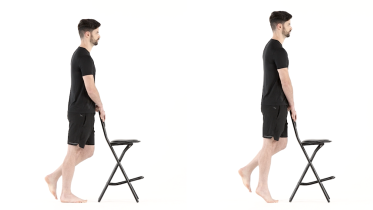
- Stand tall with your feet about hip width apart and your arms relaxed by your sides. The video shows it without support. If your balance is poor, face a kitchen counter with both hands resting on it, or at least keep a wall or chair back within reach.
- Push up through the balls of your feet and lift your heels as high as you comfortably can. Knees straight, but not locked.
- Pause at the top for a moment. Your weight should stay over the big toe and second toe, not roll out toward the little toes.
- Lower your heels slowly back to the floor, as the video shows. For a harder version, the voice guide holds for a few seconds at the top, then stops the heels just before they touch the floor and holds there too.
- Rise again for the next one, with the same slow pace up and down.
What you should feel
Your calf working, more and more toward the end of the set. A mild burn there is normal. You should not get sharp pain at the back of the heel or in the arch of the foot.
Common mistakes
- Rising only halfway. Go as high as you can control.
- Letting the heels drop fast instead of lowering them.
- Rolling onto the outside edge of the foot at the top, so the ankle tips outward.
- Leaning forward from the hips or bending the knees to get higher.
How often
A common starting point is 2 to 3 sets of 10 to 15 on both legs, once a day or a few days a week. Your physio will adjust the numbers and tell you when you are ready to move on to one leg.
Stop and check with your physio if
- Sharp pain in the Achilles tendon, heel or arch.
- A sudden pop or snap at the back of your ankle or heel, a feeling that someone kicked you there, or sudden pain there after which you cannot push off or rise onto your toes on that leg. Stop, take the weight off that leg carefully and go to an urgent care center or emergency department the same day, even if you can still walk, as this can be a torn Achilles tendon.
- Achilles or heel pain that is clearly worse the next morning. Ease off and check with your physio.
- Your calf or thigh becomes swollen, warm, tender, red or darker than usual, or has a throbbing or cramping pain that feels different from normal muscle ache. Stop and get medical advice the same day, as this can be a blood clot. If you are also short of breath or have chest pain, call emergency services.
- Your ankle gives way, or you lose your balance.
- Since the fracture or cast, the foot or ankle is getting more painful rather than less, the skin becomes very sensitive to light touch, or the foot changes color, temperature, swelling or sweating compared with the other one, or looks shiny. See your doctor or physio as soon as you can, within a few days at most, as this can be complex regional pain syndrome (CRPS) and early treatment may help.
- Chest pain or pressure, dizziness or feeling faint, a racing or irregular heartbeat, or being far more out of breath than the effort should cause.
From the clinic
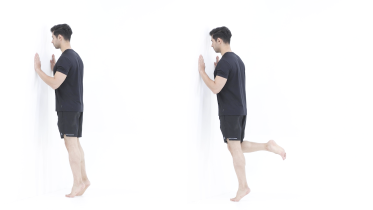
When 2 or 3 sets on both legs feel easy, the voice guide moves you on to the same exercise on one leg. Rest your fingertips on a counter or wall for balance. Expect far fewer repetitions on one leg at first. That is normal.
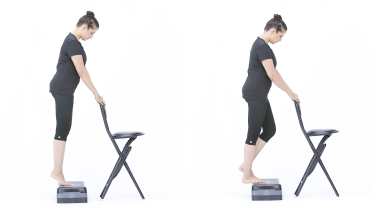
Another option is to stand with the balls of your feet on a step, holding a rail, so the heels can drop a little lower. This leads into the eccentric calf raise. Skip the drop if your pain sits where the Achilles tendon joins the heel bone, because loading the tendon in that stretched position often aggravates it.
After an Achilles tendon repair or ankle surgery, calf raises usually come in at a set stage of your surgeon's protocol, often on both feet before one. Check with your physio before you start.
If chest pain, pressure or tightness does not ease quickly when you rest, spreads to your arm, neck, jaw, stomach or back, or comes with sweating, feeling sick, feeling light-headed or being short of breath, call emergency services straight away, as this can be a heart attack. If it eases quickly and none of these happen, get medical advice the same day, and do not exercise again until you have been checked. If you faint while exercising, call emergency services, even if you feel fine again quickly.
Written and checked by the PocketPhysio editorial team. Last updated 2026-09-28.
This page is general education, not a diagnosis or a personal treatment plan. If you have pain, an injury or a health condition, see a physiotherapist or doctor before starting new exercises.