
Achilles tendon rupture: rehab and exercises after a torn Achilles
What is an Achilles tendon rupture?
Your Achilles is the thick tendon you can feel just above the heel. It links the calf muscles to the heel bone, and a rupture means it has torn right through or nearly so. OrthoInfo says it usually happens when the calf is stretched too quickly, for example landing from a jump or cutting sharply to change direction in sport. A tendon already weakened by steroid injections, some long-term conditions or fluoroquinolone antibiotics tears more easily.
People often say it felt as if someone kicked them in the calf (Cambridge University Hospitals). You may hear a pop, and severe pain and swelling near the heel can follow (OrthoInfo). If you think you have torn a tendon, the NHS says to get urgent advice. Walking on it does not mean it is intact, so have it checked the same day. To test it, a doctor may squeeze your calf to see whether the foot moves and ask you to rise onto your toes (OrthoInfo).
Who this page is for
This page is for adults with a torn Achilles tendon, whether it was managed in a boot or cast alone or repaired in an operation first. It explains what rehab usually looks like and why. It is not a week-by-week protocol. Your treating team sets the timings and how much weight you can put through the leg, and after an operation you follow your surgeon's program. Children and teenagers with a suspected Achilles injury need to see a doctor or physio, who will plan any rehab.
Pain in the tendon that came on gradually, without a pop or a sudden loss of push-off, is more likely to be Achilles tendinopathy, which has its own program. That program loads the tendon in a different way and is not meant for a tear. A twisted ankle that hurts at the side rather than the back fits the ankle sprain program better.
Boot or surgery: how a torn Achilles is treated
Without surgery, the foot is held with the toes pointed down in a boot or cast (OrthoInfo). With a boot, heel wedges hold that angle, and they come out in steps over the following weeks until the foot is back to a normal angle (Costa and colleagues, 2020; Hull). With surgery, the torn tendon is repaired with stitches or anchors first, and the leg is then protected in the same way for a while, following your surgeon's plan. OrthoInfo lists infection, nerve injury, wound breakdown and blood clots among the risks of surgery.
Surgeons still disagree about which is better (OrthoInfo). In a Norwegian trial of 554 adults, function at 12 months was similar after treatment without surgery, open surgery or minimally invasive surgery (Myhrvold and colleagues, 2022). The tendon tore again in 6.2% of the group treated without surgery and in 0.6% of each surgery group, and nerve injuries were more common after surgery, especially the minimally invasive kind. A review of 29 studies came to a similar balance: slightly fewer repeat tears after surgery, more other complications (Ochen and colleagues, 2019). Your surgeon will go through it with you, and OrthoInfo says surgery is more likely to be suggested for competitive athletes and for people whose activities depend on jumping and pushing off.
Living with the boot
Clinics differ in the detail, so follow your own. In the UKSTAR trial, people in the boot could take their full weight on the foot straight away, and the wedges were reduced over 8 weeks (Costa and colleagues, 2020). One NHS trust starts with 2 weeks in a cast with no weight on the foot, then a boot with 4 wedges that come out in stages, and the boot comes off at about 10 weeks after a check (Hull).
The boot is usually worn day and night, including in bed, and taken off only to wash and check the skin (Cambridge University Hospitals; Hull). While it is off, keep the foot off the floor (Cambridge University Hospitals). Take it off for exercises only if your team has said you can, as some plans start them only once the boot comes off for good (Hull). Do not remove the wedges until your team tells you to.
Blood clots form more easily in a leg that is held still in a boot or cast. NICE tells doctors to consider blood-thinning medicine when a leg is immobilized and the person's clot risk is higher than their bleeding risk (NICE NG89). The Hull trust often prescribes injections or tablets for 6 weeks. If you have them, take every dose the way your team explained. The Hull leaflet says to expect some thinning of the calf muscle, and sometimes some swelling, which is why the clot warning signs below talk about changes that do not fit your injury.
How long does a torn Achilles take to heal?
Much longer than the time in the boot. OrthoInfo advises planning on at least 6 weeks in a boot and about 12 months for a complete recovery, and some people say it took closer to 2 years to reach all their goals. Hull puts normal function at 12 to 18 months. Its leaflet expects driving and everyday activities to return at about 12 weeks.
Some calf strength is lost whichever treatment you had (OrthoInfo). With focused strengthening most people get back to their previous level of activity, but it can take up to 18 to 24 months after the injury. That is the main reason the calf work carries on for months after the boot is off.
What rehab usually looks like, and the evidence
Rehab after a torn Achilles has moved toward earlier walking and earlier movement. In the UKSTAR trial of 540 adults treated without surgery, walking in a boot from the start did as well at 9 months as a traditional plaster cast, with similar rates of repeat tears (Costa and colleagues, 2020). In a Canadian trial of 144 people, all on an early walking and early movement program, repeat tears were rare with or without surgery: 2 in the surgery group and 3 in the group treated without it (Willits and colleagues, 2010). After surgery, the American Academy of Orthopaedic Surgeons guideline gave a moderate-strength recommendation for early protected weight bearing (Chiodo and colleagues, 2010).
No one exercise program has strong evidence behind it. A 2026 review found that early rehab has not been shown to raise the risk of a repeat tear and may help in the short term, but that clear long-term benefit over slower approaches has not been shown, and that programs differ a lot (Hashimoto and colleagues, 2026). The stages on this page come from common physio practice and sit inside the plan your treating team sets. They are not a tested protocol.
How to use this program
Start stage 1 only when your treating team says the boot can come off for exercise, and move on only when they or your physio say so. The signs for moving on come from common practice and are only a rough guide. Where they differ from your team's plan, follow the plan. Begin an exercise only once you have been cleared for it, even if its own page does not mention this.
You will find a typical starting dose on every exercise page. Across programs, the early movements are often done 1 to 3 times a day, calf raises as 2 to 3 sets of 8 to 15 daily or a few days a week, and balance holds for 10 to 30 seconds. Your physio will adjust this to your tendon and to the job, sport or daily activities you are working back toward.
Stage 1 should feel stiff but not painful. From stage 2, some mild discomfort while you exercise is acceptable, provided it eases soon afterward and the heel is no worse the next morning. Sharp pain at the back of the heel, pain that climbs with each repetition, or a heel that is clearly sorer or more swollen the next day tells you the load was too much. Go back a step and let your physio know.
The exercise program
Stage 1: Gentle ankle movement out of the boot
Start only when your treating team says the boot can come off for exercise, and follow their plan for how far the foot may bend up toward you. While you still wear the boot between sessions, many plans let the foot come up no further than a right angle to the shin, and some ask you to keep the knee bent when you bring the foot up in the early weeks, as that puts less pull on the tendon. Sit with the leg supported and move the ankle slowly: circles, turning the sole in and out, and lifting your heels with no weight on your knees. Many programs use 10 to 15 slow circles each way 1 to 3 times a day, 10 to 15 slow turns 2 to 3 times a day, and 2 to 3 sets of 10 to 20 seated heel lifts a few days a week. Expect stiffness, not pain. Never push the foot up into a stretch at the back of the heel. Put the boot back on between sessions for as long as your team wants you to wear it.
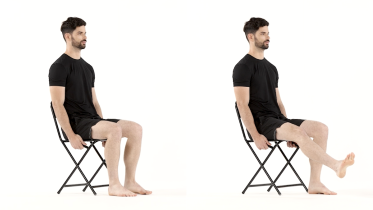 Ankle circles
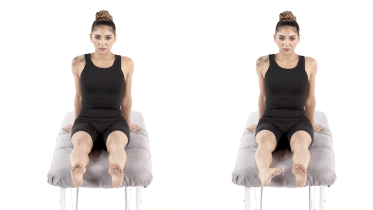 Active ankle inversion
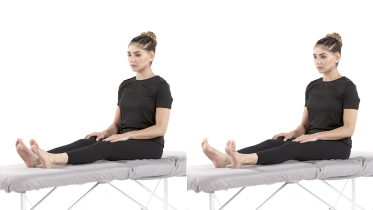 Active ankle eversion
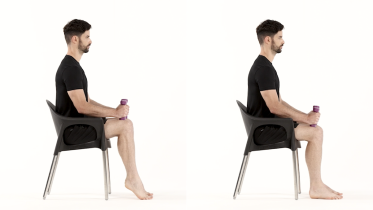 Seated calf raise
Stage 2: Walk in your own shoes and rebuild the calf on two feet
For when your team has moved you out of the boot and into your own shoes. In the two weight shifts the ankle learns to take your weight again, with a counter to hold. Walking with longer steps practices landing on the heel and rolling through to push off. Set the markers only a little further apart than your usual step, and never so far that you feel a stretch at the back of the heel. If your team gave you a heel raise for your shoe, keep it in for as long as they say. Weeks in a boot take away a lot of push-off, and the band exercise and calf raises on both feet begin to bring it back, often at 2 to 3 sets of 10 to 15 once a day or a few days a week. Rise and lower slowly on a flat floor, with your weight shared evenly between both feet. A little discomfort is OK as long as it fades soon after and the heel feels no worse the next morning.
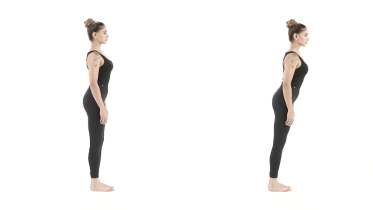 Forward and backward weight shift
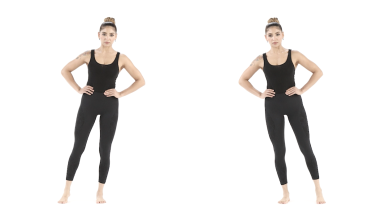 Side to side weight shift
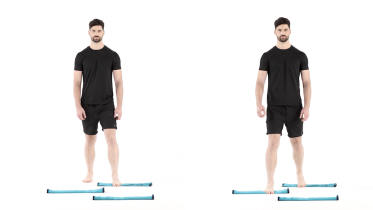 Walking with longer steps
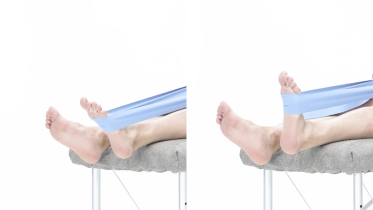 Ankle plantar flexion with band
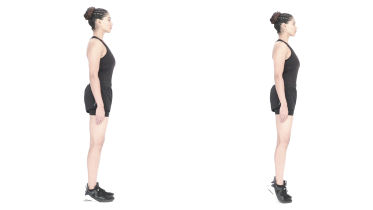 Calf raises
Stage 3: Strength on one leg, balance and stairs
Move on when you walk without a limp, calf raises on both feet feel easy and your team or physio says the tendon is ready for more load. The eccentric calf raise is the bridge: up on both feet, then down slowly on the injured leg only, with the heel coming down to step level or the floor and never sinking below a step. The bent-knee and single leg heel raises come next, and weight is added only when your physio says so. For balance, stand with one foot in front of the other (tandem stance), then on the injured leg alone. The step-up builds strength for stairs. Keep a counter or sturdy chair close enough to grab. Planning to run, jump or play sport again? Your physio will test the calf against the other leg and plan that build-up with you.
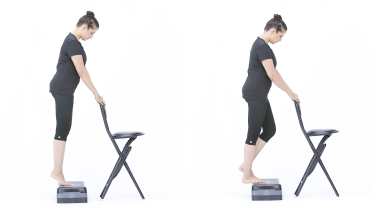 Eccentric calf raise
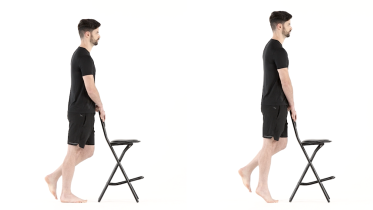 Bent-knee calf raise
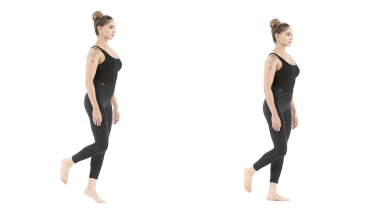 Single leg heel raise
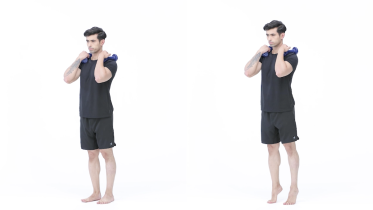 Weighted calf raise
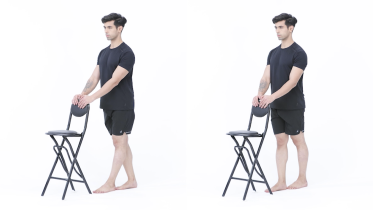 Tandem stance
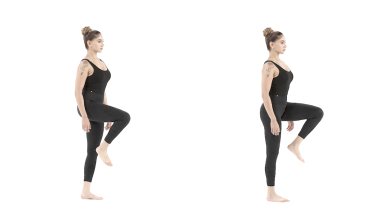 Single leg stance
 Step up
Protecting the healing tendon
A healed Achilles tendon can end up longer than before. In a small study of 8 people followed for a year after a tear, the injured tendon was longer than the other one, and a longer tendon went with a lower heel rise on that side (Silbernagel and colleagues, 2012). The Hull leaflet also notes that a tendon that heals slightly long can weaken push-off when you walk quickly or run. That is one reason this program has no calf stretches. Do not stretch your calf, or let your heel drop below the edge of a step, unless your physio has told you to.
Because the tendon usually tears when the calf is stretched suddenly (OrthoInfo), take care on stairs and on wet or uneven ground, and avoid anything that makes you jump or lunge. Use your crutches or walking aid for as long as your team asks. Back in your own shoes, pick flat, well-fitting ones that grip, rather than walking in socks, tights or bare feet. Do the balance work next to a counter or sturdy chair you can hold.
Falls are common in the months after a torn Achilles. In the UKSTAR trial, about 1 in 5 people in each group had a fall without an injury in the first 9 months, and about 1 in 12 had a fall that did injure them (Costa and colleagues, 2020). If you fall, or keep tripping or feeling unsteady, in the boot or in the first weeks back in your own shoes, tell your physio or fracture clinic within a few days so they can check your walking aid and how you walk. A fall that leaves the heel more painful or push-off weaker needs checking the same day (see the warning signs below).
When to see a physio or doctor
OrthoInfo says physical therapy starts once the tendon has begun to heal, so most people see a physical therapist (physiotherapist) at some point. Ask for a referral if nobody has arranged one, or if you still limp or cannot rise onto your toes on that leg. It is worth asking too if you have a physical job or a sport to return to. A physio can compare the calf strength and heel rise of the two legs and plan the build-up. OrthoInfo says returning to sport may involve a set of tests to check you are ready.
After surgery it is your surgeon and physio who decide when the leg can take weight and when the wedges come out. For how fast to act on a problem, see the warning signs below.
For physiotherapists
This is a patient-facing framework for acute Achilles tendon rupture, managed non-operatively in a functional brace or after repair. Every stage is gated by the treating team's protocol, and there are no week-by-week timings. The JOSPT Achilles pain, stiffness and muscle power deficits guideline (Martin and colleagues, 2018) covers midportion tendinopathy, not rupture, so it is not used for staging here. The AAOS guideline (Chiodo and colleagues, 2010) made no strong recommendations; its two moderate-strength recommendations were early postoperative protective weight bearing and protective devices that allow postoperative mobilization.
UKSTAR (Costa and colleagues, 2020) randomized 540 adults treated non-operatively to a below-knee cast in gravity equinus or a removable rigid boot with two solid heel wedges and full weight bearing from the start, with the foot brought to plantigrade over 8 weeks in both arms. ATRS at 9 months did not differ (adjusted mean difference -1.38, 95% CI -4.9 to 2.1), and re-rupture was 6% vs 5%. After 8 weeks, both groups had the same written advice to move the toes, ankle and knee within comfort and to walk. DVT occurred in 3 cast and 6 brace participants, and PE in 0 and 2, so screen for thrombosis and check that VTE prophylaxis was assessed (NICE NG89). Over 9 months, 23% and 19% had a fall without injury and 8% and 9% a fall with injury, 15% and 19% had pressure sores, and 41% and 47% reported numbness around the foot, which is why the page carries falls and cast lines.
The Norwegian ACHILLES trial (Myhrvold and colleagues, 2022) found no difference in change in ATRS at 12 months between non-operative treatment, open repair and minimally invasive surgery. Re-rupture was 6.2% after non-operative treatment and 0.6% in each surgical group, and nerve injuries were 5.2% after minimally invasive surgery, 2.8% after open repair and 0.6% after non-operative treatment. Willits and colleagues (2010) found 2 vs 3 re-ruptures with accelerated functional rehabilitation in 144 patients, and 13 vs 6 complications, mostly soft tissue, in the operative group. Ochen and colleagues (2019) pooled 29 studies: re-rupture 2.3% vs 3.9% and other complications 4.9% vs 1.6%, operative vs non-operative; in studies using accelerated functional rehabilitation with early range of motion, the re-rupture difference was not significant (RR 0.60, 95% CI 0.26 to 1.37).
Silbernagel and colleagues (2012) linked side-to-side differences in heel-rise height to tendon elongation in 8 patients followed to 12 months, which is the rationale for leaving out calf stretching and below-step heel drops here. Calf stretching and hopping are left to the treating team's protocol, as is dorsiflexion past neutral while the boot is still in use (Marrone and colleagues, 2024, limit active dorsiflexion to neutral with the knee flexed early after repair and advise against dorsiflexion past neutral until 8 weeks). Screen each visit for DVT, wound problems and sural nerve symptoms after repair, pressure areas under the boot, early CRPS signs, and a positive calf squeeze test or sudden loss of plantarflexion strength that may mean re-rupture. Progression here follows the treating team's protocol and the 24-hour symptom response rather than a tested exercise program.
See a doctor promptly if
- Emergency: you suddenly become short of breath, you get chest pain or pain in your upper back that may be worse when you breathe in, you cough up blood, your heart is beating very fast, or you faint. Call emergency services straight away, even if your leg looks normal. These can be signs of a blood clot in the lungs (pulmonary embolism).
- Emergency: sudden, severe pain in your lower leg that is much worse than you would expect, especially after an operation or with a cast, boot or tight bandage on the leg. It may come with a tight, swollen leg, pain that gets worse when the muscle is stretched, numbness, pins and needles or weakness. Call emergency services or go to an emergency department straight away, and do not drive yourself. This can be acute compartment syndrome, which needs urgent surgery.
- Emergency: while you are in a cast or boot, your toes turn blue, white or pale, or feel cold. Do not wait to see if raising your leg helps. Go to an emergency department straight away, and do not drive yourself. The cast or boot may be cutting off the blood supply, or pressure may be building up inside the leg (compartment syndrome), and both need checking quickly.
- In a cast or boot, the pain gets worse, your toes feel numb, tingle or burn or look more swollen, or the cast or boot feels too tight. Stop, raise your foot above your hip, keep moving your toes and contact your fracture clinic or get medical advice straight away. If you wear a boot, loosen the straps but keep it on. If you cannot move your toes, the pain is severe even after painkillers, or the numbness, tingling, burning or swelling has not settled within 30 minutes of raising your foot, go to your fracture clinic or an emergency department straight away, and do not drive yourself.
- A calf or thigh that is newly swollen, warm, tender, red or darker than usual, has swollen veins that are sore to touch, or has a throbbing or cramping pain that does not fit your injury or condition, or that feels different from normal muscle soreness after exercise. This can be a sign of a blood clot (deep vein thrombosis), especially after surgery, an injury, time in a cast or boot, a long trip or a spell of being much less mobile than usual. Get medical advice the same day. If you are also short of breath or have chest pain, call emergency services.
- A new pop or snap at the back of your ankle or heel, a feeling that someone kicked you there, or sudden pain there after which pushing off or rising onto your toes on that leg is suddenly weaker or no longer possible. Stop, take the weight off that leg carefully and get it checked the same day by your treating team, an urgent care center or an emergency department, even if you can still walk, as the tendon may have torn again.
- A fall, slip or stumble, in the boot or after it, that leaves the back of your ankle more painful or swollen, or pushing off on that leg weaker than before, even without a pop. Keep your weight off the leg and get it checked the same day by your treating team, an urgent care center or an emergency department, even if you can still walk.
- Since your operation, your wound is oozing, leaking or has pus coming out of it, or its edges start to come apart, or the skin around it is getting more red, hot, swollen or painful instead of settling, or you have a high temperature or feel hot and cold or shivery. Redness can be harder to see on brown or black skin. Contact your surgical team the same day, or get urgent medical advice if you cannot reach them. If you feel very unwell, go to an emergency department. If you have a very high or very low temperature, shivering you cannot control, you are breathing very fast or finding it hard to breathe, you are confused or your speech is slurred, your skin, lips or tongue look blue, gray, pale or blotchy (on brown or black skin this can be easier to see on the palms of the hands or soles of the feet), or you have a rash that does not fade when you press it, call emergency services, as this can be sepsis.
- Since your operation, new numbness, tingling or burning along the outer edge of your foot or elsewhere in your lower leg or foot, beyond the numb patch of skin near your scar. Contact your surgical team or get medical advice the same day.
- Your cast is cracked, soft, loose or wet, your cast or boot rubs painfully, or there is a bad smell or liquid coming from under the cast. Contact your fracture clinic or plaster room straight away. If they cannot see you that day, go to an emergency department.
- A blister or sore on your leg or foot, for example where the boot rubs, becomes more red, hot, swollen or painful, or starts to leak or ooze, or you have a high temperature or feel hot, cold or shivery. Contact your fracture clinic or medical team the same day.
- Since the injury, operation or boot, your foot or ankle is getting more painful rather than less, often with a burning pain that feels far worse than the injury, the skin becomes very sensitive to light touch, bedclothes or a change in temperature, or the foot changes color, temperature, swelling or sweating compared with the other one, or looks shiny. See your doctor or physio as soon as you can, within a few days at most, as this can be complex regional pain syndrome (CRPS) and early treatment may help.
- Months after the boot came off, you still cannot rise onto your toes on the injured leg at all, or you still limp badly, and it is not getting better from month to month. This is not an emergency, but ask your treating team or physio for a review in the next week or two.
Common questions
How long does it take to recover from an Achilles tendon rupture?
Usually about a year, and sometimes longer. The American Academy of Orthopaedic Surgeons (OrthoInfo) puts full recovery at about 12 months and notes that some people feel it took nearer 2 years to reach all their goals. A Hull University Teaching Hospitals leaflet gives 12 to 18 months to regain normal function. The boot itself usually stays on for at least 6 weeks (OrthoInfo); in the UKSTAR trial it was 8 weeks. Most of the strength work comes after that.
Do you need surgery for a ruptured Achilles tendon?
Not always. In a trial of 554 adults in Norway, people treated without surgery, with open surgery or with keyhole-style (minimally invasive) surgery had similar function at 12 months (Myhrvold and colleagues, 2022). Repeat tears were 6.2% without surgery and 0.6% in each surgery group, but nerve injuries were more common after surgery. OrthoInfo says surgeons still debate the choice and may suggest surgery if you are a competitive athlete or jumping and pushing off are central to what you do. This is a decision to make with your surgeon.
Can you walk with a ruptured Achilles tendon?
Sometimes. OrthoInfo says you may not be able to walk on the injured leg. Other muscles can still point the foot down, though, so some people walk with a limp after a tear, and a torn Achilles is sometimes missed at first (Maffulli and colleagues, 2017). Being able to walk does not rule out a tear. The usual checks are a squeeze of the calf, to see whether the foot moves, and trying to stand on your toes. A pop, or a feeling of being kicked in the calf, needs checking the same day, walking or not. Once it is diagnosed, how much weight you put through the leg depends on your clinic's plan.
Can an Achilles tendon tear again?
Yes, although it is not common. In the UKSTAR trial of 540 adults treated without surgery, the tendon tore again in 6% of the plaster cast group and 5% of the boot group (Costa and colleagues, 2020). A review of 29 studies with 15,862 people found repeat tears in 2.3% after surgery and 3.9% without it, but more other complications after surgery (Ochen and colleagues, 2019). A new pop, or push-off that suddenly gets weaker, needs checking the same day.
Should I stretch my calf after an Achilles rupture?
Not unless your physio or treating team tells you to. A healed Achilles tendon can end up longer than before, and in a small study of 8 people a longer tendon went with a lower heel rise on that side (Silbernagel and colleagues, 2012). That is why this program has no calf stretches and keeps the heel at step level or on the floor. Your physio will decide if and when stretching has a place.
When can I drive after an Achilles tendon rupture?
Not while you are in the boot or cast. The Cambridge University Hospitals leaflet says not to drive in the walking boot or plaster cast, and the Hull leaflet says it is not safe and you will not be covered by your insurance. The Hull leaflet says you are likely to start driving and other everyday activities at about 12 weeks after the injury. Check with your treating team, and with your insurer if you are not sure.
References
- American Academy of Orthopaedic Surgeons. Achilles tendon rupture (tear). OrthoInfo. https://www.orthoinfo.org/en/diseases--conditions/achilles-tendon-rupture-tear/
- NHS. Tendonitis. Page last reviewed 9 June 2023. https://www.nhs.uk/conditions/tendonitis/
- Costa ML, Achten J, Marian IR, et al. Plaster cast versus functional brace for non-surgical treatment of Achilles tendon rupture (UKSTAR): a multicentre randomised controlled trial and economic evaluation. Lancet. 2020;395(10222):441-448. https://doi.org/10.1016/S0140-6736(19)32942-3
- Myhrvold SB, Brouwer EF, Andresen TKM, et al. Nonoperative or Surgical Treatment of Acute Achilles' Tendon Rupture. New England Journal of Medicine. 2022;386(15):1409-1420. https://doi.org/10.1056/NEJMoa2108447
- Willits K, Amendola A, Bryant D, et al. Operative versus nonoperative treatment of acute Achilles tendon ruptures: a multicenter randomized trial using accelerated functional rehabilitation. Journal of Bone and Joint Surgery (American). 2010;92(17):2767-2775. https://doi.org/10.2106/JBJS.I.01401
- Ochen Y, Beks RB, van Heijl M, et al. Operative treatment versus nonoperative treatment of Achilles tendon ruptures: systematic review and meta-analysis. BMJ. 2019;364:k5120. https://doi.org/10.1136/bmj.k5120
- Chiodo CP, Glazebrook M, Bluman EM, et al. Diagnosis and treatment of acute Achilles tendon rupture. Journal of the American Academy of Orthopaedic Surgeons. 2010;18(8):503-510. https://doi.org/10.5435/00124635-201008000-00007
- Silbernagel KG, Steele R, Manal K. Deficits in heel-rise height and Achilles tendon elongation occur in patients recovering from an Achilles tendon rupture. American Journal of Sports Medicine. 2012;40(7):1564-1571. https://doi.org/10.1177/0363546512447926
- Hashimoto M, Yasui Y, Nakasa T, Kawano H, Miyamoto W. How Early Is Early? Defining Functional Rehabilitation After Acute Achilles Tendon Rupture: A Narrative Review. Journal of Clinical Medicine. 2026;15(17):6597. https://doi.org/10.3390/jcm15176597
- Marrone W, Andrews R, Reynolds A, Vignona P, Patel S, O'Malley M. Rehabilitation and Return to Sports after Achilles Tendon Repair. International Journal of Sports Physical Therapy. 2024;19(9):1152-1165. https://doi.org/10.26603/001c.122643
- Martin RL, Chimenti R, Cuddeford T, et al. Achilles Pain, Stiffness, and Muscle Power Deficits: Midportion Achilles Tendinopathy Revision 2018. Journal of Orthopaedic and Sports Physical Therapy. 2018;48(5):A1-A38. https://doi.org/10.2519/jospt.2018.0302
- Hull University Teaching Hospitals NHS Trust. Achilles tendon rupture. Patient information, reference HEY1414/2024. Last updated 29 February 2024. https://www.hey.nhs.uk/patient-leaflet/achilles-tendon-rupture/
- Cambridge University Hospitals NHS Foundation Trust. Achilles tendon rupture. Patient information. Approved 14 January 2025. https://www.cuh.nhs.uk/patient-information/achilles-tendon-rupture/
- Maffulli N, Via AG, Oliva F. Chronic Achilles tendon rupture. Open Orthopaedics Journal. 2017;11:660-669. https://doi.org/10.2174/1874325001711010660
- NHS. Compartment syndrome. Page last reviewed 4 September 2026. https://www.nhs.uk/conditions/compartment-syndrome/
- NHS. Complex regional pain syndrome. Page last reviewed 27 October 2022. https://www.nhs.uk/conditions/complex-regional-pain-syndrome/
- NHS. Deep vein thrombosis (DVT). Page last reviewed 30 April 2026. https://www.nhs.uk/conditions/deep-vein-thrombosis-dvt/
- National Institute for Health and Care Excellence. Venous thromboembolism in over 16s: reducing the risk of hospital-acquired deep vein thrombosis or pulmonary embolism. NICE guideline NG89. Published 21 March 2018, last updated 13 August 2019. https://www.nice.org.uk/guidance/ng89
- NHS. Pulmonary embolism. Page last reviewed 25 May 2023. https://www.nhs.uk/conditions/pulmonary-embolism/
- NHS. Sepsis. Page last reviewed 14 May 2026. https://www.nhs.uk/conditions/sepsis/
Written and checked by the PocketPhysio editorial team. Last updated 2026-09-28.
This page is general education, not a diagnosis or a personal treatment plan. See a physiotherapist or doctor for advice about your own situation.