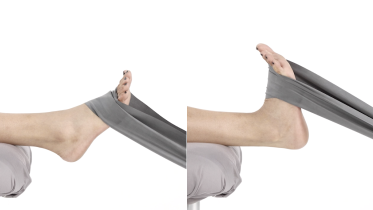
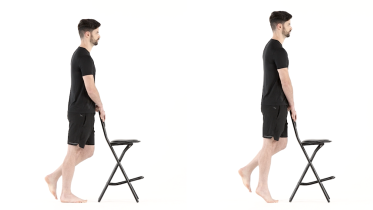
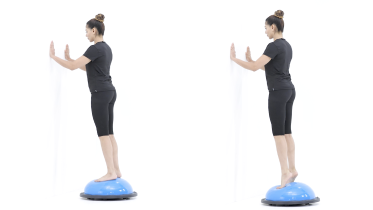
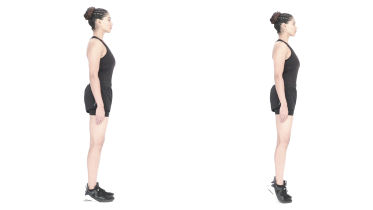
Eccentric calf raise
An eccentric calf raise is all about the way down. You rise onto your toes on both feet, lift one foot away, then lower yourself slowly on the other leg. It is often part of rehab for Achilles tendon pain, since the slow lowering loads the calf and tendon in a controlled way.
How to do the eccentric calf raise
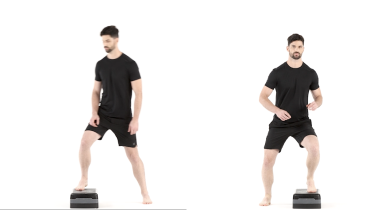
- Stand with your whole foot on a low, stable step and a sturdy chair or table in front of you. Rest a hand on the chair for balance, and keep it there throughout if you are unsteady. No step? The voice guide says flat floor works too.
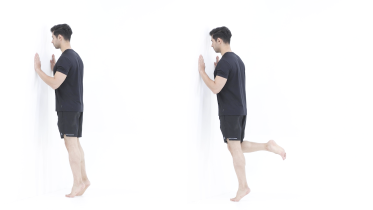
- Rise onto your toes on both legs, knees straight.
- At the top, bend the knee of your uninjured leg behind you so that foot comes off the step. All your weight is now on the leg you are working.
- Take a few seconds to lower the heel until it rests on the step again.
- Hold there for a moment.
- Put the other foot back down and rise on both legs again, so the working leg only ever does the lowering. In the video the other foot comes up first and the working leg rises on its own. That is the harder version. Save it for when your physio says you are ready.
What you should feel
Effort in the calf of the working leg, mostly on the slow way down. Many Achilles programs accept mild discomfort in the tendon during this exercise, as long as it settles within a day and is no worse the next morning. Your physio will tell you how much is fine in your case.
Common mistakes
- Rising on the working leg alone. Up on two, down on one.
- Dropping the heel. The lowering should take a few seconds.
- Bending the knee of the working leg as you lower, unless your physio has asked for a bent knee version.
- Leaning heavily on the chair so the calf does very little.
How often
2 to 3 sets of 10 to 15 slow lowerings, once or twice a day, is a common place to start. Later on, many programs add weight such as a backpack. Your physio will set the numbers, the speed and how much discomfort is acceptable for you.
Stop and check with your physio if
- A sudden sharp pain in the Achilles tendon or heel. Stop the set.
- A sudden pop or snap at the back of your ankle or heel, a feeling that someone kicked you there, or sudden pain there after which you cannot push off or rise onto your toes on that leg. Stop, take the weight off that leg carefully and go to an urgent care center or emergency department the same day, even if you can still walk, as this can be a torn Achilles tendon.
- Tendon pain that is clearly worse the next morning and still has not settled a day later.
- Your calf or thigh becomes swollen, warm, tender, red or darker than usual, or has a throbbing or cramping pain that feels different from normal muscle ache. Stop and get medical advice the same day, as this can be a blood clot. If you are also short of breath or have chest pain, call emergency services.
- You cannot stay balanced on the step, or the ankle gives way.
From the clinic
In the video the whole foot stays on the step, so the heel only comes down to step level. Some programs later move you to the edge with just the ball of the foot on the step, so the heel can sink below it for a bigger stretch at the bottom. That is not right for everyone. If your pain sits right where the tendon joins the heel bone, your physio will usually keep you at step level or on flat floor.
The voice guide says "injured leg", but the pattern is the same whichever side you work. Still finding the regular calf raise on both legs hard? Start there. After an Achilles tendon repair, this exercise only comes in at the stage your surgeon's protocol allows, so check with your physio rather than starting on your own.
Written and checked by the PocketPhysio editorial team. Last updated 2026-09-26.
This page is general education, not a diagnosis or a personal treatment plan. If you have pain, an injury or a health condition, see a physiotherapist or doctor before starting new exercises.