
Sever's disease exercises and advice for parents
What is Sever's disease?
The Achilles tendon connects the calf muscles to the back of the heel bone. In a child who is still growing, that part of the heel bone has a growth plate (the calcaneal apophysis), an area of softer bone that has not yet turned into solid bone. Every run and jump pulls on it through the tendon. Too much of that irritates the growth plate, and the heel gets sore and tender, sometimes a little swollen (OrthoInfo).
Doctors also call it calcaneal apophysitis. The word "disease" is misleading here. It is an overuse problem of growing bone, not an illness.
Most children with it are between about 8 and 15 (James and colleagues, 2013). It tends to start during a growth spurt, and children in running and jumping sports get it more often (OrthoInfo). It is common. Dutch family doctor records showed 3.7 cases for every 1,000 registered children and teenagers, and the authors think the real figure may be higher (Wiegerinck and colleagues, 2014).
Both heels can be affected, often one worse than the other. The pain usually comes with running, jumping and sport (OrthoInfo).
Why the heel needs checking first
A doctor or physical therapist (physiotherapist) should see the heel before your child starts any program. The diagnosis comes from what you and your child describe and from an examination, which includes pressing on the bottom and sides of the heel and may include watching your child walk, run or jump (OrthoInfo). An X-ray is sometimes taken to rule out other causes such as a broken bone, especially when only one heel hurts (Kothari and colleagues, 2023).
A few rarer problems cause heel pain in children too, and some need treating quickly, which is why the check matters (Kothari and colleagues, 2023). This page gives general information for families and cannot replace a plan made for your own child.
Is it Sever's disease, plantar fasciitis or Achilles tendinopathy?
All three cause heel pain, but they tend to affect different people. Sever's disease hurts at the growth plate, at the back and bottom of the heel, in a child who is still growing. Plantar fasciitis hurts under the heel and is worst with the first steps in the morning. Achilles tendinopathy hurts in the tendon itself, either above the heel or where the tendon joins it.
Both of those pages are written for adults. Once the heel bone has finished growing, Sever's disease cannot come back (OrthoInfo), so an adult with heel pain has something else.
Osgood-Schlatter disease is the same kind of growth plate problem, at the knee just below the kneecap. The advice on cutting back and rebuilding sport is much the same.
How is Sever's disease treated?
The aim is to settle the pain and swelling (OrthoInfo). In practice that means cutting down the running and jumping that set the heel off, a heel cushion or raise in the sports shoes, ice after activity, and pain relief if needed. OrthoInfo also recommends calf stretches, then leg strengthening once the pain is better. Some children need several months off sport. A few need a walking boot for a while to keep the foot still.
There is not much research, and what there is suggests children get better with any of the usual options. A trial of 101 children aged 8 to 15 compared waiting to see, a heel raise insert and a supervised exercise program. Heel pain fell clearly in all three groups over 3 months, and by the end none had done meaningfully better than the others (Wiegerinck and colleagues, 2016). Children given the heel raise were more satisfied at 6 weeks. The authors suggest that doctors, parents and children choose the treatment together.
Another trial, in 124 children aged 8 to 14, tested a simple heel raise against a ready-made shoe insert (orthosis), each with or without new shoes (James and colleagues, 2016). At 1 and 2 months the heel raise gave slightly better physical function. By 6 and 12 months there was no difference between any of the choices. A 2026 Cochrane review found 7 trials in Sever's disease and rated most of the evidence from its trials as low or very low in certainty (Williams and colleagues, 2026).
How to use this program
Begin with stage 1 unless your physio suggests otherwise. Your child can move up a stage once the exercises feel easy and the heel is no sorer the following morning. The stretches and strength exercises follow OrthoInfo's advice. The eccentric calf raise is one simple way to do the kind of exercise used in the Wiegerinck trial. Nobody has tested this exact program in a trial.
You will find a typical starting dose on each exercise page. Roughly, many programs hold each calf stretch for about 30 seconds and repeat it 2 to 3 times per leg, once or twice a day. For strength work, many programs begin with 2 to 3 sets of 8 to 20 repetitions. How often depends on the exercise, anywhere from a few days a week to once or twice a day.
Younger children do best with an adult nearby to keep each movement slow and controlled. Your physio will adjust the exercises and the numbers to suit your child's heel and sport.
In stage 1 the heel should feel comfortable. From stage 2 on, some mild heel discomfort while exercising is usually OK if it settles soon afterwards and the heel is no worse the next morning. Sharp pain, pain that builds with every repetition or a heel that is sorer the next day means the jump in difficulty was too big. Drop back to an easier version rather than stopping altogether.
The exercise program
Stage 1: Ease off sport and stretch the calf
This is the starting point for the first weeks, while your child cuts back on the running and jumping that hurts. OrthoInfo says stretching the calf may ease the stress on the heel, so begin with the two calf stretches, one with the knee straight and one with it bent. Go gently. Stop well before the heel hurts, since a hard stretch pulls on the sore growth plate too. Toe curls work the small muscles under the foot without any pounding through the heel.
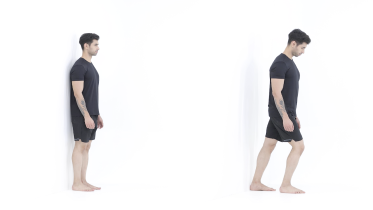 Calf stretch
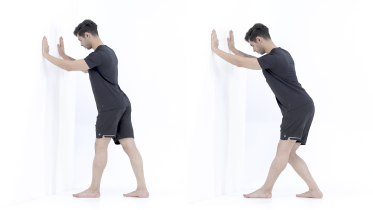 Soleus stretch
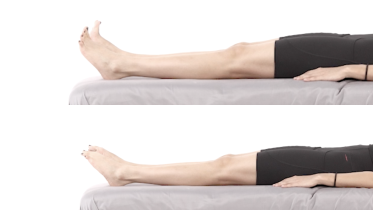 Toe curls
Stage 2: Strengthen the calf on both feet
Move on once walking and ordinary play are pain free and the heel feels no worse the morning after. OrthoInfo advises adding leg strengthening when the pain has eased. The seated calf raise comes first, then calf raises on both feet. Keep every repetition slow. The Wiegerinck trial used eccentric exercise, where the calf works while it lengthens, and the eccentric calf raise is an easy way to do this at home: go up on both feet and come down slowly on the sore side only, or on each side in turn if both heels hurt. Keep the whole foot on the step or floor. The heel comes down level with the step and never sinks below it.
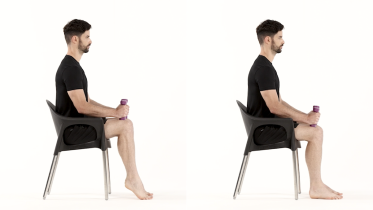 Seated calf raise
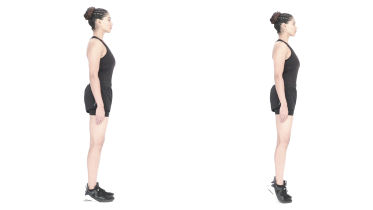 Calf raises
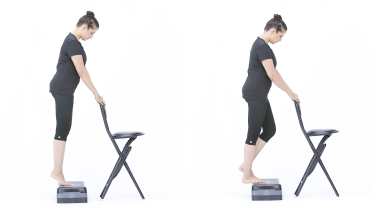 Eccentric calf raise
Stage 3: One leg at a time, then back to sport
Start here once calf raises on both feet are easy and any heel soreness has gone by the next morning. Running and jumping need a strong calf on each leg, so this stage uses heel raises on one leg, first with the knee straight, then with a slight bend at the knee. Low pogo hops on both feet are the first return to jumping. Wait until single leg heel raises are comfortable and the heel is no worse the next morning. Keep the hops small, and make them higher only a little at a time. Sport returns gradually during this stage, usually with training before full matches. Your physio can add running and landing drills for your child's sport.
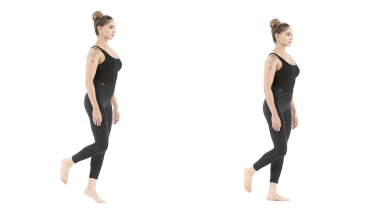 Single leg heel raise
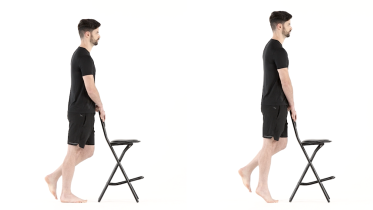 Bent-knee calf raise
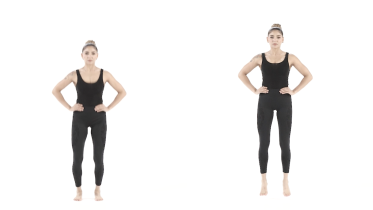 Pogo hops
Sport, PE and everyday activity
Treatment often means doing less exercise for a while. Even so, OrthoInfo notes that a child without much pain or a limp may be able to keep playing sport. Usually that means dropping the hardest running and jumping sessions for a time, not stopping everything. Swimming puts little load on the heel and keeps your child fit and with their friends. For school PE, ask the teacher whether your child can do less running and jumping for a few weeks.
Build sport back up slowly, adding one thing at a time. A training session comes before a full match, for example, and each time you check the heel the next morning. It is not unusual for Sever's disease to come back when a child steps up their sport again (OrthoInfo). If it does, go back a stage for a while instead of stopping everything.
Heel cups, shoes, ice and pain relief
A heel cushion or heel cup in the sports shoes can soak up some of the impact, and lifting the heel slightly may take pressure off the growth plate (OrthoInfo). In the James trial, a simple heel raise did at least as well as a ready-made orthosis, and new shoes made no clear difference (James and colleagues, 2016). So a pair that fits well and cushions the heel is usually enough. For heel pain in general, the NHS suggests wide, comfortable shoes with a low heel and a soft sole, and avoiding long spells of walking or standing, especially barefoot.
Ice can take the edge off the pain after sport. The NHS suggests holding an ice pack, or a bag of frozen peas wrapped in a towel, on the heel for up to 20 minutes every 2 to 3 hours (NHS Heel pain). OrthoInfo also mentions anti-inflammatory painkillers such as ibuprofen. Ask a pharmacist or doctor what pain relief and dose suit your child's age. Do not give aspirin to children under 16 unless a doctor prescribes it (NHS Aspirin).
How long does Sever's disease last?
There is no set timeline. Kothari and colleagues (2023) note that it can go on for up to 2 years, and it can flare again when training picks up (OrthoInfo). In the Wiegerinck trial, pain had dropped clearly by 3 months in all three groups. Once your child has stopped growing and the heel growth plate has turned into solid bone, Sever's disease does not come back (OrthoInfo).
When to see a physio or doctor
Get the heel checked before your child starts this program, so the cause is clear. Go back to the doctor or physio if 2 weeks of home treatment has not helped, if the pain is getting worse or keeps returning (NHS Heel pain), or if your child has missed sport or PE for weeks. A physio can look at the heel and calf, watch how your child runs, pick the right starting stage and work out a return to sport with you.
The warning signs below need faster help, and each one gives its own time frame. Keep a close eye on any limp. A limp when your child has not been doing sport, or pain in the hip, thigh or knee, means seeing a doctor the same day, because in a growing child a limp can come from a hip problem rather than the heel (NHS Irritable hip; OrthoInfo, Slipped Capital Femoral Epiphysis).
For physiotherapists
The Wiegerinck trial (2016) randomized 101 children aged 8 to 15 with at least 4 weeks of heel pain and a Faces Pain Scale-Revised score of 3 or more to wait and see, a heel raise inlay (ViscoHeel) or a physiotherapist-supervised eccentric exercise program, for 10 weeks. All three groups improved on every outcome, with no clinically relevant difference at 3 months. At 6 weeks the heel raise group was more satisfied and had better Oxford Ankle Foot Questionnaire child scores than wait and see, and the physiotherapy group had better parent scores.
James and colleagues (2016) ran a 2 x 2 factorial trial in 124 children aged 8 to 14: heel raise or prefabricated orthosis, with new or current footwear. The heel raise showed a main effect only in the physical domain of the Oxford questionnaire at 1 and 2 months, and there were no effects at 6 or 12 months. An earlier review found limited evidence from 9 studies, 3 of them randomized, and suggested orthoses gave more short-term relief than heel raises, while warning of methodological problems and short follow-up (James and colleagues, 2013). The later, larger James trial did not support that ranking. The 2026 Cochrane review included 7 calcaneal apophysitis trials and found moderate-certainty evidence of little to no difference in pain between foot orthoses and heel lifts, and very uncertain evidence for Kinesio tape against placebo.
Differentials worth ruling out: calcaneal stress fracture, bone infection (a child with bone pain and fever is treated as having osteomyelitis until proven otherwise), osteoid osteoma with night pain, and tarsal coalition (Kothari and colleagues, 2023). Kothari and colleagues also suggest X-rays when the pain is on one side only. Enthesitis-related arthritis can inflame tendons and ligaments as well as joints (OrthoInfo, Juvenile Arthritis), and slipped capital femoral epiphysis presents with a limp after activity and pain in the groin, hip, thigh or knee (OrthoInfo).
The night pain line follows NICE NG12. Recommendation 1.11.3 advises a very urgent (within 48 hours) direct access X-ray for unexplained bone pain or swelling in children and young people. Under 1.10.2 and 1.10.3, a child with unexplained petechiae is referred for immediate specialist assessment, and any of persistent or unexplained bone pain, pallor, persistent fatigue, unexplained fever, unexplained bruising or unexplained bleeding calls for a very urgent full blood count.
Kothari and colleagues note that a squeeze test helps separate a calcaneal stress fracture from other heel conditions, but the sides of the heel are also tender in Sever's disease, so the page does not offer it to parents.
See a doctor promptly if
- Your child is limping even when they have not been running or playing sport, the limp is getting worse, or they have pain in the hip, groin, thigh or knee as well as the heel. Get an urgent appointment with a doctor the same day, and keep them off sport and these exercises until they have been checked. If they cannot put weight on the leg, have a high temperature or seem very unwell, go to an emergency department. A limp after sport is common with Sever's disease, but some hip problems in growing children, such as a slipped growth plate at the top of the thigh bone (slipped capital femoral epiphysis), also cause a limp and need checking quickly.
- The heel pain started with a fall, a landing from a height or a twist, or with a sudden sharp pain, pop or snap at the back of the heel during sport, or your child cannot walk on tiptoe or put weight on the foot. Keep the weight off the foot and take them to an urgent care center or emergency department the same day, even if they can still walk. If the foot or ankle has changed shape or sits at an odd angle, or the foot turns cold, pale or blue, go to an emergency department straight away. This can be a broken bone or a torn tendon rather than Sever's disease.
- The heel pain keeps getting worse even after a break from running and jumping, ordinary walking becomes more painful instead of less, or the pain started after a sudden increase in training. Stop running and jumping, cut down on walking and standing, and see a doctor within a few days, as this can be a stress fracture of the heel bone. If walking hurts so much that your child limps, make it the same day. An X-ray can look normal for the first 2 to 3 weeks, so a normal early X-ray does not rule it out.
- The heel or foot is red, hot or swollen, or your child has heel pain with a fever or seems unwell. Get medical help the same day, and go to an emergency department if they seem very unwell. If your child has a very high or very low temperature, shivering they cannot control, is breathing very fast or finding it hard to breathe, is confused or their speech is slurred, their skin, lips or tongue look blue, gray, pale or blotchy (on brown or black skin this can be easier to see on the palms of the hands or soles of the feet), or they have a rash that does not fade when you press it, call emergency services, as this can be sepsis. In a child, bone pain with a fever can be a bone infection, which needs treatment quickly.
- Your child has numbness, tingling, burning or loss of feeling in the foot. Book an assessment with a doctor or physio in the next week or two.
- Pain that wakes your child at night, pain at rest that keeps getting worse, or a lump or swelling on the heel or ankle that keeps growing. See a doctor within a day or two. Do the same if the pain comes with looking pale, unusual tiredness, fevers with no clear cause, bruising or bleeding easily, or weight loss. If your child also has a rash that does not fade when you press it, call emergency services or go to an emergency department. Bone pain that is worse at night, or a new lump, needs checking to rule out rarer causes such as a bone tumor or a blood cancer (leukemia). If your child is being treated for cancer now, contact their cancer team the same day.
- Both heels hurt and your child also has swollen, warm or painful joints elsewhere, joint stiffness that is worst in the morning, or back pain. This is not an emergency, but see a doctor in the next week or two, as it can be a sign of arthritis in children (juvenile arthritis), which is best treated early. If your child also has a red, painful eye, get it checked the same day. If light hurts the eye, the eye turns very dark red, their sight changes, or they also have a severe headache and feel sick, go to an emergency department or emergency eye service straight away. Arthritis in children can also inflame the inside of the eye (uveitis), which can harm sight if it is not treated.
Common questions
How long does Sever's disease last?
It varies. A review of heel pain in children says it can last up to 2 years (Kothari and colleagues, 2023). OrthoInfo notes that it is not unusual for it to come back when a child increases their sport again. It stops for good once your child is fully grown and the heel growth plate has turned into solid bone. In the Wiegerinck trial, pain was clearly lower after 3 months whichever of the three treatments the children had.
Can my child still play sport with Sever's disease?
Often, yes, as long as the heel can cope. OrthoInfo says it may be safe to keep playing if your child does not have a lot of pain or a limp, though some children need several months off sport. The usual first step is to skip the training sessions with lots of running and jumping. A physio can help you judge how much your child can do.
What is the fastest way to heal Sever's disease?
Nothing has been shown to speed it up. In a trial of 101 children, pain came down clearly by 3 months whether they simply waited, wore a heel raise insert or did a supervised exercise program, and none of the three did meaningfully better by the end (Wiegerinck and colleagues, 2016). The heel raise group were more satisfied at 6 weeks. Less of the sport that hurts, a heel cushion and a gradual exercise program together make a sensible plan to talk through with your physio.
Do heel cups help Sever's disease?
They may, and they are easy to try. OrthoInfo says heel cushions in sports shoes can absorb impact and take some stress off the heel. In a trial of 124 children, a heel raise helped physical function a little more than a ready-made insole at 1 and 2 months. By 6 and 12 months the options did equally well (James and colleagues, 2016). Use them together with the changes to sport, not in place of them.
What shoes are best for Sever's disease?
Shoes that fit well and cushion the heel. The NHS heel pain advice suggests wide, comfortable shoes with a low heel and a soft sole, plus soft insoles or heel pads. One trial tested new shoes and found no clear benefit over the child's own shoes with a heel raise or insole (James and colleagues, 2016). While the heel is sore, the NHS also advises against long spells of walking or standing, especially barefoot.
References
- American Academy of Orthopaedic Surgeons. Sever's Disease (Heel Pain). OrthoInfo. https://www.orthoinfo.org/diseases--conditions/severs-disease/
- Wiegerinck JI, Zwiers R, Sierevelt IN, van Weert HC, van Dijk CN, Struijs PA. Treatment of Calcaneal Apophysitis: Wait and See Versus Orthotic Device Versus Physical Therapy: A Pragmatic Therapeutic Randomized Clinical Trial. Journal of Pediatric Orthopedics. 2016;36(2):152-157. https://doi.org/10.1097/BPO.0000000000000417
- James AM, Williams CM, Haines TP. Effectiveness of footwear and foot orthoses for calcaneal apophysitis: a 12-month factorial randomised trial. British Journal of Sports Medicine. 2016;50(20):1268-1275. https://doi.org/10.1136/bjsports-2015-094986
- James AM, Williams CM, Haines TP. Effectiveness of interventions in reducing pain and maintaining physical activity in children and adolescents with calcaneal apophysitis (Sever's disease): a systematic review. Journal of Foot and Ankle Research. 2013;6(1):16. https://doi.org/10.1186/1757-1146-6-16
- Williams CM, Krommes K, Paterson KL, Haines T, Caserta A, Thorborg K. Non-surgical treatment for lower limb apophyseal injuries. Cochrane Database of Systematic Reviews. 2026;(7):CD015156. https://doi.org/10.1002/14651858.CD015156.pub2
- Wiegerinck JI, Yntema C, Brouwer HJ, Struijs PA. Incidence of calcaneal apophysitis in the general population. European Journal of Pediatrics. 2014;173(5):677-679. https://doi.org/10.1007/s00431-013-2219-9
- Kothari EA, Padgett AM, Young SM, Ray J, Shah A, Conklin MJ. A Review of Pediatric Heel Pain. Cureus. 2023;15(1):e34228. https://doi.org/10.7759/cureus.34228
- NHS. Heel pain. Page last reviewed 24 October 2025. https://www.nhs.uk/symptoms/foot-pain/heel-pain/
- NHS. Hip pain in children (irritable hip). Page last reviewed 3 April 2024. https://www.nhs.uk/symptoms/hip-pain-children-irritable-hip/
- American Academy of Orthopaedic Surgeons. Slipped Capital Femoral Epiphysis. OrthoInfo. https://www.orthoinfo.org/diseases--conditions/slipped-capital-femoral-epiphysis-scfe
- American Academy of Orthopaedic Surgeons. Juvenile Arthritis. OrthoInfo. https://www.orthoinfo.org/diseases--conditions/juvenile-arthritis/
- NHS. Symptoms of bone cancer. Page last reviewed 20 May 2025. https://www.nhs.uk/conditions/bone-cancer/symptoms/
- National Institute for Health and Care Excellence. Suspected cancer: recognition and referral (NG12). Published 23 June 2015, last updated 15 April 2026. https://www.nice.org.uk/guidance/ng12
- NHS. Red eye. Page last reviewed 27 October 2025. https://www.nhs.uk/symptoms/red-eye/
- NHS. Sepsis. Page last reviewed 14 May 2026. https://www.nhs.uk/conditions/sepsis/
- NHS. Aspirin for pain relief. https://www.nhs.uk/medicines/aspirin-for-pain-relief/
Written and checked by the PocketPhysio editorial team. Last updated 2026-09-29.
This page is general education, not a diagnosis or a personal treatment plan. See a physiotherapist or doctor for advice about your own situation.