
Osgood-Schlatter disease exercises and advice for teens
What is Osgood-Schlatter disease?
The big muscle at the front of the thigh (quadriceps) pulls on the kneecap tendon, which attaches to a bony bump at the top of the shin (tibial tubercle). While a child is still growing, that bump has a growth plate in it, a patch of softer bone that is still developing. All the pulling from running and jumping irritates the growth plate, so the bump gets painful and tender to touch, and it often swells (OrthoInfo). Whatever the name suggests, this is not an infection or an illness. Growing bone is simply getting more pull than it can cope with for a while.
It mostly affects active children and young teenagers in a growth spurt, and it is most common in sports with a lot of running and jumping (OrthoInfo). In a Dutch study of family doctor records, it was more common in boys than girls, and new cases peaked at about age 12 in boys and 11 in girls (van Leeuwen and colleagues, 2022). Some children have it in both knees. One review counted 937 affected knees in 747 young people (Neuhaus and colleagues, 2021).
Get it checked before starting
Before your child starts any program, have a doctor or physical therapist (physiotherapist) look at the knee. Most of the time the diagnosis comes from what your child describes and from pressing on the bump, which will be tender. An X-ray is not usually needed (OrthoInfo).
The visit still matters, because other problems can cause knee pain at this age. Some hip problems, for example, can be felt in the knee or thigh (OrthoInfo, Slipped Capital Femoral Epiphysis). What follows is general information for families. It is not a plan written for your child.
Is it Osgood-Schlatter, patellar tendinopathy or patellofemoral pain?
These three all cause pain at the front of the knee, and they are easy to confuse. With Osgood-Schlatter, the sore spot is the bony bump on the shin a little below the kneecap, and the child is still growing. Patellar tendinopathy hurts in the tendon itself, just under the kneecap, and that page is aimed at adults in jumping sports. If a growing child is sore right at the lower tip of the kneecap, it may be Sinding-Larsen-Johansson disease, a similar growth plate problem. A physio or doctor can tell the two apart.
Patellofemoral pain is more of an ache around or behind the kneecap. Stairs, squatting and sitting for a long time tend to bring it on. It is common in teenagers, but that page is written for those aged 16 and over. If your child's pain is around the kneecap rather than on the bump below it, ask the physio which program fits.
How is Osgood-Schlatter disease treated?
Physios call the usual approach load management. Your child does less of the running and jumping that flare the knee while the pain settles, then builds strength before sport comes back in steps. OrthoInfo lists rest or cutting back activity when the pain is bad, ice, pain relief, thigh stretches and a strap below the kneecap. Surgery is rarely needed.
The research on any single treatment is thin. A 2026 Cochrane review found only three trials in Osgood-Schlatter disease, all testing injections or a steroid medicine delivered through the skin with a small electric current, and rated the evidence as very low certainty (Williams and colleagues, 2026). A 2021 review found that stretching seemed to help in some studies, but no randomized trial had compared specific exercises with usual care or a sham (Neuhaus and colleagues, 2021). A randomized trial of exercise, education and activity changes against usual care has been set up (Krommes and colleagues, 2024). The Cochrane review lists it as ongoing, and no results have been published yet.
The best guide to an exercise program so far comes from a study by Rathleff and colleagues (2020). It followed 51 young people aged 10 to 14 who had had knee pain for about 21 months on average. For the first 4 weeks they stopped sport and painful activities and did static thigh holds and bridges each day. Over the next 8 weeks they moved through three levels of knee strengthening and followed a step-by-step plan back to sport. They had to manage a squat with little pain before moving further along that plan.
At 12 weeks, 80% said they were better, but only 16% were back playing sport. By 12 months, 90% reported a good result and 69% were back in sport. The study had no comparison group, so the authors say they cannot separate the effect of the program from natural recovery (Rathleff and colleagues, 2020). Still, the authors point out that these children had been in pain for 21 months on average, which makes a quick natural recovery less likely.
How to use this program
Begin at stage 1 unless your physio picks a different starting point. Go up a stage once the current one feels easy and the knee is not sorer the morning after. The program follows the pattern of the Rathleff study, but not its exact exercise list, which is in the study's appendix. The hip exercises and stretches come from common practice for front of knee pain and from the usual advice to stretch the thigh (OrthoInfo), rather than from a trial in Osgood-Schlatter disease. Younger children tend to manage better if an adult stays close by and keeps each movement slow and controlled.
The exercise pages each list a typical starting dose. For the strength exercises, many programs use 2 to 3 sets of 6 to 15 repetitions. Quad sets are often about 10 holds of 5 to 10 seconds, several times a day, and wall sits 3 to 5 holds of 10 to 30 seconds. Stretches are usually held for 20 to 30 seconds, 2 to 4 times.
The Rathleff study used 10 static holds of 30 seconds, done daily. Your physio will adjust this.
In stage 1, nothing should hurt at the bump. From stage 2 on, a little discomfort there during exercise is usually fine, as long as it fades soon afterwards and the knee is no worse the next morning. OrthoInfo describes the aim as a dull ache at most, one that goes away quickly once the activity is over. If the pain is sharp, gets worse with every repetition, or the knee is sorer the next day, that step up was too big. Go back to an easier version, without stopping everything.
The exercise program
Stage 1: Settle the knee and keep the muscles working
Use this stage for the first few weeks, while your child eases off the sprinting and jumping that hurt. Start with quad sets, a gentle held tightening of the thigh with the leg straight, and the glute bridge, much like the static thigh holds and bridges in the Rathleff study. Add the wall sit once quad sets feel easy, starting high on the wall at a depth where the bump does not hurt. If even a shallow wall sit hurts the bump, stay with quad sets for now. The side-lying hip exercises and the thigh stretches are not from the study, but physios often add them. Go gently with the stretch for the front of the thigh. Pulled hard, it tugs on the tendon and the sore bump.
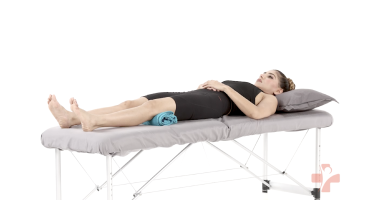 Quad sets (towel under knee)
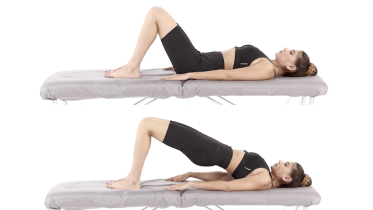 Glute bridge
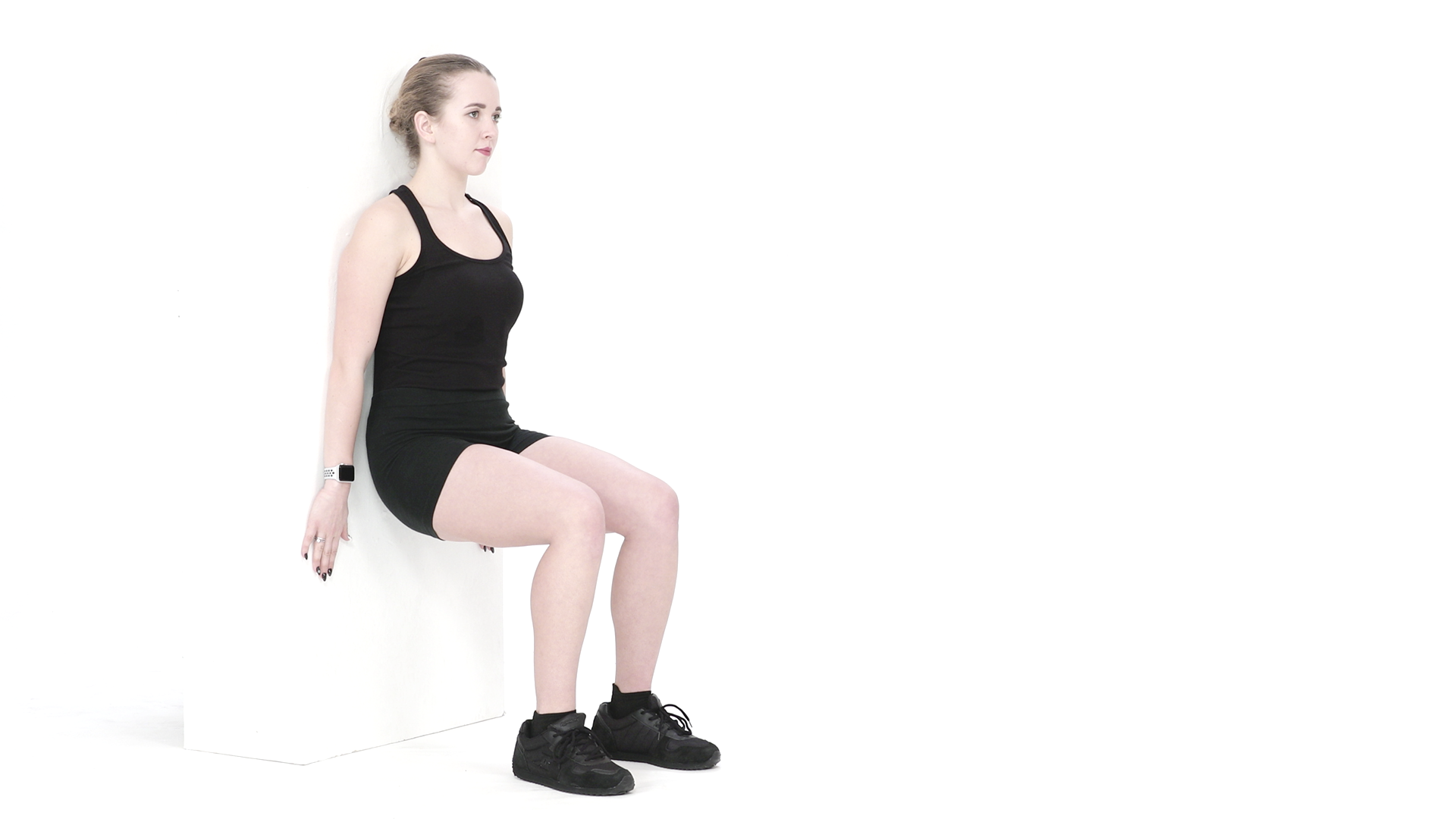 Wall sit
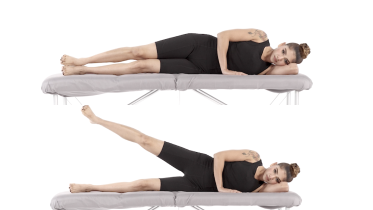 Side lying hip abduction
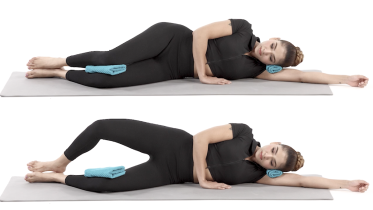 Clamshell
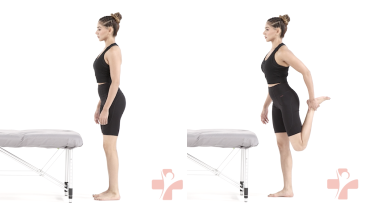 Standing quad stretch
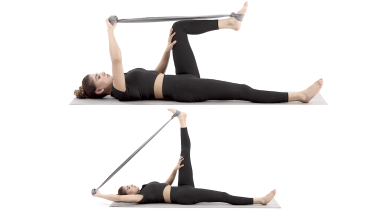 Supine hamstring stretch
Stage 2: Build strength standing up
Move here once stage 1 feels comfortable and the knee is not sorer the morning after. The squat matters most. In the Rathleff study, young people had to manage a squat with little pain before they moved further along the step-by-step plan back to sport. Begin with the mini squat, then squat a little deeper each week if the bump allows. For the step up, pick a step no higher than a normal stair, and watch that the knee points over the second toe.
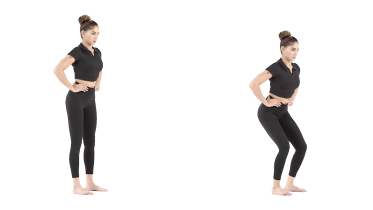 Mini squat
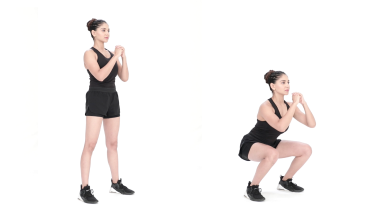 Squat
Squat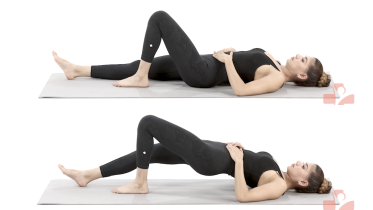 Single leg bridge
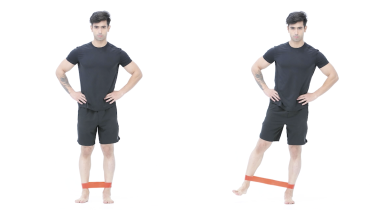 Standing hip abduction with band
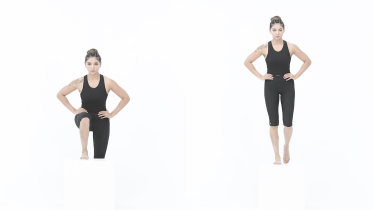 Step up
Stage 3: Single leg strength and a return to sport
Start this stage when squats and step ups are easy and any soreness at the bump has gone by the next morning. In the Rathleff study, the knee exercises built up from static holds to lunges. Keep the back knee off the floor in both exercises. Kneeling presses right on the bump, and that is what hurts. Sport comes back during this stage a little at a time, with training sessions before full matches. A physio can plan the running and jumping drills that your child's sport calls for.
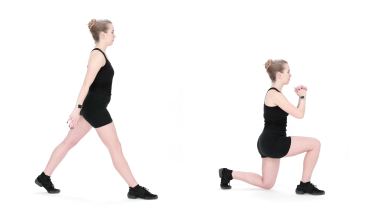 Split squat
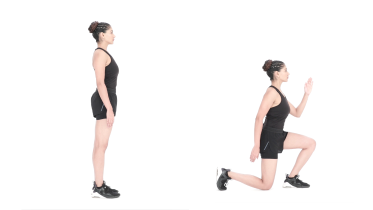 Reverse lunge
Sport, school and daily activity
Two sources give slightly different advice, and both are reasonable. OrthoInfo says it is safe for children to take part in activities as tolerated, and that carrying on will not cause long-term damage to the knee. A child who is limping or has a lot of pain even at rest may need to limit exercise for a short time. The Rathleff study paused painful sport for 4 weeks and then brought it back one step at a time.
The usual middle path is to drop the sessions with the most sprinting and jumping for a while, and stay active in other ways. Swimming, or anything else that leaves the bump alone, keeps them fit and still seeing their friends. Bring sport back one piece at a time, usually a training session before a full match. How the knee feels the next morning tells you whether that step was the right size. For school PE, talk to the teacher about adjusting the most painful activities for a while.
Ice, pain relief and knee straps
After sport, ice often takes the edge off the pain. OrthoInfo suggests a cold pack for 20 minutes at a time, several times a day. The NHS knee pain page gives more detail: a bag of frozen peas or an ice pack wrapped in a tea towel, for up to 20 minutes every 2 to 3 hours (NHS Knee pain).
For pain relief, OrthoInfo mentions anti-inflammatory medicines like ibuprofen. Check with a pharmacist or doctor which one to use and the right dose for your child's age. Do not give aspirin to children under 16 unless a doctor prescribes it (NHS Aspirin).
A strap worn around the tendon just below the kneecap is another option in OrthoInfo, but it has little research behind it. Injections are not a first choice: the Cochrane review found the evidence for them very uncertain (Williams and colleagues, 2026).
How long does Osgood-Schlatter disease last?
It often settles once the growth spurt is over, at around age 14 in girls and 16 in boys (OrthoInfo). Not always, though. In a Danish study that followed 51 young people for 2 years, just over a third (37%) still had knee pain from Osgood-Schlatter disease at the end (Holden and colleagues, 2021).
Until your child stops growing, the pain can come and go with growth and with busy sports seasons. The bump itself tends to stay, and it may get a little bigger over that time. That is normal and does not mean the problem is getting worse.
When to see a physio or doctor
Have a doctor or physio confirm the cause before your child starts this program. Go back if the pain is not improving within a few weeks (NHS Knee pain), or if it keeps your child from sport, PE or sleep. At that visit a physio can examine the knee and hip, choose the stage to start from and work out the return to sport with you.
The warning signs further down need help sooner, and each one says how soon. A new limp, or hip or thigh pain on top of the knee pain, needs a doctor the same day. Some hip problems in growing children show up as knee pain (NHS Irritable hip; OrthoInfo, Slipped Capital Femoral Epiphysis).
For physiotherapists
The family program here is modelled on the load management approach tested by Rathleff and colleagues (2020): 4 weeks of activity modification with daily quadriceps static holds (10 x 30 seconds) and bridges, then 8 weeks of home knee strengthening in three progression levels, with the squat as the gatekeeper for the activity ladder and graded return to sport. Mean age was 12.7 years and mean symptom duration 21 months; at 12 weeks, knee extension strength rose by 32% and hip abduction strength by 24%. The published text describes the knee exercises as progressing from isometric holds to lunges, with sets and repetitions in its appendix, which this page does not reproduce; the exercise list here follows the pattern, not the appendix. The design was uncontrolled, and at 24 months 37% of the cohort still reported knee pain from Osgood-Schlatter disease (Holden and colleagues, 2021).
The SOGOOD protocol from the same research group spells out the knee loading more fully: a mild isometric knee press at about 75 degrees of knee flexion in the first month, then weight-bearing wall squats at about 90 degrees, then lunges, progressed only while pain stays at or below 2 out of 10 during exercise and up to the next morning (Krommes and colleagues, 2024). That is why stage 1 here starts with quad sets and adds the wall sit only when it does not hurt the bump.
Evidence for other conservative treatments is limited. Neuhaus and colleagues (2021) found 13 studies, only two randomized, of poor to moderate quality. The 2026 Cochrane review on apophyseal injuries included three tibial tubercle trials, all of dextrose injection or dexamethasone iontophoresis, with very low certainty evidence, and lists the SOGOOD trial (Krommes and colleagues, 2024) as ongoing, with no results yet.
Differentials worth ruling out in this age group: slipped capital femoral epiphysis presenting as knee pain with a limp after activity (AAOS OrthoInfo), Sinding-Larsen-Johansson disease, patellofemoral pain, bone tumors when there is night pain or an enlarging mass (NHS Bone cancer), and leukemia when bone pain comes with pallor, fatigue, unexplained fever, bruising or bleeding. NICE NG12 advises considering a very urgent direct access X-ray, within 48 hours, for unexplained bone swelling or pain in children and young people, a very urgent ultrasound for an unexplained lump that is increasing in size, and a very urgent full blood count for persistent or unexplained bone pain or the other leukemia signs, with immediate specialist assessment for unexplained petechiae. That is why the page sets a day or two for these signs rather than the few days used on adult pages. Acute pain with loss of active knee extension after a jump or sprint suggests a tibial tubercle avulsion fracture, which mostly affects adolescent boys in jumping and sprinting sports; prior Osgood-Schlatter disease is a suggested predisposing factor (Cole and colleagues, 2020; Yao and colleagues, 2025).
See a doctor promptly if
- Your child or teenager is still growing and has a limp, or pain in the hip, groin or thigh as well as the knee. Get an urgent appointment with a doctor the same day, and keep them off sport and these exercises until they have been checked. If they cannot put weight on the leg, have a high temperature or feel very unwell, go to an emergency department. Some hip problems in growing children and teenagers, such as a slipped growth plate at the top of the thigh bone (slipped capital femoral epiphysis), are felt in the knee and need checking quickly.
- A sudden sharp pain, pop or snap below the kneecap while jumping, landing or sprinting, and then your child cannot straighten the knee, lift the leg out straight or put weight on it, or the knee swells quickly. Keep the weight off the leg and go to an emergency department straight away. This can be a break where the bump at the top of the shin pulls away (tibial tubercle avulsion fracture). It is rare, and a history of Osgood-Schlatter disease may make it more likely.
- The pain started with a fall, a twist or a blow to the knee, or you cannot put weight on the leg. Get medical advice the same day. If the knee has changed shape, swelled up very quickly or you felt a pop or snap, or your foot turns cold, pale or blue or you have tingling or no feeling in the leg or foot, go to an emergency department straight away, and do not drive yourself.
- The kneecap has slipped out of place, even if it went back by itself. If it is still out of place, go to an emergency department straight away, and do not drive yourself. If it went back by itself, get medical advice the same day.
- The knee is hot, red and swollen, or you have knee pain with a high temperature or feel hot, cold or shivery. Get medical advice the same day, and go to an emergency department if you feel very unwell. This can be a sign of infection in the joint, which needs treatment quickly. In a child, bone pain with a fever can be a bone infection, which needs treatment quickly. If you have a very high or very low temperature, shivering you cannot control, you are breathing very fast or finding it hard to breathe, you are confused or your speech is slurred, your skin, lips or tongue look blue, gray, pale or blotchy (on brown or black skin this can be easier to see on the palms of the hands or soles of the feet), or you have a rash that does not fade when you press it, call emergency services, as this can be sepsis.
- The knee locks and you cannot straighten it, or it keeps giving way under you. Get medical advice the same day.
- The knee swells up with no clear reason. Get medical advice the same day.
- Pain that wakes your child at night, pain at rest that keeps getting worse, or a lump or swelling around the knee or thigh that keeps growing and is not the hard bump just below the kneecap. See a doctor within a day or two. Do the same if the pain comes with looking pale, unusual tiredness, fevers with no clear cause, bruising or bleeding easily, or weight loss. If your child also has a rash that does not fade when you press it, call emergency services or go to an emergency department. Bone pain that is worse at night, or a new lump, needs checking to rule out rarer causes such as a bone tumor or a blood cancer (leukemia). If your child is being treated for cancer now, contact their cancer team the same day.
Common questions
How long does Osgood-Schlatter disease last?
It varies, and it can last a long time. The American Academy of Orthopaedic Surgeons says most symptoms go completely once the growth spurt is over, at around age 14 in girls and 16 in boys (OrthoInfo). That is not true for everyone: in a Danish study of 51 young people, just over a third still had knee pain from it 2 years later (Holden and colleagues, 2021). In the Rathleff study, the young people had already had pain for about 21 months on average. After 12 weeks of a load management program, 80% felt better, but most took longer to get back to their sport.
Can my child keep playing sport with Osgood-Schlatter?
Usually, as long as the amount is something the knee can cope with. OrthoInfo says it is safe to take part in activities as tolerated and that carrying on will not cause long-term damage to the knee, although a child who is limping or has a lot of pain even at rest may need to cut back for a short time. In the Rathleff study, painful sport was paused for 4 weeks and then brought back in steps. A physio can help you work out how much is right for your child.
Will the bump below the knee go away?
Usually not completely. The pain settles as growth finishes, but OrthoInfo notes that the bump stays and can get a little bigger until the child stops growing. A bigger bump on its own does not mean the problem is getting worse. A lump that grows quickly, feels soft or sits somewhere else around the knee is different and needs a doctor's check.
Does a knee strap help Osgood-Schlatter?
It may help some children. OrthoInfo lists a strap worn just below the kneecap (a patellar tendon strap) among the treatment options, but there is little research on it. It is worth a try as an extra, on top of the exercises and the changes to sport, never as a replacement for them.
Should you stretch with Osgood-Schlatter?
Stretching the front and back of the thigh is part of the usual advice, and OrthoInfo suggests doing it 3 to 4 times a day. A systematic review found that stretching seemed to help in some studies, but no randomized trial had compared specific exercises with usual care or a sham (Neuhaus and colleagues, 2021). Keep the stretch gentle and stop short of pain at the bump.
References
- American Academy of Orthopaedic Surgeons. Osgood-Schlatter Disease (Knee Pain). OrthoInfo. https://www.orthoinfo.org/diseases--conditions/osgood-schlatter-disease-knee-pain/
- Rathleff MS, Winiarski L, Krommes K, Graven-Nielsen T, Holmich P, Olesen JL, Holden S, Thorborg K. Activity Modification and Knee Strengthening for Osgood-Schlatter Disease: A Prospective Cohort Study. Orthopaedic Journal of Sports Medicine. 2020;8(4):2325967120911106. https://doi.org/10.1177/2325967120911106
- Holden S, Olesen JL, Winiarski LM, Krommes K, Thorborg K, Holmich P, Rathleff MS. Is the Prognosis of Osgood-Schlatter Poorer Than Anticipated? A Prospective Cohort Study With 24-Month Follow-up. Orthopaedic Journal of Sports Medicine. 2021;9(8):23259671211022239. https://doi.org/10.1177/23259671211022239
- Neuhaus C, Appenzeller-Herzog C, Faude O. A systematic review on conservative treatment options for OSGOOD-Schlatter disease. Physical Therapy in Sport. 2021;49:178-187. https://doi.org/10.1016/j.ptsp.2021.03.002
- Williams CM, Krommes K, Paterson KL, Haines T, Caserta A, Thorborg K. Non-surgical treatment for lower limb apophyseal injuries. Cochrane Database of Systematic Reviews. 2026;(7):CD015156. https://doi.org/10.1002/14651858.CD015156.pub2
- Krommes K, Thorborg K, Clausen MB, Rathleff MS, Olesen JL, Kallemose T, Holmich P. Self-management including exercise, education and activity modification compared to usual care for adolescents with Osgood-Schlatter (the SOGOOD trial): protocol of a randomized controlled superiority trial. BMC Sports Science, Medicine and Rehabilitation. 2024;16(1):89. https://doi.org/10.1186/s13102-024-00870-0
- van Leeuwen GJ, de Schepper EI, Rathleff MS, Bindels PJ, Bierma-Zeinstra SM, van Middelkoop M. Incidence and management of Osgood-Schlatter disease in general practice: retrospective cohort study. British Journal of General Practice. 2022;72(717):e301-e306. https://doi.org/10.3399/BJGP.2021.0386
- Yao H, He Y, Li X, Shi M, Wang P, Zhang M, Zhang X, Liu X. Tibial tubercle avulsion fractures in children and adolescents. Pediatric Discovery. 2025;3(1):e2521. https://doi.org/10.1002/pdi3.2521
- Cole WW, Brown SM, Vopat B, Heard WMR, Mulcahey MK. Epidemiology, Diagnosis, and Management of Tibial Tubercle Avulsion Fractures in Adolescents. JBJS Reviews. 2020;8(4):e0186. https://doi.org/10.2106/JBJS.RVW.19.00186
- American Academy of Orthopaedic Surgeons. Slipped Capital Femoral Epiphysis. OrthoInfo. https://www.orthoinfo.org/diseases--conditions/slipped-capital-femoral-epiphysis-scfe
- NHS. Knee pain. Page last reviewed 21 December 2023. https://www.nhs.uk/symptoms/knee-pain/
- NHS. Hip pain in children (irritable hip). Page last reviewed 3 April 2024. https://www.nhs.uk/symptoms/hip-pain-children-irritable-hip/
- NHS. Osteomyelitis. Page last reviewed 16 August 2023. https://www.nhs.uk/conditions/osteomyelitis/
- NHS. Sepsis. Page last reviewed 14 May 2026. https://www.nhs.uk/conditions/sepsis/
- NHS. Aspirin for pain relief. https://www.nhs.uk/medicines/aspirin-for-pain-relief/
- NHS. Symptoms of bone cancer. Page last reviewed 20 May 2025. https://www.nhs.uk/conditions/bone-cancer/symptoms/
- National Institute for Health and Care Excellence. Suspected cancer: recognition and referral (NG12). Published 23 June 2015, last updated 15 April 2026. https://www.nice.org.uk/guidance/ng12
Written and checked by the PocketPhysio editorial team. Last updated 2026-09-29.
This page is general education, not a diagnosis or a personal treatment plan. See a physiotherapist or doctor for advice about your own situation.