Single leg bridge
A single leg bridge is a hip lift that puts most of the work on one leg. You lie on your back with one knee bent and the other leg straight on the floor, then push down through the bent leg's foot to lift your hips. It works the buttock and the back of the thigh on the bent side. Physios often bring it in once a two leg bridge feels easy.
How to do the single leg bridge
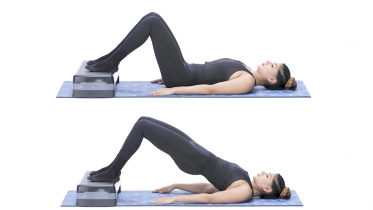
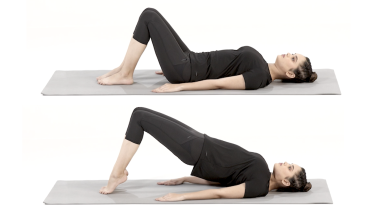
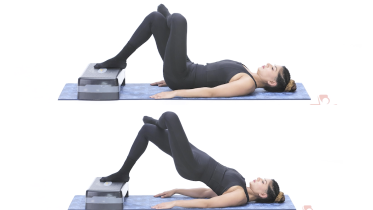
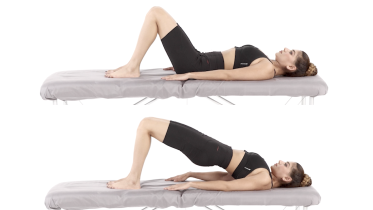
- Lie on your back on a mat. Bend one knee and put that foot flat on the floor. Keep the other leg straight and resting on the mat. Rest your hands on your stomach.
- Gently tighten your stomach and squeeze the buttock on the bent leg side.
- Push down through the foot of the bent leg and lift your hips off the mat. As in the video, the straight leg stays long and rests on the floor the whole time.
- Lift until your body makes a straight line from the bent knee to your shoulders. Keep both sides of your pelvis level so one hip does not drop.
- Hold for a moment, then lower your hips slowly back to the mat and repeat.
What you should feel
Work in the buttock and the back of the thigh on the bent leg side. Your lower back should not be the part doing the lifting.
Common mistakes
- Arching the lower back to get the hips higher. Stop when you reach a straight line.
- Letting the hip on the straight leg side drop, so the pelvis twists.
- Pushing mostly through the straight leg instead of the bent one.
- Dropping back down fast instead of lowering with control.
How often
Many programs start with 2 to 3 sets of 8 to 12 on each side, with a hold of 2 to 5 seconds at the top, a few days a week. Your physio will adjust this to suit you.
From the clinic
Going from two legs to one is not a step up in skill. It is a step up in load: the same lift, one side doing it. That is why it waits until a two leg bridge is genuinely easy, and why it sits in the later stages of programs for hamstring tendinopathy, patellofemoral pain and greater trochanteric pain.
Watch the straight leg. It is lying on the floor, so it can quietly join in, and someone who finds this version easy on the first try is often pressing down through that heel. Slide a hand palm up under that calf. If the leg presses into your hand as the hips rise, it is taking a share of the work.
The pelvis is the other thing to watch, and you cannot see it from where you are lying. A hand on each hip bone tells you straight away whether one side has sunk.
Cramp in the back of the thigh is a common complaint with this one. Bring the bent foot a little closer to your bottom and it usually settles. If you cannot keep your hips level yet, go back to the two leg glute bridge for a while.
There is a harder version, too. You lift the straight leg off the floor and hold it in line with the other thigh while you bridge. Your physio will tell you when you are ready for it.
Before you start
- After hip, knee or back surgery, single leg work starts when your surgeon's protocol allows it.
- Past the first trimester of pregnancy, ask your physio before doing exercises lying flat on your back.
When to stop and get help
- Sharp pain in the lower back, hip or knee, rather than the feeling of muscles working.
- Pain travels down the leg, or the leg goes numb or tingly.
Written and checked by the PocketPhysio editorial team. Last updated 2026-10-11.
This page is general education, not a diagnosis or a personal treatment plan. If you have pain, an injury or a health condition, see a physiotherapist or doctor before starting new exercises.