
Greater trochanteric pain syndrome exercises and physiotherapy
What is greater trochanteric pain syndrome?
Greater trochanteric pain syndrome is the name for pain over the bony point on the outside of your hip (the greater trochanter). The two muscles at the side of your hip, gluteus medius and gluteus minimus, attach there by tendons, and those tendons are now seen as a main local source of the pain (Grimaldi and colleagues, 2015). You may also hear it called gluteal tendinopathy, lateral hip pain or trochanteric bursitis.
The pain is usually felt on the outside of the hip, and the area is often tender to press. It can spread down the outer thigh. It tends to be worse lying on that side at night, and with tasks that load one leg, such as stairs or walking uphill. It is most common in mid-life, in people who play sport and people who do not, and it affects women more than men (Grimaldi and colleagues, 2015).
This page is for adults with outer hip pain that is being managed without surgery. It does not cover rehab after hip surgery. If you have had an operation on your hip, follow the program from your surgical team and physio instead.
Why education and exercise help gluteal tendinopathy
Tendons are thought to cope worst with two things at once: being squeezed against bone and being pulled hard (Grimaldi and colleagues, 2015). For the gluteal tendons, the squeeze happens when the thigh moves across the midline of the body (hip adduction), which presses the tendon against the bony point of the hip (Grimaldi and colleagues, 2015). So the treatment has two parts. You cut down on the positions that squeeze the tendon, and you build the muscles and tendons up with exercise that gets gradually harder.
The main trial of this approach is the LEAP trial from Australia (Mellor and colleagues, 2018). It included 204 people aged 35 to 70 who had had outer hip pain for more than 3 months, with the tendon problem confirmed on an MRI scan. One group had 14 physio sessions over 8 weeks, with education on avoiding positions that compress the tendons plus a daily home exercise program. A second group had a single steroid injection. The third had one session of general advice and was told to wait and see.
At 8 weeks, 51 of 66 people in the education and exercise group rated themselves as better, compared with 38 of 65 after the injection and 20 of 68 in the wait and see group. At 1 year, the education and exercise group still had better overall improvement than the injection group, though pain levels were similar by then. Hip strength changed only a little, and the authors suggest the advice about positions and daily activity may have helped people feel better.
A 2024 review of 6 trials with 733 people came to a similar view (Kjeldsen and colleagues, 2024). Compared with a control group (wait and see or a sham exercise), exercise slightly reduced hip pain over the long term and slightly improved function, and compared with steroid injections it gave better long-term overall improvement. The authors recommend exercise as the first treatment for this condition, while noting that the evidence comes from only a few trials.
Positions that squeeze the tendon, and what to do instead
The idea is to spend less time with the sore thigh pulled across the body. It sounds minor next to the exercises, but the LEAP authors think this advice may be part of why their program worked.
- Sitting: do not cross your legs or let one knee drift across the other. Avoid low chairs and sofas, and a wedge cushion can bring your hips a little higher than your knees.
- Standing: do not stand with your weight hung on one hip, with that hip pushed out to the side, as people often do while holding a child. Stand with your weight even on both feet.
- Lying: try not to lie on the sore side. Sleep on your back, or on your good side with a pillow between your knees so the top leg cannot drop across. From about 28 weeks of pregnancy the NHS advises going to sleep on your side rather than on your back, because going to sleep on your back in the last months is linked to a higher risk of stillbirth. So use your good side with a pillow between your knees, and leave lying on your back until after the birth. The NHS also says not to worry if you wake up on your back: settle onto your side again and carry on.
- Stretching: leave out stretches that pull the leg across the body, such as the IT band stretch and the piriformis stretch, unless your physio has a specific reason to use one.
- Walking and stairs: keep walks shorter for now and on flatter ground. On stairs, use the rail on the side opposite your sore hip and place your feet a little wider.
These points come from two NHS leaflets, from Cambridge University Hospitals and Kingston and Richmond, and they follow the same idea as the LEAP education, which taught people to avoid movements and positions that press the tendons against the bone (Mellor and colleagues, 2018). The LEAP program did not include outer hip stretches, which the trial team noted hold the hip in a compressed position (Mellor and colleagues, 2016).
How to use this program
Pick the stage that matches your hip today. If you are not sure, start at stage 1, and move up when the current stage feels easy and your hip is no worse the next morning. These signs are a rough guide from common practice, not fixed rules.
In the LEAP trial, people did 4 to 6 exercises at home every day alongside their physio sessions (Mellor and colleagues, 2018). The early holds in that program lasted about 5 to 15 seconds, and the effort built from light toward somewhat hard or hard over the 8 weeks (Mellor and colleagues, 2016). Most exercises were done as 1 set of 5 to 15 repetitions, many of them slow at about 3 seconds each way, and the harder single leg exercises built to 2 sets of 5 to 10 from week 3.
The Kingston and Richmond leaflet uses 8 to 15 repetitions of its bridges, squats and side steps, once a day. As a rough guide, start with 5 to 10 slow repetitions of each exercise and build over several weeks toward 1 to 2 sets of 8 to 15, with fewer repetitions of the single leg exercises. Your physio will adjust the exercises, the numbers and the effort to suit you.
A tired ache in the buttock and hip muscles while you exercise is normal, and it should settle soon after. Pain over the bony point on the outside of your hip is different. In the LEAP program, the bridging, squatting and stepping exercises were meant to cause no extra pain over that bony point, and the load was adjusted so pain did not build from week to week (Mellor and colleagues, 2016 and 2018).
If an exercise brings on that pain, make it smaller or easier. If the outside of your hip is clearly sorer the next day, or it keeps you awake that night, the load was too much. Drop back a step rather than stopping altogether.
Two exercises you may see in other hip programs are left out here. Side lying hip abduction loads the tendon hard, and if the top leg drops behind or below level at the start of each lift, it also squeezes it. The hip hike lets the pelvis drop on one side, which moves the standing hip into the compressed position. Physios sometimes add them late in rehab, once the hip is settled, so wait until yours suggests it.
Breathe normally through each hold and repetition rather than holding your breath, especially if you have high blood pressure.
The exercise program
Stage 1: Take the pressure off and start loading
For a hip that is sore to lie on or aches with walking, or if you are new to exercise. The isometric clamshell works the muscles at the side of the hip without the leg moving: lie on your good side with a pillow between your knees, so the sore hip is on top and the top knee cannot drop across. If lying on your sore side hurts, work only the sore hip, and if lying on either side hurts, use the standing hold from the LEAP trial instead (stand with your feet a little wider than your hips and gently press them outward into the floor, as if to slide them apart, without letting them move). For the bridge, keep your feet and knees hip width apart; in the side to side weight shift, move over the sore leg with your pelvis level and stop before that hip pushes out past your foot. Use a higher chair for sit to stand, and in the mini squat keep your knees apart and in line with your toes.
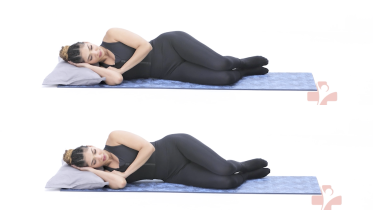 Isometric clamshell
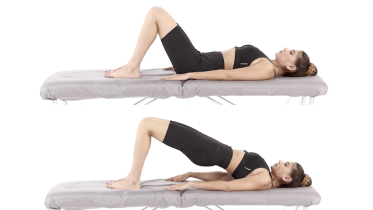 Glute bridge
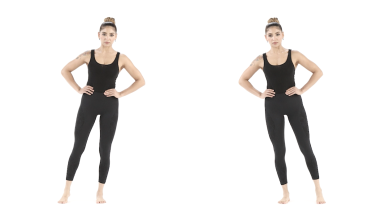 Side to side weight shift
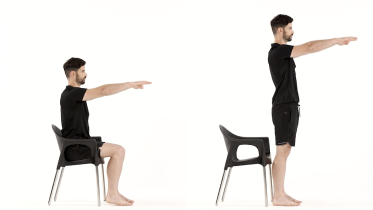 Sit to stand
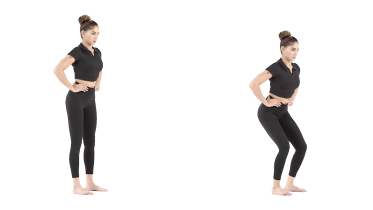 Mini squat
Stage 2: Build strength standing up
When stage 1 feels easy and your hip is no worse the next morning, move on to working the muscles at the side of the hip while you stand, which is what walking asks of them. Side stepping and standing hip abduction work both hips, the one that moves and the one you stand on, so keep your body upright rather than leaning to the side, and in side stepping bring your feet back only to about hip width, not right together. For the clamshell, lie on your good side with a thin pillow between your knees so the top leg does not drop across at the start, keep the top hip stacked over the bottom one, and work only the sore hip if lying on it hurts. Leave the clamshell out if it brings on pain over the bony point of your hip. In the step taps and single leg stance, stand tall on the sore leg with your pelvis level and do not let that hip slide out to the side; hold a counter if your balance is not steady.
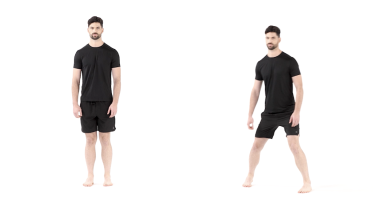 Side stepping
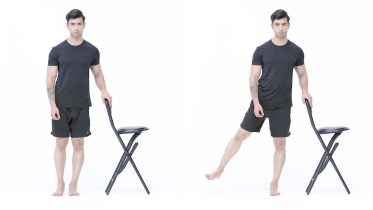 Standing hip abduction
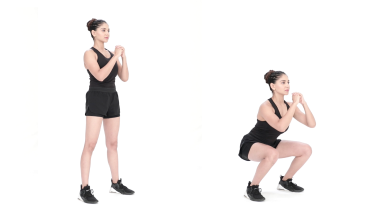 Squat
Squat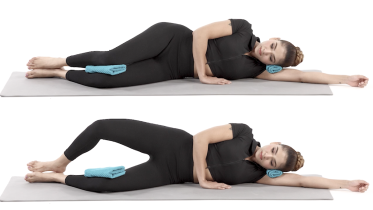 Clamshell
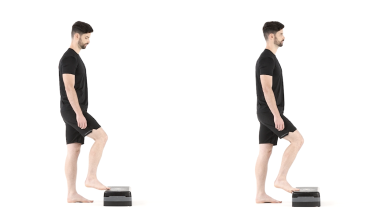 Step taps
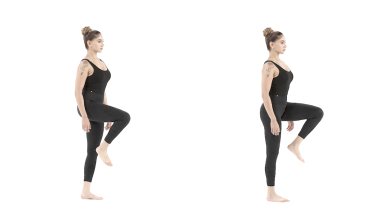 Single leg stance
Stage 3: Bands, one leg at a time and stairs
When stage 2 is comfortable and the hip settles well after sessions. The bands add load to the muscles at the side of the hip, and the single leg bridge, step up and backward step down train the hip for stairs and slopes. Start with a light band and a low step, and hold a rail or counter on the side opposite the working leg until you feel steady. Keep the working knee in line with your second toe, and do not let the knee roll inward or the opposite hip drop as you step. If one exercise flares the outside of your hip the next day, go back to the version from stage 2 for a week or so.
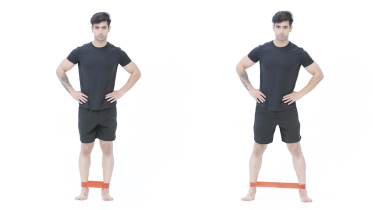 Lateral band walk
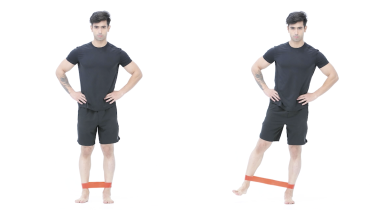 Standing hip abduction with band
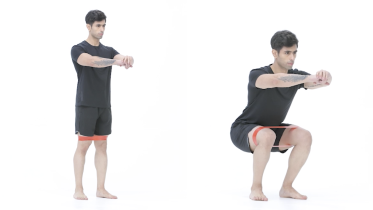 Banded squat
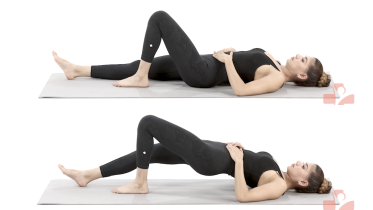 Single leg bridge
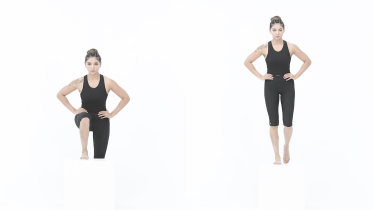 Step up
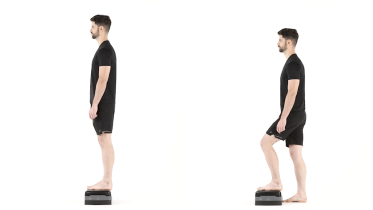 Backward step-down
Injections, shockwave and other treatments
Steroid injections can help with pain in the short term. In a Dutch trial of 120 people in primary care, more had recovered with an injection than with usual care at 3 months, but by 12 months there was no difference (Brinks and colleagues, 2011). In a trial of 229 people with long-standing outer hip pain, where people were placed in groups in turn rather than at random, the injection group did best at 1 month, but at 15 months both home exercise and shockwave therapy did better than the injection (Rompe and colleagues, 2009). The Cambridge University Hospitals leaflet adds that steroids may have negative effects on the health of some tendons.
So an injection may help you through a bad spell, but it does not replace the positions and exercises above. Shockwave therapy is another option some clinics offer, and surgery is kept for pain that does not improve with other treatment (Grimaldi and colleagues, 2015). Talk these options through with your doctor or physio.
For day-to-day pain, the NHS suggests paracetamol or an ibuprofen gel, and an ice pack wrapped in a towel for up to 20 minutes every 2 to 3 hours. Ask a pharmacist if you are not sure a medicine is safe for you.
When to see a physio or doctor
Book a routine appointment with a doctor or physio if outer hip pain is stopping you sleeping or doing normal activities, or if it has not improved after 2 weeks of looking after it at home (NHS). It is also worth an assessment if you are not sure the pain is coming from the hip tendons. Pain in the groin, or pain that spreads below the knee with numbness, often has another cause. If you have been doing the exercises regularly for 6 to 8 weeks and nothing has changed, a physio can check the diagnosis and adjust the program.
Some signs need help faster, from an emergency visit to an appointment within a couple of weeks. They are listed under the warning signs below.
For physiotherapists
This page gives patients a starting framework based on the LEAP education and exercise program (Mellor and colleagues, 2018). The protocol (Mellor and colleagues, 2016) describes low load isometric abduction in supine and standing in the first week, then functional loading through bridging and squatting progressions toward single leg work, and frontal plane abductor loading through sidestepping and band-resisted side slides. Effort was guided by the Borg scale: light (11 to 12) for the warm up, somewhat hard to hard (13 to 15) for functional retraining, and up to hard to very hard (14 to 17) for slow heavy abductor strengthening.
No increase in trochanteric pain was accepted during functional retraining. Pain up to 5 out of 10 was tolerated only in the slow heavy strengthening, which avoided tendon compression, and only if it eased afterwards and was no worse that night or the next morning. Hip stretches that hold the joint in adduction were not used.
The library has no supine or standing isometric abduction video, so the isometric clamshell stands in here, with a pillow between the knees to keep the top hip out of adduction, and the stage 1 text describes the LEAP standing hold for patients who cannot lie on either side. The Kingston and Richmond NHS leaflet starts with pushing out against a belt around the knees in supine, and the Cambridge leaflet uses belt holds in supine and sitting. The trial reports summarize the education only as detailed advice on tendon care and avoiding compressive positions; the specific positions on this page come from the two NHS leaflets. In LEAP sidestepping, the trailing foot returned only to hip width, not to feet together.
Grimaldi and colleagues (2015) describe excessive compression, particularly in hip adduction, combined with high tensile load as the most damaging combination. They propose a battery of compressive and tensile provocation tests for assessment, as there is no consensus on which clinical test is most useful. The Kjeldsen 2024 meta-analysis (6 trials, 733 patients) supports exercise as first-line care, with a long-term advantage over corticosteroid injection for global rating of change, though the authors note the small number of trials.
Screen for intra-articular hip pathology when groin pain or restricted hip flexion and rotation dominate, and for lumbar referral when pain spreads below the knee or comes with neurological signs. Ask about long-term corticosteroid use and heavy alcohol intake, which are risk factors for osteonecrosis of the femoral head (AAOS), and keep fracture in mind after any fall in older or osteoporotic patients.
See a doctor promptly if
- Emergency: you have had a fall or an injury and now have severe hip pain, or you cannot walk or put weight on the leg. Call emergency services or go to an emergency department. This can be a sign of a broken hip (hip fracture).
- Emergency: tingling or loss of feeling in the hip or leg after a fall or injury. Call emergency services or go to an emergency department.
- Emergency: pain, tingling, numbness or weakness in both legs, numbness or altered feeling around your genitals or bottom, or new trouble peeing or controlling your bladder or bowels. The same applies if you lose feeling in one leg. Call emergency services or go to an emergency department straight away. These can be signs of pressure on the nerves at the base of the spine (cauda equina syndrome).
- Same day: the hip is hot and swollen, the skin around it has changed color, or you have hip pain with a high temperature or feel hot, cold or shivery. Get medical help the same day, and go to an emergency department if you feel very unwell. A joint infection needs treatment quickly.
- Same day: severe hip pain that came on suddenly without a fall or injury. Get medical advice the same day.
- Same day: new hip or groin pain after a fall, even a small one, if you are older, have low bone density (osteoporosis) or have taken steroid tablets for a long time, even if you can still walk. Get medical advice the same day. A broken hip is not always obvious at first.
- Within a few days: hip pain at night or at rest that does not ease when you change position, and keeps getting worse. See your doctor within a few days. If you have had cancer, now or in the past, or are losing weight without trying, see your doctor sooner, within a day or two, and mention it. This applies even if the pain is not getting worse. If you are being treated for cancer now, contact your cancer team the same day.
- Within a few days: new pain in the groin or buttock, and you take steroid tablets long term, or have in the past, or you regularly drink a lot of alcohol. This can be a sign of a problem with the blood supply to the top of the thighbone (avascular necrosis). Book an appointment with your doctor within a few days and mention the steroids or alcohol.
- Same day: a leg or foot that is getting weaker, for example your foot drags, catches on the ground or slaps down when you walk (foot drop). Get medical advice the same day. If the weakness is getting worse by the hour, go to an emergency department.
- Same day: a child or teenager has sudden pain in the hip, thigh or knee, is limping, or cannot put weight on one leg. Get an urgent appointment with a doctor the same day. If they have a high temperature or seem very unwell, go to an emergency department. This page is for adults, and hip pain in children has different causes.
- Within 2 weeks: pain that spreads down the leg below the knee, especially with numbness or tingling in the leg or foot. The pain may be coming from your lower back rather than the hip tendons. Book an appointment with a doctor or physio.
- Within 2 weeks: the pain is mostly in the groin rather than on the outside of the hip, or the hip is stiff and hard to bend, for example when you put on socks. This points more toward the hip joint itself, such as hip osteoarthritis. Book an appointment with a doctor or physio so the cause can be checked.
Common questions
Is it trochanteric bursitis or gluteal tendinopathy?
For many people, it is mainly the tendons. Outer hip pain used to be called trochanteric bursitis, after the small fluid-filled sac (bursa) over the bony point of the hip. The tendons of the gluteus medius and gluteus minimus muscles are now recognized as a primary local source of the pain (Grimaldi and colleagues, 2015), which is why the umbrella name greater trochanteric pain syndrome is used. Treatment is similar either way: reduce the pressure on the area and build up the hip muscles.
What is the best sleeping position for outer hip pain?
Try lying on your back, or on your good side with a pillow between your knees. The pillow stops the top knee dropping across the bottom one, which squeezes the tendon on the top hip. Two NHS leaflets, from Cambridge University Hospitals and Kingston and Richmond, give this advice and suggest avoiding lying on the painful side. If both hips are sore, the Cambridge leaflet suggests sleeping on your back with pillows under your knees. From about 28 weeks of pregnancy the NHS advises going to sleep on your side rather than on your back, because going to sleep on your back in the last months is linked to a higher risk of stillbirth. So use your good side with a pillow between your knees, and leave lying on your back until after the birth. The NHS also says not to worry if you wake up on your back: settle onto your side again and carry on.
Should I stretch my hip if I have gluteal tendinopathy?
Usually not in the early stages. The common stretches for the outer hip, such as the IT band stretch and the piriformis stretch, pull the leg across the body, which presses the tendon hard against the bone. The LEAP trial team pointed out that these stretches hold the hip in a compressed position, and their program did not include them (Mellor and colleagues, 2016). The Cambridge University Hospitals leaflet also advises avoiding stretching. If a stretch feels good in the moment but the hip aches more that night or the next day, it is probably adding to the problem.
Is walking good for greater trochanteric pain syndrome?
Walking is usually fine, but the amount matters. The Cambridge University Hospitals leaflet suggests keeping walks shorter for a while and avoiding hills and stairs where you can. Several shorter walks on flat ground are often easier on the hip than one long one. On stairs, use the rail on the side opposite your sore hip and place your feet a little wider. Build the distance up again as the exercises get easier.
How long does gluteal tendinopathy take to heal?
Usually months. The Kingston and Richmond NHS leaflet says symptoms usually improve within 3 to 6 months. The Cambridge University Hospitals leaflet says the best results come after at least 12 weeks of exercise. In the LEAP trial, the exercise and education program ran for 8 weeks, and people in that group were still doing better overall than the injection group a year later (Mellor and colleagues, 2018).
Are steroid injections good for greater trochanteric pain syndrome?
They can ease pain for a while, but the benefit tends to fade. In a Dutch primary care trial, more people had recovered with an injection than with usual care at 3 months, but by 12 months the two groups were the same (Brinks and colleagues, 2011). In the LEAP trial, education plus exercise did better than an injection at 8 weeks and gave better overall improvement at 1 year, although pain levels were similar by then (Mellor and colleagues, 2018). The Cambridge University Hospitals leaflet also notes that steroids may have negative effects on the health of some tendons. Whether an injection suits you is a decision to make with your doctor.
References
- Mellor R, Bennell K, Grimaldi A, Nicolson P, Kasza J, Hodges P, Wajswelner H, Vicenzino B. Education plus exercise versus corticosteroid injection use versus a wait and see approach on global outcome and pain from gluteal tendinopathy: prospective, single blinded, randomised clinical trial. BMJ. 2018;361:k1662. https://doi.org/10.1136/bmj.k1662
- Mellor R, Grimaldi A, Wajswelner H, Hodges P, Abbott JH, Bennell K, Vicenzino B. Exercise and load modification versus corticosteroid injection versus 'wait and see' for persistent gluteus medius/minimus tendinopathy (the LEAP trial): a protocol for a randomised clinical trial. BMC Musculoskeletal Disorders. 2016;17:196. https://doi.org/10.1186/s12891-016-1043-6
- Grimaldi A, Mellor R, Hodges P, Bennell K, Wajswelner H, Vicenzino B. Gluteal Tendinopathy: A Review of Mechanisms, Assessment and Management. Sports Medicine. 2015;45(8):1107-1119. https://doi.org/10.1007/s40279-015-0336-5
- Kjeldsen T, Hvidt KJ, Bohn MB, Mygind-Klavsen B, Lind M, Semciw AI, Mechlenburg I. Exercise compared to a control condition or other conservative treatment options in patients with Greater Trochanteric Pain Syndrome: a systematic review and meta-analysis of randomized controlled trials. Physiotherapy. 2024;123:69-80. https://doi.org/10.1016/j.physio.2024.01.001
- Brinks A, van Rijn RM, Willemsen SP, Bohnen AM, Verhaar JA, Koes BW, Bierma-Zeinstra SM. Corticosteroid injections for greater trochanteric pain syndrome: a randomized controlled trial in primary care. Annals of Family Medicine. 2011;9(3):226-234. https://doi.org/10.1370/afm.1232
- Rompe JD, Segal NA, Cacchio A, Furia JP, Morral A, Maffulli N. Home training, local corticosteroid injection, or radial shock wave therapy for greater trochanter pain syndrome. American Journal of Sports Medicine. 2009;37(10):1981-1990. https://doi.org/10.1177/0363546509334374
- Cambridge University Hospitals NHS Foundation Trust. Gluteal tendinopathy. Patient information. Approved 14 January 2025. https://www.cuh.nhs.uk/patient-information/gluteal-tendinopathy/
- Kingston and Richmond NHS Foundation Trust. Greater trochanteric pain syndrome. Patient leaflet. Last updated 9 December 2024. https://www.kingstonandrichmond.nhs.uk/patients-and-families/patient-leaflets/greater-trochanteric-pain-syndrome
- NHS. Hip pain in adults. Page last reviewed 20 November 2025. https://www.nhs.uk/symptoms/hip-pain/
- NHS. Sciatica. Page last reviewed 3 December 2024. https://www.nhs.uk/conditions/sciatica/
- American Academy of Orthopaedic Surgeons. Osteonecrosis of the hip. OrthoInfo. https://www.orthoinfo.org/en/diseases--conditions/osteonecrosis-of-the-hip/
- NHS. 27 weeks pregnant: the best sleeping positions during pregnancy. Best Start in Life week by week guide. https://www.nhs.uk/best-start-in-life/pregnancy/week-by-week-guide-to-pregnancy/2nd-trimester/week-27/
Written and checked by the PocketPhysio editorial team. Last updated 2026-09-30.
This page is general education, not a diagnosis or a personal treatment plan. See a physiotherapist or doctor for advice about your own situation.