Clamshell
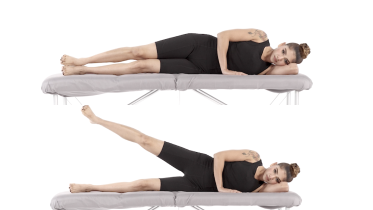
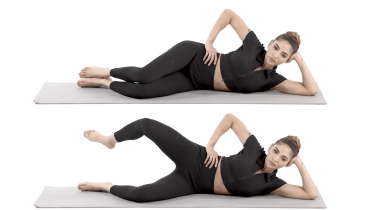
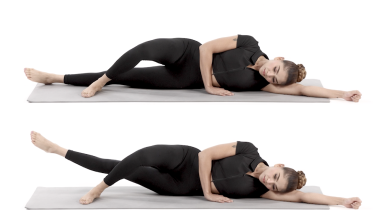
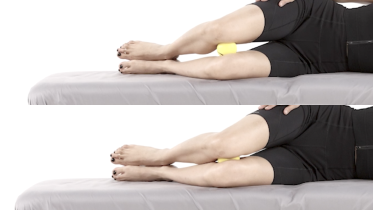
The clamshell strengthens the muscles at the side and back of your hip. You lie on your side with your knees bent and open your top knee like a shell, keeping your feet together.
How to do the clamshell
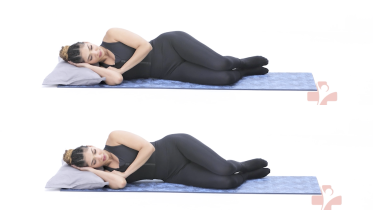
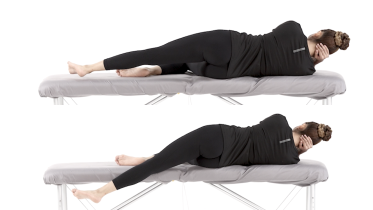
- Lie on your side with your hips bent a little and your knees bent to about a right angle. Rest your head on your lower arm, with a small rolled towel under your neck if that is more comfortable.
- Stack your top hip directly over the bottom one. Rest your top hand on the floor in front of you, or on your hip so you can feel if it rolls.
- Keep your heels touching and lift your top knee toward the ceiling.
- Stop when your hip starts to roll backward. For some people that is only a small lift, and that is fine.
- Hold for a few seconds at the top, then lower slowly.
What you should feel
Work deep in the side and back of the top hip. You should not feel it in your lower back or the front of the hip.
Common mistakes
- Rolling the pelvis back to get the knee higher. The lift looks bigger but the hip muscles do less.
- Letting the heels separate.
- Rushing. Take about two seconds to lift and two seconds to lower.
How often
Many programs start with 2 to 3 sets of 10 to 15 on each side, once a day, and your physio will fit this to you.
Stop and check with your physio if
- You feel sharp or pinching pain in the hip or groin.
- Pain spreads into the leg, or you notice numbness or tingling.
- Pain on the outside of your hip builds during the set or is worse the next morning.
From the clinic
We give the clamshell a lot for knee pain as well as hip pain. When the muscle at the side of the hip is weak, the knee often drifts inward on stairs and during squats, and this is one of the simplest ways to start working on it.
A folded towel between your lower legs, as in the video, can make the start position more comfortable. Sore on the outside of the hip? A pillow between your knees also stops the top leg dropping across your body, which squeezes the tendons there. Tell your physio if lying on either side hurts.
Once the basic version is easy, the usual next step is a light resistance band just above the knees.
If you have had a hip replacement or other hip surgery, get the go-ahead from your surgeon or physio before you try clamshells. Opening the knee turns the thigh outward, and many surgeons ask you to avoid that for the first months after some operations. Lying on your side may also be limited in that time.
Written and checked by the PocketPhysio editorial team. Last updated 2026-09-26.
This page is general education, not a diagnosis or a personal treatment plan. If you have pain, an injury or a health condition, see a physiotherapist or doctor before starting new exercises.