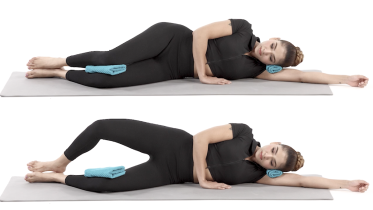
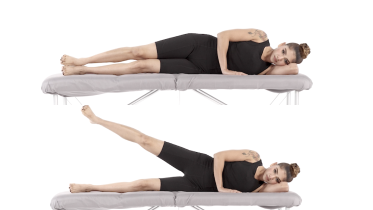
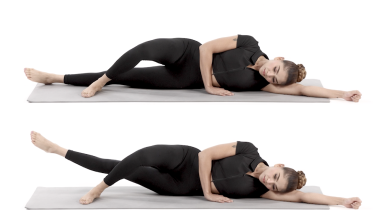
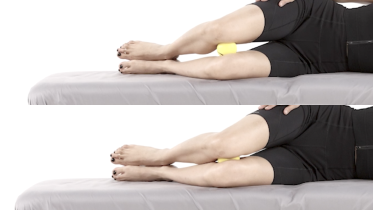
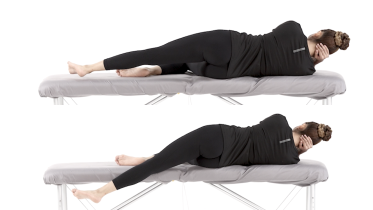
Side lying hip abduction with rotation
Side lying hip abduction with rotation puts two movements together to work the muscles at the side and back of your hip. Lying on your side, you lift the top leg, then turn the thigh outward so the knee points toward the ceiling, before bringing it back down. Think of a side leg lift and a clamshell done as one movement. That makes it harder than either on its own.
How to do the side lying hip abduction with rotation
- Lie on your side on a mat with your legs stacked, knees slightly bent and hips in line with your body. Rest your head on your lower hand and put your top hand on your hip.
- Line your top hip up directly over the bottom one so your pelvis does not roll back.
- Lift the top leg a little way off the bottom one, keeping it roughly in line with your body.
- At the top, turn the thigh outward so the knee points up toward the ceiling, letting the knee bend so the foot stays lower than the knee.
- Turn the leg back, straighten it and lower it slowly onto the other leg. Finish your reps, then change sides.
What you should feel
Work in the side and back of the top hip, around the buttock. Your lower back should not be doing any of the work.
Common mistakes
- Rolling the pelvis backward as the knee turns up. Keep the top hip stacked, even if the turn is smaller.
- Hitching your waist up toward your ribs to get the leg higher. The lift comes from the hip.
- Bringing the leg forward in front of your body instead of lifting it up and out.
- Letting the leg flop down at the end instead of lowering it with control.
How often
Around 8 to 12 slow reps on each side, for 2 to 3 sets once a day, is a typical starting range. Your physio will adjust this.
Stop and check with your physio if
- Sharp or catching pain in the hip or groin as the leg turns.
- Pain over the bony point of the outer hip that builds through the set or aches more the next day.
- Pain in your lower back as the top leg lifts or turns.
- Numbness, tingling or pain that travels from the hip into the leg.
From the clinic
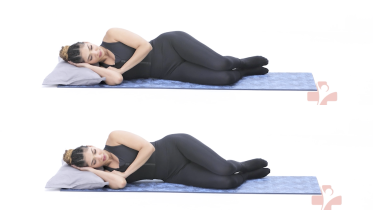
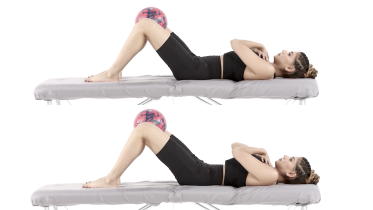
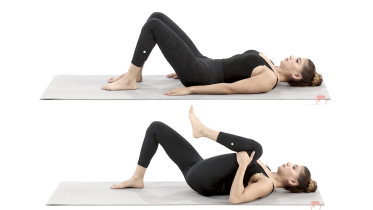
The voice guide that plays with this clip describes a different movement done lying on your back, so follow the video and the steps on this page. The leg does not need to go high. Keep the top hip stacked while the knee turns up, and let the height look after itself.
If the full movement is too hard, practice the two parts separately first: side lying hip abduction for the lift and the clamshell for the turn. A pillow under your head helps if your neck gets tired. If the hip underneath gets sore, put a folded blanket under it and mention it to your physio.
If you have had a hip replacement or other hip surgery, get the go-ahead from your surgeon or physio before you try side lying hip abduction with rotation. Turning the knee up toward the ceiling rolls the thigh outward, and many surgeons ask you to avoid that for the first months after some operations. The side lift also loads the muscles at the side of the hip, which some approaches have to open and repair, so ask when it is safe to add. If the operated leg is on top, do not let it drop forward or across the other leg, a common early limit after an operation done from the back of the hip (posterior approach). You may not be comfortable lying on the operated side yet.
Written and checked by the PocketPhysio editorial team. Last updated 2026-09-26.
This page is general education, not a diagnosis or a personal treatment plan. If you have pain, an injury or a health condition, see a physiotherapist or doctor before starting new exercises.