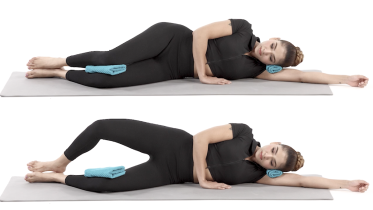
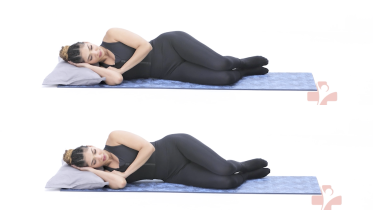
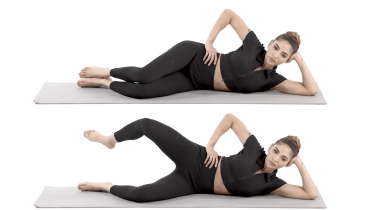
Side lying IT band stretch
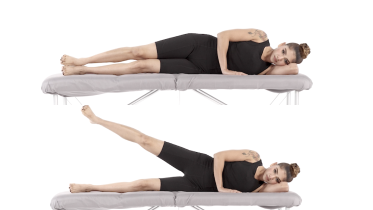
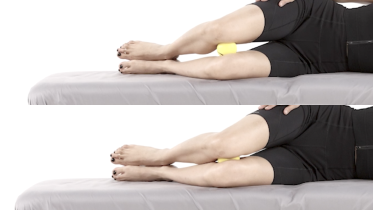
The side lying IT band stretch works on the outside of the hip and thigh. You lie on your side near the edge of a bed, straighten the top leg, take it slightly back and let it hang down over the edge, so the weight of the leg does the stretching. Lying down takes balance out of the picture, so people often use it in place of the standing versions.
How to do the side lying it band stretch
- Lie on your side close to the edge of a firm bed, with the leg you want to stretch on top and your back toward the edge. Rest your head on your lower arm or a pillow.
- Bend your bottom knee and hip a little to keep yourself steady.
- Straighten the top leg fully, in line with your body, with the toes pointing forward.
- Keeping that knee straight, move the top leg a little behind you, then let it lower over the edge of the bed toward the floor. Your pelvis stays where it is and does not roll back with the leg.
- Hold where you feel the stretch and breathe slowly. Then lift the leg back onto the bed, bending the knee if that is easier.
What you should feel
A stretch along the outside of the top hip and thigh, sometimes reaching toward the knee. The hanging leg creates it, so there is no need to push.
Common mistakes
- Rolling the top hip backward, so the leg drops straight down instead of going behind you.
- Bending the top knee as the leg lowers. The voice guide keeps it straight.
- Lying so close to the edge that you feel you might roll off.
How often
A usual starting point is 2 or 3 holds of 20 to 30 seconds on each tight side, done once or twice a day. Your physio will adjust this.
Stop and check with your physio if
- Sharp pain at the bony point on the outside of the hip, or pain there that lingers into the evening.
- Pain, numbness or tingling spreading down the leg.
- Your lower back aches or pinches as the leg drops.
From the clinic
This is a lying version of the standing IT band stretch, handy if standing with crossed legs feels wobbly. A firm bed or a treatment table works best, because a soft mattress lets you sink. Lie near enough to the edge for the leg to hang freely, and use the bent bottom knee to stop yourself rolling. If you are worried about rolling off, have someone nearby the first few times.
Not every outer hip problem suits this stretch. Dropping the leg behind and down presses the tendons at the side of the hip against the bone, which can irritate greater trochanteric pain. If the bony point of your hip is tender to touch or to lie on, ask your physio first.
If you have had a hip replacement, get the go-ahead from your surgeon or physio before you try the side lying IT band stretch. Letting the top leg drop back and down over the edge takes that hip behind you and in past the midline of your body, and many surgeons ask you to avoid that for the first months after some operations. If you are pregnant and have pain at the front or back of your pelvis, check with your physio before you try it, as one leg hangs down on its own while the other stays on the bed.
Written and checked by the PocketPhysio editorial team. Last updated 2026-09-26.
This page is general education, not a diagnosis or a personal treatment plan. If you have pain, an injury or a health condition, see a physiotherapist or doctor before starting new exercises.