
Snapping hip syndrome exercises and treatment
Warning signs, and when to get help
What is snapping hip syndrome?
A tendon slides over a bony ridge, catches for an instant, then lets go. That release is the snap, and in some hips it is loud enough for other people in the room to hear. The medical name you may see on a letter is coxa saltans, which simply means jumping hip.
Lewis (2010) divides the snapping that happens outside the joint into two groups by where the noise comes from, and Yen and colleagues (2015) use the same split. At the front, the iliopsoas tendon shifts across the bony rim of the pelvis. At the side, the iliotibial band or the top edge of the gluteus maximus flicks over the bony point at the top of the thighbone. A third, smaller group comes from inside the joint itself and behaves differently.
The split matters because it decides what you do about it. The front type is managed by changing how you load the hip flexors and by control work through the trunk and hip. The side type is managed with gluteal strength and with attention to how you stand and walk. No trial has compared those two approaches, so the split is clinical reasoning rather than tested fact, and in practice treating one type as though it were the other is the commonest reason a program does nothing.
Internal snapping hip syndrome
This is the one people feel deep in the groin or the front of the hip. It shows up when the hip moves from bent to straight: getting out of a car, standing up from a low chair, a leg raise, a dead bug, the top of a cycling stroke, a kick in football or a developpe in ballet.
The sound often comes with a sensation of something slipping or shifting rather than clicking. Many people can reproduce it on demand, which is both reassuring and a trap, because repeating it to show somebody is exactly what keeps it irritable. If you can set it off whenever you like, stop doing that for a few weeks.
The iliopsoas is also involved in hip impingement and in hip flexor strain, and those pages go further into the anatomy and into the positions that pinch at the front of the hip. If deep bending brings on a pinch rather than a snap, read them alongside this page.
External snapping hip
This is felt on the outside of the hip, over the bony point, and people often describe the hip as feeling like it is dislocating. It is not. The band on the outside of the thigh is passing over the bone as the hip bends and straightens, most noticeably when you walk, climb stairs, run or roll in bed.
Because the sensation is so dramatic, people brace against it and start walking stiffly, which usually makes the side of the hip ache on top of the snapping. Where the outer hip is the painful part rather than the noisy part, greater trochanteric pain syndrome and outer hip pain are the closer fit and worth reading first.
The external type is the one being tested in a trial. Tønning and colleagues (2026) published the protocol for a randomized trial of progressive resistance training against no intervention in adults with external snapping hip, with pain at 12 weeks as the main outcome. It has not reported, so nobody can yet tell you how well that training works, only that it is the approach being formally tested.
Hip clicking when walking, and two hips this page is not about
Searches for a clicking hip bring together very different people, so it is worth saying plainly which one you are.
If you are an adult whose hip clicks or snaps as you walk, with or without pain, this page is for you. If the hip you are asking about belongs to a baby, it is not: a click or clunk in an infant hip is checked for the way the socket has formed, and the warning signs on this page tell you how to get that looked at. And if you have had a hip replacement and the new joint clicks, go to the total hip replacement rehab program and speak to your surgical team, because a clicking replaced hip is a different question with a different answer.
One more group. If the hip catches, locks or gives way rather than simply snapping, or the snap started with an injury and hurts, then something inside the joint is the likelier cause, and the hip labral tear program covers that. Le (2025) is a review of how snapping hip is imaged, and the point that matters to a patient is that a scan taken while you lie still can miss what a moving one shows: dynamic ultrasound can catch the tendon jumping as the hip moves (Lewis, 2010).
There is also a version of this that was never caught in childhood. The NHS lists hip pain, groin pain and a clicking, snapping or popping feeling in the joint as the way hip dysplasia shows up when it is mild enough to go unnoticed at birth and only declares itself in late childhood, the teenage years or adulthood. It is diagnosed on an X-ray in adults rather than a scan. So if your hip has clicked and ached for as long as you can remember, that is worth asking your doctor about by name, because it changes what the imaging is looking for.
How is snapping hip syndrome treated?
The published approach is conservative first. What the two reviews actually list is three things: reduce the activities that set the snap off repeatedly rather than resting the hip altogether, work on length where the front or the side of the hip is genuinely tight, and use anti-inflammatory medicine or other pain relief if that is what lets you move (Lewis, 2010; Yen and colleagues, 2015). Worth knowing how modest the numbers behind that are. Lewis pulled together the case series available to him and found that somewhere between 36 and 67 percent of people had their symptoms reduced or cleared by conservative care, which is not the same as everybody.
Strength and control work is the fourth part of this page and it is not on either review's list, so we are not going to pretend it is. Yen and colleagues come closest, describing a weak gluteus medius alongside the internal type, an imbalance between gluteus maximus and tensor fascia lata in the external type, and the need to hold control as the muscle lengthens. Progressive resistance training is also what the trial now running has chosen to test (Tønning and colleagues, 2026). We include it because a tendon being dragged across bone at the end of its range is a loading problem, and because the alternative on offer is stretching alone.
What those reviews do not provide is a dose. There is no trial telling us how many sets, how often, or for how long, which is why every number on this page is given as a range and why the ranges come from general practice rather than from a snapping hip study. Anyone publishing an exact protocol for this condition is making it up, including the exercise sheet that currently fills the first page of search results under half a dozen different hospital logos.
Injections and surgery sit behind all of this. Lewis reports surgical lengthening of the iliotibial band or the iliopsoas for cases that do not settle, and warns that prolonged weakness can follow, which is a particular problem if your hip flexors matter to your sport. That makes a well-run program worth real time before anybody operates.
How to use this program
Start at stage 1 if the hip is sore, or stage 2 if it snaps but only aches after activity. Move up when the current stage is easy and the hip is no worse the day after. Drop back a stage for a few days after a flare instead of stopping altogether.
Each exercise page gives a typical starting dose. Across this program that is mostly 1 to 3 sets of 5 to 15, with holds at 5 to 10 seconds and stretches at 20 to 30 seconds. The lying exercises can be done daily and the one-leg strength work 2 or 3 days a week so the muscles recover in between. Your physio will adjust the exercises and the numbers to suit you.
If you are pregnant, check with your midwife, doctor or physio before you start. If you are pregnant and past the first three months, check with your physio before exercising flat on your back: three of the five stage 1 exercises are done in that position, and so are the dead bug in stage 2 and the single leg bridge in stage 3.
Check with your doctor before you start if you have a heart or lung condition, or blood pressure that is not under control. If you have had a hip replacement or other hip surgery, get the go-ahead from your surgeon or physio before you try these, because several bend the hip past a right angle or take the leg out to the side. If you have fallen in the past year or feel unsteady, do the standing exercises next to a kitchen counter.
Some discomfort while you exercise is fine if it eases soon afterward and the hip is no worse the next day. A sharp pinch at the front of the hip means you bent too deep, so make the movement smaller rather than pushing through it.
The exercise program
Stage 1: Settle the irritable tendon
For a hip that snaps and hurts, or one that has just flared. Everything here is done lying down, the hip never bends past a right angle, and the holds work the muscles while the joint barely moves. That matters with a snapping hip, because it is the repeated flicking that irritates the tissue, not the muscle working. Many of these start at 1 to 3 sets of 5 to 15, with the holds at 5 to 10 seconds, done daily or most days, and your physio will adjust this. If you have high blood pressure, breathe steadily through every hold and never hold your breath. Keep walking at a distance and speed that does not build the pain up, and leave out whatever makes the hip snap repeatedly for now.
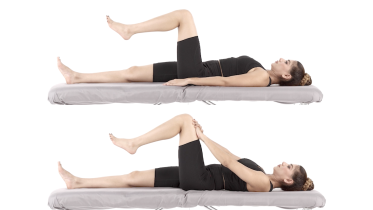 Isometric hip flexion
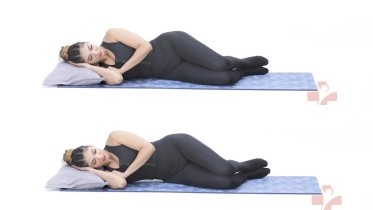 Isometric clamshell
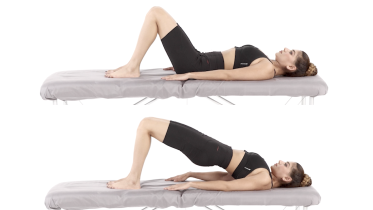 Glute bridge
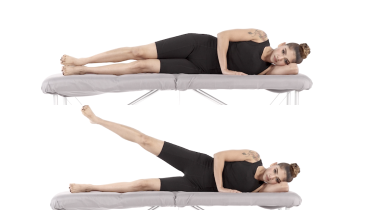 Side lying hip abduction
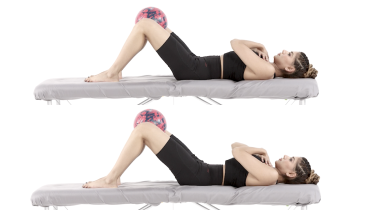 Adductor ball squeeze
Stage 2: Length at the front, control through the middle
Start when stage 1 is easy and the hip is no worse the day after, which often takes a couple of weeks. The two stretches are for the front of the hip and the outer thigh, and they are for comfort and range rather than for curing the snap. Take each one to a comfortable pull and no further, because pushing into the end of the range on the sore side tends to make an irritable tendon sorer. In the dead bug and the bird dog your hips bend to roughly 90 degrees, so make the movement smaller if something catches at the front. The band work in standing starts the gluteal strengthening that the external type needs most. Hold a counter if you are unsteady. Stretches are often held 20 to 30 seconds and repeated 2 or 3 times, and the strength work 2 to 3 sets of 8 to 15, most days.
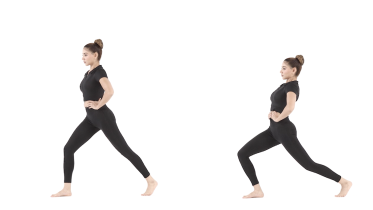 Hip flexor stretch
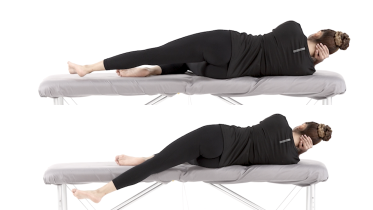 Side lying IT band stretch
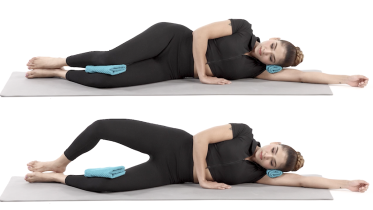 Clamshell
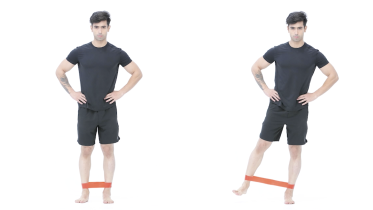 Standing hip abduction with band
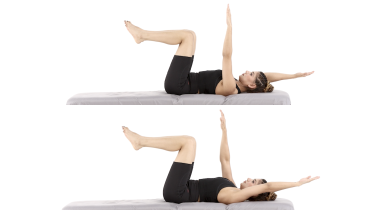 Dead bug
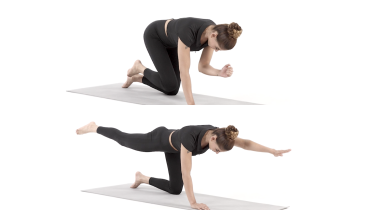 Bird dog
Stage 3: One leg at a time, and back to your sport
Move up when stage 2 feels comfortable and the hip calms down quickly afterward. Every exercise here loads one leg, which is what walking, stairs, running and dancing actually ask for, and it is where the lasting change happens for most people. Keep a counter within reach for single leg stance and the step up at first. These are usually 2 to 3 sets of 6 to 12 on each side, 2 or 3 days a week, with side plank held 10 to 30 seconds. If you have high blood pressure, breathe steadily through the side plank hold and never hold your breath. Going back to running, dancing or anything with repeated kicking or deep hip bending is built up gradually on a plan you agree with your physio, rather than tested all at once.
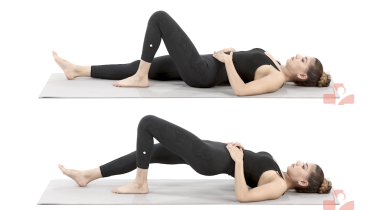 Single leg bridge
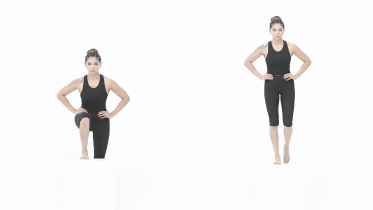 Step up
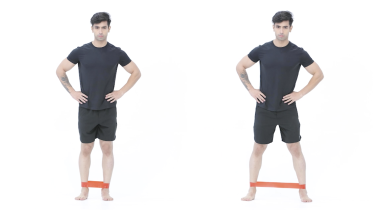 Lateral band walk
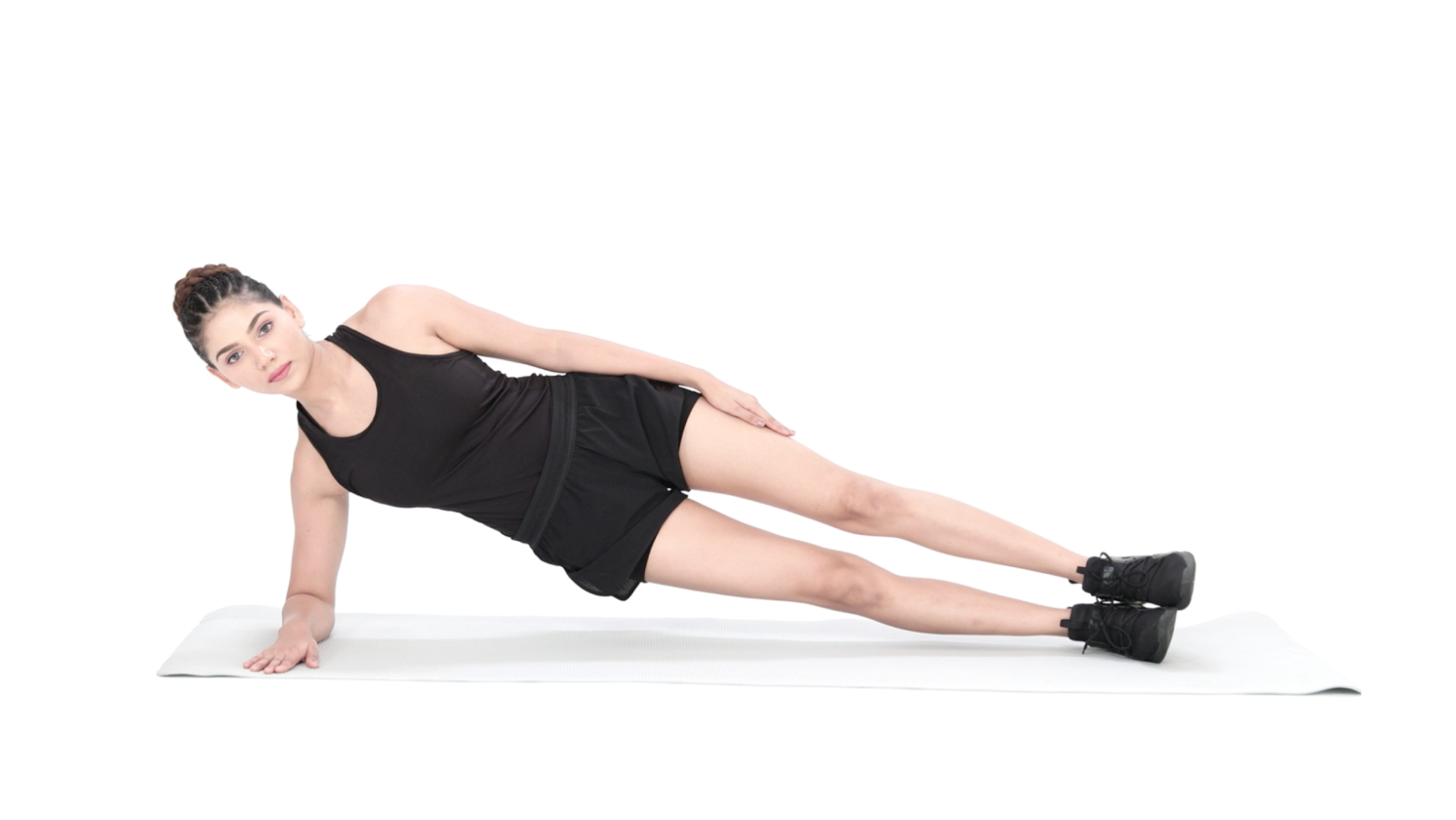 Side plank
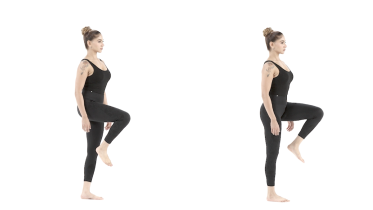 Single leg stance
What exercises should you avoid with snapping hip syndrome?
There is no banned list, and that is not a dodge. The movements that irritate a snapping hip are the ones that drag the tendon across its ridge again and again, so the same exercise can be fine at five repetitions and sore at twenty.
Three habits cause most of the trouble. Demonstrating the snap to people, which nobody counts as exercise but which can happen fifty times a day. Long sets of straight leg raises, bicycles or leg lifts for the front type, where every repetition reproduces it. And deep stretching into the end of the range on the painful side, which tends to make a sore tendon sorer rather than longer.
Swaps that work in practice: keep the other knee bent during any lying leg movement, so the front of the hip is not pulled taut. Get out of a car by swinging both legs together rather than lifting one leg over. Take stairs with a shorter step for a while. On the side type, stop crossing your legs when you stand, because standing with the weight on one leg and the pelvis dropped is the position that tightens the band over the bone.
What we notice in the clinic
People arrive worried about the noise and leave caring about the load. Almost everyone has been told at some point that their hip is wearing out, and a snap that you can hear across a room sounds exactly like something coming apart. It usually is not, and the reassurance alone changes how people move.
The pattern that keeps a snapping hip going is guarding. The hip snaps, you brace, and the bracing changes how you walk, so the side of the hip or the back starts aching within a fortnight. By the time someone comes in, the noisy tendon is often the smaller of the two problems.
The other thing we see is a hip flexor that is both tight and weak at once. People stretch it for months because it feels tight, and nobody ever asks it to work hard through range. The held exercises in stage 1 and the one-leg work in stage 3 are there for that reason.
When to see a physio or doctor
See a physio or doctor if the snap hurts, if the hip is getting worse rather than better, if it catches, locks or gives way, or if 2 weeks of easing off has not helped. A painless snap in a hip that works normally does not need an appointment, although it is a fair thing to mention at one you already have.
Ask for a reassessment if 3 months of regular, progressive work has changed nothing. The Zurich consensus on hip-related pain recommends exercise-based treatment and says it should last at least 3 months (Kemp and colleagues, 2020). It says nothing about what to do next, and it was written about pain coming from inside the hip joint rather than about snapping, so treat the 3 months as a sensible point to be looked at again rather than as a deadline for anything. The warning signs below say what needs help faster, and how fast.
For physiotherapists
The page splits management by type, following Lewis (2010) and Yen and colleagues (2015): iliopsoas over the iliopectineal eminence for the internal type, iliotibial band or the posterior border of gluteus maximus over the greater trochanter for the external type, and intra-articular causes handled as a separate pathway with its own symptom pattern of catching, locking and giving way. Le (2025) is cited for the scope of its imaging review only, since the full text is paywalled here; the dynamic ultrasound point is taken from the full text of Lewis (2010), which describes abrupt movement of the iliotibial band, gluteus maximus or iliopsoas tendon on dynamic ultrasound.
What the two reviews carry and what they do not, checked against their full texts rather than their abstracts. Both list conservative management as avoidance of inciting activities, stretching and anti-inflammatory medicine; neither prescribes strengthening, and neither gives a dose. Lewis reports 36 to 67 percent symptom reduction or resolution with conservative measures across the series he reviewed, which is the number behind the page's statement that most cases settle without surgery and is quoted alongside it. Yen is the source of the page's only published duration figure, 6 to 12 months to regain function without snapping under a controlled physiotherapy program, presented on the page as those authors' estimate because no study is attached to it; Yen also notes gluteus medius weakness with coxa saltans interna and a gluteus maximus to tensor fascia lata activation imbalance with coxa saltans externa, which is the closest either review comes to the strength and control work in stages 2 and 3. The page says in its own voice that this fourth element is clinical reasoning plus the intervention Tønning and colleagues are testing, not a review recommendation.
No dose is traceable to a snapping hip study. Tønning and colleagues (2026) is the protocol for the first randomized controlled trial of progressive resistance training for external snapping hip, with pain at 12 weeks as the primary outcome and a delayed-start comparison; it has not reported, and the page says so rather than implying a known effect. Every number in the phase text is therefore presented as a general range with the physio adjusting it, and the syndicated vendor exercise module that dominates the search results for this phrase supplies no rep counts to this page.
Kemp and colleagues (2020) is applied for the general principles of physiotherapist-led care in hip-related pain: recommendation (ii), that exercise-based treatment should be at least 3 months duration, and recommendation (v), that physical activity which may include sport is recommended. Both are quoted from the consensus recommendations as they are listed in the abstract.
The same abstract records that the systematic review commissioned for the meeting found strong evidence for physiotherapist-led treatment to be lacking, so the 3 months is a consensus duration rather than a demonstrated one, which is a second reason the page uses it only as a review point. The consensus makes no recommendation about escalation after 3 months, and an earlier draft of this page read it that way; the page now uses the 3 months as a review point only, with the caveat that hip-related pain in that document means intra-articular pathology and not snapping hip. Screen exertional groin pain for femoral neck stress fracture (Clough, 2002), long-term corticosteroid or heavy alcohol use for osteonecrosis, and pain below the knee for lumbar referral. A clicking infant hip goes to developmental dysplasia screening, and a clicking prosthetic hip to the surgical team, both routed on the page rather than left implicit.
Warning signs
Get emergency help now
- Emergency: you have had a fall or an injury and now have severe hip pain, or you cannot walk or put weight on the leg. Call emergency services or go to an emergency department. This can be a sign of a broken hip (hip fracture).
- Emergency: tingling or loss of feeling in the hip or leg after a fall or injury. Call emergency services or go to an emergency department.
- Emergency: pain, tingling, numbness or weakness in both legs, numbness or altered feeling around your genitals or bottom, or new trouble peeing or controlling your bladder or bowels. The same applies if you lose feeling in one leg. Call emergency services or go to an emergency department straight away. These can be signs of pressure on the nerves at the base of the spine (cauda equina syndrome).
Get help today
- Same day: the hip is hot and swollen, the skin around it has changed color, or you have hip pain with a high temperature or feel hot, cold or shivery. Get medical help the same day, and go to an emergency department if you feel very unwell. A joint infection needs treatment quickly. If you have a very high or very low temperature, shivering you cannot control, you are breathing very fast or finding it hard to breathe, you are confused or your speech is slurred, your skin, lips or tongue look blue, gray, pale or blotchy (on brown or black skin this can be easier to see on the palms of the hands or soles of the feet), or you have a rash that does not fade when you press it, call emergency services, as this can be sepsis.
- Same day: severe hip pain that came on suddenly without a fall, or pain that is getting worse quickly over a few days. Get medical advice the same day.
- Same day: groin pain that built up with running, marching or jumping, often after you increased your training, and now hurts when you walk, makes you limp, or aches at rest or at night. Stop running and jumping and keep walking to a minimum until it has been checked. Get medical advice the same day and mention your training. If you cannot put weight on the leg, go to an emergency department. This can be a stress fracture in the neck of the thighbone (femoral neck stress fracture), which is easy to miss at first and can become a full break if you keep loading it.
- Same day: new hip or groin pain after a fall, even a small one, if you are older, have low bone density (osteoporosis) or have taken steroid tablets for a long time, even if you can still walk. Get medical advice the same day. A broken hip is not always obvious at first.
- Same day: a child or teenager has sudden pain in the hip, thigh or knee, is limping, or cannot put weight on one leg. Get an urgent appointment with a doctor the same day. If they have a high temperature or seem very unwell, go to an emergency department. This page is for adults, and hip pain in children has different causes.
- Same day: a leg or foot that is getting weaker, for example your foot drags, catches on the ground or slaps down when you walk (foot drop). Get medical advice the same day. If the weakness is getting worse by the hour, go to an emergency department.
- Same day: a calf or thigh that is newly swollen or getting more swollen, warm, tender, red or darker than usual, has swollen veins that are sore to touch, or has a throbbing or cramping pain that does not fit your injury or condition, or that feels different from normal muscle soreness after exercise. This can be a sign of a blood clot (deep vein thrombosis), especially after surgery, an injury, time in a cast or boot, a long trip or a spell of being much less mobile than usual. Get medical advice the same day. If you are also short of breath or have chest pain, call emergency services.
- Same day: hip or groin pain that is worse at night or does not ease with rest, and keeps getting worse. If you are being treated for cancer now, contact your cancer team the same day.
Book an appointment
- Within a day or two: hip or groin pain that is worse at night or does not ease with rest, and keeps getting worse. If you have had cancer, now or in the past, or are losing weight without trying, see your doctor sooner, within a day or two, and mention it. This applies even if the pain is not getting worse.
- Within a few days: hip or groin pain that is worse at night or does not ease with rest, and keeps getting worse. See your doctor within a few days.
- Within a few days: new groin or hip pain and you take steroid tablets long term, or have in the past, or you regularly drink a lot of alcohol. This can be a sign of a problem with the blood supply to the top of the thighbone (avascular necrosis). Book an appointment with your doctor within a few days and mention the steroids or alcohol.
- Within a few days: a baby's hip clicks, clunks or pops, one leg looks shorter than the other or moves differently during play or nappy changes, the skin creases on the legs look uneven, or they drag one leg when they crawl or limp when they start walking. Book an appointment with your doctor, health visitor or child health nurse and ask about a hip check. This page is for adults, and a clicking hip in a baby is checked for a problem with the way the socket has formed (developmental dysplasia of the hip), which is usually painless, so it is easy to miss.
- Within a few days: the hip gives way under you, or it catches or locks so that you have to shift your leg to free it. Book an appointment with a doctor or physio, and until it has been checked, leave out the exercises you do standing on one leg, hold the rail on stairs and take care on uneven ground, because a hip that gives way without warning is how people fall.
- Within 2 weeks: pain that spreads down the leg below the knee, especially with numbness or tingling in the leg or foot. The pain may be coming from your lower back rather than the hip. Book an appointment with a doctor or physio.
Common questions
Is snapping hip serious?
Usually not. A hip that snaps and does not hurt is a mechanical quirk rather than damage, and it does not need treating for its own sake. Lewis (2010) reports that most cases of extra-articular snapping hip settle without surgery. What makes it worth attention is pain with the snap, a hip that gives way or locks, or a snap that started after an injury, because those point at something in the joint rather than a tendon flicking over bone. The warning signs on this page cover the symptoms that need checking faster.
How do I get rid of snapping hip syndrome?
The honest answer is that the snap itself often stays and the pain is what goes. The approach in the published reviews is conservative first: back off the activities that set it off repeatedly, work on length at the front and the side of the hip, build the muscles that control it, and use pain relief if you need it to get moving (Lewis, 2010; Yen and colleagues, 2015). Those reviews reserve surgical lengthening of the iliopsoas or the iliotibial band for cases that do not settle, and Lewis notes that this can leave prolonged weakness, which is a real cost to weigh.
What causes a clicking hip in an adult?
Most often a tendon moving across a bony ridge. At the front, the iliopsoas tendon shifts over the rim of the pelvis as the hip straightens from a bent position. At the side, the iliotibial band or the upper edge of the gluteus maximus flicks over the bony point of the thighbone. Both are outside the joint. A smaller group of clicks comes from inside the joint, where a torn piece of the rim cartilage or a loose fragment catches, and that group behaves differently: it tends to hurt, to catch unpredictably and to come with a hip that gives way (Yen and colleagues, 2015).
Why does my hip click when I lift my leg or do dead bugs?
That is the classic internal pattern. Bending the hip and then straightening it, which is what a leg raise, a dead bug or a bicycle movement does, drags the iliopsoas tendon across the bony rim underneath it, and in some hips it goes with an audible snap. If it is painless, you can keep going. If it hurts, make the movement smaller and slower, keep the other leg bent to take the strain off the front of the hip, and do fewer repetitions for a while. Snapping in the same position every single repetition is also a sign to switch to the held versions in stage 1 for a couple of weeks.
Should I stretch a snapping hip?
Stretching has a place and it is not the main event. The reviews list stretching among the usual conservative measures (Lewis, 2010; Yen and colleagues, 2015), and in the clinic it helps most where the front of the hip is genuinely short, for example in people who sit all day or cycle a lot. What it does not do is stop a tendon crossing a bony ridge. The strength and control work in stages 2 and 3 is the part that changes how the hip behaves under load, which is why the trial now running tests progressive resistance training rather than stretches (Tønning and colleagues, 2026).
Can I keep running with a snapping hip?
Often yes, in amounts the hip settles from. The Zurich consensus on hip-related pain recommends staying physically active alongside exercise-based care, and that can include sport (Kemp and colleagues, 2020). Cut the parts that set the snap off hardest, which for runners is usually hills, sprints and high knees, and keep the rest. Build back up a bit at a time as stage 3 gets easier. Pain that climbs week by week, or a groin that starts aching at rest or at night after you increased your training, is a different matter and the warning signs on this page cover it.
How long does snapping hip syndrome last?
No trial has measured it. The nearest thing to a published figure comes from Yen and colleagues (2015), who write that a controlled physiotherapy program can get a hip back to normal function without snapping over a period of 6 to 12 months, and that the movement changes and the stretching still have to be kept up afterward to stop it coming back. Take that as those authors' clinical estimate, because they attach no study to it, and it is longer than most people expect. From the clinic, a painful snapping hip managed by cutting the provoking load and building strength often quiets down over weeks to a few months, and the audible snap frequently remains after the pain has gone. If 3 months of steady, loaded work has not changed anything, that is the point to be reassessed rather than to repeat the program again.
References
- Lewis CL. Extra-articular snapping hip: a literature review. Sports Health. 2010;2(3):186-190. https://doi.org/10.1177/1941738109357298
- Yen YM, Lewis CL, Kim YJ. Understanding and treating the snapping hip. Sports Medicine and Arthroscopy Review. 2015;23(4):194-199. https://doi.org/10.1097/JSA.0000000000000095
- Tønning LU, Jakobsen SS, Dalgas U, et al. Effects of resistance training for external snapping hip: protocol for a randomized controlled trial. Contemporary Clinical Trials. 2026;170:108465. https://doi.org/10.1016/j.cct.2026.108465
- Le J. Snapping hip syndrome. Magnetic Resonance Imaging Clinics of North America. 2025;33(1):75-82. https://doi.org/10.1016/j.mric.2024.06.006
- Kemp JL, Risberg MA, Mosler A, et al. Physiotherapist-led treatment for young to middle-aged active adults with hip-related pain: consensus recommendations from the International Hip-related Pain Research Network, Zurich 2018. British Journal of Sports Medicine. 2020;54(9):504-511. https://doi.org/10.1136/bjsports-2019-101458
- Clough TM. Femoral neck stress fracture: the importance of clinical suspicion and early review. British Journal of Sports Medicine. 2002;36(4):308-309. https://doi.org/10.1136/bjsm.36.4.308
- NHS. Hip pain in adults. Page last reviewed 20 November 2025. https://www.nhs.uk/symptoms/hip-pain/
- NHS. Hip pain in children (irritable hip). Page last reviewed 3 April 2024. https://www.nhs.uk/symptoms/hip-pain-children-irritable-hip/
- NHS. Developmental dysplasia of the hip. Page last reviewed 11 March 2026. https://www.nhs.uk/conditions/developmental-dysplasia-of-the-hip/
- NHS. Deep vein thrombosis (DVT). Page last reviewed 30 April 2026. https://www.nhs.uk/conditions/deep-vein-thrombosis-dvt/
Written and checked by the PocketPhysio editorial team. Last updated 2026-10-27.
This page is general education, not a diagnosis or a personal treatment plan. See a physiotherapist or doctor for advice about your own situation.