
Outer hip pain: causes, triggers and what helps
Where outer hip pain is felt, and what that tells you
Put a hand on the side of your hip and you will find a bony ridge under it. That is the greater trochanter, the top corner of the thigh bone, and the tendons of the muscles at the side of the hip attach there. Pain over that spot, tender when you press it and sometimes spreading a hand's width down the outer thigh, is the classic picture of greater trochanteric pain syndrome.
Two other locations are worth knowing, because they change the answer. Pain deep in the groin, with a hip that is stiff to bend and hard to get a sock on, points at the joint itself. Pain that runs from the buttock down the back of the leg, past the knee, with pins and needles, points at the lower back.
What causes pain on the side of the hip?
None of this is a diagnosis. It is the list a physio works through, with the features that usually go with each.
Greater trochanteric pain syndrome
The umbrella name for the common version, covering gluteal tendinopathy and what used to be called trochanteric bursitis. The tendons of the gluteus medius and gluteus minimus are now regarded as the main local source of the pain (Grimaldi and Fearon, 2015). Tendons cope badly with being squeezed against bone and pulled hard at the same time, and the squeeze happens when the thigh crosses the midline of the body (Grimaldi and colleagues, 2015). It was more common in women in a study of 3,026 adults aged 50 to 79, and it kept company with iliotibial band tenderness, knee osteoarthritis and low back pain (Segal and colleagues, 2007). The greater trochanteric pain syndrome program has the staged treatment, including the exercises most used for gluteal tendinopathy.
Hip osteoarthritis
Wear-related change in the ball and socket joint. OrthoInfo puts the pain most often in the groin or thigh, spreading to the buttock or the knee, with stiffness that makes walking and bending difficult, and symptoms that are often worse in the morning or after sitting a while. Plenty of people feel some of it on the outside of the hip too, which is why groin pain plus stiffness, rather than the exact spot, is the better clue. NICE says osteoarthritis can be diagnosed from age 45 without an X-ray when the joint hurts with use and morning stiffness either lasts no more than half an hour or is absent. The hip osteoarthritis program covers the exercise side.
Referred pain from the lower back
Nerve root irritation in the lumbar spine sends pain into the buttock and leg. The NHS describes sciatica as affecting the bottom and the back of one leg, often reaching the foot and toes, and adds that the pain may be worse when you move, sneeze or cough. Pain that flares when you bend over, cough or sneeze, spreads below the knee, or comes with numbness, tingling or weakness in the leg or foot is a back pattern rather than a hip one, and it needs an assessment. Pain, tingling, numbness or weakness in both legs, numbness around the genitals or bottom, a change in bladder or bowel control, or loss of feeling in one leg is an emergency, and the warning signs below spell out what to do.
The iliotibial band
The IT band is the thick sheet of tissue running down the outside of the thigh, and it gets blamed for a lot. The condition named after it, iliotibial band syndrome, causes pain at the outside of the knee rather than the hip, and dissection and MRI work found the band anchored to the lower thigh bone by fibrous strands rather than rolling freely over it (Fairclough and colleagues, 2006). Over the hip, the band lies across the bony point and adds to the pressure on the tendons underneath when the thigh crosses the midline (Grimaldi and colleagues, 2015). So outer hip pain and tenderness along the band often turn up together (Segal and colleagues, 2007), which is a reason to build the hip muscles up rather than to work on the band itself. Rolling or stretching over the bony point presses on tissue that is already sore, and Cambridge University Hospitals asks people to leave the area alone while symptoms settle.
If your pain sits at the outer knee rather than the hip, the IT band syndrome program is the better fit.
After a hip replacement
Discomfort with activity and at night is common for several weeks after a total hip replacement (OrthoInfo). What sits behind soreness on the side of an operated hip depends on the operation you had, so it is a question for the team that did it rather than one to work out from a web page. Your surgeon and the hospital team decide what you do and when, and their protocol comes before this page. The total hip replacement rehab program explains the usual stages, and new or rapidly worsening pain, a wound that is red, hot or leaking, a fever, or a calf that is newly swollen, warm or tender all mean contacting that team the same day rather than waiting.
If you are pregnant
Pain around the hip and pelvis during pregnancy is handled differently, so this page does not advise on it. The pregnancy back and pelvic pain program is the place to go, with your midwife or maternity physio leading. If you are pregnant, check with your midwife or physio before you start.
One thing on this page changes. From about 28 weeks the NHS advises going to sleep on your side rather than on your back, because going to sleep on your back in the last months is linked to a higher risk of stillbirth. So use the side position, on the pain-free side with a firm pillow between your knees, and leave lying on your back until after the birth. The NHS also says not to worry if you wake up on your back: settle onto your side again and carry on.
What brings outer hip pain on
Four everyday positions and activities account for most flares, and all four have the same mechanism behind them: the thigh drifting across the midline, or one leg taking the load without the pelvis staying level.
- Walking distance, hills and stairs. Each step loads one hip at a time. Cambridge University Hospitals asks patients to cut the daily distance for a time and to stay off slopes and steps where that is possible.
- Standing with your weight hung on one hip, as people do while waiting or holding a child. That pushes the hip out to the side and compresses the tendon.
- Sitting with your legs crossed, or in a low, soft chair. Both pull the thigh inward across the body.
- Lying on that side at night. This is the one that wakes people, and it has its own page.
Running, a sudden jump in training, and a long drive in a low seat come up often in clinic as well, usually on top of one of the four above rather than on their own.
Pain when you lie on that side
Most people with this problem notice it first in bed. Your body weight pins the sore side against the mattress, and without a pillow to keep the knees apart the upper thigh settles into the position that compresses the tendon. Switching to your back, or to the other side with a firm pillow between the knees, usually takes the edge off. If you are more than about 28 weeks pregnant, use the other side rather than your back, for the reason in the pregnancy note above. Hip pain at night covers the positions and pillows that help, and the night pain signs that need a doctor.
What helps at home
Change the positions first. Sit square with both feet on the floor in a chair high enough that your hips are not below your knees, stand with your weight even on both feet, and keep the pillow between your knees at night. This is the load management education the LEAP trial paired with the exercises (Mellor and colleagues, 2018).
Trim the load that aggravates it for a few weeks, without shutting everything down. Two or three short walks spread through the day are usually easier on the hip than one long outing. On stairs, hold the rail on your good side and widen your foot placement a little. Skip the outer hip stretches for now, since they hold the tendon in the compressed position (Cambridge University Hospitals).
The NHS self-care list for hip pain includes ice wrapped in a towel, used for up to 20 minutes and repeated every 2 to 3 hours, paracetamol (acetaminophen) or an ibuprofen gel, soft-soled shoes that absorb shock, and staying out of low chairs. Ask a pharmacist if you are not sure which of those suits you.
Exercises for outer hip pain
Loading the hip muscles gradually is the treatment with the best support behind it. In the LEAP trial of 204 adults with gluteal tendinopathy, 14 physio sessions of education and exercise over 8 weeks, with daily home exercises, produced more people rating themselves improved at 8 weeks than a steroid injection or a wait and see approach, and better overall improvement than the injection at 1 year (Mellor and colleagues, 2018). A 2024 review of 6 trials with 733 people reached the same conclusion and recommended exercise as the first treatment, while noting how few trials there are (Kjeldsen and colleagues, 2024). For hip osteoarthritis, NICE recommends exercise for everyone with the condition.
Expect a working ache in the buttock and thigh muscles. Pain over the bony point itself is the signal to make the exercise smaller or easier, and a hip that is clearly sorer the next day, or that keeps you awake, means the load was too much for now. Progress takes months, not weeks.
The clamshell needs one setup rule. Lie on your good side with a pillow between your knees so the top thigh never drops across your body, and work only the sore hip if lying on it hurts. Cambridge University Hospitals tells people in floor Pilates classes to leave clams out altogether, because done flat the thigh crosses the midline and squeezes the tendon (Grimaldi and colleagues, 2015). If the exercise brings on pain over the bony point even with the pillow, drop it for now and start instead with the isometric clamshell, which works the same muscles with the leg still.
If you have had a hip replacement, get the go-ahead from your surgeon or physio before you try the clamshell, sit to stand, side stepping, standing hip abduction, the step up or the backward step down. Some operations limit this kind of work for the first months, so the timing depends on your surgery. If you are pregnant, check with your midwife or physio before you start.
Exercises that can help
Work down the list rather than starting at the bottom, and add the standing exercises once the first two cause no extra soreness over the bony point the next day. Most start at 2 to 3 sets, usually 10 to 15 repetitions for the hip exercises, 5 to 10 for sit to stand and 8 to 12 for the step work, once a day, and your physio will adjust this.
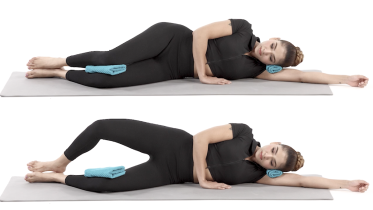 Clamshell
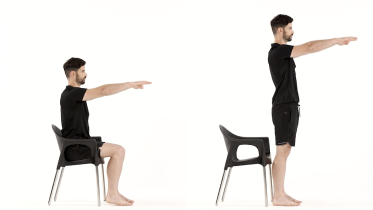 Sit to stand
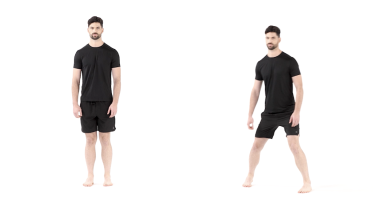 Side stepping
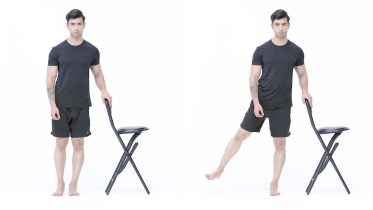 Standing hip abduction
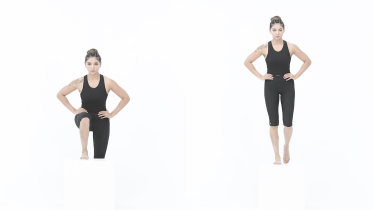 Step up
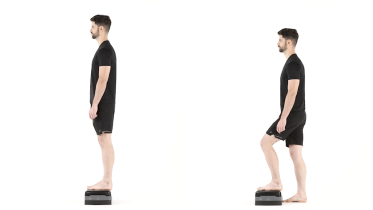 Backward step-down
The greater trochanteric pain syndrome program puts these into three stages with more options at each level, including band work and single leg exercises.
When to see a physio (physical therapist)
Book an appointment if the pain is stopping you doing normal things, is waking you regularly, keeps coming back, or has not improved after 2 weeks of looking after it at home (NHS). Go sooner if you are not convinced the pain is coming from the hip at all. Groin pain with a stiff joint, and leg pain below the knee with pins and needles, both need a different assessment.
A physio will press over the bony point, test the hip muscles, watch you walk and stand on one leg, and check your back. That usually tells them which structure is involved, and what load to start you on. If you have been doing the exercises properly for 6 to 8 weeks with no change, go back and have the plan reviewed rather than pushing harder.
Related exercise programs
See a doctor promptly if
- Emergency: you have had a fall or an injury and now have severe hip pain, or you cannot walk or put weight on the leg. Call emergency services or go to an emergency department. This can be a sign of a broken hip (hip fracture).
- Emergency: tingling or loss of feeling in the hip or leg after a fall or injury. Call emergency services or go to an emergency department.
- Emergency: pain, tingling, numbness or weakness in both legs, numbness or altered feeling around your genitals or bottom, or new trouble peeing or controlling your bladder or bowels. The same applies if you lose feeling in one leg. Call emergency services or go to an emergency department straight away. These can be signs of pressure on the nerves at the base of the spine (cauda equina syndrome).
- Same day: the hip is hot and swollen, the skin around it has changed color, or you have hip pain with a high temperature or feel hot, cold or shivery. Get medical help the same day, and go to an emergency department if you feel very unwell. A joint infection needs treatment quickly.
- Same day: severe hip pain that came on suddenly without a fall or injury. Get medical advice the same day.
- Same day: new hip or groin pain after a fall, even a small one, if you are older, have low bone density (osteoporosis) or have taken steroid tablets for a long time, even if you can still walk. Get medical advice the same day. A broken hip is not always obvious at first.
- Same day: a leg or foot that is getting weaker, for example your foot drags, catches on the ground or slaps down when you walk (foot drop). Get medical advice the same day. If the weakness is getting worse by the hour, go to an emergency department.
- Same day: a child or teenager has sudden pain in the hip, thigh or knee, is limping, or cannot put weight on one leg. Get an urgent appointment with a doctor the same day. If they have a high temperature or seem very unwell, go to an emergency department. This page is for adults, and hip pain in children has different causes.
- Same day: a calf or thigh that is newly swollen, warm, tender, red or darker than usual, has swollen veins that are sore to touch, or has a throbbing or cramping pain that does not fit your injury or condition, or that feels different from normal muscle soreness after exercise. This can be a sign of a blood clot (deep vein thrombosis), especially after surgery, an injury, time in a cast or boot, a long trip or a spell of being much less mobile than usual. Get medical advice the same day. If you are also short of breath or have chest pain, call emergency services.
- Within a few days: hip pain at night or at rest that does not ease when you change position, and keeps getting worse. See your doctor within a few days. If you have had cancer, now or in the past, or are losing weight without trying, see your doctor sooner, within a day or two, and mention it. This applies even if the pain is not getting worse. If you are being treated for cancer now, contact your cancer team the same day.
- Within a few days: new pain in the groin or buttock, and you take steroid tablets long term, or have in the past, or you regularly drink a lot of alcohol. This can be a sign of a problem with the blood supply to the top of the thighbone (avascular necrosis). Book an appointment with your doctor within a few days and mention the steroids or alcohol.
- Within 2 weeks: pain that spreads down the leg below the knee, especially with numbness or tingling in the leg or foot. The pain may be coming from your lower back rather than the hip tendons. Book an appointment with a doctor or physio.
- Within 2 weeks: the pain is mostly in the groin rather than on the outside of the hip, or the hip is stiff and hard to bend, for example when you put on socks. This points more toward the hip joint itself, such as hip osteoarthritis. Book an appointment with a doctor or physio so the cause can be checked.
Common questions
What causes pain on the outside of the hip?
The most common reason in adults is greater trochanteric pain syndrome, and the gluteal tendons where they attach to the bony point at the top of the thigh bone are now regarded as the main local source of it (Grimaldi and Fearon, 2015). Other possibilities are osteoarthritis in the hip joint, which is usually felt more in the groin, and pain referred from the lower back. In a US study of 3,026 adults aged 50 to 79, this kind of pain was more common in women and went along with tenderness over the iliotibial band, knee osteoarthritis and low back pain (Segal and colleagues, 2007). Only an assessment can sort out which applies to you.
Why does the outside of my hip hurt when I walk or go up stairs?
Both put your whole weight on one leg at a time, which is exactly what the muscles at the side of the hip are for. Each step asks them to hold the pelvis level, and if the hip drops or swings out to the side the tendon gets squashed against the bone underneath it. Uphill walking and stairs add more of the same. The Cambridge University Hospitals leaflet asks people to limit how far they walk in a day while the tendon settles, and to leave out slopes and steps where that is practical, then to build back up as the exercises get easier.
Why does my outer hip hurt after sitting or when I cross my legs?
Sitting with one leg crossed over the other pulls the thigh across the midline of the body, and that position presses the gluteal tendons into the bony point (Grimaldi and colleagues, 2015). Low, soft seats do the same thing by dropping the knees higher than the hips. The pain often builds while you sit and then bites when you stand up. Sitting square with both feet on the floor, in a higher chair, usually settles it, and a wedge cushion helps if the sofa is the problem.
Should I stretch the outside of my hip?
Usually not while it is sore. The popular outer hip and buttock stretches drag the thigh across the body, which is the position that compresses the tendon, and the Cambridge University Hospitals leaflet tells people not to stretch while symptoms are settling. The physio led program in the LEAP trial left those stretches out and still worked better than a steroid injection or waiting (Mellor and colleagues, 2018). A useful test is the next morning: a stretch that feels pleasant at the time but leaves the hip sorer overnight is not helping.
Can sciatica cause outer hip pain?
A nerve irritated in the lower back can certainly be felt around the hip and buttock. The NHS describes sciatica as affecting the bottom and the back of one leg, often running into the foot and toes, with burning pain, tingling, numbness or weakness, and pain that may be worse when you move, sneeze or cough. Pain that stays over the bony point and hurts to press is more likely to be tendon related. Numbness in both legs, numbness around the genitals or bottom, or a new problem with your bladder or bowels is an emergency, and it is listed in the warning signs on this page.
Is outer hip pain in pregnancy normal?
Hip and pelvic pain is common during pregnancy, but it is assessed and treated differently, so this page is not the right guide for it. The pregnancy back and pelvic pain program on this site covers that ground, and your midwife or maternity physio leads the plan, including anything you want to try at home.
References
- Grimaldi A, Fearon A. Gluteal Tendinopathy: Integrating Pathomechanics and Clinical Features in Its Management. Journal of Orthopaedic and Sports Physical Therapy. 2015;45(11):910-922. https://doi.org/10.2519/jospt.2015.5829
- Grimaldi A, Mellor R, Hodges P, Bennell K, Wajswelner H, Vicenzino B. Gluteal Tendinopathy: A Review of Mechanisms, Assessment and Management. Sports Medicine. 2015;45(8):1107-1119. https://doi.org/10.1007/s40279-015-0336-5
- Mellor R, Bennell K, Grimaldi A, Nicolson P, Kasza J, Hodges P, Wajswelner H, Vicenzino B. Education plus exercise versus corticosteroid injection use versus a wait and see approach on global outcome and pain from gluteal tendinopathy: prospective, single blinded, randomised clinical trial. BMJ. 2018;361:k1662. https://doi.org/10.1136/bmj.k1662
- Kjeldsen T, Hvidt KJ, Bohn MB, Mygind-Klavsen B, Lind M, Semciw AI, Mechlenburg I. Exercise compared to a control condition or other conservative treatment options in patients with Greater Trochanteric Pain Syndrome: a systematic review and meta-analysis of randomized controlled trials. Physiotherapy. 2024;123:69-80. https://doi.org/10.1016/j.physio.2024.01.001
- Segal NA, Felson DT, Torner JC, Zhu Y, Curtis JR, Niu J, Nevitt MC. Greater trochanteric pain syndrome: epidemiology and associated factors. Archives of Physical Medicine and Rehabilitation. 2007;88(8):988-992. https://www.archives-pmr.org/article/S0003-9993(07)00302-4/abstract
- Fairclough J, Hayashi K, Toumi H, Lyons K, Bydder G, Phillips N, Best TM, Benjamin M. The functional anatomy of the iliotibial band during flexion and extension of the knee: implications for understanding iliotibial band syndrome. Journal of Anatomy. 2006;208(3):309-316. https://doi.org/10.1111/j.1469-7580.2006.00531.x
- Cambridge University Hospitals NHS Foundation Trust. Gluteal tendinopathy. Patient information. Approved 14 January 2025. https://www.cuh.nhs.uk/patient-information/gluteal-tendinopathy/
- American Academy of Orthopaedic Surgeons. Osteoarthritis of the hip. OrthoInfo. https://www.orthoinfo.org/en/diseases--conditions/osteoarthritis-of-the-hip/
- American Academy of Orthopaedic Surgeons. Total Hip Replacement. OrthoInfo. https://www.orthoinfo.org/en/treatment/total-hip-replacement/
- National Institute for Health and Care Excellence. Osteoarthritis in over 16s: diagnosis and management (NG226). 2022. https://www.nice.org.uk/guidance/ng226
- NHS. Hip pain in adults. https://www.nhs.uk/symptoms/hip-pain/
- NHS. Sciatica. https://www.nhs.uk/conditions/sciatica/
- NHS. 27 weeks pregnant: the best sleeping positions during pregnancy. Best Start in Life week by week guide. https://www.nhs.uk/best-start-in-life/pregnancy/week-by-week-guide-to-pregnancy/2nd-trimester/week-27/
Written and checked by the PocketPhysio editorial team. Last updated 2026-09-30.
This page is general education, not a diagnosis or a personal treatment plan. See a physiotherapist or doctor for advice about your own situation.