
Hip pain when sitting: where it hurts and what to change
Warning signs, and when to get help
Why does sitting make your hip hurt?
Sitting does three things to a hip at once, and each of them explains a different kind of pain.
It holds the hip bent. The angle between your thigh and your trunk closes, and it closes from either end: a deep sofa closes it, and so does leaning forward over your knees. A joint that is irritable at the front has less room in that position than it does standing.
It puts your body weight through the bone you sit on. The hamstring tendon attaches there, and the deep buttock muscles and the sciatic nerve lie just beside it. A hard seat for an hour is a long time under load for tissue that is sore.
And it changes what the outside of the hip is doing. Crossing one knee over the other, or letting both knees drift to one side, takes the thigh across the middle of your body, and that position presses the bony point on the outside of the hip into the tendons lying over it.
So where you feel it is the first useful piece of information, and what it costs you to stand up afterward is the second. People mention that as an afterthought and it is often the most telling detail in the appointment.
Where it hurts: front, buttock, or the side of the hip
Deep in the groin or the front of the hip
Pain here usually means the joint. In adults from middle age on, hip osteoarthritis is the common version, and sitting low or deep is one of the positions that provokes it. Start-up pain is typical: the first few steps after getting out of the chair are the worst, and then it loosens. Our hip osteoarthritis program is the one to follow if that is the diagnosis you have.
Be careful what you expect from it. The Cochrane review of land-based exercise for hip osteoarthritis found that exercise probably reduces pain and improves function slightly compared with no treatment, usual care or brief education, with the reviewers judging those average changes unlikely to be large enough to make a clear difference (Hall and colleagues, 2026). Guidelines still start there, and for good reasons that the averages hide: NICE tells clinicians to offer therapeutic exercise to everyone with osteoarthritis, tailored to the person, giving local muscle strengthening and general aerobic fitness as its examples, and to say up front that joint pain may increase when the exercise starts and that sticking with it is what brings the benefit (NG226, recommendations 1.3.1 and 1.3.3).
In younger and middle-aged active adults, the same groin pain more often traces back to the shape of the joint and the cartilage rim around the socket. The Warwick Agreement describes hip impingement as pain in the hip or groin linked to movement or position, sometimes with clicking, catching, locking, stiffness or the hip giving way (Griffin and colleagues, 2016). Deep sitting is a provoking position for exactly that reason, and our hip impingement and hip labral tear pages carry the detail.
The bone you sit on, or the buttock
Pain right at the sitting bone, worse the longer you sit and worse again on a hard chair, fits the hamstring tendon where it attaches there. Rich and colleagues (2025) describe proximal hamstring tendinopathy as presenting with localized lower buttock pain during activities that include prolonged sitting, which is about as close to a description of this complaint as the literature gets. The hamstring strain page separates a tendon problem that built up gradually from a muscle tear that started in one moment, because they are managed differently.
Pain deeper in the buttock, sometimes with pins and needles down the leg, raises the nerve. A review of the published cases of piriformis syndrome found the features reported most often were buttock pain, pain that is worse sitting, tenderness near the notch where the sciatic nerve leaves the pelvis, and pain on movements that tighten that muscle; the same review found the accuracy of those features unproven, which is why clinicians use the label carefully (Hopayian and Danielyan, 2018). We cover it on the piriformis syndrome page, and if the pain travels below the knee with numbness or tingling, the sciatica program is the better fit.
Pain at the very bottom of the spine rather than in the hip, worst on a hard seat and worse again standing up, is usually the tailbone, and the seating advice differs. The tailbone pain page handles that one.
Over the bony point on the outside
Tender to press, sometimes running down the outer thigh, and often noticed when you stand up or that night in bed rather than while sitting. That is the buttock tendons where they attach at the bony point, and the greater trochanteric pain syndrome program is where the exercises for it live. Our page on outer hip pain works through the other things that hurt in that spot.
Hip pain when sitting cross legged, and on the floor
Crossing your legs is the single most searched version of this question in all five markets we measured, and it has a clean mechanical answer.
Put one knee over the other and look at where the upper thigh has gone. It has crossed the center line of your body, which turns the top of the thigh bone and pushes the bony point outward into the tendons and the band of tissue lying over them (Grimaldi and colleagues, 2015). The delay is what catches people out: crossed legs often do not hurt while you are sitting, and the hip objects when you stand or later in bed, so nobody connects the two.
Sitting cross legged on the floor adds a second problem on top of that. The hip is in deep bend, turned out and taken toward the midline at the same time, and the knee usually sits lower than the hip, which deepens the angle further. If the front of your hip is the sore part, floor sitting is often the first thing to come out and the last to go back in.
What to do about it is not a ban. Uncross for a while, keep your knees roughly hip width with your feet under them, and put a firm cushion under you so the hips sit level with or slightly above the knees. Our page on sitting and crossing your legs with outer hip pain is the full version and worth reading if the outer hip is your sore spot.
Hip pain sitting on the toilet, and what seat height does
This is a height question. A toilet seat is usually lower than a dining chair, so it closes the thigh to trunk angle further, and the push back up starts from a deeper position with less to hold onto. A hip that manages a kitchen chair can object to a low seat for that reason alone.
The NHS is direct about the principle, advising people with hip pain not to sit in low chairs, because this puts extra pressure on the hips. In practice: a raised toilet seat, called an elevated toilet seat in the United States and Canada, a firm surface to push from, and leaning your weight forward over your hips as you stand rather than pushing straight up. Sofas and low cars are the same problem in a different shape.
Hip pain when sitting or lying down
If the hip is at its worst in bed rather than in a chair, that is a different pattern and a different page. Outer hip pain in particular is often worst lying on that side, and night pain has its own causes and its own warning signs. Our page on hip pain at night covers the sleeping positions, and the warning list on this page carries the night pain timings that matter.
Groin pain that is at its worst sitting still, rather than moving, is worth saying clearly at an appointment. It changes what gets examined.
If you have had a hip replacement, a hip fixed after a break, or a resurfacing
Your surgeon's own instructions decide what you sit on, how low, and what you do with your legs. Nothing on this page overrides them, and this section is here because sitting, crossed legs and toilet height are exactly what those instructions are about.
One thing to settle before the detail, because the heading groups three different operations. If your hip was fixed after a break rather than replaced, with screws, a nail or a plate, or you had a resurfacing, the particular restrictions below are not yours. The principle is: your own surgeon and physio decide what you may sit on and how much weight goes through that leg, and the warning lines on this page that name metalwork in the bone are written for you as much as for a new hip.
The restrictions are not universal and they differ by the approach used. The NHS version asks people not to sit with their legs crossed, not to bend the hip past a right angle, which it gives as 90 degrees, not to reach down to the feet or ankles, and not to use a low chair, a low toilet seat or a chair with no arms, since the trouble there is getting back up. It mentions that raised toilet seats are available. Our page on hip precautions, what they are and how long sets all of that out, including why the angle closes from either end and why some surgeons give no restrictions at all now.
Two more items on the same NHS list belong on a page about sitting. It suggests sitting in a reclining position, and separately avoiding long spells of sitting still, which fit together better than they sound: a reclined seat opens the angle at the hip rather than closing it, and getting up often keeps the swelling down. It also asks you to leave out exercise involving jumping or sudden turns, or with a high risk of falling, while the hip is recovering. The turning half of that is worth carrying across to a chair, which is our reading rather than the NHS's, because a turn hides inside ordinary movements: pivoting on the operated leg as you lower yourself down, or twisting to reach something behind you while seated.
If nobody gave you a list, or you have one but do not know which approach your surgeon used, do not try to settle it from this page. The precautions page keeps a short set of cautious limits to hold for the few days it takes to ask, which is the safe way round the problem: keeping to restrictions you turn out not to need costs you nothing at all, and setting aside ones you were given can put the hip out. Your discharge letter and the ward that looked after you can usually tell you the approach, and the scar on its own cannot. Nothing here is a reason to drop precautions you were given, and nothing here imposes them on you if your surgeon lifted them.
Crossing your legs matters here for a different reason than it does for a sore tendon. Knee over knee takes the thigh across the body and turns it inward at the same time, and that pairing is what can lever a new hip out of its socket, which is why it appears on so many restriction lists. It is not a question of how much it hurts. Whether crossing at the ankles is allowed is a question for your own team.
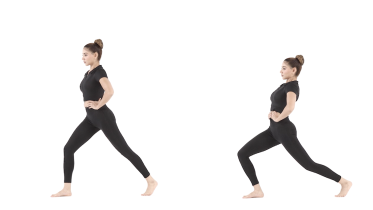
That mechanism belongs to a hip reached from the back, and it is only one direction. A replaced hip can also come out forward, and the position that does that is the leg taken back behind you with the foot turned outward, which surgeons have recorded as instability in extension with external rotation at the time of surgery (Di Schino and colleagues, 2009). So opening the front of the hip is not an obvious safe alternative to crossing your legs, and the hip flexor stretch in the program below is one to clear with your own team rather than one to swap in.
Pain in a replaced hip that is new, or worse than it was, is not something to work on with exercises, and the people to take it to are the surgical team rather than a physio appointment next week. New or rapidly worsening pain, a wound that is red, hot or leaking, a fever, or a calf that is newly swollen or getting more swollen, warm or tender all mean contacting that team the same day rather than waiting. The total hip replacement rehab program explains the usual stages, and the warning signs on this page carry the routes for a dislocation, a loosening, an infection and a break in the bone around the implant, each with its own timing.
Two specifics, because sitting is what this page is about. Groin pain that shows up when you stand out of a chair or lift the leg, rather than when you walk, can come from the tendon at the front of the hip being caught against the implant: a Scottish review of 1,000 hip replacements found 24 people, 2.4%, diagnosed with that, and they were younger on average than the people having the operation (Howell and colleagues, 2021). Image-guided steroid injection with physiotherapy settled it completely in 61% of those cases, and 8 of the 24, all of whom had responded to an injection at first, later had surgery, so it is a question to put to your team rather than something to stretch at. The toilet is worth naming as well. In a series of 2,612 replacements done from the front or the side where no restrictions were given at all, four hips dislocated, at an average of 5 days after surgery, and two of those four happened at the toilet (Restrepo and colleagues, 2011).
Four in 2,612 is a small number, and that is the point: the seat height and something firm to push up from earn their place on a discharge list without the risk being large.
If you have had a hip replacement, get the go-ahead from your surgeon or physio before you try sit to stand, the glute bridge, the isometric clamshell, standing hip abduction or the hip flexor stretch. Some operations limit this kind of work for the first months, so the timing depends on your surgery. The same goes for a hip fixed after a break, with screws, a nail or a plate, and for a resurfacing. After a break the bone sets the timing as much as the soft tissue does, and how much weight may go through that leg is a decision your surgeon has already made rather than one to work out from how it feels.
Hip pain when sitting too long: how to break it up
The most effective change is the least interesting one. Get up before the hip asks you to, rather than waiting for the ache and then jumping out of the chair. Every 20 to 30 minutes, even for half a minute, suits most sore hips better than one long break at lunchtime.
Alternate what you do so some tasks happen standing. Take calls on your feet. Set the seat up once rather than adjusting it when it already hurts. On a long drive, plan the stops, and give yourself a minute on your feet before you lift anything out of the car.
If you are pregnant, pain around the hip and pelvis is handled differently, with your own midwife or maternity physio leading, and our pregnancy back and pelvic pain program is the place to go instead of this page. Either way, clear these exercises with your midwife or physio before you start any of them. The glute bridge is done flat on your back, and if you are past the first three months, check with your physio before exercising in that position.
Three more checks. Standing hip abduction and the sit to stand put you on one leg or move you in and out of a chair, so if your balance is not steady or you have fallen in the past year, do them next to a counter or a sturdy chair and keep a hand on it. If you have high blood pressure, breathe steadily through every hold and never hold your breath, which matters most on the isometric clamshell, where the temptation is to brace and hold. And if your sore spot is the bone you sit on, go easy on anything that pulls the hamstring long: stretching it hard presses the tendon against the bone it attaches to, which is the same squeeze that sitting applies, so that is usually the last thing to add rather than the first.
Exercises that can help
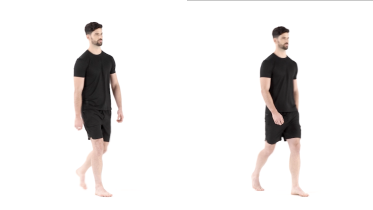
These are starting points for the muscles that sitting leaves long or short, not a program for a diagnosis. The sit to stand usually starts at 2 to 3 sets of 5 to 10 and is as much a technique drill as a strength one. The glute bridge often starts at 2 to 3 sets of 10 to 12 and standing hip abduction at 2 to 3 sets of 10 to 15 on each leg. The isometric clamshell is a hold rather than a lift, so it is counted differently: 5 to 10 seconds, 5 to 10 times on each side, at a moderate effort rather than a maximum squeeze. The hip flexor stretch is held 20 to 30 seconds and repeated 2 to 3 times each side. Brisk walking commonly begins at 10 to 20 minutes on most days. Your physio will adjust this. Leave out anything that brings on sharp groin pain or makes you limp afterward.
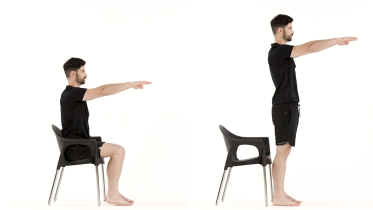 Sit to stand
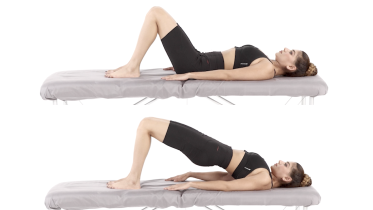 Glute bridge
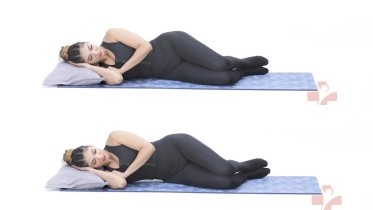 Isometric clamshell
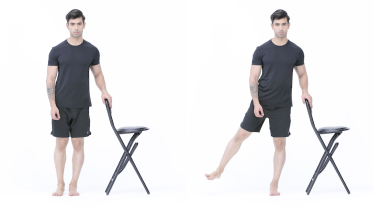 Standing hip abduction
 Hip flexor stretch
 Brisk walking
When should hip pain when sitting be checked?
Book an appointment if hip pain is stopping you doing normal things, is affecting your sleep, is getting worse, keeps coming back, has not improved after 2 weeks of home care, or if stiffness lasts more than 30 minutes after waking, which are the thresholds the NHS uses. Those are for a hip that has not been replaced. A new hip that has started hurting goes to the surgical team, with the timings in the warning signs below.
Bring the details that are easy to forget. How long you can sit before it starts. Which chairs are worst. What it costs you to stand up. Whether crossing your legs makes a difference, and whether anything travels below the knee.
A physio will test the joint, the tendons and the back, and watch you get out of a chair, which tells them more than most tests do.
Some signs should not wait for an appointment. Read the warning signs below, and act on the timing given for each line.
Related exercise programs
Warning signs
Get emergency help now
- Emergency: you have had a fall or an injury and now have severe hip pain, or you cannot walk or put weight on the leg. Call emergency services or go to an emergency department. This can be a sign of a broken hip (hip fracture).
- Emergency: tingling or loss of feeling in the hip or leg after a fall or injury. Call emergency services or go to an emergency department.
- Emergency: you have had a hip replacement and have sudden severe pain in your hip or groin, sometimes with a clunk or pop, and you cannot move the leg or put weight on it, or the leg suddenly looks shorter or turned in or out. Do not try to walk on it or push it back into place. Keep still and call emergency services or go to an emergency department, and do not drive yourself. Your new hip may have come out of its socket (dislocated), and a medical team needs to put it back.
- Emergency: your operated leg looks shorter than it did, or its foot turns in or out more than before, or the hip moves in an unusual way, even if the pain is not severe. Keep your weight off it and go to an emergency department straight away, and do not drive yourself. If you are in severe pain or cannot move the leg, call emergency services.
- Emergency: since your operation, you suddenly become short of breath, you get chest pain or pain in your upper back that may be worse when you breathe in, you cough up blood, your heart is beating very fast, or you faint. Call emergency services straight away, even if your leg looks normal. These can be signs of a blood clot in the lungs (pulmonary embolism).
- Emergency: pain, tingling, numbness or weakness in both legs, numbness or altered feeling around your genitals or bottom, or new trouble peeing or controlling your bladder or bowels. The same applies if you lose feeling in one leg. Call emergency services or go to an emergency department straight away. These can be signs of pressure on the nerves at the base of the spine (cauda equina syndrome).
- Emergency: your foot or leg suddenly turns cold, pale or blue, or suddenly becomes very painful, numb or weak, even while you are resting. Call emergency services or go to an emergency department straight away. This can be a sign that the blood supply to the leg is blocked, which needs treatment at once.
Get help today
- Same day: the hip is hot and swollen, the skin around it has changed color, or you have hip pain with a high temperature or feel hot, cold or shivery. Get medical help the same day, and go to an emergency department if you feel very unwell. A joint infection needs treatment quickly. If you have a very high or very low temperature, shivering you cannot control, you are breathing very fast or finding it hard to breathe, you are confused or your speech is slurred, your skin, lips or tongue look blue, gray, pale or blotchy (on brown or black skin this can be easier to see on the palms of the hands or soles of the feet), or you have a rash that does not fade when you press it, call emergency services, as this can be sepsis.
- Same day: at any time after your operation, even years later, new pain in your new hip along with a high temperature or feeling hot, cold or shivery, or a hip that becomes hot, red or swollen, which counts on its own, with or without pain and with or without a temperature. Contact your surgical team or get medical advice the same day. A new joint can become infected long after the operation, and that needs treating quickly. A normal temperature is not an all clear: OrthoInfo says fever is no longer considered a sign of an infection after a joint replacement, that the signs can be as little as mild redness and swelling and sometimes there are none at all, and that increased pain or stiffness in a joint that had been working well is one of them. So do not wait for a temperature before you report new or increasing pain in your new hip to your surgical team.
- Same day: you have had a hip replacement and your hip clunks and feels as if it partly slipped out of place and went back, even if it settles straight away and your leg looks normal. Stop the exercises, avoid the movement that brought it on, go back to your crutches or frame, and keep away from deep bending, crossing your legs and twisting on that leg until you have been seen. Contact your surgical team or get medical advice the same day. If the leg then looks shorter or turned, or you cannot move it or put weight on it, call emergency services.
- Same day: you have had a hip replacement, or a broken hip fixed with screws, a nail or a plate, and after a fall or a knock, even a small one, your hip, groin or thigh is newly painful, bruised or swollen, even if you can still walk and your leg looks normal. Stop the exercises and keep your full weight off that leg, using your stick, frame or crutches if you have them and asking someone for help to move about, then contact your surgical team or get medical advice the same day. A break in the bone around a new hip, or around metalwork left in the bone, is not always obvious at first, and walking normally on one can move the broken ends apart.
- Same day: severe hip pain that came on suddenly without a fall, or pain that is getting worse quickly over a few days. Get medical advice the same day.
- Same day: new hip or groin pain after a fall, even a small one, if you are older, have low bone density (osteoporosis) or have taken steroid tablets for a long time, even if you can still walk. Get medical advice the same day. A broken hip is not always obvious at first.
- Same day: you felt or heard a pop or snap high at the back of your thigh, near the buttock or the bone you sit on, and now have large bruising spreading down the back of the thigh, a gap or dip you can feel, a stiff-legged walk, or clear weakness when you bend the knee. Get assessed the same day at urgent care or an emergency department, and ask whether you need a scan and a surgeon's opinion. The tendon may have pulled away from the bone (proximal hamstring avulsion). When surgery is needed, repair within the first 4 weeks is favored over later repair, so do not wait to see if it settles. This page does not cover this injury.
- Same day: a leg or foot that is getting weaker, for example your foot drags, catches on the ground or slaps down when you walk (foot drop). Get medical advice the same day. If the weakness is getting worse by the hour, go to an emergency department.
- Same day: a calf or thigh that is newly swollen or getting more swollen, warm, tender, red or darker than usual, has swollen veins that are sore to touch, or has a throbbing or cramping pain that does not fit your injury or condition, or that feels different from normal muscle soreness after exercise. This can be a sign of a blood clot (deep vein thrombosis), especially after surgery, an injury, time in a cast or boot, a long trip or a spell of being much less mobile than usual. Get medical advice the same day. If you are also short of breath or have chest pain, call emergency services.
- Same day: a child or teenager has sudden pain in the hip, thigh or knee, is limping, or cannot put weight on one leg. Get an urgent appointment with a doctor the same day. If they have a high temperature or seem very unwell, go to an emergency department. This page is for adults, and hip pain in children has different causes.
- Same day: hip or groin pain that is worse at night or does not ease with rest, and keeps getting worse. If you are being treated for cancer now, contact your cancer team the same day.
Book an appointment
- Within a day or two: hip or groin pain that is worse at night or does not ease with rest, and keeps getting worse. If you have had cancer, now or in the past, or are losing weight without trying, see your doctor sooner, within a day or two, and mention it. This applies even if the pain is not getting worse.
- Within a few days: hip or groin pain that is worse at night or does not ease with rest, and keeps getting worse. See your doctor within a few days.
- Within a few days: new groin or hip pain and you take steroid tablets long term, or have in the past, or you regularly drink a lot of alcohol. This can be a sign of a problem with the blood supply to the top of the thighbone (avascular necrosis). Book an appointment with your doctor within a few days and mention the steroids or alcohol.
- Within 2 weeks: pain that spreads down the leg below the knee, especially with numbness or tingling in the leg or foot. The pain may be coming from your lower back rather than the hip. Book an appointment with a doctor or physio.
- Routine: pain in your new hip that had settled and has come back, or pain that is getting worse month by month, for example in the groin or thigh when you first stand up and start to walk. This is not an emergency, but ask your surgical team for a review, as the parts of a new joint can loosen or wear over the years. Get medical advice the same day instead, not a routine appointment, if the hip also becomes hot, red or swollen, or you have a high temperature or feel hot, cold or shivery, or the pain is building week by week rather than month by month. A new joint can become infected years after the operation, and the two can feel similar at first.
- Routine: pain or aching in a leg that comes on when you walk and goes after a few minutes' rest, and a doctor has not checked it yet. Book an appointment with your doctor. Narrowed arteries in the legs (peripheral arterial disease) can cause this too, and they need different treatment. If the distance you can walk before the pain starts has become much shorter over a few weeks, see your doctor within a few days. Pain, tingling, numbness or weakness in both legs is on the emergency list above.
Common questions
Why does my hip hurt when I sit but not when I walk?
Because sitting is a position and walking is a movement, and they load the hip in opposite ways. Sitting holds the hip bent, which narrows the front of the joint, and it puts your body weight directly through the bone you sit on and the tissues over it. Walking takes the hip into and out of extension and lets the blood move. So a joint that is irritable at the front, a tendon at the sitting bone, or a nerve in the deep buttock can all be quiet on the move and loud in a chair. It is a pattern worth reporting rather than apologizing for, and it tends to send a physio looking at the front of the joint and the buttock first. Pain that is worst when you walk follows a different pattern, which our page on hip pain when walking covers.
Why does sitting cross legged hurt my hip?
Two different reasons, and which one applies to you decides what you do about it. If the pain is over the bony point on the outside of the hip, crossing one knee over the other takes the thigh across the middle of your body, which rotates the top of the thigh bone and presses that point into the tendons lying over it. That is the mechanism described by Grimaldi and colleagues (2015), and our page on sitting and crossing your legs with outer hip pain goes through it in detail, including why the hip often objects later rather than at the time. If the pain is deep in the groin instead, crossing adds bend and rotation to a joint that is already near the end of what it will give comfortably, which is the pattern on our hip impingement page. And if you have had a hip replacement, crossing your legs is on most surgeons' restriction lists for a different reason again, which is covered in its own section on this page.
Why does my hip hurt when I sit on the toilet?
Nearly always the height, not the sitting. A low seat closes the angle between your thigh and your trunk further than a dining chair does, and it makes standing up a harder push from a deeper position. The NHS advises people with hip pain not to sit in low chairs, because it puts extra pressure on the hips, and the same logic applies here. A raised toilet seat, sold as an elevated toilet seat in the United States and Canada, is the usual answer, and so is having something firm to push up from. If you have had a hip replacement, a raised seat is often part of the standard advice rather than an optional extra, and our page on stairs, car transfers and the toilet covers that properly.
How should I sit with hip pain?
Aim for hips level with your knees or a little higher, both feet flat on the floor and under your knees rather than out in front or tucked back, and knees roughly hip width apart, not pressed together and not crossed. A firm cushion in a soft chair does most of that in one move. Then stop treating it as a posture problem and treat it as a time problem: get up every 20 to 30 minutes, even for half a minute, before the hip starts complaining. Nobody is asking you to sit with your knees wide, which is uncomfortable and unnecessary. If you have had a hip replacement, the restrictions from your own surgical team set the seat height and the leg positions, and they come first.
How long should hip pain when sitting last before I get it checked?
The NHS threshold for hip pain is to see a GP if it is stopping you doing normal activities or affecting your sleep, if it is getting worse or keeps coming back, if it has not improved after treating it at home for 2 weeks, or if you have hip stiffness for more than 30 minutes after waking up. That last one is worth noting, because start-up stiffness that clears quickly behaves differently from stiffness that drags on. Those thresholds were written for a hip that has not been operated on. If your hip has been replaced, new pain in it, or pain that had settled and came back, goes to your surgical team instead and does not go onto a 2 week clock. Some signs do not wait 2 weeks either: read the warning signs section on this page, because each line carries its own timing and several of them are same day or sooner.
References
- NHS. Hip pain in adults. Page last reviewed 20 November 2025. https://www.nhs.uk/symptoms/hip-pain/
- National Institute for Health and Care Excellence. Osteoarthritis in over 16s: diagnosis and management (NG226). Published 2022. https://www.nice.org.uk/guidance/ng226
- Grimaldi A, Mellor R, Hodges P, Bennell K, Wajswelner H, Vicenzino B. Gluteal tendinopathy: a review of mechanisms, assessment and management. Sports Medicine. 2015;45(8):1107-1119. https://doi.org/10.1007/s40279-015-0336-5
- Rich A, Cook J, Hahne A, Ford J. Treatment of proximal hamstring tendinopathy with individualized physiotherapy: a clinical commentary. International Journal of Sports Physical Therapy. 2025;20(6). https://doi.org/10.26603/001c.138308
- Hall M, Lawford BJ, Hinman RS, et al. Exercise for osteoarthritis of the hip. Cochrane Database of Systematic Reviews. 2026;2026(7):CD007912. https://doi.org/10.1002/14651858.CD007912.pub3
- Griffin DR, Dickenson EJ, O'Donnell J, et al. The Warwick Agreement on femoroacetabular impingement syndrome (FAI syndrome): an international consensus statement. British Journal of Sports Medicine. 2016;50(19):1169-1176. https://doi.org/10.1136/bjsports-2016-096743
- Hopayian K, Danielyan A. Four symptoms define the piriformis syndrome: an updated systematic review of its clinical features. European Journal of Orthopaedic Surgery and Traumatology. 2018;28(2):155-164. https://doi.org/10.1007/s00590-017-2031-8
- American Academy of Orthopaedic Surgeons. Total hip replacement. OrthoInfo. https://www.orthoinfo.org/en/treatment/total-hip-replacement/
- American Academy of Orthopaedic Surgeons. Infection after joint replacement. OrthoInfo. https://www.orthoinfo.org/en/diseases--conditions/joint-replacement-infection/
- NHS. Complications of a hip replacement. Page last reviewed 6 March 2024. https://www.nhs.uk/tests-and-treatments/hip-replacement/complications-of-a-hip-replacement/
- NHS. Recovering from a hip replacement. Page last reviewed 6 March 2024. https://www.nhs.uk/tests-and-treatments/hip-replacement/recovering-from-a-hip-replacement/
- Howell M, Rae FJ, Khan A, Holt G. Iliopsoas pathology after total hip arthroplasty: a young person's complication. Bone and Joint Journal. 2021;103-B(2):305-308. https://doi.org/10.1302/0301-620X.103B2.BJJ-2020-1318.R1
- Restrepo C, Mortazavi SM, Brothers J, Parvizi J, Rothman RH. Hip dislocation: are hip precautions necessary in anterior approaches? Clinical Orthopaedics and Related Research. 2011;469(2):417-422. https://doi.org/10.1007/s11999-010-1668-y
- Di Schino M, Baudart F, Zilber S, Poignard A, Allain J. Anterior dislocation of a total hip replacement. Radiographic and CT-scan assessment. Behavior following conservative management. Orthopaedics and Traumatology: Surgery and Research. 2009;95(8):573-578. https://doi.org/10.1016/j.otsr.2009.08.003
- NHS. DVT (deep vein thrombosis). Page last reviewed 30 April 2026. https://www.nhs.uk/conditions/deep-vein-thrombosis-dvt/
- NHS. Sciatica. Page last reviewed 3 December 2024. https://www.nhs.uk/conditions/sciatica/
Written and checked by the PocketPhysio editorial team. Last updated 2026-10-28.
This page is general education, not a diagnosis or a personal treatment plan. See a physiotherapist or doctor for advice about your own situation.