
Hip pain when walking: what it points to and what helps
Why walking is what brings it out
Walking is a series of single-leg balances. Each step puts your body weight through one hip while the muscles around it hold the pelvis steady and the other leg swings through. Whatever structure around that hip is irritated tends to speak up at exactly that moment, which is why a hip can feel fine in a chair and sore 10 minutes into a walk. A pain score tells you very little here. Where you feel it and when in the walk it arrives matter far more, and so does what the hip is like the next morning.
Pain from the hip joint is also a traveler. It is commonly felt in the groin and can spread to the buttock, the thigh or even the knee (OrthoInfo). Plenty of people point at the side of their hip and turn out to have a joint problem, and plenty point at their back and turn out to have a tendon problem. Where you feel it is a strong clue, not proof.
What causes hip pain when walking?
These are the patterns that point toward one cause or another. They are what a physio or doctor weighs up, not a diagnosis, and two causes can sit together in the same hip.
Groin or the front of the hip
Deep groin pain, sometimes spreading into the front of the thigh, usually means the joint itself. Hip osteoarthritis is the common version from middle age on: OrthoInfo lists groin pain as the most frequent site, along with stiffness that makes walking and bending harder, a grinding noise in the joint and a reduced range of movement that can cause a limp. Start-up stiffness is typical, so the first few steps after you have been sitting are often the worst and then it loosens.
NICE says osteoarthritis can be diagnosed without a scan when a person is 45 or over, has joint pain that comes on with activity, and has either no morning stiffness or stiffness that clears within 30 minutes (NG226). Morning stiffness that drags on much longer is one of the features that sends a doctor looking for another explanation. The hip osteoarthritis program is the one to follow if that is the diagnosis you have been given.
In younger and middle-aged adults who are active, the same groin pain more often traces back to the shape of the joint and the cartilage rim around the socket. The Warwick Agreement describes hip impingement as pain in the hip or groin linked to movement or position, sometimes with clicking, catching, locking, stiffness or the hip giving way (Griffin and colleagues, 2016). Deep bending and twisting are the usual triggers, and a long or brisk walk adds enough repetition to keep it grumbling. An international research network groups impingement, hip dysplasia or instability, and labral and cartilage problems together as hip-related pain in this age group, and says neither the examination nor the scan settles which one it is on its own (Reiman and colleagues, 2020).
See hip impingement and hip labral tear for the detail on those two. Groin pain that began in a single moment during kicking, sprinting or a sharp turn is a different problem and belongs with groin strain. A sharp pull felt at the front of the hip in that same kind of moment fits a hip flexor strain.
The side of the hip
Pain over the bony point on the outside of the hip, tender to press and sometimes running down the outer thigh, usually comes from the buttock tendons where they attach there. It is typically worse with tasks that load one leg at a time, such as stairs and walking uphill, and worse again lying on that side in bed (Grimaldi and colleagues, 2015). Long walks, hills and camber on the road are the everyday triggers. In a trial of 204 people with this problem, a program of education and exercise did better than a wait and see approach at 8 weeks and still did better a year later (Mellor and colleagues, 2018), so treating it beats waiting it out. The greater trochanteric pain syndrome program sets out the exercises, and outer hip pain works through the other things that hurt in that spot.
The buttock
Pain behind the hip often belongs to the lower back or the pelvis rather than the hip joint. Sacroiliac joint pain sits around the dimple at the top of the buttock and can spread into the back of the thigh; no single test settles it, so clinicians rely on a group of provocation tests taken together (Laslett and colleagues, 2005).
An irritated nerve in the lower back gives a different picture again. The NHS puts sciatica symptoms in the buttock and down the back of one leg, often into the foot and toes, with sharp or burning pain, pins and needles, numbness or weakness, and pain that can worsen when you move, sneeze or cough. Piriformis syndrome is a narrower label: a review of the published cases found the features reported most often were buttock pain, pain that is worse sitting, tenderness near the notch where the sciatic nerve leaves the pelvis, and pain on movements that tighten that muscle (Hopayian and Danielyan, 2018). The same review found the accuracy of those features unproven, which is why clinicians use the label carefully. The sacroiliac joint pain, sciatica and piriformis syndrome programs cover these.
Pain that travels below the knee, or comes with pins and needles, numbness or weakness in the leg or foot, is the part to mention at any appointment. It changes what gets examined.
Pain that built up with running, marching or big walking weeks
When the training load has gone up fast, think about bone. A stress fracture in the neck of the thighbone shows itself as exertional groin pain in runners and military recruits, and it is often missed at first, which is why early suspicion and early review are the advice (Clough, 2002). The pattern to take seriously is groin pain that built over weeks, now hurts with ordinary walking, and makes you limp. This is not one to walk off. It has its own warning sign below, and the answer is to stop running and jumping and be seen the same day.
An ache that arrives at the same distance every time
Some leg pain on walking is a circulation problem rather than a joint or tendon one. The NHS describes peripheral arterial disease as a painful ache in the legs when walking that usually disappears after a few minutes' rest, and lists smoking as the biggest risk factor, along with diabetes, high blood pressure, high cholesterol and older age. What people notice is how regular it is: much the same distance brings it on, a few minutes of rest clears it, and it returns at about the same distance next time. A hip or tendon problem is rarely that predictable.
That pattern is a reason to be checked, though, not a test you can finish at home. Narrowing in the lower back can produce leg and buttock pain after a set distance too, and OrthoInfo notes that people with spinal stenosis often feel better leaning forward or sitting, while standing up straight and walking make it worse. Some people have both. Narrowed arteries need different treatment from a hip or a back, so book the appointment and let the examination sort it out. The warning signs below give the levels of urgency, and the spinal stenosis program covers the back version.
A limp, whatever the cause
People mention a limp as an afterthought, which undersells it. Limping shifts load onto the other leg and the back, and it usually means the hip is being asked for more than it can currently give. When a hip that used to walk normally starts to limp, shorten the walk rather than pushing through it, and get it looked at if it does not settle within a couple of weeks. A limp that comes with a fever, that follows a fall, or that appears in a child or teenager is on the warning list below and needs help sooner.
How much walking, and what helps at home
Keep walking, but change the dose. The NHS advice for hip pain is to stay active while avoiding too much strain on the hip, and to skip carrying heavy loads or sitting in low chairs. In practice that usually means splitting one long walk into two or three shorter ones and picking flatter ground for a few weeks. Slow the pace before you cut the distance, and judge the walk by the next morning rather than by how it feels at the time.
Keep walking is the general rule here, not a rule for every hip. If one of the warning signs below fits you, the answer is to stop walking and get checked first. The stress fracture pattern is the clearest example of that.
For a flare, the NHS suggests holding an ice pack wrapped in a towel on the hip for up to 20 minutes, every 2 to 3 hours, with paracetamol (acetaminophen) or an ibuprofen gel if you need it. The NHS also suggests comfortable, shock-absorbing shoes with a soft sole, and worn-out shoes are an easy thing to fix. If you carry extra weight, NICE advises that losing some improves pain and function in osteoarthritis, and that any amount of loss is likely to help. If the pain keeps coming back, you still need to find out why.
Hip pain that is at its worst when you sit still, rather than when you move, follows a different pattern, so say that clearly at your appointment. After a hip replacement or other hip surgery, the program from your surgical team and physio comes first, not this page.
If you are pregnant, pain over the pubic bone, at either side of the lower back or spreading into the thighs, worse with walking, stairs and standing on one leg, is often pregnancy-related pelvic girdle pain rather than a hip joint problem, and the NHS asks you to call your midwife or doctor if it is hard to move around. Your own midwife, doctor or maternity physio team comes first there, and the pregnancy back and pelvic pain program covers it.
Exercise for hip pain when walking
Strength around the hip is the common thread across most of these causes. For hip osteoarthritis, NICE says exercise should be offered to everyone with osteoarthritis, tailored to the person, and gives muscle strengthening and general aerobic fitness as its examples. It also tells clinicians to warn people that joint pain can rise when they first start. The Cochrane review of land-based exercise for hip osteoarthritis found that it probably reduces pain and improves function slightly compared with no exercise or usual care, and the reviewers judged those average changes unlikely to be large enough to make a clear difference (Hall and colleagues, 2026). The evidence for the other causes sits on their own program pages, so go there once you know which one fits.
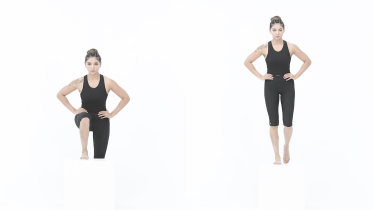
The six below are starting points, not a full program. They work the muscles that hold the pelvis level and push you forward in each step, which is what walking asks for. Leave out anything that brings on sharp groin pain or makes you limp afterwards, and hold a counter for the standing ones if your balance is not steady. When the sore spot is the bony point on the outside of the hip, keep the working leg from crossing the midline of your body, because that position presses the tendons against the bone (Grimaldi and colleagues, 2015).
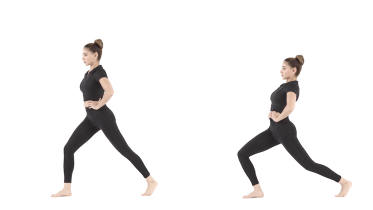
If you have had a hip replacement, get the go-ahead from your surgeon or physio before you try the glute bridge, the clamshell, sit to stand, standing hip abduction, the step up or the hip flexor stretch. Some operations limit this kind of work for the first months, so the timing depends on your surgery. If you are pregnant, check with your midwife or physio before you start. The glute bridge is done flat on your back, and if you are past the first three months, check with your physio before exercising in that position.
Exercises that can help
Most of the strength exercises here start at 2 to 3 sets of 8 to 15 repetitions, the sit to stand at 2 to 3 sets of 5 to 10, and the hip flexor stretch is held 20 to 30 seconds and repeated 2 to 3 times on each side. Your physio will adjust this. Anything that leaves you limping afterwards, or hurting more the next morning, was too much for now.
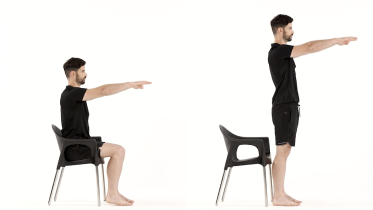 Sit to stand
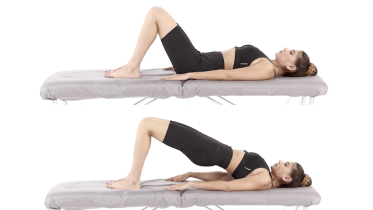 Glute bridge
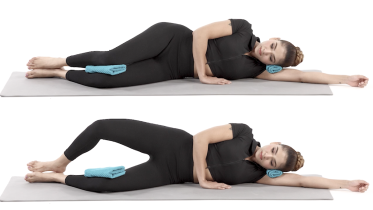 Clamshell
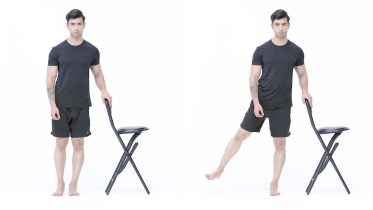 Standing hip abduction
 Step up
 Hip flexor stretch
When to see a physio (physical therapist)
Book an appointment if hip pain is stopping you doing normal things, is affecting your sleep, is getting worse, keeps coming back, or has not improved after 2 weeks of looking after it at home, which is the threshold the NHS uses. Stiffness that lasts more than 30 minutes after waking is another reason to get checked. A physio will watch you walk, test the joint and the tendons, and check whether your back is part of the story. Then they can pick exercises for the cause rather than for the symptom. Bring the details that are easy to forget: how far you can walk before it starts, what it does on stairs, and whether it wakes you at night.
Some signs should not wait for an appointment. Read the warning signs below, and act on the timing given for each.
Related exercise programs
See a doctor promptly if
- Emergency: you have had a fall or an injury and now have severe hip pain, or you cannot walk or put weight on the leg. Call emergency services or go to an emergency department. This can be a sign of a broken hip (hip fracture).
- Emergency: tingling or loss of feeling in the hip or leg after a fall or injury. Call emergency services or go to an emergency department.
- Emergency: pain, tingling, numbness or weakness in both legs, numbness or altered feeling around your genitals or bottom, or new trouble peeing or controlling your bladder or bowels. The same applies if you lose feeling in one leg. Call emergency services or go to an emergency department straight away. These can be signs of pressure on the nerves at the base of the spine (cauda equina syndrome).
- Emergency: your foot or leg suddenly turns cold, pale or blue, or suddenly becomes very painful, numb or weak, even while you are resting. Call emergency services or go to an emergency department straight away. This can be a sign that the blood supply to the leg is blocked, which needs treatment at once.
- Same day: groin pain that built up with running, marching or jumping, often after you increased your training, and now hurts when you walk, makes you limp, or aches at rest or at night. Stop running and jumping and keep walking to a minimum until it has been checked. Get medical advice the same day and mention your training. If you cannot put weight on the leg, go to an emergency department. This can be a stress fracture in the neck of the thighbone (femoral neck stress fracture), which is easy to miss at first and can become a full break if you keep loading it.
- Same day: new hip or groin pain after a fall, even a small one, if you are older, have low bone density (osteoporosis) or have taken steroid tablets for a long time, even if you can still walk. Get medical advice the same day. A broken hip is not always obvious at first.
- Same day: the hip is hot and swollen, the skin around it has changed color, or you have hip pain with a high temperature or feel hot, cold or shivery. Get medical help the same day, and go to an emergency department if you feel very unwell. A joint infection needs treatment quickly.
- Same day: severe hip pain that came on suddenly without a fall, or pain that is getting worse quickly over a few days. Get medical advice the same day.
- Same day: a child or teenager has sudden pain in the hip, thigh or knee, is limping, or cannot put weight on one leg. Get an urgent appointment with a doctor the same day. If they have a high temperature or seem very unwell, go to an emergency department. This page is for adults, and hip pain in children has different causes.
- Same day: a leg or foot that is getting weaker, for example your foot drags, catches on the ground or slaps down when you walk (foot drop). Get medical advice the same day. If the weakness is getting worse by the hour, go to an emergency department.
- Same day: a severe burning pain in your feet or legs that carries on even when you rest, skin on your feet or lower legs that has become pale, shiny, smooth and dry, sores on your feet or legs that do not heal, or toes that have become cold and numb and are turning red and then black. Contact your doctor straight away, the same day. These can be signs that poor circulation in the legs has become serious (critical limb ischemia). If a sore or toe is also getting red, hot and swollen, or you feel feverish or very unwell, go to an emergency department.
- Same day: a calf or thigh that is newly swollen, warm, tender, red or darker than usual, has swollen veins that are sore to touch, or has a throbbing or cramping pain that does not fit your injury or condition, or that feels different from normal muscle soreness after exercise. This can be a sign of a blood clot (deep vein thrombosis), especially after surgery, an injury, time in a cast or boot, a long trip or a spell of being much less mobile than usual. Get medical advice the same day. If you are also short of breath or have chest pain, call emergency services.
- Within a few days: hip or groin pain that is worse at night or does not ease with rest, and keeps getting worse. See your doctor within a few days. If you have had cancer, now or in the past, or are losing weight without trying, see your doctor sooner, within a day or two, and mention it. This applies even if the pain is not getting worse. If you are being treated for cancer now, contact your cancer team the same day.
- Within a few days: new groin or hip pain and you take steroid tablets long term, or have in the past, or you regularly drink a lot of alcohol. This can be a sign of a problem with the blood supply to the top of the thighbone (avascular necrosis). Book an appointment with your doctor within a few days and mention the steroids or alcohol.
- Within 2 weeks: pain that spreads down the leg below the knee, especially with numbness or tingling in the leg or foot. The pain may be coming from your lower back rather than the hip. Book an appointment with a doctor or physio.
- Routine: pain or aching in your legs that comes on when you walk and goes after a few minutes' rest, and a doctor has not checked it yet. Book an appointment with your doctor. Narrowed arteries in the legs (peripheral arterial disease) can cause this too, and they need different treatment. If the distance you can walk before the pain starts has become much shorter over a few weeks, see your doctor within a few days.
Common questions
Should I keep walking with hip pain?
In most cases yes, but in smaller amounts and on flatter ground for a while. NICE recommends exercise for everyone with osteoarthritis, including general aerobic fitness as well as muscle strength, and walking is the simplest way to get it; the NHS tells people with hip pain to keep moving rather than rest up completely, while keeping heavy strain off the joint. The practical test is what happens afterwards: soreness that settles by the next morning is usually acceptable, while a hip that is worse the next day, or a walk that leaves you limping, means the distance was too far for now. Two or three short walks often sit better than one long one. Stop and get advice if the pain is sharp, if you cannot put weight on the leg, or if it began after a fall.
Why does my hip hurt walking up stairs or uphill?
Both put more weight through one leg at a time and ask the buttock muscles to hold the pelvis level for longer. Pain from the tendons on the outside of the hip is typically worse with exactly that kind of loading, including stairs and uphill walking, and the area is often tender to press (Grimaldi and colleagues, 2015). A stiff arthritic hip can also object, because going up needs more bend and more push off than walking on the flat, and OrthoInfo lists stiffness that makes walking and bending difficult among the usual symptoms. On stairs, hold the rail and take one step at a time while it is sore. Choosing a flatter route for a few weeks is a change to the load, not giving up on walking.
Why does my hip hurt when walking if I am young?
Hip osteoarthritis becomes more likely from middle age, so in a younger adult a physio will think about the shape of the joint, the rim of cartilage around the socket and the muscles and tendons around it. The Warwick Agreement describes hip impingement as groin or hip pain brought on by particular movements and positions, sometimes with clicking, catching, locking or a feeling of the hip giving way (Griffin and colleagues, 2016); pain of this kind is described mainly in young and middle-aged active adults (Reiman and colleagues, 2020). A strain of the groin or hip flexor muscles is another common cause in sport, and it usually starts in one identifiable moment. Bone matters too: groin pain that built up after a rise in running or marching, and now hurts at every step, may be a stress fracture and needs checking the same day. A child or teenager with hip, thigh or knee pain or a limp should see a doctor before starting any exercise program.
Can sciatica or hip bursitis cause hip pain when walking?
Both can. Sciatica starts with an irritated nerve in the lower back. The NHS says it usually runs down one leg, from the buttock to the foot and toes, with burning pain, tingling or numbness, and pain that can worsen when you move. What used to be called hip bursitis is now more often called greater trochanteric pain syndrome, because the tendons of the buttock muscles are usually involved rather than the fluid sac alone (Grimaldi and colleagues, 2015). That one is felt on the outside of the hip, is tender to press, and gets worse with loading one leg at a time. Telling them apart matters because the programs differ, so if the pain travels below the knee or comes with pins and needles, mention that at your appointment.
Should I use a walking stick for hip pain?
It can be a sensible short-term choice, and NICE says a walking aid such as a stick can be considered for people with osteoarthritis in a leg joint, which includes the hip. Hold it in the hand opposite the sore hip, so that it takes some weight off that side as you step, and set it about one small stride ahead as the painful leg goes forward (OrthoInfo). OrthoInfo also says that when you stand up straight, the top of the stick should reach the crease of your wrist, with your elbow slightly bent. Get a physio to check the height and the pattern if you can, because a stick that is too long or in the wrong hand tends to make walking harder rather than easier. Using one for a few weeks while you build strength is different from using one for good.
References
- NHS. Hip pain in adults. Page last reviewed 20 November 2025. https://www.nhs.uk/symptoms/hip-pain/
- American Academy of Orthopaedic Surgeons. Osteoarthritis of the hip. OrthoInfo. https://www.orthoinfo.org/en/diseases--conditions/osteoarthritis-of-the-hip/
- National Institute for Health and Care Excellence. Osteoarthritis in over 16s: diagnosis and management (NG226). 2022. https://www.nice.org.uk/guidance/ng226
- Hall M, Lawford BJ, Hinman RS, et al. Exercise for osteoarthritis of the hip. Cochrane Database of Systematic Reviews. 2026;(7):CD007912. https://doi.org/10.1002/14651858.CD007912.pub3
- Griffin DR, Dickenson EJ, O'Donnell J, et al. The Warwick Agreement on femoroacetabular impingement syndrome (FAI syndrome): an international consensus statement. British Journal of Sports Medicine. 2016;50(19):1169-1176. https://doi.org/10.1136/bjsports-2016-096743
- Reiman MP, Agricola R, Kemp JL, et al. Consensus recommendations on the classification, definition and diagnostic criteria of hip-related pain in young and middle-aged active adults from the International Hip-related Pain Research Network, Zurich 2018. British Journal of Sports Medicine. 2020;54(11):631-641. https://doi.org/10.1136/bjsports-2019-101453
- Grimaldi A, Mellor R, Hodges P, Bennell K, Wajswelner H, Vicenzino B. Gluteal tendinopathy: a review of mechanisms, assessment and management. Sports Medicine. 2015;45(8):1107-1119. https://doi.org/10.1007/s40279-015-0336-5
- Mellor R, Bennell K, Grimaldi A, et al. Education plus exercise versus corticosteroid injection use versus a wait and see approach on global outcome and pain from gluteal tendinopathy: prospective, single blinded, randomised clinical trial. BMJ. 2018;361:k1662. https://doi.org/10.1136/bmj.k1662
- Laslett M, Aprill CN, McDonald B, Young SB. Diagnosis of sacroiliac joint pain: validity of individual provocation tests and composites of tests. Manual Therapy. 2005;10(3):207-218. https://doi.org/10.1016/j.math.2005.01.003
- Hopayian K, Danielyan A. Four symptoms define the piriformis syndrome: an updated systematic review of its clinical features. European Journal of Orthopaedic Surgery and Traumatology. 2018;28(2):155-164. https://doi.org/10.1007/s00590-017-2031-8
- NHS. Sciatica. Page last reviewed 3 December 2024. https://www.nhs.uk/conditions/sciatica/
- American Academy of Orthopaedic Surgeons. Lumbar spinal stenosis. OrthoInfo. https://www.orthoinfo.org/en/diseases--conditions/lumbar-spinal-stenosis/
- Clough TM. Femoral neck stress fracture: the importance of clinical suspicion and early review. British Journal of Sports Medicine. 2002;36(4):308-309. https://doi.org/10.1136/bjsm.36.4.308
- NHS. Peripheral arterial disease (PAD). Page last reviewed 10 April 2026. https://www.nhs.uk/conditions/peripheral-arterial-disease-pad/
- American Academy of Orthopaedic Surgeons. How to use crutches, canes, and walkers. OrthoInfo. https://www.orthoinfo.org/en/recovery/how-to-use-crutches-canes-and-walkers/
- NHS. Deep vein thrombosis (DVT). Page last reviewed 30 April 2026. https://www.nhs.uk/conditions/deep-vein-thrombosis-dvt/
- American Academy of Orthopaedic Surgeons. Osteonecrosis of the hip. OrthoInfo. https://www.orthoinfo.org/en/diseases--conditions/osteonecrosis-of-the-hip/
- NHS. Hip pain in children (irritable hip). Page last reviewed 3 April 2024. https://www.nhs.uk/symptoms/hip-pain-children-irritable-hip/
- NHS. Pelvic pain in pregnancy. https://www.nhs.uk/pregnancy/related-conditions/common-symptoms/pelvic-pain/
Written and checked by the PocketPhysio editorial team. Last updated 2026-09-30.
This page is general education, not a diagnosis or a personal treatment plan. See a physiotherapist or doctor for advice about your own situation.