
Spinal stenosis exercises and physiotherapy
What is lumbar spinal stenosis?
Lumbar spinal stenosis means the spaces in your lower back that the nerves pass through have become narrower. It usually comes from the wear and tear changes in the spine that build up with age, and OrthoInfo notes that it commonly affects people over 60. The North American Spine Society (NASS) guideline describes the typical pattern: pain or tiredness in the buttocks or legs, with or without back pain, brought on by walking or standing upright and eased by bending forward, sitting or lying down. Doctors call this pattern neurogenic claudication.
It is common. A review in JAMA estimates that about 11% of adults in the US have the symptoms of lumbar spinal stenosis, and that this rises with age (Katz 2022). OrthoInfo notes that some people can walk further when they lean on a shopping cart, or can ride an exercise bike when walking is hard. Both keep the back bent slightly forward, which can give the nerves more room.
The outlook is often better than people fear. In the JAMA review, among people followed for up to 3 years without surgery, about a third improved and about half stayed the same. About 10% to 20% got worse (Katz 2022).
If your leg pain is sharp, runs down one leg and started recently, the sciatica program may suit you better. If the pain stays in your back, start with the low back pain program.
Is it stenosis or poor circulation?
Leg pain that comes on with walking has another common cause: narrowed arteries in the legs, called peripheral arterial disease (PAD). The NHS describes it as a painful ache in the legs on walking that usually goes after a few minutes' rest. Stenosis symptoms, by contrast, usually ease when you sit down or bend forward (NASS), and standing up straight tends to make them worse (OrthoInfo). Only a proper check can tell the two apart, and some people have both. In one small study, people with stenosis who also had poor leg circulation had worse balance and more fear of falling than those with stenosis alone (Güneş 2021).
How quickly you need to be seen depends on the signs. Leg pain on walking that eases with rest and has not been checked needs a routine appointment with your doctor, as the NHS advises. If the distance you can walk shrinks quickly, see your doctor within a few days. Burning pain in the feet at rest, or sores on the feet that do not heal, need a doctor straight away, the same day. A foot or leg that suddenly turns cold, pale or numb is an emergency, and NHS referral guidance for doctors in Cornwall treats a suddenly blocked blood supply to the leg as an emergency admission.
Do exercises help spinal stenosis?
Exercise and physical therapy are a standard first step. The JAMA review lists activity changes (such as shorter spells of standing and walking), pain relief and physical therapy as first-line treatment (Katz 2022). The evidence behind them is modest, though.
The NASS guideline found too little evidence to recommend for or against physical therapy or exercise used on their own. Its expert group still considered a limited course of active physical therapy a reasonable option. A later systematic review found moderate-quality evidence that hands-on treatment combined with exercise (with or without education) improved symptoms and function in the short term more than medical care or community group exercise did (Ammendolia 2022). Most other non-surgical treatments had only low-quality evidence.
Exercise or surgery?
Nobody knows for certain which is better. One trial took 169 adults aged 50 or over who were already candidates for surgery and gave them either physical therapy or surgery. After 2 years, physical function had improved by a similar amount in both groups (Delitto 2015). But 57% of the physical therapy group crossed over to surgery during the trial, and there was no untreated comparison group.
A Cochrane review of 5 trials with 643 people found no clear difference in disability between surgery and non-surgical care at 6 months and 1 year, and a small difference in favor of surgery at 2 years (Zaina 2016). The evidence was low quality. The authors noted side effects in 10% to 24% of people having surgery, and no reported side effects from the non-surgical treatments. They had very little confidence in saying which approach is better.
The NASS guideline suggests decompression surgery for people with moderate to severe symptoms. So a common path is to give exercise a proper try first, then talk to a spine specialist if walking stays badly limited. Emergency signs, such as numbness around your genitals or new bladder or bowel trouble, skip this path entirely.
How to use this program
Pick the stage that matches you today. If you are not sure, start at stage 1. Move up when the current stage feels easy and your legs settle well afterward.
Each exercise page gives a typical starting dose. As a rough guide, many programs hold the stretches for 15 to 30 seconds, 2 to 5 times, once or twice a day. The strength exercises often start with 1 to 3 sets of 5 to 12 slow repetitions, and balance holds often start at a few seconds and build to 10 to 30 seconds, repeated a few times. Your physio will adjust this.
Walking and standing will often bring on some leg ache or heaviness when you have stenosis. That is expected, as long as it settles within a few minutes of sitting or bending forward and your legs are no worse the next morning. During the exercises themselves, stop any that send pain, numbness or tingling further down your leg, or leave symptoms lingering after you rest.
Stop and get medical advice the same day if numbness or weakness in your legs is getting worse, even if the pain is easing. Breathe normally through every exercise rather than holding your breath, especially if you have high blood pressure.
The exercise program
Stage 1: Ease the legs by bending forward
For when standing or walking quickly brings on leg pain, heaviness or tingling. These gently round your lower back, the direction that usually eases stenosis symptoms, and they are done lying down or on your hands and knees. On the cat-camel, keep the dip of the back small, because arching the lower back tends to stir stenosis up. Keep the exercises that leave your legs the same or easier, and leave out any that make leg symptoms spread or linger. Use a firm bed if getting down to the floor and up again is hard.
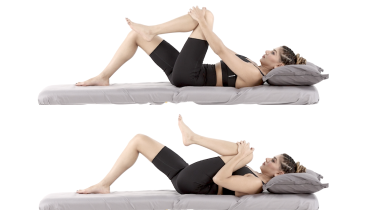 Knee to chest stretch
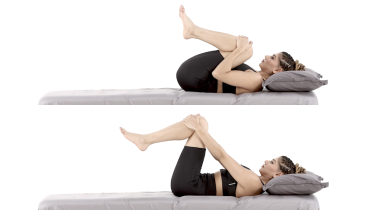 Double knee to chest stretch
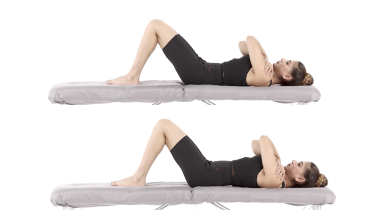 Pelvic tilt
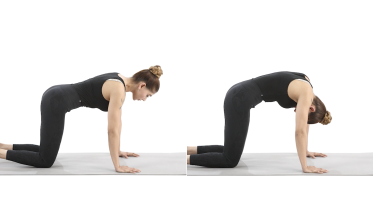 Cat-camel stretch
Stage 2: Build strength and start a walking plan
Once stage 1 feels comfortable and you want to walk further. Brisk walking here means walking in short spells with rests, as described below the program, and building up the total time slowly. Supine marching, the lying bicycle, the glute bridge and the pelvic curl work your stomach and hip muscles while your lower back stays flat or gently rounded. Sit to stand builds the thigh strength you need for chairs and stairs, and the Thomas stretch works the front of the hip while the hugged knee holds your lower back flat. Keep bridges and curls low enough that your back does not arch at the top.
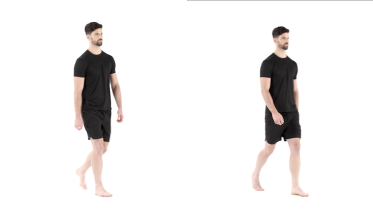 Brisk walking
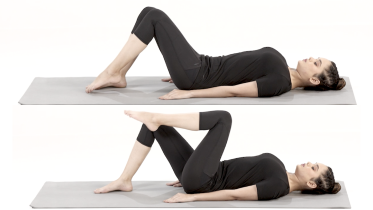 Supine marching
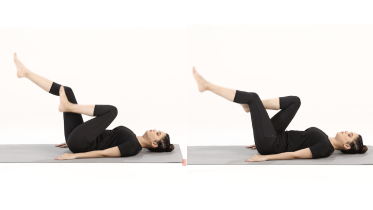 Lying bicycle exercise
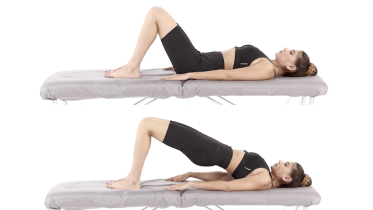 Glute bridge
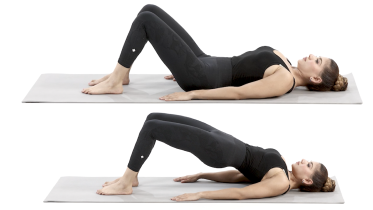 Pelvic curl
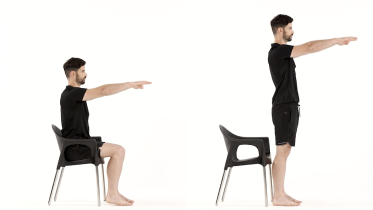 Sit to stand
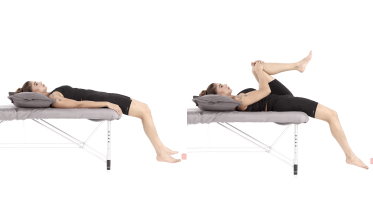 Thomas stretch
Stage 3: Balance and strength for walking further
Once stage 2 feels steady and walking is getting easier, move on to these balance and leg strength exercises, because numb, heavy or weak legs can make you less steady. Stand next to a kitchen counter or a sturdy chair for every standing exercise, and move from tandem stance to single leg stance to tandem walking only as each one feels safe. Leave standing with your eyes closed until last, and ask your physio first if your feet are numb. The two ball exercises need a firm ball and a clear space. Over the ball, lift each leg only as high as your body so your lower back does not arch, and if you have had a fall in recent months or feel unsteady on the ball, do the marching on a chair instead.
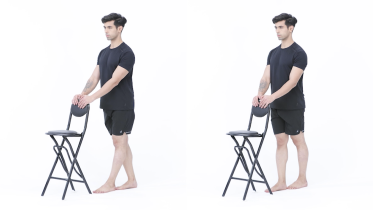 Tandem stance
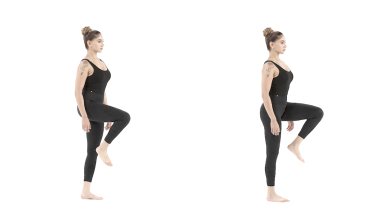 Single leg stance
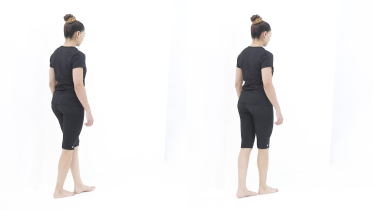 Tandem walking
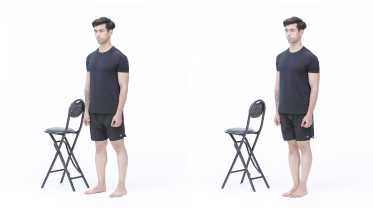 Standing balance with eyes closed
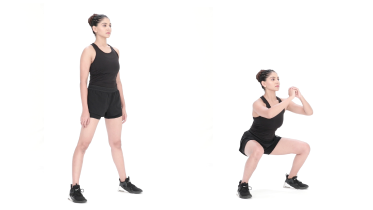 Squat hold
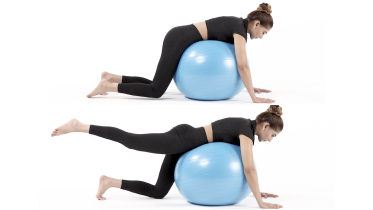 Hip extension over a gym ball
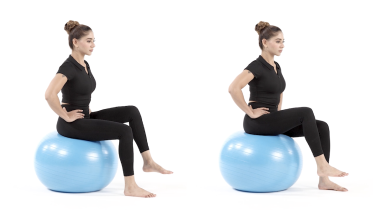 Seated ball marching
Building up your walking and cycling
Walking brings the symptoms on, and it is also part of the treatment. A walk and rest plan is common practice, although this exact method has not been tested on its own in trials: walk at a comfortable pace until your legs start to ache or feel heavy, then sit or lean forward until it settles, and set off again. Count the total walking time rather than the longest single spell. Add a little each week, and keep a note so you can see progress.
Plan routes with benches, or walk with a shopping cart or a walker to lean on. Your physio can advise on a walking aid and set it to the right height. If your walking distance keeps shrinking despite the plan, tell your doctor or physio.
Cycling is a good second option on days when walking is hard. A static exercise bike avoids the balance demands of riding outdoors and lets you lean slightly forward. Start with a few minutes and build up gradually.
Balance and falls
Stenosis may affect your balance as well as your walking. In a study of 1,101 older adults living at home in Japan, those with symptoms of stenosis were more likely to have fallen in the past year (Kobayashi 2026). When men and women were looked at separately, the link showed in men but not in women. That study looked at one point in time, so it cannot show that stenosis caused the falls.
Balance training helps. A Cochrane review found that exercise programs, especially those built on balance and functional exercises, reduce the rate of falls in older people living at home (Sherrington 2019). That review looked at older adults in general, not at stenosis in particular. The NHS advises doing activities that improve strength and balance at least twice a week.
The NHS also suggests shoes or slippers that fit well and grip the floor, grab rails where you need them, and a home kept clear of clutter and anything you could trip on. Have your eyes and hearing checked, and ask a GP or pharmacist if you think your medicines affect your balance. If you are worried about your balance or have had a fall, see your doctor, who may refer you to a falls service.
What to avoid or change
Bending backward often makes stenosis symptoms worse. Check with your physio before exercises that arch your lower back, such as standing back extension, prone lying, the cobra stretch and the superman. Long spells of standing still, such as queuing or cooking, can bring symptoms on. Break them up by sitting for a moment or leaning forward on a counter.
If you have low bone density (osteoporosis), ask your physio before the knee to chest stretches and the pelvic curl, because deep or repeated forward bending of the spine is usually limited. If you have had a hip replacement, several of these exercises bend the hip past a right angle, so get the go-ahead from your surgeon or physio first. Check with your doctor before starting the walking plan if you have a heart or lung condition or blood pressure that is not under control.
This program is not for rehab after spinal surgery. If you have had an operation on your back, follow your surgeon's program. If you are pregnant, check with your physio or midwife before you start. The program is written for adults. If a child or teenager has back or leg pain, get them checked by a doctor or physio first.
When to see a physio or doctor
See a physio or doctor if leg pain on walking is new and has not been checked, so the cause can be confirmed. Book an appointment too if your walking distance is getting shorter, if symptoms stop you doing normal activities, or if you are not improving after several weeks of regular exercise. A physio can check your strength, feeling and balance and set up a walking plan with you.
See your doctor within a few days if your walking distance has shrunk quickly over a few weeks, or if your balance is getting steadily worse or your legs feel stiff rather than achy. Pressure on the spinal cord in the neck can also make walking unsteady, so mention any clumsiness in your hands.
Some signs need help much faster, from an emergency visit to an appointment within a few days. They are listed under the warning signs below. The most urgent ones are numbness around your genitals or bottom, new bladder or bowel trouble, and a foot that suddenly turns cold, pale or numb.
For physiotherapists
This page gives patients a starting framework. The Ammendolia 2022 review found moderate-quality evidence for manual therapy with exercise over medical care or community group exercise in the short term. It also found moderate-quality evidence that manual therapy, education and exercise delivered with a cognitive-behavioral approach improved walking distance more than self-directed home exercise. The same review concluded that epidural steroids are not effective for neurogenic claudication, and NICE NG59 advises against epidural injections for neurogenic claudication in people with central spinal canal stenosis.
Screen for vascular claudication at the first visit. Check foot pulses and skin, ask whether standing still is enough to relieve the legs, and refer for vascular assessment when in doubt. Where both problems are present, the Güneş 2021 study found poorer balance and more fear of falling, so balance work may deserve a larger share of the program.
Degenerative cervical myelopathy can present with imbalance, frequent falls and loss of hand dexterity in people over 50, and it is often diagnosed late (Davies 2018). When gait problems seem out of proportion to the lumbar findings, or come with clumsy hands, examine the upper limbs and consider the neck.
For shared decision making, the Delitto 2015 trial is useful to discuss with patients: similar function at 2 years with physical therapy or surgery, alongside a 57% crossover rate to surgery. The NASS guideline's expert group considered the natural history favorable in about one third to one half of people with mild to moderate symptoms.
See a doctor promptly if
- Emergency: numbness, tingling or altered feeling around or under your genitals, between your inner thighs, or around your bottom (anus), for example it feels different when you wipe after using the toilet. Call emergency services or go to an emergency department straight away. This can be a sign of pressure on the bundle of nerves at the base of the spine (cauda equina syndrome), which needs emergency treatment.
- Emergency: you find it hard to start peeing, cannot pee, cannot feel yourself peeing or cannot control when you pee, or you do not notice when you need to poo or cannot control when you poo, and this is not normal for you. The same applies to a new change in how your genitals feel during sex, or new trouble getting an erection or ejaculating. Call emergency services or go to an emergency department straight away. These can also be signs of cauda equina syndrome.
- Emergency: sciatica in both legs, or tingling, numbness or weakness in both legs, that is new for you or getting worse quickly. The same applies if both legs keep getting weaker, even slowly, for example both feet drag or catch on the ground. Call emergency services or go to an emergency department straight away. Aching, heaviness or tingling in both legs that has built up slowly over weeks or months, comes on with walking or standing and settles within minutes when you sit or bend forward is the usual stenosis pattern and is not an emergency on its own. If a doctor has not checked it yet, book an appointment. If numbness in both legs is slowly spreading or getting worse, get medical advice the same day, and tell your doctor about any other change.
- Emergency: your foot or leg suddenly turns cold, pale or blue, or suddenly becomes very painful, numb or weak, even while you are resting. Call emergency services or go to an emergency department straight away. This can be a sign that the blood supply to the leg is blocked, which needs treatment at once.
- Emergency: hands that suddenly become clumsy, for example you can no longer do up buttons, or legs that become stiff, weak or unsteady over a few hours or days and stay that way when you rest. Call emergency services straight away. These can be signs of pressure on the spinal cord in the neck. Leg ache or heaviness that comes on with walking and settles when you sit is the usual stenosis pattern, not this.
- Emergency: back or leg pain that started after a serious accident, such as a car crash or a fall from a height, or back pain with chest pain. Call emergency services.
- Emergency: you have had a fall or an injury and now have severe hip pain, or you cannot walk or put weight on the leg. Call emergency services or go to an emergency department. This can be a sign of a broken hip (hip fracture).
- A leg or foot that is getting weaker, for example your foot drags, catches on the ground or slaps down when you walk (foot drop). Get medical advice the same day. If the weakness is getting worse by the hour, go to an emergency department.
- Same day: a severe burning pain in your feet or legs that carries on even when you rest, skin on your feet or lower legs that has become pale, shiny, smooth and dry, sores on your feet or legs that do not heal, or toes that have become cold and numb and are turning red and then black. Contact your doctor straight away, the same day. These can be signs that poor circulation in the legs has become serious (critical limb ischemia). If a sore or toe is also getting red, hot and swollen, or you feel feverish or very unwell, go to an emergency department.
- Back or leg pain with a fever, or you feel hot, cold, shivery or generally unwell. Get medical advice the same day, and go to an emergency department if you feel very unwell.
- New back or leg pain and you have had cancer, now or in the past, or you have lost weight without trying. Get medical advice the same day and mention it. If you are being treated for cancer now, contact your cancer team the same day.
- Emergency: you have had cancer, now or in the past, and your back or neck pain feels like a tight band around your body, or comes with pain spreading down an arm or leg, weakness, numbness or pins and needles in your arms or legs, trouble walking, or trouble controlling your bladder or bowels. Call your cancer team's emergency number straight away, or go to an emergency department if you do not have one or cannot get through. This can be cancer pressing on the spinal cord (metastatic spinal cord compression), which needs treatment straight away.
- Emergency: new neck or back pain after a fall, a knock or a jolt, even a minor one such as a trip or a sudden stop in a car, if you have a condition that stiffens the spine, such as ankylosing spondylitis. Call emergency services or go to an emergency department straight away, do not drive yourself, and tell the staff about your spine condition, so they keep your neck and back in their usual position. A stiff spine can break after a small injury, and the break is easy to miss at first. If the pain started straight after the injury, or you also have numbness, tingling or weakness in your arms or legs, keep still and call emergency services.
- Back pain after a minor fall or strain if you are older, have low bone density (osteoporosis) or have taken steroid tablets for a long time. Get medical advice the same day.
- Pain that does not ease at all with rest or changing position, or is worse at night. See your doctor within a few days. Get medical advice the same day if you also feel unwell, have lost weight without trying, or have had cancer, now or in the past. If you are being treated for cancer now, contact your cancer team the same day.
- Severe pain that comes on suddenly or is getting worse quickly. Get medical advice the same day.
- A calf or thigh that is newly swollen, warm, tender, red or darker than usual, has swollen veins that are sore to touch, or has a throbbing or cramping pain that does not fit your injury or condition, or that feels different from normal muscle soreness after exercise. This can be a sign of a blood clot (deep vein thrombosis), especially after surgery, an injury, time in a cast or boot, a long trip or a spell of being much less mobile than usual. Get medical advice the same day. If you are also short of breath or have chest pain, call emergency services.
- Hands that have slowly become clumsy, for example trouble doing up buttons or dropping things, or numbness in both hands. Get medical advice the same day. These can be signs of pressure on the spinal cord in the neck (cervical myelopathy). If the clumsiness or numbness gets worse quickly, call emergency services straight away.
- Routine: pain or aching in your legs that comes on when you walk and goes after a few minutes' rest, and a doctor has not checked it yet. Book an appointment with your doctor. Narrowed arteries in the legs (peripheral arterial disease) can cause this too, and they need different treatment. If the distance you can walk before the pain starts has become much shorter over a few weeks, see your doctor within a few days.
Common questions
Is walking good for spinal stenosis?
Walking is usually part of the plan, although it is also what brings the symptoms on. A common approach is to walk in spells: walk until your legs start to ache or feel heavy, rest by sitting or leaning forward until it settles, then walk again. Count the total minutes and add a little each week. OrthoInfo notes that some people can walk further while leaning on a shopping cart, and a walker you can lean on may help in the same way. Your physio will adjust the plan to your walking distance.
Is cycling good for spinal stenosis?
Often, yes. OrthoInfo notes that some people with stenosis can ride an exercise bike, and that leaning forward, as you do on a bike, can give the nerves more room. In a trial of 68 people with stenosis, cycling twice a week for 6 weeks, added to an exercise program, did as well as treadmill walking with part of the body weight supported, and both groups improved (Pua 2007). The authors thought some of that improvement was probably natural recovery. A static exercise bike avoids the balance demands of riding outdoors.
What exercises should I avoid with spinal stenosis?
No exercise is banned for everyone, but bending backward often makes stenosis worse. Check with your physio before exercises that arch the lower back, such as the cobra stretch, the superman, prone back extensions and standing back bends. If you have low bone density (osteoporosis), ask before deep forward bending stretches too. What matters most is how your legs respond: an exercise that leaves leg symptoms lingering or spreading is one to drop for now.
Does spinal stenosis get worse over time?
Not for most people. A review in JAMA describes people with stenosis followed for up to 3 years without surgery: about a third improved, about half stayed the same, and about 10% to 20% got worse (Katz 2022). The NASS guideline says that for people with mild to moderate symptoms, a rapid or severe decline in nerve function is rare. Tell your doctor if your walking distance keeps shrinking, or your legs get weaker or more numb.
Will I need surgery for spinal stenosis?
Many people never do. The NHS lists physiotherapy, losing weight if you are overweight, and steroid injections among the treatments you may have before an operation to take pressure off the nerves (lumbar decompression). The NASS guideline suggests decompression surgery for people with moderate to severe symptoms. In one trial, people who were already candidates for surgery did about as well at 2 years with physical therapy as with surgery, but more than half of the physical therapy group went on to have surgery anyway (Delitto 2015). If your symptoms keep limiting your life after a good trial of exercise, talk the options through with a spine specialist.
References
- Kreiner DS, Shaffer WO, Baisden JL, et al. An evidence-based clinical guideline for the diagnosis and treatment of degenerative lumbar spinal stenosis (update). The Spine Journal. 2013;13(7):734-743. https://doi.org/10.1016/j.spinee.2012.11.059
- Delitto A, Piva SR, Moore CG, et al. Surgery versus nonsurgical treatment of lumbar spinal stenosis: a randomized trial. Annals of Internal Medicine. 2015;162(7):465-473. https://doi.org/10.7326/M14-1420
- Zaina F, Tomkins-Lane C, Carragee E, Negrini S. Surgical versus non-surgical treatment for lumbar spinal stenosis. Cochrane Database of Systematic Reviews. 2016;(1):CD010264. https://doi.org/10.1002/14651858.CD010264.pub2
- Ammendolia C, Hofkirchner C, Plener J, et al. Non-operative treatment for lumbar spinal stenosis with neurogenic claudication: an updated systematic review. BMJ Open. 2022;12(1):e057724. https://doi.org/10.1136/bmjopen-2021-057724
- Katz JN, Zimmerman ZE, Mass H, Makhni MC. Diagnosis and management of lumbar spinal stenosis: a review. JAMA. 2022;327(17):1688-1699. https://doi.org/10.1001/jama.2022.5921
- Pua YH, Cai CC, Lim KC. Treadmill walking with body weight support is no more effective than cycling when added to an exercise program for lumbar spinal stenosis: a randomised controlled trial. Australian Journal of Physiotherapy. 2007;53(2):83-89. https://doi.org/10.1016/S0004-9514(07)70040-5
- Kobayashi H, Watanabe K, Otani K, et al. Impact of coexisting lumbar spinal stenosis and sleep disorders on fall risk: a cross-sectional study of community-dwelling residents (locomotive syndrome and health outcome in Aizu cohort study). European Spine Journal. 2026;35(6):3165-3172. https://doi.org/10.1007/s00586-025-09208-x
- Sherrington C, Fairhall NJ, Wallbank GK, et al. Exercise for preventing falls in older people living in the community. Cochrane Database of Systematic Reviews. 2019;(1):CD012424. https://doi.org/10.1002/14651858.CD012424.pub2
- Güneş M, Özmen T, Güler TM. The association between pain, balance, fall, and disability in patients with lumbar spinal stenosis with vascular claudication. Korean Journal of Pain. 2021;34(4):471-478. https://doi.org/10.3344/kjp.2021.34.4.471
- Davies BM, Mowforth OD, Smith EK, Kotter MR. Degenerative cervical myelopathy. BMJ. 2018;360:k186. https://doi.org/10.1136/bmj.k186
- National Institute for Health and Care Excellence. Low back pain and sciatica in over 16s: assessment and management (NG59). Published 2016, last updated July 2026. https://www.nice.org.uk/guidance/ng59
- Getting It Right First Time (GIRFT), NHS England. National suspected cauda equina syndrome (CES) pathway. February 2023, updated March 2026. https://gettingitrightfirsttime.co.uk/wp-content/uploads/2026/04/National-Suspected-Cauda-Equina-Pathway-March-2026.pdf
- American Academy of Orthopaedic Surgeons. Lumbar spinal stenosis. OrthoInfo. https://www.orthoinfo.org/en/diseases--conditions/lumbar-spinal-stenosis/
- NHS. Peripheral arterial disease (PAD). https://www.nhs.uk/conditions/peripheral-arterial-disease-pad/
- NHS. Lumbar decompression surgery. https://www.nhs.uk/conditions/lumbar-decompression-surgery/
- NHS. Falls. https://www.nhs.uk/conditions/falls/
- NHS Cornwall Referral Management Service. Primary care clinical referral criteria: vascular, peripheral arterial disease. https://rms.cornwall.nhs.uk/rms/primary_care_clinical_referral_criteria/rms/primary_care_clinical_referral_criteria/vascular/peripheral_arterial_disease
Written and checked by the PocketPhysio editorial team. Last updated 2026-09-28.
This page is general education, not a diagnosis or a personal treatment plan. See a physiotherapist or doctor for advice about your own situation.