
Pregnancy back and pelvic pain exercises and physiotherapy
What are pregnancy back pain and pelvic girdle pain?
Pelvic girdle pain (PGP) is pain in the joints of the pelvis, at the front, the back or both (POGP). You may feel it over the pubic bone, across one or both sides of your lower back, in the area between your vagina and anus, or spreading into your thighs (NHS). It is often worse when you walk, climb stairs, stand on one leg, turn over in bed or move your legs apart, and some women notice clicking or grinding in the pelvis. It used to be called symphysis pubis dysfunction (SPD).
PGP affects about 1 in 5 pregnant women (RCOG). Pain in the lower back or the back of the pelvis is even more common, and POGP puts it at about half of pregnant women. The NHS explains that ligaments soften and stretch in pregnancy to prepare for labor, which can strain the joints of the lower back and pelvis. POGP adds joints that move unevenly, weaker muscles in the tummy, buttocks, inner thighs and pelvic floor, the baby's position and old injuries. It is more likely if you have a physical job, gain a lot of weight in pregnancy or have had PGP or back pain before (POGP).
PGP does not harm your baby (NHS; RCOG). POGP's booklet adds that your pelvis stays strong and stable through pregnancy and birth, and that pain does not always mean damage. Common does not mean you have to put up with it, though. The NHS suggests contacting your midwife or GP if the pain makes it hard to move around, turn over in bed, get out of a car or use the stairs.
Your midwife or doctor comes first
Tell your midwife, or the doctor looking after your pregnancy, about any new back or pelvic pain before you start this program. Back pain is common in pregnancy, but it can also come from early labor, a urine or kidney infection, or other problems that need checking (NHS). The NHS advises contacting your GP or midwife urgently if you have back pain in the second or third trimester, as it can be a sign of early labor. Their advice about your pregnancy comes before anything on this page, and some pregnancy complications change which exercise is right for you.
On this page, "maternity unit" means the hospital, birth center or doctor's team looking after your pregnancy. Before about 20 weeks, this may be your GP or an early pregnancy unit (NHS). Keep the number in your phone.
Does exercise help back and pelvic pain in pregnancy?
A Cochrane review of 34 trials with 5,121 pregnant women found low-quality evidence that exercise, on land or in water, may reduce pregnancy-related low back pain (Liddle 2015). In the same review, an 8 to 12 week exercise program reduced the number of women who reported low back and pelvic pain together (moderate-quality evidence), and exercise on land reduced sick leave for that pain. For pelvic pain on its own, group exercise made no clear difference to how many women reported it. Evidence for acupuncture and other treatments came mostly from single studies. So exercise is worth doing, but expect a modest benefit, not an end to every pain.
For pregnancy-related PGP, NICE suggests considering referral to physiotherapy for exercise advice, a non-rigid pelvic support belt, or both (NICE NG201). The European guidelines on PGP recommend clear information and reassurance, with exercises tailored to each pregnant woman (Vleeming 2008). Tailoring matters with PGP. The movements that set off the pain differ from one woman to the next, and the NHS and POGP both advise avoiding the ones that make yours worse.
Staying active is good for you and your pregnancy in general. The UK Chief Medical Officers advise aiming for at least 150 minutes of moderate activity every week throughout pregnancy, with muscle strengthening twice a week, and starting gradually if you are not active now. The NHS says exercise is not dangerous for your baby, but if you were not active before pregnancy, do not suddenly take up strenuous exercise.
What helps: pacing, positions, belts and specialist physio
Keep active, but avoid doing things that make the pain worse, and rest when you can (NHS). POGP calls this pacing: break jobs into shorter spells with regular breaks, rather than pushing through and paying for it later. The RCOG suggests changing position often and not sitting for more than 30 minutes at a time. Flat, supportive shoes help too (NHS; POGP).
A physio who treats pregnancy-related pain can work out which movements set off yours. The RCOG lists what they may offer: advice on movements to avoid, exercises, hands-on treatment (manual therapy) to the muscles and joints, warm baths or heat or ice packs, and a support belt or crutches. POGP adds exercise in water, and acupuncture or a TENS machine for pain relief. Ask your midwife or doctor about a referral.
A non-rigid pelvic support belt is a soft belt worn around the hips. NICE suggests considering one for PGP, and NCT advises that it can help if you use it regularly for short periods. A physio can check the type and fit.
For pain relief, the NHS says you can take paracetamol as directed unless your GP or midwife advises otherwise, and the RCOG says it is safe in pregnancy and may help if taken in regular doses. Ask your midwife, GP or pharmacist before taking any other painkiller. Massage and warm baths may also ease back pain (NHS).
Moving in daily life with PGP
Turning over in bed is often the hardest part. Keep your knees together as you roll, and sleep on your side, on the less painful side if you can, with a pillow between your legs and one under your bump (RCOG). Keep your top knee and toes in line with your hip rather than letting the top leg drop across (FSFHG). The log roll in the program practices getting in and out of bed with your knees together.
Take stairs one step at a time or sideways. Try not to go up and down more often than you need to (FSFHG; NHS). Sit down to get dressed and undressed, even to put on underwear and shoes (NHS; RCOG; FSFHG). To get into a car, sit on the seat first, then turn your whole body round with your knees and ankles together (FSFHG).
When you stand, put equal weight on both legs (NHS), and stand tall with your bump and bottom tucked in a little (RCOG). Sit evenly on both buttocks rather than crossing your legs (POGP; FSFHG). If walking is painful, leaning on a shopping cart, a stroller or crutches takes some of the weight off your pelvis (FSFHG).
Avoid lifting anything heavy, such as full shopping bags (NHS). When you do lift, bend your knees and keep your back straight, turn by moving your feet rather than twisting, and share the weight between two bags (NHS). POGP lists sex among the activities that can hurt with PGP, and lying on your side with a pillow between your legs may be more comfortable than lying on your back (FSFHG).
How to use this program
Check with your midwife or doctor before you start, then begin at stage 1. Move slowly and breathe normally. Never hold your breath, and stay within comfortable limits. If an exercise brings on pain that is still there that evening or the next morning, leave it out and tell your physio.
If you are pregnant and past the first three months, check with your physio before exercising flat on your back. The NHS advises against lying flat on your back for long periods, particularly after 16 weeks, because the weight of the bump presses on the main blood vessel bringing blood back to your heart, which can make you feel faint. That is why the program is done sitting or standing, lying on your side, or on your hands and knees. The pelvic floor exercise page shows the squeeze lying on your back, so do it sitting upright or lying on your side instead, as that page suggests.
Each exercise page gives its own starting dose. As a rough guide, the seated pelvic tilt and the cat-camel often start at 5 to 10 slow repetitions, once or more a day. The NHS describes the standing pelvic tilt as up to 10 tilts, each held for about 4 seconds. The pelvic floor squeeze often starts at 8 to 10 slow breaths three times a day, and the hands and knees hold at 6 to 10 holds of 5 to 10 seconds, once or twice a day.
Sit to stand often starts at 2 to 3 sets of 5 to 10, and the wall squat at 2 to 3 sets of 8 to 12 slow slides a few days a week, at a depth you can control without pain. Walking often starts at 10 to 20 minutes on most days, or shorter walks if walking stirs up your pain, adding time only while it stays comfortable. Your physio will adjust this, and you may need to do less as your pregnancy goes on.
The pregnancy stop sign on our exercise pages applies to the whole program. You are pregnant and notice bleeding or fluid leaking from your vagina, regular painful tightenings, tummy pain that does not settle when you rest or comes with lower back pain, or a change in your baby's usual movements, such as moving less than usual. Stop and contact your midwife or maternity unit straight away. Do the same for a severe headache, problems with your vision such as blurring or flashing lights, pain just below your ribs, or sudden swelling of your face, hands or feet, which can be signs of pre-eclampsia. Call emergency services if the bleeding is heavy, the tummy pain is severe, bleeding or tummy pain comes with pain in your shoulder or feeling sick, faint or dizzy, or a headache comes on suddenly and is very severe.
Also stop exercising at once if you get pain in your tummy, a headache, pain or swelling in a calf, chest pain, or feel dizzy or faint, if you are short of breath before you even start, or if your legs feel weak or unsteady (ACOG). The warning signs below say how quickly to get help for each. If you faint while exercising, call emergency services, even if you feel fine again quickly.
The exercise program
Stage 1: Gentle movement for a stiff back and pelvis
For any stage of pregnancy, and for days when your back or pelvis feels stiff. The seated pelvic tilt and the cat-camel rock your pelvis and spine slowly forward and back, and the cat-camel on hands and knees is close to the back exercise the NHS describes for pregnancy. In the NHS version you round your back up, then come back to a flat back without letting it sag, so keep the dip toward the floor small, or leave it out if it hurts. Do the pelvic tilt standing with your back against a wall, as the NHS describes, rather than lying on your back, unless your physio has shown you another version. Keep each movement small and slow, and stay in the range that feels comfortable.
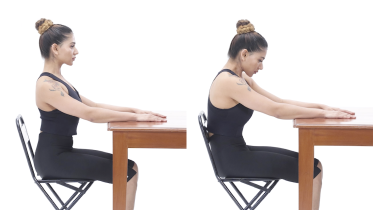 Seated pelvic tilt
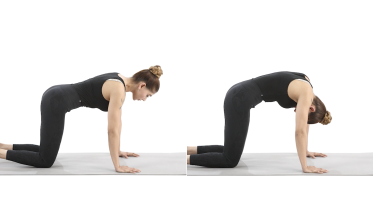 Cat-camel stretch
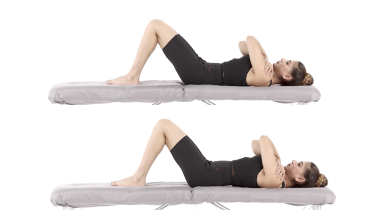 Pelvic tilt
Stage 2: Deep tummy and pelvic floor muscles
Once the stage 1 movements feel easy, or alongside them. You can do the pelvic floor squeeze sitting upright or lying on your side, so use one of those positions rather than lying on your back. The hands and knees hold gently draws in your deep tummy muscle in the same all-fours position as the cat-camel. Lift gently, never bear down, and let the muscles relax fully after each squeeze. Both exercise pages ask you to check first if you are pregnant, so talk to your midwife or physio before you start.
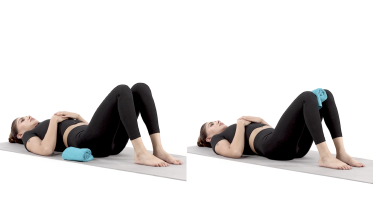 Pelvic floor exercise lying down
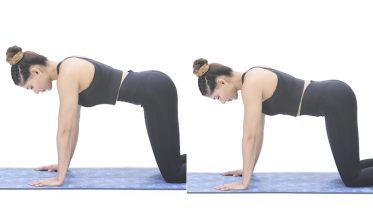 Hands and knees core activation
Stage 3: Strength for everyday life
When stages 1 and 2 feel steady and your pain allows. Sit to stand and the wall squat build strength for getting up from a chair, the toilet or the car, with your weight even on both feet and your feet about hip width apart. Go slowly rather than fast, keep the squat shallow, and use a higher seat or push off your thighs if you need to. You do not need to walk briskly. Take smaller steps, walk at a pace where you can still hold a conversation, and stop before your pain builds, as walking can stir up PGP (POGP; FSFHG). If walking hurts, ask your physio about swimming or exercise in water instead.
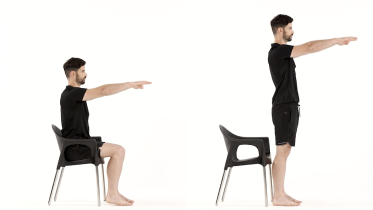 Sit to stand
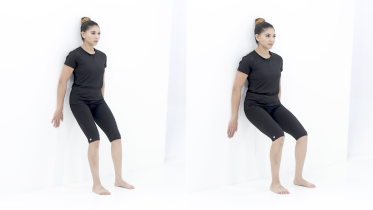 Wall squat
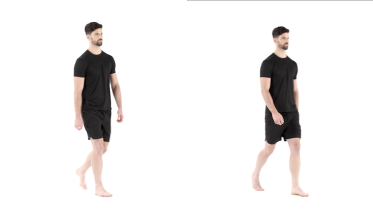 Brisk walking
Alongside any stage: getting in and out of bed
The log roll takes you from lying to sitting on the edge of the bed without twisting. Keep your knees together as they tip across, with a pillow between them if that feels better, and roll your shoulders and hips as one piece. Use the same steps in reverse to lie down, and turn onto your side soon after you lie down rather than staying on your back.
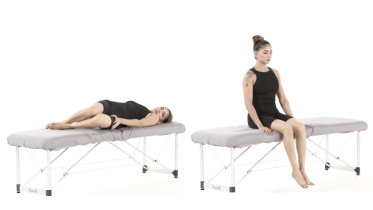 Log roll out of bed
What to avoid or change
With PGP, standing on one leg and moving your legs wide apart often bring on the pain (NHS; POGP). That is why this program leaves out single-leg standing, lunges, side leg lifts, clamshells and wide-legged stretches. Squeezing a ball between the knees is also left out, because the inner thigh muscles it works attach close to the joint at the front of the pelvis, which is often the sore spot. Your physio may add some of these back once they have assessed you.
The NHS advises against contact sports where you could be hit, scuba diving and exercise at heights over 2,500 meters in pregnancy. With PGP, a hospital physio leaflet from Western Australia also advises avoiding high-impact activities such as running and jumping (FSFHG). Swimming and exercise in water support your weight and take pressure off the pelvic joints (NHS; FSFHG). If you swim, leave out the breaststroke (frog) kick, which moves your legs wide apart, and use a flutter kick or walk in the water instead (FSFHG).
If you were given a separate plan by your midwife, doctor or physio, follow it rather than this one. The same applies if you have been told to limit exercise because of a pregnancy complication. ACOG advises against aerobic exercise, such as brisk walking, with some conditions: a heart or lung condition that affects your blood flow or breathing, a weak cervix or a stitch in your cervix, bleeding that keeps coming back after the first three months, a low-lying placenta after 26 weeks, early labor or waters that have broken, pre-eclampsia or high blood pressure caused by pregnancy, severe anemia, or twins or more with a risk of early labor. If any of these apply, ask your doctor which parts of this page, if any, are right for you.
Labor and after the birth
Many women with PGP can have a normal vaginal birth (NHS). Write in your birth plan that you have PGP, so the team caring for you in labor knows (NHS). The RCOG says staff will make sure your legs are supported and help you move and change position. All types of pain relief are possible, including an epidural (RCOG).
The RCOG says PGP usually improves after birth, although around 1 in 10 women have ongoing pain. POGP notes that the pain can carry on after the baby is born. If it does, ask your midwife, health visitor or doctor about a physio referral. If you have had PGP, you are more likely to have it in a future pregnancy (RCOG), so ask for help early next time.
When to contact your midwife, doctor or physio
Contact your midwife or GP if the pain makes it hard to move around, if it hurts to get out of a car or turn over in bed, or if stairs are painful (NHS). POGP also advises getting help if your symptoms do not improve within a week or two, or are affecting your sleep and daily activities. A pelvic health physio can examine you and tailor the treatment to your pain.
Pregnancy can cause some leaking of pee when you cough, sneeze or laugh, because of the extra pressure on your tummy (NHS), and on its own that is not one of the emergency signs below. New numbness around your genitals or bottom is different. So is losing control of your bladder or bowels. Both need emergency help. The warning signs below say how quickly to act.
For physiotherapists
This page is a patient framework for pregnancy-related lumbopelvic pain, not a full plan. Vleeming 2008 recommends diagnosing PGP with pain provocation tests (P4 or thigh thrust, Patrick's Faber, Gaenslen's and the modified Trendelenburg) and palpation of the long dorsal ligament and the symphysis, with the active straight leg raise as a functional test. Its recommended treatment in pregnancy is adequate information and reassurance plus individualized exercise. NICE NG201 suggests considering referral to physiotherapy for exercise advice and/or a non-rigid lumbopelvic belt.
Liddle 2015 (34 RCTs, 5,121 women) found low-quality evidence that land-based exercise reduced low back pain (SMD -0.64, 95% CI -1.03 to -0.25) and moderate-quality evidence that an 8 to 12 week program reduced the number of women reporting lumbopelvic pain (RR 0.66, 95% CI 0.45 to 0.97). Land-based exercise also reduced lumbopelvic pain-related sick leave (RR 0.76, 95% CI 0.62 to 0.94). Group exercise did not reduce the number reporting pelvic pain alone (RR 0.97, low quality), and acupuncture, craniosacral therapy and osteomanipulative therapy rest on single or unpooled studies.
Screen every new presentation for obstetric causes first: preterm labor, bleeding and abruption, pre-eclampsia (including right upper quadrant or epigastric pain), urinary tract infection or pyelonephritis, venous thromboembolism, and any recent fall or blow to the abdomen. RCOG Green-top Guideline 37b asks for expeditious objective testing, with low-molecular-weight heparin until VTE is excluded, so send suspected DVT to the maternity unit straight away and suspected PE as an emergency, never to routine review. Screen for cauda equina syndrome as well. Pregnancy itself can cause stress leakage (NHS), so ask specifically about new saddle sensory change and retention. Avoid prolonged supine positions after about 16 weeks (NHS), and use side lying, sitting or four-point kneeling for assessment and exercise.
See a doctor promptly if
- Emergency: heavy bleeding from your vagina, for example soaking a pad soon after you put it on, or any bleeding with severe pain in your tummy, pain in your shoulder, or feeling sick, faint or dizzy. Call emergency services straight away.
- Any bleeding or spotting from your vagina, even if it is light and you have no pain. Contact your midwife or maternity unit straight away.
- Your waters break, or you have a gush or trickle of fluid from your vagina, at any stage of pregnancy. Contact your midwife or maternity unit straight away.
- Before 37 weeks, you have regular tightenings or contractions, period-type pains, or backache that is not usual for you. Contact your midwife or maternity unit straight away, as this can be a sign of early (premature) labor.
- New back pain in the second or third trimester (from 13 weeks), even if you think it is PGP or ordinary backache. Contact your midwife or maternity unit straight away, as it can be a sign of early labor. Once they have checked it, follow their advice about when to call again.
- Your baby is moving less than usual, you cannot feel your baby moving anymore, or the usual pattern of movements has changed. Contact your midwife or maternity unit straight away, even in the middle of the night. Do not wait until the next day, and do not use a home heartbeat monitor to check.
- A severe headache that does not go away with simple painkillers, problems with your vision such as blurring or flashing lights, pain just below your ribs, sudden swelling of your face, hands or feet, being sick (vomiting), heartburn that does not go away with heartburn medicines, or feeling very unwell. Contact your maternity unit straight away, as these can be signs of pre-eclampsia, which needs checking and treating quickly. Call emergency services if you have a fit (seizure), or a headache that came on suddenly and is very severe.
- Emergency: any sign of a stroke, even if it goes away. That means a face that droops on one side, an arm you cannot lift or keep up, slurred or muddled speech, weakness or numbness on one side of your body or face, sudden blurred vision, double vision or loss of sight, trouble swallowing, sudden dizziness with unsteadiness or falling over, a sudden severe headache, or a sudden fall where your legs give way but you do not black out (a drop attack). Call emergency services straight away.
- A calf or thigh that is newly swollen, warm, tender, red or darker than usual, has swollen veins that are sore to touch, or has a throbbing or cramping pain that does not fit your injury or condition, or that feels different from normal muscle soreness after exercise. This can be a sign of a blood clot (deep vein thrombosis), especially after surgery, an injury, time in a cast or boot, a long trip or a spell of being much less mobile than usual. Get medical advice the same day. If you are also short of breath or have chest pain, call emergency services. Pregnancy and the first 6 weeks after giving birth also make a clot more likely, so if you are pregnant or gave birth in the last 6 weeks, contact your maternity unit, midwife or GP straight away.
- Emergency: you suddenly become short of breath, you get chest pain or pain in your upper back that may be worse when you breathe in, you cough up blood, your heart is beating very fast, or you faint. Call emergency services straight away, even if your leg looks normal. These can be signs of a blood clot in the lungs (pulmonary embolism).
- You are out of breath when you lie down, or breathlessness comes with dizziness. Contact your maternity unit straight away. If you are severely short of breath when you are resting, or so breathless that you are gasping or cannot get your words out, call emergency services. Feeling a little more out of breath as your baby grows is common, but this pattern needs checking.
- Back pain with a high temperature (38C or above), feeling hotter than usual or shivery, pain or burning when you pee, pee that looks cloudy, pink, red or brown, or pain in one or both sides of your back just under the ribs. Contact your midwife, maternity unit or doctor straight away, as this can be a urine or kidney infection. If you have a very high or very low temperature, shivering you cannot control, you are breathing very fast or finding it hard to breathe, you are confused or your speech is slurred, your skin, lips or tongue look blue, gray, pale or blotchy (on brown or black skin this can be easier to see on the palms of the hands or soles of the feet), or you have a rash that does not fade when you press it, call emergency services, as this can be sepsis.
- Tummy pain that does not go away after you have rested for 30 to 60 minutes, or comes with lower back pain. The same applies to back or pelvic pain that comes on suddenly, is getting worse quickly or is much worse than your usual pain. Contact your maternity unit straight away. Call emergency services if the tummy pain is severe, any pain comes with bleeding from your vagina, or tummy pain comes with pain in your shoulder or feeling sick, faint or dizzy.
- You fall, or your bump is knocked or hit, for example in a car accident, even if you feel fine. Contact your maternity unit straight away so you and your baby can be checked.
- New back pain and you have had cancer, now or in the past. Get medical advice the same day and mention your cancer history. If you are being treated for cancer now, contact your cancer team the same day.
- Emergency: you have had cancer, now or in the past, and your back or neck pain feels like a tight band around your body, or comes with pain spreading down an arm or leg, weakness, numbness or pins and needles in your arms or legs, trouble walking, or trouble controlling your bladder or bowels. Call your cancer team's emergency number straight away, or go to an emergency department if you do not have one or cannot get through. This can be cancer pressing on the spinal cord (metastatic spinal cord compression), which needs treatment straight away.
- Emergency: numbness, tingling or altered feeling around or under your genitals, between your inner thighs, or around your bottom (anus), for example it feels different when you wipe after using the toilet. Call emergency services or go to an emergency department straight away. This can be a sign of pressure on the bundle of nerves at the base of the spine (cauda equina syndrome), which needs emergency treatment.
- Emergency: you find it hard to start peeing, cannot pee, cannot feel yourself peeing or cannot control when you pee, or you do not notice when you need to poo or cannot control when you poo, and this is not normal for you. The same applies to a new change in how your genitals feel during sex, or new trouble getting an erection or ejaculating. Call emergency services or go to an emergency department straight away. These can also be signs of cauda equina syndrome.
- Emergency: sciatica in both legs, or pain, tingling, numbness or weakness in both legs. The same applies if you lose feeling in one leg. Call emergency services or go to an emergency department straight away.
- A leg or foot that is getting weaker, for example your foot drags, catches on the ground or slaps down when you walk (foot drop). Get medical advice the same day. If the weakness is getting worse by the hour, go to an emergency department.
- Emergency: back or leg pain that started after a serious accident, such as a car crash or a fall from a height, or back pain with chest pain. Call emergency services.
Common questions
Is pelvic girdle pain harmful to my baby?
No. The NHS and the RCOG both say PGP does not harm your baby, although it can be very painful and make it hard to get around. Pain from something other than PGP is different, for example tightenings, bleeding or a severe headache, so check the warning signs on this page. Tell your midwife or doctor about new pain rather than waiting for your next appointment.
What exercises are safe with pelvic girdle pain in pregnancy?
This program sticks to gentle exercises that keep your weight even on both legs and your knees fairly close together, such as the pelvic tilt, the cat-camel, pelvic floor squeezes and shallow sit to stands, because POGP lists standing on one leg and moving the legs apart among the things that often hurt. One hospital physio leaflet also advises avoiding high-impact activities such as running and jumping, and notes that exercise in water supports your weight without putting pressure on the pelvic joints (FSFHG). The evidence for exercise in pregnancy is modest, and weakest for pelvic pain on its own (Liddle 2015). Check with your midwife or doctor before you start, and your physio will adjust this.
Do pregnancy support belts help pelvic pain?
They can. NICE suggests considering referral to physiotherapy for exercise advice, a non-rigid pelvic support belt, or both, for pregnancy-related PGP (NICE NG201). The research is limited. In the Cochrane review, one small study found that a non-rigid belt eased pelvic pain more than exercise over six weeks, while another found that adding a belt to exercise gave no extra pain relief (Liddle 2015). NCT advises that a belt can help if you use it regularly for short periods. A physio can check which type and fit suit you.
Does pelvic girdle pain go away after birth?
Usually, yes. The RCOG says PGP usually improves after birth, although around 1 in 10 women have ongoing pain. If you have had PGP, you are more likely to have it in a future pregnancy (RCOG). If pain carries on after your baby is born, ask your midwife, health visitor or doctor about a physio referral.
Can I have a normal birth with pelvic girdle pain?
Many women with PGP can have a normal vaginal birth (NHS). Write in your birth plan that you have PGP, so the team caring for you in labor knows (NHS). The RCOG says staff will make sure your legs are supported and help you move and change position, and that all types of pain relief are possible, including an epidural.
Can I lie on my back to exercise when pregnant?
Not for long once your bump grows. If you are pregnant and past the first three months, check with your physio before exercising flat on your back. The NHS advises against lying flat on your back for long periods, particularly after 16 weeks, because the weight of the bump presses on the main blood vessel bringing blood back to your heart, which can make you feel faint. Most exercises on this page are done sitting, standing, on your side or on your hands and knees for that reason.
References
- NHS. Back pain in pregnancy. Page last reviewed 10 January 2024. https://www.nhs.uk/pregnancy/common-symptoms/back-pain/
- NHS. Pelvic pain in pregnancy. Page last reviewed 12 December 2022. https://www.nhs.uk/pregnancy/common-symptoms/pelvic-pain/
- NHS. Exercise in pregnancy. Page last reviewed 15 March 2023. https://www.nhs.uk/pregnancy/keeping-well/exercise/
- Royal College of Obstetricians and Gynaecologists (RCOG). Pelvic girdle pain and pregnancy. Patient information leaflet. June 2015. https://www.rcog.org.uk/for-the-public/browse-our-patient-information/pelvic-girdle-pain-and-pregnancy/
- Pelvic, Obstetric and Gynaecological Physiotherapy (POGP). Pregnancy related pelvic girdle pain and low back pain during pregnancy and after having a baby. https://thepogp.co.uk/patient_information/womens_health/pregnancy_pgp_lbp.aspx
- Pelvic, Obstetric and Gynaecological Physiotherapy (POGP). Pregnancy related pelvic girdle pain and other common conditions in pregnancy. Booklet. 23 March 2023. https://thepogp.co.uk/Resources/112/pregnancy_related_pelvic_girdle_pain_and_other_common_conditions_in_pregnancy/
- National Institute for Health and Care Excellence. Antenatal care (NG201). Published 19 August 2021. https://www.nice.org.uk/guidance/ng201
- National Guideline Alliance. Management of pelvic girdle pain in pregnancy. Antenatal care, evidence review U. NICE; 2021. https://www.ncbi.nlm.nih.gov/books/NBK573945/
- Liddle SD, Pennick V. Interventions for preventing and treating low-back and pelvic pain during pregnancy. Cochrane Database of Systematic Reviews. 2015;(9):CD001139. https://doi.org/10.1002/14651858.CD001139.pub4
- Vleeming A, Albert HB, Ostgaard HC, Sturesson B, Stuge B. European guidelines for the diagnosis and treatment of pelvic girdle pain. European Spine Journal. 2008;17(6):794-819. https://doi.org/10.1007/s00586-008-0602-4
- UK Chief Medical Officers, Department of Health and Social Care. Physical activity for pregnant women (text of the infographic). Infographic first published 7 September 2019 with the UK Chief Medical Officers' physical activity guidelines, replaced with an updated version 10 July 2026, page updated 16 July 2026. https://www.gov.uk/government/publications/physical-activity-guidelines-pregnancy-and-after-childbirth/physical-activity-for-pregnant-women-text-of-the-infographic
- Fiona Stanley Fremantle Hospitals Group, WA Health. Manage pelvic girdle pain. Last updated 16 December 2025. https://fsfhg.health.wa.gov.au/Our-services/Maternity/Pregnancy-care/Physiotherapy-during-pregnancy/Manage-pelvic-girdle-pain
- NCT. Pelvic girdle pain in pregnancy. Last reviewed 28 July 2026. https://www.nct.org.uk/information/pregnancy/body-pregnancy/pelvic-girdle-pain-pregnancy
- NHS. Pregnancy symptoms you need to get help for. Page last reviewed 24 June 2026. https://www.nhs.uk/pregnancy/common-symptoms/pregnancy-symptoms-you-need-to-get-help-for/
- NHS. Signs that labour has begun. Page last reviewed 9 November 2023. https://www.nhs.uk/pregnancy/labour-and-birth/signs-that-labour-has-begun/
- NHS. Premature labour and birth. Page last reviewed 10 January 2024. https://www.nhs.uk/pregnancy/labour-and-birth/premature-labour-and-birth/
- NHS. Vaginal bleeding in pregnancy. Page last reviewed 17 February 2026. https://www.nhs.uk/pregnancy/common-symptoms/vaginal-bleeding/
- NHS. Your baby's movements. Page last reviewed 8 July 2024. https://www.nhs.uk/pregnancy/keeping-well/your-babys-movements/
- NHS. Pre-eclampsia. Page last reviewed 23 March 2026. https://www.nhs.uk/conditions/pre-eclampsia/
- NHS. Stomach pain in pregnancy. Page last reviewed 18 November 2024. https://www.nhs.uk/pregnancy/common-symptoms/stomach-pain/
- NHS. DVT (deep vein thrombosis). Page last reviewed 30 April 2026. https://www.nhs.uk/conditions/deep-vein-thrombosis-dvt/
- NHS. Pulmonary embolism. Page last reviewed 25 May 2023. https://www.nhs.uk/conditions/pulmonary-embolism/
- NHS. Shortness of breath. Page last reviewed 30 January 2024. https://www.nhs.uk/symptoms/shortness-of-breath/
- NHS. Urinary tract infections (UTIs). Page last reviewed 11 July 2025. https://www.nhs.uk/conditions/urinary-tract-infections-utis/
- NHS. Sepsis. Page last reviewed 14 May 2026. https://www.nhs.uk/conditions/sepsis/
- NHS. What to do if someone has a seizure (fit). Page last reviewed 19 December 2023. https://www.nhs.uk/symptoms/what-to-do-if-someone-has-a-seizure-fit/
- NHS. Stroke: symptoms. Page last reviewed 12 September 2024. https://www.nhs.uk/conditions/stroke/symptoms/
- NHS. Urinary incontinence: causes. Page last reviewed 15 June 2023. https://www.nhs.uk/conditions/urinary-incontinence/causes/
- NHS. Back pain. Page last reviewed 5 March 2026. https://www.nhs.uk/conditions/back-pain/
- American College of Obstetricians and Gynecologists. Physical activity and exercise during pregnancy and the postpartum period. Committee Opinion No. 804. Obstetrics and Gynecology. 2020;135(4):e178-e188. Reaffirmed 2023. https://doi.org/10.1097/AOG.0000000000003772
- Royal College of Obstetricians and Gynaecologists. Thromboembolic disease in pregnancy and the puerperium: acute management. Green-top Guideline No. 37b. April 2015. https://www.rcog.org.uk/media/wj2lpco5/gtg-37b-1.pdf
- Right Decision Service, NHS Scotland. Abdominal trauma / fall in pregnancy (321). Maternity guideline, version 3. Last reviewed 28 August 2024. https://www.rightdecisions.scot.nhs.uk/maternity-gynaecology-guidelines/maternity/common-obstetric-problems-maternity-assessment/abdominal-trauma-fall-in-pregnancy-321/
- Getting It Right First Time (GIRFT), NHS England. National suspected cauda equina syndrome (CES) pathway. February 2023, updated March 2026. https://gettingitrightfirsttime.co.uk/wp-content/uploads/2026/04/National-Suspected-Cauda-Equina-Pathway-March-2026.pdf
Written and checked by the PocketPhysio editorial team. Last updated 2026-09-29.
This page is general education, not a diagnosis or a personal treatment plan. See a physiotherapist or doctor for advice about your own situation.