
Hip labral tear exercises and physiotherapy
What is a hip labral tear?
The labrum is a ring of tough cartilage that lines the rim of the hip socket. OrthoInfo compares it to a gasket: it seals the joint and helps keep it stable. When it tears, the pain is usually felt in the groin or the front of the hip, less often in the buttock. Many people also get clicking, locking or a feeling of the hip giving way (Groh and Herrera, 2009). So many things cause groin pain that a tear can go a long time before anyone names it.
Groh and Herrera (2009) list the usual causes: an injury, hip impingement, a loose or very flexible hip, hip dysplasia (a shallow socket that covers too little of the ball) and wear with age. In one study of 31 people with a labral tear, 27 had at least one difference in hip shape on a plain X-ray, even though people with clear dysplasia had been left out (Wenger and colleagues, 2004). In many people, then, the tear goes with the shape of the hip rather than with one bad moment.
This page is for adults treating a labral tear without surgery, including those still weighing up an operation. Children and teenagers with pain in the hip, thigh or knee, or a limp, should see a doctor first; the warning signs below explain why. If you are pregnant, check with your midwife, doctor or physio before you start.
Does a tear on a scan explain the pain?
Not always. In a study that scanned the hips of 45 volunteers with no hip pain, labral tears showed up in 69% of hips (Register and colleagues, 2012). A review that pooled many imaging studies found labral tears in 62% of people with hip pain and in 54% of people without it (Heerey and colleagues, 2018).
The international Zurich consensus on hip-related pain says a labral problem that causes symptoms should not be confused with a tear found by chance in someone without pain (Reiman and colleagues, 2020). None of this means your pain is not real. It means a physio or doctor looks at your symptoms and examines the hip as well as reading the scan. It is also why physios treat the whole hip rather than chasing the tear.
Labral tear, hip impingement or hip osteoarthritis?
These overlap a lot. Hip impingement means the ball and socket meet too early because of their shape. If you have been told your tear comes with it, the hip impingement program goes into the positions to ease off and the surgery trials in more detail. The exercises there and here follow the same approach.
Labral damage is also linked with wear of the joint cartilage (Groh and Herrera, 2009). If an X-ray has shown hip osteoarthritis, that program is the better fit. If the pain is on the outer side of the hip and it hurts to lie on that side, greater trochanteric pain syndrome is the more likely cause.
Been told you have hip dysplasia, or a very loose or flexible hip? Have a physio assess your hip before you start. This program was built mainly for hips that pinch at the front, and a shallow or loose hip often needs a different focus. Until then, do not push any movement to the very end of its range, and stop any movement that makes the hip feel unstable or as if it might slip.
Physio-led care or surgery for a hip labral tear?
The Zurich consensus groups labral problems with the other common causes of hip-related pain in young and middle-aged active adults (Reiman and colleagues, 2020). For all of them, it recommends exercise-based treatment for at least 3 months, alongside education and shared decisions. It also admits that strong evidence for physio-led treatment is still lacking (Kemp and colleagues, 2020). Keyhole surgery (hip arthroscopy) can trim or repair the labrum and treat the shape of the bone at the same time (Groh and Herrera, 2009).
Few trials have compared the two for labral tears on their own. One trial took 90 people over 40 with a labral tear. At 12 months, those who had surgery plus physio scored about 12 points higher on a hip quality of life score out of 100 than those who had physio alone (Martin and colleagues, 2021). The catch: 28 of the 44 people given physio alone had surgery within that year, so the groups were not cleanly separated.
At 2 years the surgery group still scored better, and by then 71% of the physio group had crossed over to surgery. People who tried physio first and then had surgery did about as well as those operated on straight away (Martin and colleagues, 2024). Both reports come from one surgeon's patients, and the trial left out people with more than mild arthritis or with hip dysplasia.
Most trials of hip arthroscopy were done in people with hip impingement, where surgery also treats the labrum. Surgery came out a little ahead on average in some of those trials and no different in others, as the hip impingement page explains. So the evidence is mixed. Physio-led care is a sensible place to start for most adults. If 3 months or more of steady, well-run work has not helped enough, decide about surgery together with a hip surgeon.
How to use this program
Start at the stage that fits your hip today, or at stage 1 if you are not sure. Move up once the current stage is easy and your hip feels no worse the day after. Treat that as a rough guide from common practice, not a fixed rule.
The exercise pages each list a typical starting dose. Across this program that is mostly 1 to 3 sets, with 5 to 15 repetitions in each set. The gentle muscle holds last 5 to 10 seconds and side plank holds 10 to 30 seconds. Most people do them a few days a week, or daily for the gentle ones. Your physio will adjust the exercises, the numbers and the range to suit you.
If a recent injury started the pain, keep stage 1 pain free. After that, some discomfort while you exercise is usually fine, as long as it eases soon afterward and your hip feels no worse the day after. A sharp pinch or catch at the front of the hip usually means you bent too deep or turned too far. Make the movement smaller instead of pushing on. If your groin is clearly more sore the next day, go back a step; there is no need to stop completely.
Deep bending and twisting set off the pain for many people with a labral tear, much as in impingement. The hip impingement page lists positions to ease off, such as sinking into low, soft chairs or sitting with one knee crossed over the other, and they are worth trying here too. If you have high blood pressure, breathe steadily through every hold and repetition and never hold your breath.
The exercise program
Stage 1: Calm the hip and wake up the muscles
For a sore or irritable hip, or a flare. You do all of these lying down, and the hip never bends past a right angle. The holds make the muscles work while the joint barely moves. Stop each movement short of any pinch or catch at the front of the hip. If a recent injury started the pain, keep this stage pain free. Carry on walking, at a speed and distance your hip handles without the pain building up.
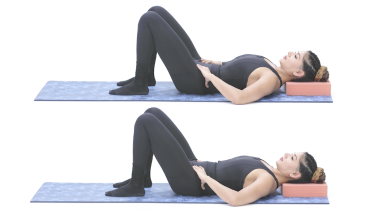 Transverse abdominis activation
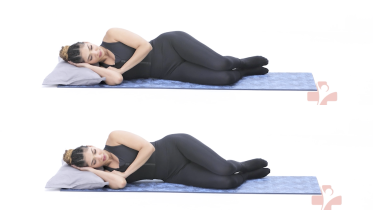 Isometric clamshell
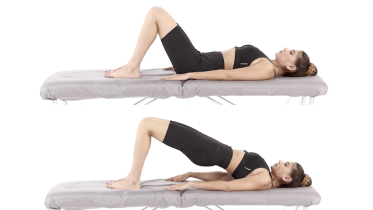 Glute bridge
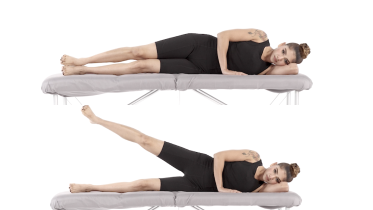 Side lying hip abduction
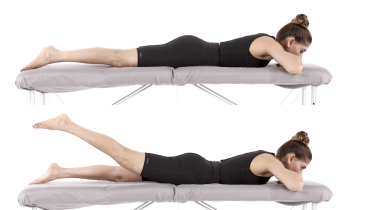 Prone hip extension
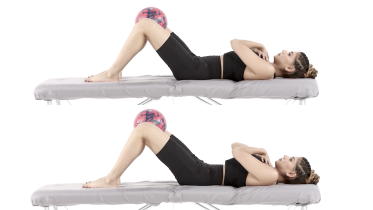 Adductor ball squeeze
Stage 2: Trunk control and strength in standing
Start this once stage 1 is easy and your hip feels no worse the day after. That often takes a few weeks. In the dead bug and bird dog your hips bend to roughly 90 degrees, so make the movement smaller if something catches at the front of the hip. The clamshell now moves the hip through its range, so open the knee only as far as stays comfortable. Start sit to stand from a higher chair and keep the mini squat shallow at first. If you are unsteady, rest a hand on a counter during the standing band work.
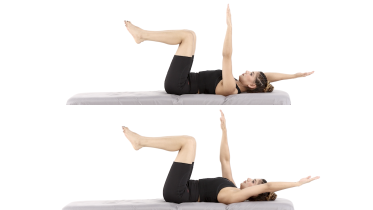 Dead bug
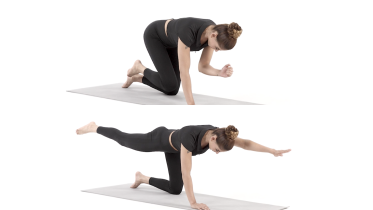 Bird dog
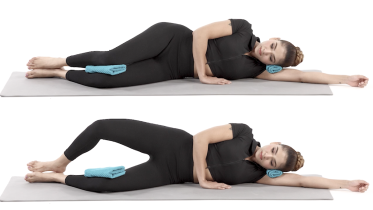 Clamshell
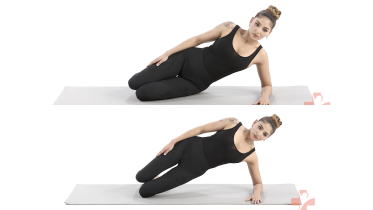 Kneeling side plank
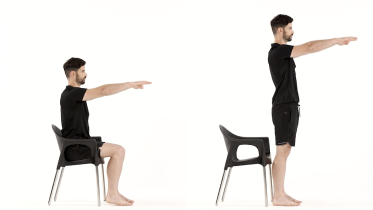 Sit to stand
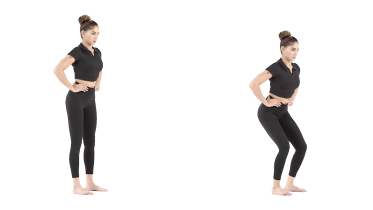 Mini squat
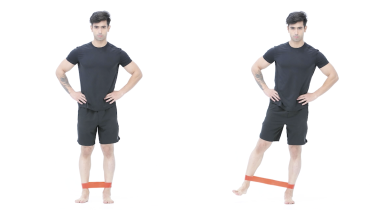 Standing hip abduction with band
Stage 3: One leg at a time and back to sport
Move up when stage 2 feels comfortable and your hip calms down quickly after each session. Every exercise here puts the load through one leg, as stairs, running and quick changes of direction do. In the single leg deadlift the hip bends as you lean forward, so lean only a little at first and keep one hand on a counter. Keep the counter close for single leg stance as well. A return to running, and to sports with twisting and jumping, usually comes after this stage, built up gradually on a plan you agree with your physio.
.png) Side plank
Side plank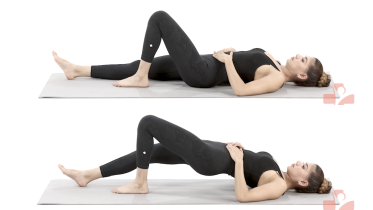 Single leg bridge
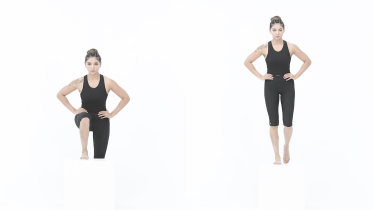 Step up
.png) Single leg deadlift
Single leg deadlift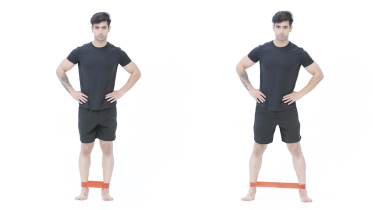 Lateral band walk
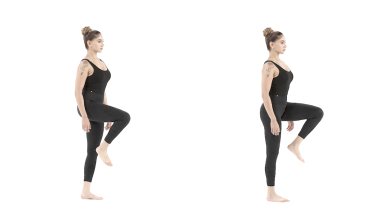 Single leg stance
After hip arthroscopy
After keyhole surgery on the hip, for example a labral repair, follow the rehab plan your surgeon and physio give you. This page does not cover rehab after an operation. The Zurich consensus recommends that a physio should lead your rehab after an operation on the hip (Kemp and colleagues, 2020). Some of the exercises here may join your rehab later on, once your surgical team agrees.
When to see a physio or doctor
See a GP or physio (a routine appointment is fine) if hip pain keeps you awake or gets in the way of normal activities, if it is worsening or keeps returning, or if 2 weeks of home care have not helped (NHS). Groin pain with clicking, catching or a hip that gives way is worth getting assessed, as several hip problems can cause it. After 3 months of doing a program like this regularly, if progress is still too slow, ask what comes next. That may mean a referral to a hip specialist.
Some symptoms need faster help. The warning signs below say how fast, from calling emergency services to booking within 2 weeks.
Check with your doctor before you start if you have a heart or lung condition, or blood pressure that is not under control. If you have fallen recently or feel unsteady, do the standing exercises next to a kitchen counter.
For physiotherapists
The Zurich 2018 classification places symptomatic labral pathology in its third group, other conditions without distinct osseous morphology, alongside FAI syndrome and acetabular dysplasia or instability (Reiman and colleagues, 2020). It warns against confusing that group with incidental labral findings, notes that clinical examination and imaging have limited diagnostic utility, and says a negative FADIR test helps rule out hip-related pain. It recommends AP pelvis and lateral femoral head-neck radiographs first, with advanced imaging kept for definitive diagnosis or surgical planning. Wenger and colleagues (2004) found at least one radiographic abnormality in 27 of 31 patients with labral tears after excluding classic dysplasia, so the X-ray is worth having.
Asymptomatic prevalence is high: 69% of hips in 45 volunteers had a labral tear on MRI (Register and colleagues, 2012), and the pooled estimate was 54% without pain against 62% with pain (Heerey and colleagues, 2018). Handy when a patient arrives with a scan report. Kemp and colleagues (2020) recommend a minimum of 3 months of exercise-based treatment, with progress tracked by physical measures and patient-reported outcomes, and decisions shared with the patient.
The one randomized trial on labral tears alone took patients over 40. Arthroscopy plus physio beat physio alone on iHOT-33 at 12 months (intention to treat, +12.1 points), but 63.6% of the physio arm crossed over (Martin and colleagues, 2021). At 24 months surgery still did better, with 71.1% crossover, and improvement did not differ significantly between immediate surgery and crossover after at least 14 weeks of physio (Martin and colleagues, 2024). Limits: single surgeon, unblinded, Tonnis 0 to 2 only, classic dysplasia excluded.
Kemp and colleagues (2020) note that strong evidence for physio-led treatment is lacking, and the older Groh and Herrera (2009) review called physio for labral tears controversial. In suspected dysplasia or instability, common practice is to assess before loading and to avoid end-range extension and external rotation stretching. The FAI trials are summarized on the hip impingement page.
Exertional groin pain in runners and military recruits should raise the question of a femoral neck stress fracture (Clough, 2002). Pain spreading below the knee suggests lumbar referral, and long-term corticosteroids or heavy alcohol intake should prompt a check for osteonecrosis (AAOS).
See a doctor promptly if
- Emergency: you have had a fall or an injury and now have severe hip pain, or you cannot walk or put weight on the leg. Call emergency services or go to an emergency department. This can be a sign of a broken hip (hip fracture).
- Emergency: tingling or loss of feeling in the hip or leg after a fall or injury. Call emergency services or go to an emergency department.
- Emergency: pain, tingling, numbness or weakness in both legs, numbness or altered feeling around your genitals or bottom, or new trouble peeing or controlling your bladder or bowels. The same applies if you lose feeling in one leg. Call emergency services or go to an emergency department straight away. These can be signs of pressure on the nerves at the base of the spine (cauda equina syndrome).
- Same day: the hip is hot and swollen, the skin around it has changed color, or you have hip pain with a high temperature or feel hot, cold or shivery. Get medical help the same day, and go to an emergency department if you feel very unwell. A joint infection needs treatment quickly.
- Same day: severe hip pain that came on suddenly without a fall, or pain that is getting worse quickly over a few days. Get medical advice the same day.
- Same day: groin pain that built up with running, marching or jumping, often after you increased your training, and now hurts when you walk, makes you limp, or aches at rest or at night. Stop running and jumping and keep walking to a minimum until it has been checked. Get medical advice the same day and mention your training. If you cannot put weight on the leg, go to an emergency department. This can be a stress fracture in the neck of the thighbone (femoral neck stress fracture), which is easy to miss at first and can become a full break if you keep loading it.
- Same day: new hip or groin pain after a fall, even a small one, if you are older, have low bone density (osteoporosis) or have taken steroid tablets for a long time, even if you can still walk. Get medical advice the same day. A broken hip is not always obvious at first.
- Same day: a child or teenager has sudden pain in the hip, thigh or knee, is limping, or cannot put weight on one leg. Get an urgent appointment with a doctor the same day. If they have a high temperature or seem very unwell, go to an emergency department. This page is for adults, and hip pain in children has different causes.
- Same day: a leg or foot that is getting weaker, for example your foot drags, catches on the ground or slaps down when you walk (foot drop). Get medical advice the same day. If the weakness is getting worse by the hour, go to an emergency department.
- Within a few days: hip or groin pain that is worse at night or does not ease with rest, and keeps getting worse. See your doctor within a few days. If you have had cancer, now or in the past, or are losing weight without trying, see your doctor sooner, within a day or two, and mention it. This applies even if the pain is not getting worse. If you are being treated for cancer now, contact your cancer team the same day.
- Within a few days: new groin or hip pain and you take steroid tablets long term, or have in the past, or you regularly drink a lot of alcohol. This can be a sign of a problem with the blood supply to the top of the thighbone (avascular necrosis). Book an appointment with your doctor within a few days and mention the steroids or alcohol.
- Within 2 weeks: pain that spreads down the leg below the knee, especially with numbness or tingling in the leg or foot. The pain may be coming from your lower back rather than the hip. Book an appointment with a doctor or physio.
Common questions
Can a hip labral tear heal on its own?
Very little research has looked at whether the tear itself heals. It does not have to heal for your hip to feel better, though. Many people with no hip pain at all have a labral tear on MRI (Register and colleagues, 2012; Heerey and colleagues, 2018), so a hip can work well with a tear in it. Physio-led care aims to ease the pain and get the hip coping with your daily life, work and sport. If 3 months or more of a well-run program has not helped enough, see a doctor or hip surgeon about the other options.
Do I need surgery for a hip labral tear?
Not as a first step, for most adults. The Zurich consensus counts labral problems as one cause of hip-related pain and advises a minimum of 3 months of exercise-based care first (Kemp and colleagues, 2020; Reiman and colleagues, 2020). In a trial of people over 40 with a labral tear, adding surgery to physio gave better average scores than physio alone. But most of the people given physio alone had surgery before the trial ended, which muddies the comparison (Martin and colleagues, 2021). If the exercises have not helped enough, talk surgery through with a hip surgeon.
What exercises should I avoid with a hip labral tear?
No exercise is off limits for everyone. Many people find that deep hip bending, twisting on the leg and pulling the knee across the body bring on the pain, as in hip impingement, so they cut back on deep squats and low chairs for a while. A review found that the examination test that bends the hip, brings the knee across and turns it inward is the most consistent sign of a tear (Groh and Herrera, 2009). The advice to cut back, though, comes from common practice and hip impingement care, not from trials in labral tears. Never push a stretch through a pinch or catch at the front of the hip. Your physio will tell you when to bring deeper movements back.
Can I keep running or playing sport with a hip labral tear?
Often you can, with some changes. Alongside exercise-based care for hip-related pain, the Zurich consensus recommends staying physically active, and that can include sport (Kemp and colleagues, 2020). Drop or reduce whatever sets off the pinch or catch, for example sprints, kicks or sharp cuts, and carry on with the rest. Add the harder parts back a bit at a time as stage 3 gets easier. Your physio can help you pace it.
Do I need an MRI for a hip labral tear?
Not always. The Zurich consensus recommends plain X-rays of the hip and pelvis first. It keeps MRI for when more detail would change the plan, such as confirming a diagnosis or planning surgery (Reiman and colleagues, 2020). An X-ray also shows the shape of the hip, which matters because most people with a labral tear have a difference in hip shape (Wenger and colleagues, 2004). A scan report that mentions a tear needs to be read alongside your symptoms and an examination.
References
- Groh MM, Herrera J. A comprehensive review of hip labral tears. Current Reviews in Musculoskeletal Medicine. 2009;2(2):105-117. doi:10.1007/s12178-009-9052-9
- Reiman MP, Agricola R, Kemp JL, et al. Consensus recommendations on the classification, definition and diagnostic criteria of hip-related pain in young and middle-aged active adults from the International Hip-related Pain Research Network, Zurich 2018. British Journal of Sports Medicine. 2020;54(11):631-641. doi:10.1136/bjsports-2019-101453
- Kemp JL, Risberg MA, Mosler A, et al. Physiotherapist-led treatment for young to middle-aged active adults with hip-related pain: consensus recommendations from the International Hip-related Pain Research Network, Zurich 2018. British Journal of Sports Medicine. 2020;54(9):504-511. doi:10.1136/bjsports-2019-101458
- Register B, Pennock AT, Ho CP, Strickland CD, Lawand A, Philippon MJ. Prevalence of abnormal hip findings in asymptomatic participants: a prospective, blinded study. American Journal of Sports Medicine. 2012;40(12):2720-2724. doi:10.1177/0363546512462124
- Heerey JJ, Kemp JL, Mosler AB, et al. What is the prevalence of imaging-defined intra-articular hip pathologies in people with and without pain? A systematic review and meta-analysis. British Journal of Sports Medicine. 2018;52(9):581-593. doi:10.1136/bjsports-2017-098264
- Wenger DE, Kendell KR, Miner MR, Trousdale RT. Acetabular labral tears rarely occur in the absence of bony abnormalities. Clinical Orthopaedics and Related Research. 2004;(426):145-150. doi:10.1097/01.blo.0000136903.01368.20
- Martin SD, Abraham PF, Varady NH, et al. Hip arthroscopy versus physical therapy for the treatment of symptomatic acetabular labral tears in patients older than 40 years: a randomized controlled trial. American Journal of Sports Medicine. 2021;49(5):1199-1208. doi:10.1177/0363546521990789
- Martin SD, Dean MC, Gillinov SM, et al. Hip arthroscopy versus physical therapy for the treatment of symptomatic acetabular labral tears in patients older than 40 years: 24-month results from a randomized controlled trial. American Journal of Sports Medicine. 2024;52(10):2574-2585. doi:10.1177/03635465241263595
- Clough TM. Femoral neck stress fracture: the importance of clinical suspicion and early review. British Journal of Sports Medicine. 2002;36(4):308-309. doi:10.1136/bjsm.36.4.308
- American Academy of Orthopaedic Surgeons. Femoroacetabular impingement. OrthoInfo. https://www.orthoinfo.org/en/diseases--conditions/femoroacetabular-impingement/
- American Academy of Orthopaedic Surgeons. Osteonecrosis of the hip. OrthoInfo. https://www.orthoinfo.org/en/diseases--conditions/osteonecrosis-of-the-hip/
- NHS. Hip pain in adults. Page last reviewed 20 November 2025. https://www.nhs.uk/symptoms/hip-pain/
- NHS. Hip pain in children (irritable hip). Page last reviewed 3 April 2024. https://www.nhs.uk/symptoms/hip-pain-children-irritable-hip/
Written and checked by the PocketPhysio editorial team. Last updated 2026-09-28.
This page is general education, not a diagnosis or a personal treatment plan. See a physiotherapist or doctor for advice about your own situation.