Transverse abdominis activation
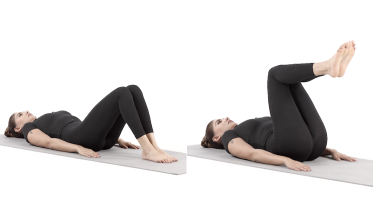
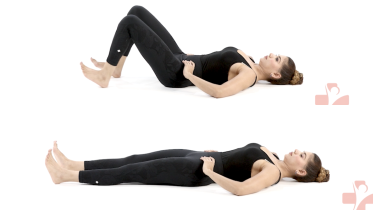
Transverse abdominis activation teaches you to gently tighten the deepest layer of your stomach muscles. You do it lying on your back with your knees bent. Many lower back and core programs use it as an early step, before the harder core work.
How to do the transverse abdominis activation
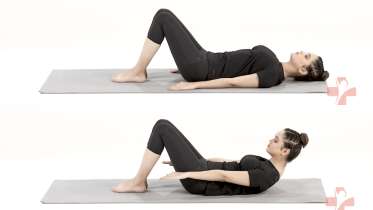
- Lie on your back on a firm, flat surface with your knees bent and feet flat, about hip width apart. Rest your head on a small pillow or block.
- Place your fingertips on each side of your lower stomach, just above and inside the bony points at the front of your hips.
- Rock your pelvis gently until your lower back is neither pressed into the floor nor arched up away from it. This is your neutral spine. Stay in it for the rest of the exercise.
- Breathe in gently. As you breathe out, slowly draw your lower stomach in, away from your fingertips, as if pulling your belly button toward your spine.
- You should feel a soft tightening under your fingers. Your back and pelvis stay still, and your ribs stay relaxed.
- Hold the tension for a few seconds while you keep breathing normally, then relax fully.
What you should feel
A gentle, deep tension under your fingertips, low down in the stomach. It is a small feeling. If your whole stomach goes hard or pushes up into your fingers, you are working too hard.
Common mistakes
- Squeezing too hard. Aim for a light tightening, well under half of your full effort.
- Tilting the pelvis or pressing the lower back into the floor to make it happen.
- Holding your breath, or pulling in the upper stomach and ribs instead of the lower belly.
How often
Many programs start with 8 to 10 holds of 5 to 10 seconds, once or twice a day, breathing normally through each hold. Your physio will adjust this as you get the hang of it.
Stop and check with your physio if
- Your back pain increases during or after the exercise.
- Pain spreads down your leg, or you get numbness or tingling.
- You feel pressure or bulging in your stomach wall or pelvic floor. Tell your physio about this.
From the clinic
This is a quiet exercise. At first a lot of people think they are doing nothing at all. That is normal, because the tightening is meant to be subtle and it gets easier to find with practice. If you still feel nothing under your fingers after a few days, ask your physio to check it with you in clinic.
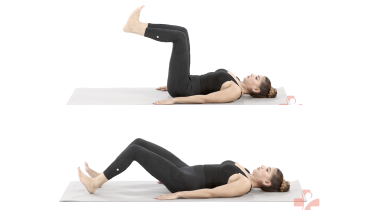
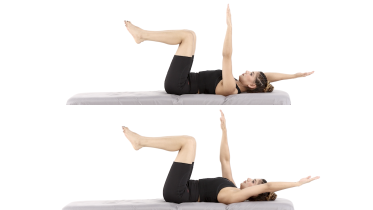
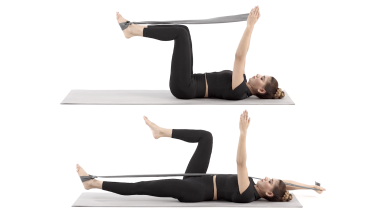
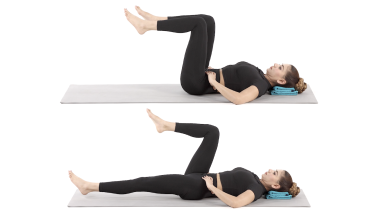
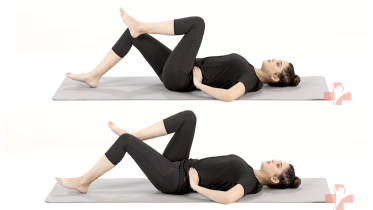
Once you can find it lying down, a common next step is to hold it while you move something else, such as sliding one heel along the floor. Later it goes into sitting and standing, and into harder work like the dead bug.
Pregnant and beyond the first trimester? Ask your physio before practicing this flat on your back. The same gentle draw-in works lying on your side or on your hands and knees.
Reviewed by the PocketPhysio by VirtueLife expert physiotherapy team. Last reviewed 2026-09-25.
This page is general education, not a diagnosis or a personal treatment plan. If you have pain, an injury or a health condition, see a physiotherapist or doctor before starting new exercises.