
Diastasis recti exercises and physiotherapy
What is diastasis recti?
Your six-pack muscle (rectus abdominis) runs down your front in two strips, one on each side of the belly button. A band of tough tissue down the middle (the linea alba) holds them together. In pregnancy the growing womb pushes the two halves apart and stretches that band, usually by about 2 finger widths, according to the NHS. The European Hernia Society defines diastasis recti as a widening of the band of more than 2 cm (Hernández-Granados 2021). It is not a hernia, because nothing pushes through a hole in the tummy wall, although the two can happen together.
You might see a ridge or dome down the middle of your tummy as you sit up from lying, or feel a soft dip around the belly button. According to POGP (the UK network of pelvic health physios), up to 60% of women may notice symptoms during pregnancy or after the birth. It also lists tummy discomfort after activity and low back pain among the symptoms worth getting help for, along with leaking or a heavy feeling in the pelvis.
How this page differs from the postnatal program
The postnatal core and pelvic floor program covers recovery after a birth in full, from bleeding and stitches through to getting back to running. This page looks only at the tummy gap. It is for anyone with diastasis recti, whether the birth was 6 weeks ago or 6 years ago, and for the smaller group who have never been pregnant. If you gave birth in the last few months, start with the postnatal program and use this page alongside it.
How long does diastasis recti take to close?
Often within a couple of months, on its own. The NHS says the gap has normally closed by the time your baby is 8 weeks old. A 2026 article for family doctors treats a gap at 2 weeks as expected. It suggests that one still there after 12 to 16 weeks, especially with discomfort, weakness or trouble with daily tasks, may point to a gap that needs treatment (Song 2026).
It does not close for everyone. A Norwegian study followed first-time mothers: 6 weeks after the birth about 6 in 10 had a gap at least 2 finger widths wide, and at 12 months about 1 in 3 still did (Sperstad 2016). In that study, a gap at 12 months did not make low back or pelvic pain more likely. So a gap by itself is not a reason to worry.
Can men get diastasis recti?
Yes, although it is most common in pregnancy. In men, Cleveland Clinic links it to heavy lifting and to long-term straining, for example with constipation. Big swings in weight can play a part too. Most of the research on treatment has been done in women after childbirth, and the Swedish national guidelines note that the findings may not apply to men or to women who have not given birth (Carlstedt 2021). If you have never been pregnant and notice a new bulge down the middle of your tummy, see a doctor first, so a hernia or another kind of lump can be ruled out.
How to check for a gap (the finger test)
The NHS describes a simple self-check. Lie on your back, knees bent and feet flat on the floor, then lift your shoulders slightly off the floor and look down at your tummy. Use your fingertips to feel along the midline above and below your belly button, and count how many fingers fit into the gap. Repeat it from time to time to see whether it is narrowing.
A finger count is only a rough guide, which is why the check is best done with a physio. A physio also feels how deep the gap is and how firm the band feels when you tighten your tummy, and watches for doming or bulging as you move (Song 2026). Those findings say more about how your tummy is coping than the width alone. A scan is not usually needed.
The gap itself usually shows as a long ridge or dip down the middle of your tummy when you strain. A rounded lump in one spot is different and needs checking by a doctor, as it can be a hernia (see the warning signs below).
Does exercise close the gap?
It narrows it a little, on average. A 2023 review of 16 trials with 698 women after birth found moderate certainty evidence that tummy exercise narrowed the gap by about 0.4 cm more than usual care (Benjamin 2023). The authors did not think a change that small makes a real difference. Binders, tape or electrical stimulation were also tried in some of those trials, and the authors concluded that none of these treatments closed the gap in a meaningful way. They added that tummy exercise may still bring other physical and emotional benefits.
A 2025 review was more upbeat about tummy training for narrowing the gap, but the evidence behind it was low certainty (Beamish 2025).
Trials also disagree on which exercises to use. One trial gave 175 first-time mothers a weekly supervised class for 16 weeks, starting 6 weeks after the birth, plus daily pelvic floor training at home. The class centered on the pelvic floor but also included tummy and general strength exercises such as planks and sit-ups. It did not reduce the number of women with a gap at 6 or 12 months (Gluppe 2018).
In a smaller trial of 40 women, adding deep core work to standard tummy exercises, 3 times a week for 8 weeks, narrowed the gap more than the standard exercises alone (Thabet 2019). That deep core work included belly breathing, pelvic floor squeezes, static tummy holds, planks and bracing with a towel wrapped around the tummy.
The evidence is thin, then, and no single program has been shown to work best. So physios look past the width. What matters more is whether you can lift and move while breathing freely, without the middle of your tummy doming and without pain or leaking. The program below works toward that.
What helps day to day
Try not to hold your breath when you lift (POGP), or with any other effort, such as pushing up from a chair. Many physios suggest breathing out as you push. To get up from lying, roll onto your side first and push up with your arms, rather than sitting straight up. The NHS also suggests standing tall and being aware of your posture through the day.
For lifting, POGP advises bending your knees, keeping your back straight and holding the load close to you. Gently lift your pelvic floor, draw in your lower tummy and keep breathing. Car seats and laundry baskets count. Straining on the toilet pushes on the midline too, and POGP suggests resting your feet on a low stool and treating constipation early.
Pelvic floor exercises belong in the plan as well. The pelvic floor and deep tummy muscles work together, and NICE advises encouraging pelvic floor muscle training as part of routine care after the birth (NICE NG210). If you leak, the program for pelvic floor weakness goes into more detail.
Sit-ups and crunches are best left out at first. So are planks and high-impact exercise (NHS, POGP). They can come back later, once the middle of your tummy stays flat through the stage 3 exercises and a pelvic health physio has checked you.
How to use this program
If you have recently given birth, including by cesarean section, or you have a gap down the middle of your stomach muscles (diastasis recti), ask your physio, midwife or doctor first. Your physio can check how your tummy moves and pick the right starting point. If you are pregnant, check with your midwife or physio before you start. If you are pregnant and past the first three months, check with your physio before exercising flat on your back.
Then start at stage 1, even if the birth was a long time ago. Move up a stage once the one you are on feels easy and the middle of your tummy stays flat, with no leaking, heaviness or pain. There is no set timetable, and many people stay at a stage for a few weeks.
You will find a typical starting dose on each exercise page. Many programs use 6 to 10 gentle holds of 5 to 10 seconds for the deep tummy exercises, 1 to 3 times a day, and 1 to 3 sets of 5 to 12 slow repetitions for the exercises that add movement, on most days. Your physio will adjust this.
Stop and drop back a stage if you see a ridge, dome or dip down the middle of your tummy, or if you leak, feel heaviness or bulging in your vagina, or get pain in your tummy, back or scar. Breathe steadily through every hold and repetition.
The exercise program
Stage 1: Breathe and find the deep muscles
Everyone starts here, however long ago the birth was. Begin with slow belly breathing, then add a light pelvic floor lift and a soft draw-in of the lower tummy as you breathe out, using well under half your full effort and breathing throughout. If lying on your back is uncomfortable, or you are pregnant, do the version on all fours, which works the same muscles. After a cesarean, never press on a scar that is still healing. Move on when you can find the lift and draw-in easily without holding your breath.
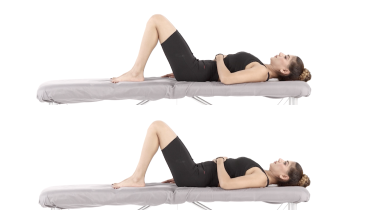 Diaphragmatic breathing
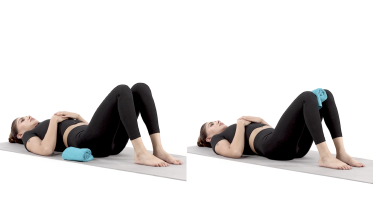 Pelvic floor exercise lying down
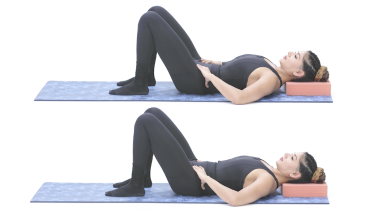 Transverse abdominis activation
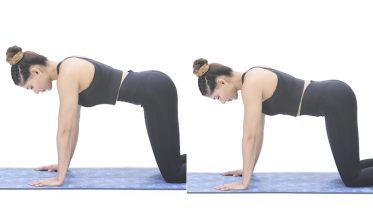 Hands and knees core activation
Stage 2: Keep the hold while your arms and legs move
Start this once stage 1 feels easy. Hold the gentle lift and draw-in while one knee lowers to the side, both heels slide away, your arms reach overhead or your hips rise into a bridge. Watch the middle of your tummy: if a ridge, dome or dip appears, make the movement smaller. Sit to stand is practice for lifting: squeeze your pelvic floor lightly and breathe out just before you stand. After a cesarean, ask your midwife, doctor or physio when your wound is ready for this stage, which is often around the 6 to 8 week check.
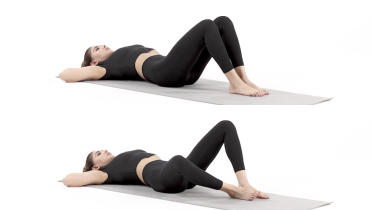 Bent knee fall out
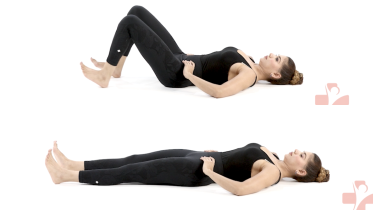 Double heel slide
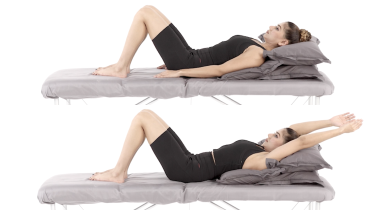 Lying arm lifts with core control
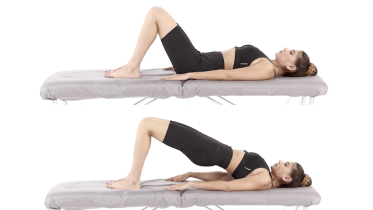 Glute bridge
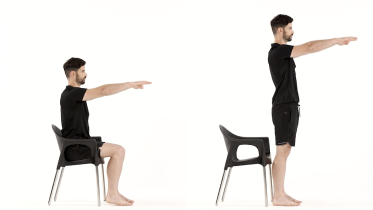 Sit to stand
Stage 3: Harder control, once the midline stays flat
Move here once stage 2 is easy and the middle of your tummy stays flat through every repetition, with no leaking, heaviness or pain. Lifting your feet off the floor, or reaching one arm and the opposite leg away, loads the band down the middle much more, so drop back to stage 2 if your tummy domes or your back arches. If you gave birth in the last few months, start this stage only after your 6 to 8 week check. If you still have an obvious gap, have had a cesarean or are pregnant, ask a pelvic health physio before you start this stage. They can also say when crunches and planks, and heavier lifting, can come back.
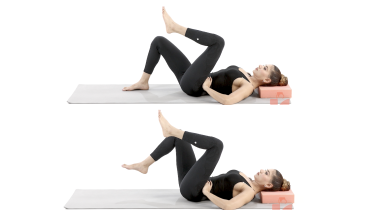 Tabletop leg lift
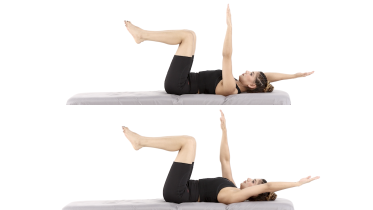 Dead bug
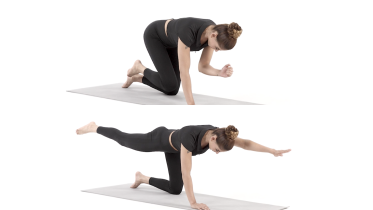 Bird dog
When surgery is considered
Surgery is not the first step. The European Hernia Society suggests that physiotherapy may be considered before surgery, and that the options are talked through so that you and your surgeon decide together (Hernández-Granados 2021). The usual operation stitches the edges of the stretched band together, and a mesh may be used if there is also a hernia.
The Swedish national guidelines consider surgery only when the gap causes problems in daily life, and set clear conditions: at least 6 months of a core training program first, a gap of at least 5 cm at its widest, at least 2 years since the last birth, and no plans for another pregnancy. A smaller gap may be repaired if there is also a hernia or the tummy bulges a lot (Carlstedt 2021).
For people whose symptoms carry on despite physio, the 2026 article for family doctors reports that repair can improve back pain, the stability of the tummy wall and quality of life. After the operation, strengthening exercises are brought back gradually over about 13 weeks (Song 2026). What is offered varies between health systems, so ask your doctor about the options where you live. After surgery, follow your surgeon's program.
When to see a physio or doctor
See your doctor (your GP in the UK) if the gap is still obvious 8 weeks after the birth (NHS). POGP suggests seeking help from a physio for tummy discomfort, back pain, bulging or doming, leaking or a heavy feeling in the pelvis, as these can improve with the right advice. This is the job of a pelvic health physio (physical therapist in the US). It is worth seeing one before you go back to running and jumping, heavy lifting or harder core work.
If you have never been pregnant, see a doctor about any new bulge in the middle of your tummy before you start these exercises. The warning signs below say which symptoms need help the same day and which need an emergency call. If you gave birth in the last few months, the postnatal program lists more warning signs after a birth, such as changes in your bladder or bowels, numbness after an epidural and low mood.
For physiotherapists
Definition: the European Hernia Society defines rectus diastasis as widening of the linea alba over 2 cm, suggests physiotherapy may be considered before surgery (weak recommendation), and suggests plication for RD without concomitant hernia and mesh-based repair with concomitant midline hernias (Hernández-Granados 2021). Song 2026 recommends clinical palpation along the linea alba at rest and during activation, assessing depth and tension, and any doming, with no routine imaging (ultrasound when the diagnosis is uncertain, CT in complex cases), and exclusion of hernia and lipoma.
Evidence: Benjamin 2023 (16 trials, 698 postnatal women; no antenatal trials) found moderate certainty evidence from 6 trials (n = 161) that abdominal exercise reduced inter-recti distance compared with usual care (MD -0.43 cm, 95% CI -0.82 to -0.05), which the authors did not consider clinically significant. Beamish 2025 found low certainty evidence of greater reduction in inter-rectus distance at rest and during head lift after abdominal muscle training. Gluppe 2018 (secondary analysis of an RCT, 175 primiparous women, some with DRA at baseline and some without; weekly supervised 45-minute classes for 16 weeks from 6 weeks postpartum, focused on PFM strength but including abdominal exercises such as half-plank, side-plank and sit-ups, plus daily home PFMT; DRA defined as 2 fingerbreadths or more) found no difference in DRA prevalence at 6 or 12 months. Thabet 2019 (RCT, 40 women after vaginal birth; caliper measurement 4.5 cm above the umbilicus during head lift) reported a larger reduction in inter-recti separation with a deep core program added to traditional abdominal exercise (mean 8.30 mm against 4.85 mm) over 8 weeks. Benjamin 2023 rated only 3 of its 16 trials at low risk of bias.
Surgery: the Swedish national recommendations (Carlstedt 2021) call core training the first treatment, and consider surgery only with functional impairment, after at least 6 months of a standardized core program, with a width of at least 5 cm (a smaller diastasis may be accepted with pronounced bulging or a concomitant epigastric or umbilical hernia), at least 2 years since the last birth and no planned pregnancy. They recommend repairing the diastasis in patients with a symptomatic ventral hernia whatever the width, and note that most studies are in postpartum women and may not apply to men or nulliparous women. Song 2026 reports strengthening exercises reintroduced over 13 weeks after abdominal wall reconstruction, and notes that some patients present years later, including after menopause.
See a doctor promptly if
- Emergency: heavy bleeding from your vagina that is bright red and flowing constantly, soaking your pad and your clothes, or you suddenly lose a lot of blood, or you are bleeding and feel faint or dizzy or have a racing heartbeat. Call emergency services straight away. This can be heavy bleeding after birth (postpartum hemorrhage), which can happen at any time up to 12 weeks after the birth.
- Emergency: you suddenly become short of breath, you get chest pain or pain in your upper back that may be worse when you breathe in, you cough up blood, your heart is beating very fast, or you faint. Call emergency services straight away, even if your leg looks normal. These can be signs of a blood clot in the lungs (pulmonary embolism).
- Emergency: chest pain that spreads to your jaw, arm or back, a heartbeat that keeps racing, or severe breathlessness when you are resting, especially when you lie down. Call emergency services straight away. Heart problems can start for the first time after having a baby.
- Emergency: tummy pain that came on very suddenly or is severe, especially if you also feel faint, have a racing heartbeat or feel very unwell, or tummy pain when you cannot poo or pass wind at all. Call emergency services or go to an emergency department straight away.
- Emergency: you have thoughts of ending your life or of harming yourself or your baby and feel you might act on them, you have already harmed yourself, or you do not feel you can keep yourself or your baby safe. Call emergency services or go to an emergency department straight away.
- You are pregnant and notice bleeding or fluid leaking from your vagina, regular painful tightenings, tummy pain that does not settle when you rest or comes with lower back pain, or a change in your baby's usual movements, such as moving less than usual. Stop and contact your midwife or maternity unit straight away. Do the same for a severe headache, problems with your vision such as blurring or flashing lights, pain just below your ribs, or sudden swelling of your face, hands or feet, which can be signs of pre-eclampsia. Call emergency services if the bleeding is heavy, the tummy pain is severe, bleeding or tummy pain comes with pain in your shoulder or feeling sick, faint or dizzy, or a headache comes on suddenly and is very severe.
- A soft lump at or near your belly button, along the middle of your tummy or at your cesarean scar that gets bigger when you cough or strain. This can be a hernia, so see your doctor. If the lump becomes painful or tender, or you have a bloated tummy, you feel or are being sick, you are constipated, or you have a high temperature or feel hot, cold or shivery, get medical help straight away, the same day, for example at urgent care or an emergency department. If the pain is severe or came on suddenly, you cannot poo or pass wind at all, you are vomiting blood or your vomit looks like coffee grounds, or you have suddenly become confused, call emergency services or go to an emergency department straight away.
- A calf or thigh that is newly swollen, warm, tender, red or darker than usual, has swollen veins that are sore to touch, or has a throbbing or cramping pain that does not fit your injury or condition, or that feels different from normal muscle soreness after exercise. This can be a sign of a blood clot (deep vein thrombosis), especially after surgery, an injury, time in a cast or boot, a long trip or a spell of being much less mobile than usual. Get medical advice the same day. If you are also short of breath or have chest pain, call emergency services. Pregnancy and the first 6 weeks after giving birth also make a clot more likely, so if you are pregnant or gave birth in the last 6 weeks, contact your maternity unit, midwife or GP straight away.
- A high temperature or feeling hot and shivery, discharge from your vagina that smells unpleasant, flu-like symptoms, tummy or pelvic pain that is new or getting worse, or, after a cesarean, a new cough or feeling short of breath. Get medical advice the same day from your midwife, maternity unit or GP, as these can be signs of an infection. If you have a very high or very low temperature, shivering you cannot control, you are breathing very fast or finding it hard to breathe, you are confused or your speech is slurred, your skin, lips or tongue look blue, gray, pale or blotchy (on brown or black skin this can be easier to see on the palms of the hands or soles of the feet), or you have a rash that does not fade when you press it, call emergency services, as this can be sepsis.
- Your cesarean wound, or the stitches from a tear or a cut (episiotomy), become red, swollen, hot or more painful, ooze pus or fluid, smell unusual, or start to come apart. Contact your midwife or GP straight away, the same day. If you also have a fever or feel unwell, use the line above.
- You pass a blood clot the size of a 50p coin (about 3 cm across) or larger, you soak a maternity pad within an hour, your bleeding gets heavier instead of settling or is still heavy after the first week, or you feel breathless or faint doing everyday things such as walking to the toilet or getting dressed. Contact your midwife, maternity unit or GP straight away, the same day, and do not wait for your next check.
- A severe headache that does not go away with simple painkillers, vision problems such as blurred vision or flashing lights, pain below your ribs, heartburn that does not go away with heartburn medicines, sudden swelling of your face, hands or feet, being sick, or feeling very unwell. Contact your maternity unit, midwife or GP straight away, or NHS 111 in the UK if you cannot reach them. Pre-eclampsia can develop in the days or weeks after the birth, and it needs checking immediately. The same applies to a headache after an epidural or spinal anesthetic that gets worse when you sit or stand up and eases when you lie down. Call emergency services if you have a fit (seizure), or a headache came on suddenly and is very severe. Call emergency services too if you have a headache with a stiff neck and either a high temperature or bright light hurting your eyes, as this can be meningitis.
- A bulge or lump you can feel or see inside or coming out of your vagina, or a feeling of heaviness or pressure in your lower tummy or vagina. Book an appointment with your doctor. This can be a sign of pelvic organ prolapse, and pelvic floor exercises are often part of the treatment once it has been checked.
- Thoughts of suicide or of harming yourself or your baby, even if you do not plan to act on them. Get urgent help the same day from your GP, midwife or health visitor, or NHS 111 in the UK. In the UK, you can also talk to Samaritans on 116 123.
Common questions
How do I know if I have diastasis recti?
The usual signs are a ridge or dome down the middle of your tummy as you sit up from lying, and a soft, jelly-like feel around the belly button. Some women also notice that their tummy still looks rounded some time after the birth. For the NHS self-check, lie on your back with knees bent, lift your head and shoulders a little and feel along the middle for a gap. A physio can check it more fully, including how deep the gap is and how the tummy behaves when you move.
Does diastasis recti go away on its own?
For many women, yes. The NHS says the gap usually closes by the time the baby is 8 weeks old. It does not for everyone: in one study, about 1 in 3 first-time mothers still had a gap at least 2 finger widths wide a year after the birth (Sperstad 2016). If yours is still obvious at 8 weeks, see your doctor, or ask for a pelvic health physio.
What exercises should I avoid with diastasis recti?
At first, the NHS and POGP advise against crunches and sit-ups, especially straight after the birth. Planks and high-impact exercise are on the same list. Try not to lift heavy things or strain on the toilet either. These are not banned for good. They come back gradually once the middle of your tummy stays flat under load, and a pelvic health physio can tell you when.
Can men get diastasis recti?
Yes. It is most common in pregnancy, but anyone can have it, and heavy lifting, long-term straining and big changes in weight can play a part in men (Cleveland Clinic). Most of the treatment research has been done in women after childbirth. A man with a new bulge down the middle of the tummy should see a doctor first to rule out a hernia.
Do I need surgery for diastasis recti?
Most people do not. Surgery is usually considered only when problems carry on after a good exercise program, and the decision is made with a surgeon. Swedish national guidelines, for example, consider surgery only for tummy problems that limit daily life, after at least 6 months of core training, usually with a gap of at least 5 cm, at least 2 years after the last birth and with no plans for another pregnancy (Carlstedt 2021).
References
- NHS. Your post-pregnancy body. Page last reviewed 20 July 2026. https://www.nhs.uk/baby/support-and-services/your-post-pregnancy-body/
- Pelvic, Obstetric and Gynaecological Physiotherapy (POGP). Tummy muscle separation. https://thepogp.co.uk/patient_information/womens_health/tummy_muscle_separation.aspx
- National Institute for Health and Care Excellence (NICE). Pelvic floor dysfunction: prevention and non-surgical management. NICE guideline NG210. Published 9 December 2021. https://www.nice.org.uk/guidance/ng210
- Benjamin DR, Frawley HC, Shields N, Peiris CL, van de Water ATM, Bruder AM, Taylor NF. Conservative interventions may have little effect on reducing diastasis of the rectus abdominis in postnatal women: a systematic review and meta-analysis. Physiotherapy. 2023;119:54-71. https://doi.org/10.1016/j.physio.2023.02.002
- Beamish NF, Davenport MH, Ali MU, et al. Impact of postpartum exercise on pelvic floor disorders and diastasis recti abdominis: a systematic review and meta-analysis. British Journal of Sports Medicine. 2025;59(8):562-575. https://doi.org/10.1136/bjsports-2024-108619
- Gluppe SL, Hilde G, Tennfjord MK, Engh ME, Bø K. Effect of a postpartum training program on the prevalence of diastasis recti abdominis in postpartum primiparous women: a randomized controlled trial. Physical Therapy. 2018;98(4):260-268. https://doi.org/10.1093/ptj/pzy008
- Thabet AA, Alshehri MA. Efficacy of deep core stability exercise program in postpartum women with diastasis recti abdominis: a randomised controlled trial. Journal of Musculoskeletal and Neuronal Interactions. 2019;19(1):62-68. https://pmc.ncbi.nlm.nih.gov/articles/PMC6454249/
- Sperstad JB, Tennfjord MK, Hilde G, Ellström-Engh M, Bø K. Diastasis recti abdominis during pregnancy and 12 months after childbirth: prevalence, risk factors and report of lumbopelvic pain. British Journal of Sports Medicine. 2016;50(17):1092-1096. https://doi.org/10.1136/bjsports-2016-096065
- Song MSH, Brew TJ, Yousif YF, van't Schip K, Abela C. Management of postpartum rectus diastasis in primary care. British Journal of General Practice. 2026;76(767):286-287. https://doi.org/10.3399/BJGP.2025.0590
- Hernández-Granados P, Henriksen NA, Berrevoet F, et al. European Hernia Society guidelines on management of rectus diastasis. British Journal of Surgery. 2021;108(10):1189-1191. https://doi.org/10.1093/bjs/znab128
- Carlstedt A, Bringman S, Egberth M, et al. Management of diastasis of the rectus abdominis muscles: recommendations for Swedish national guidelines. Scandinavian Journal of Surgery. 2021;110(3):452-459. https://doi.org/10.1177/1457496920961000
- Cleveland Clinic. Diastasis recti. Last updated 21 April 2025. https://my.clevelandclinic.org/health/diseases/22346-diastasis-recti
- NHS. Hernia. Page last reviewed 19 May 2026. https://www.nhs.uk/conditions/hernia/
- NHS. Pelvic organ prolapse. Page last reviewed 3 July 2025. https://www.nhs.uk/conditions/pelvic-organ-prolapse/
- NHS. Sepsis. Page last reviewed 14 May 2026. https://www.nhs.uk/conditions/sepsis/
- NHS. Pre-eclampsia. Page last reviewed 23 March 2026. https://www.nhs.uk/conditions/pre-eclampsia/
- NHS. Meningitis. Page last reviewed 12 June 2026. https://www.nhs.uk/conditions/meningitis/
- NHS. Epidural: side effects and complications. Page last reviewed 1 February 2023. https://www.nhs.uk/tests-and-treatments/epidural/side-effects/
- NHS. Where to get urgent help for mental health. Page last reviewed 26 April 2023. https://www.nhs.uk/nhs-services/mental-health-services/where-to-get-urgent-help-for-mental-health/
- NHS. Deep vein thrombosis (DVT). Page last reviewed 30 April 2026. https://www.nhs.uk/conditions/deep-vein-thrombosis-dvt/
- NHS. Pulmonary embolism. Page last reviewed 25 May 2023. https://www.nhs.uk/conditions/pulmonary-embolism/
- Royal College of Obstetricians and Gynaecologists (RCOG). Heavy bleeding after birth (postpartum haemorrhage). December 2016. https://www.rcog.org.uk/for-the-public/browse-our-patient-information/heavy-bleeding-after-birth-postpartum-haemorrhage/
Written and checked by the PocketPhysio editorial team. Last updated 2026-09-29.
This page is general education, not a diagnosis or a personal treatment plan. See a physiotherapist or doctor for advice about your own situation.