Lying arm lifts with core control
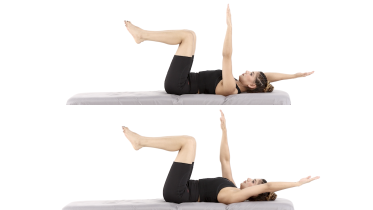
Lying arm lifts are a gentle core control exercise. You lie on your back with your knees bent and your head and shoulders raised on pillows, then lift both arms up and back over your head and return them to your sides. The work is in keeping your ribs and lower back still while the arms move.
How to do the lying arm lifts with core control
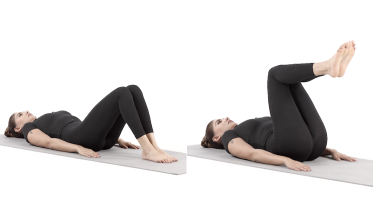
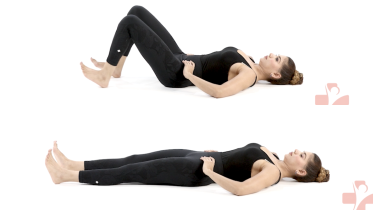
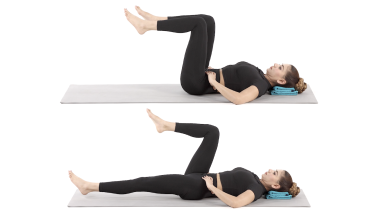
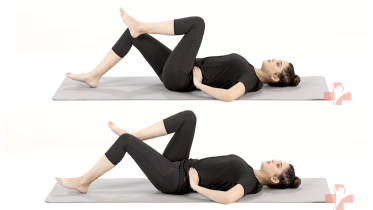
- Lie face up on a mat or firm bed, knees bent and both feet flat. In the video a stack of pillows props up the head and upper back, and you can do the same if lying flatter is uncomfortable. Start with your arms resting alongside you.
- Lift your pelvic floor a little, as if holding in wind. Let your lower tummy draw in gently with it, without pulling it in hard.
- Breathe out and slowly raise both arms together, straight up toward the ceiling.
- Carry on until your arms are back beside your head, but only as far as your ribs stay down and your lower back does not arch away from the bed.
- Bring the arms back up over your chest and lower them slowly to your sides. Breathe normally from start to finish.
What you should feel
Light work deep in your lower tummy that keeps your trunk still, and a gentle stretch at the front of the shoulders as the arms go overhead.
Common mistakes
- Arching the lower back or letting the ribs pop up as the arms go back.
- Dropping the arms quickly instead of lowering them under control.
- Clenching hard in the stomach or holding your breath.
- Shrugging the shoulders up toward your ears.
How often
Many programs use 1 to 3 sets of 8 to 10 slow arm lifts, once a day or on most days. Your physio will adjust this.
Stop and check with your physio if
- Lower back pain that builds as you go on, or pain, tingling or numbness spreading down a leg.
- Sharp or catching pain in a shoulder as the arm goes overhead.
- A ridge or bulge along the middle of your stomach, or a heavy, dragging feeling in your pelvis. Stop there and let your physio know.
From the clinic
Take the arms back only as far as your trunk can stay still. For many people that is just past the face at first, and the range grows with practice. If you cannot yet find the gentle hold low in your tummy, transverse abdominis activation is the step before this one, and the dead bug adds leg control later on. If you have high blood pressure, breathe steadily through every repetition and never hold your breath.
Check with your doctor or physio before you start if you have a hernia or have had stomach or back surgery in recent months.
After shoulder surgery, including a rotator cuff repair, or after a shoulder fracture or dislocation, follow your surgeon's or physio's plan, and do only the movements and range they have cleared. Many plans allow only passive movement at first, where the arm is moved for you and its muscles stay relaxed.
If you have recently given birth, including by cesarean section, or you have a gap down the middle of your stomach muscles (diastasis recti), ask your physio, midwife or doctor first. If you are pregnant, check with your midwife or physio before you start. If you are pregnant and past the first three months, check with your physio before exercising flat on your back.
Written and checked by the PocketPhysio editorial team. Last updated 2026-09-26.
This page is general education, not a diagnosis or a personal treatment plan. If you have pain, an injury or a health condition, see a physiotherapist or doctor before starting new exercises.