Bent knee leg lowering
Bent knee leg lowering is a core control exercise done lying on your back. From tabletop, with your hips and knees at right angles, you lower both feet together toward the floor with the knees still bent, then bring them back up. With both legs moving at once, your stomach muscles have more to do to keep the lower back still than when you lower one leg at a time.
How to do the bent knee leg lowering
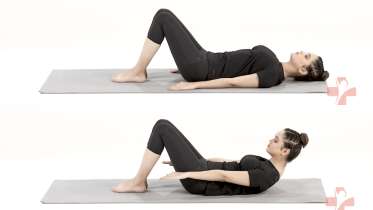
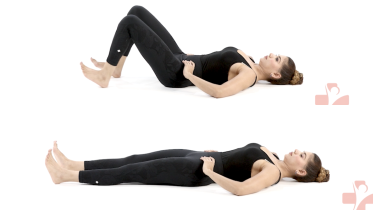
- Lie on your back on a mat with your knees bent, feet flat and arms resting by your sides, palms down, as in the video.
- Tighten your stomach muscles gently, as if getting ready for a light poke in the tummy, and let your lower back rest on the mat. You should still be able to breathe and talk.
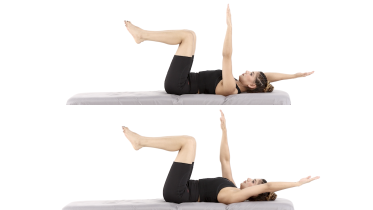
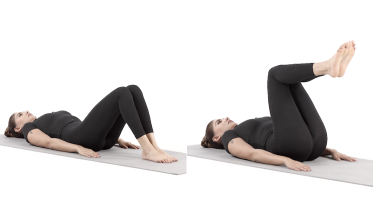
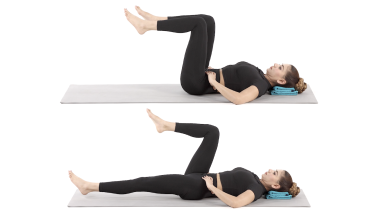
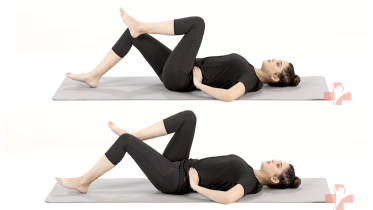
- Lift both feet off the mat together and bring the legs up until both hips and knees sit at right angles and your shins are level with the floor (tabletop). If lifting both at once pulls on your lower back, bring one leg up and then the other.
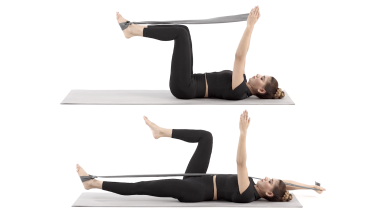
- Keep your knees bent and slowly lower both feet together toward the floor. The knees open a little as the feet go down, as in the video. Stop before the heels touch, or sooner if your lower back starts to arch off the mat.
- Lift both legs back to tabletop with the same control, then go again. When you finish, lower one foot to the mat and then the other.
What you should feel
Hard, steady work low in your stomach, and effort at the front of both hips as the legs come back up. Your lower back should feel supported the whole time.
Common mistakes
- Lowering further than you can control, so the lower back peels off the mat and arches.
- Letting the legs drop quickly, then swinging them back up.
- Holding your breath, or pushing your stomach out hard.
- Letting the knees straighten out as the feet go down, which makes the lever longer and the exercise much harder.
How often
Many programs start with 1 to 3 sets of 5 to 8 slow lowers, resting between sets, on most days. Your physio will adjust this.
Stop and check with your physio if
- Lower back pain that builds with each lowering, even when you make the movement smaller.
- Pain, pins and needles or numbness that travels from your back into a leg.
- A sharp pinch deep in the groin or at the front of a hip as the legs lower or lift.
- Your stomach bulges or forms a ridge down the middle, or you feel heaviness or pressure low in your pelvis. Stop there and tell your physio about it.
From the clinic
The voice guide describes lowering one heel at a time, with your hands resting on your stomach. The video shows both legs lowering together with the arms by the sides, and the steps above follow the video. One leg at a time is the easier version, so start there if moving both legs pulls your back off the mat: that is the lying alternate heel taps exercise. If holding tabletop is already hard, build up with the tabletop leg lift first. Your physio may also bring in the dead bug or leg lowering with a tummy draw-in as next steps.
The voice guide's tip is worth borrowing, though. Rest your fingertips on your lower stomach and you can feel whether the muscles stay switched on as the legs go down. If you have high blood pressure, breathe steadily through every repetition and never hold your breath.
If you have had a hip replacement, get the go-ahead from your surgeon or physio before you try bent knee leg lowering. Some operations limit this kind of work for the first months, so the timing depends on your surgery.
With a hernia, or after an operation on your stomach or back, ask your physio before you start, because lifting and lowering both legs puts a lot of load through the stomach wall. If you have recently given birth, including by cesarean section, or you have a gap down the middle of your stomach muscles (diastasis recti), ask your physio, midwife or doctor first. If you are pregnant, check with your midwife or physio before you start. If you are pregnant and past the first three months, check with your physio before exercising flat on your back.
Written and checked by the PocketPhysio editorial team. Last updated 2026-09-28.
This page is general education, not a diagnosis or a personal treatment plan. If you have pain, an injury or a health condition, see a physiotherapist or doctor before starting new exercises.