Tabletop leg lift
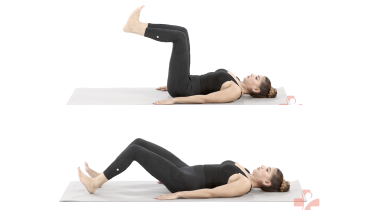
The tabletop leg lift is a core control exercise done lying on your back. With a gentle hold on your deep stomach muscle (transversus abdominis) and pelvic floor, you bring one knee up over your hip, then lift the other foot off the floor, and lower them one at a time. Your lower back and pelvis stay still throughout. It follows on from easier moves where one foot always stays down.
How to do the tabletop leg lift
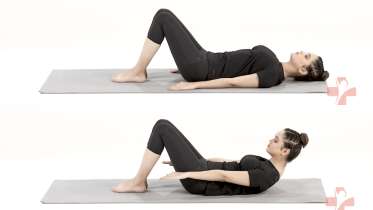
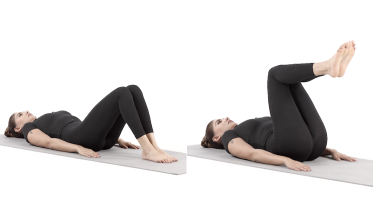
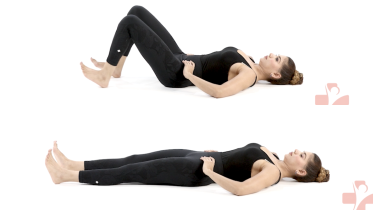
- Lie face up with your knees bent and feet flat, your hands on your lower stomach and a small pillow or block under your head if you like. Leave the small natural curve in your lower back as it is.
- Gently lift your pelvic floor and draw your lower stomach in. Keep the effort light enough that you can breathe normally.
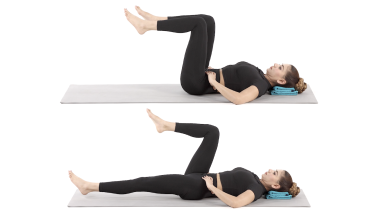
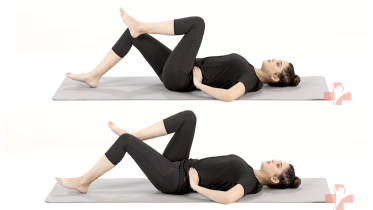
- Raise one knee until it sits above your hip, about a right angle at the hip, without holding it with your hands. Your pelvis stays level and still.
- Keep breathing and lift the other foot just off the floor as well, without letting your back arch or your pelvis tip.
- Slowly lower one foot and then the other back to the mat. Repeat with the same leg leading, then do the same number leading with the other leg.
What you should feel
Steady work low in your stomach and some effort at the front of the hips. Your lower back should feel supported, not strained.
Common mistakes
- Letting your lower back arch or your pelvis tip as the second foot comes up.
- Swinging the leg up or pulling the knee in with your hands.
- Holding your breath as the feet leave the floor.
- Letting the feet drop heavily back to the floor.
How often
Many programs start with 1 to 3 sets of 5 to 8 lifts leading with each leg, with a pause of a few seconds at the top. Your physio will adjust this.
Stop and check with your physio if
- Lower back pain that builds from one rep to the next.
- A sharp, pinching pain deep in the groin or at the front of the hip.
- A bulge along the middle of your stomach, or pressure or heaviness in your pelvis. Mention it to your physio.
From the clinic
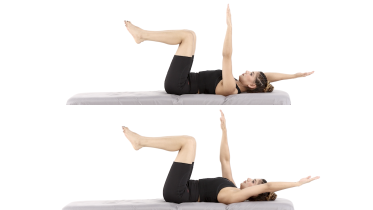
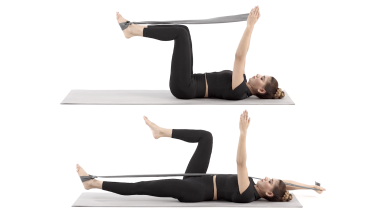
In the video the second foot only lifts a little way. The full tabletop, with the second knee also brought up over the hip so both shins sit level, is the harder version. Save it for when your back stays quiet. If the first stage is already a struggle, supine marching keeps one foot down, and the double heel slide keeps both heels on the floor. Once the tabletop is steady, the dead bug is a common next step.
If you have had a hip replacement, get the go-ahead from your surgeon or physio before you try the tabletop leg lift. Some operations limit this kind of work for the first months, so the timing depends on your surgery. With a hernia, a gap in the stomach muscles after pregnancy (diastasis recti), recent stomach surgery, or leaking or a heavy feeling in the pelvis, ask your physio first. If you are pregnant and past the first three months, check with your physio before exercising flat on your back.
Written and checked by the PocketPhysio editorial team. Last updated 2026-09-26.
This page is general education, not a diagnosis or a personal treatment plan. If you have pain, an injury or a health condition, see a physiotherapist or doctor before starting new exercises.