
Pelvic floor weakness exercises and physiotherapy
What does pelvic floor weakness mean?
Your pelvic floor is a layer of muscles at the base of your pelvis, running from the pubic bone at the front to the tailbone at the back. It supports your bladder and bowel and helps keep them closed until you choose to go. When these muscles are weak or damaged, the tube that carries pee out of the bladder (urethra) may not stay closed when pressure suddenly rises inside your tummy.
That leak under pressure is called stress urinary incontinence. The "stress" is physical, not emotional: a cough, a sneeze, a laugh, lifting something heavy or exercise. The NHS lists damage during childbirth, extra pressure on the tummy from pregnancy or being very overweight, and operations such as a hysterectomy or removal of the prostate among the causes. Leaking also becomes more likely with age.
It is common, and the NHS encourages anyone with leaking to see a GP rather than put up with it out of embarrassment. Some people leak with a sudden, strong need to pee instead (urge incontinence), and many have a mix of both. This page is mainly about the stress type.
Why pelvic floor exercises help
NICE in the UK recommends a trial of supervised pelvic floor muscle training, lasting at least 3 months, as the first treatment for women with stress or mixed incontinence. It also advises carrying on with the exercises if they help.
A Cochrane review of 31 trials with 1,817 women compared pelvic floor training with no treatment (Dumoulin 2018). In the 4 trials that measured cure for stress incontinence, women who trained were about eight times more likely to report being cured by the end of treatment: 56% compared with 6%. The review authors concluded that pelvic floor training could be included in first-line care. Most trials followed women for less than a year, so how well the benefit lasts over many years is less clear.
There are limits, though. Nearly all of this research is in women, and there is much less on men who have not had prostate surgery. And the stage 2 and 3 exercises below are there to help you practice the squeeze while you move, following the way POGP suggests progressing from lying and sitting to standing and everyday activity. They do not replace the squeezes themselves. The squeezes are the part with the evidence behind them.
How to find your pelvic floor muscles
Sit on a firm chair with your knees a little apart, or lie on your back with your knees bent. Imagine you are trying to stop yourself passing wind and stopping yourself peeing at the same time. Squeeze those muscles and lift them up and in. Then let them go completely, and feel them drop back to rest.
Keep your buttocks and thighs relaxed, and do not pull your tummy in hard. A slight tightening low in the tummy often comes with the squeeze, and that is fine. Keep breathing normally through every squeeze and never hold your breath. POGP advises against practicing by stopping your flow of pee on the toilet, so use that picture to find the muscles, not as the exercise.
If you feel a push down or a bulge rather than a lift, or you cannot feel anything happening after a few weeks of trying, see a pelvic health physio. They can check how well your muscles tighten and relax and set the program for you. NICE recommends this kind of supervised training as the first treatment for women with stress leaking.
How to use this program
Start at stage 1. The squeezes stay the main part of the program at every stage, so keep doing them even after you move on to the movement exercises.
There are two kinds of squeeze. Long holds: squeeze, hold, then relax fully. Quick squeezes: tighten quickly, then let go straight away.
POGP suggests working up to 10 long squeezes of up to 10 seconds each, followed by 10 quick squeezes, at least 3 times a day, and NICE recommends at least 8 squeezes, 3 times a day. If you can only hold for a couple of seconds at first, start there, as the NHS suggests, and build toward 10 seconds. Your physio will adjust this.
Rest for a few seconds between long holds so the muscles fully let go. Once the squeezes are easy lying down, do them sitting and then standing. Linking them to something you already do each day, such as brushing your teeth, makes them easier to remember.
For the movement exercises, each exercise page gives a typical starting dose. Move up a stage when the current one feels steady and you are not leaking during it. Give the whole program time: improvement is usually measured in months.
The exercise program
Stage 1: Find the squeeze
Start here, lying down or sitting, until you can feel the pelvic floor tighten and lift and then let go. Begin with the pelvic floor exercise lying down, and keep any tummy draw-in gentle, as the lift inside is the part that matters. The other two add a gentle draw-in of the lower tummy, so bring them in once the pelvic floor squeeze is clear and you can do it without holding your breath.
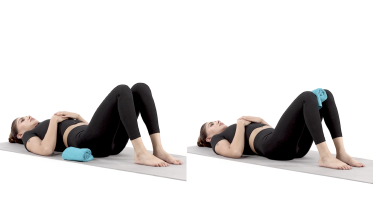 Pelvic floor exercise lying down
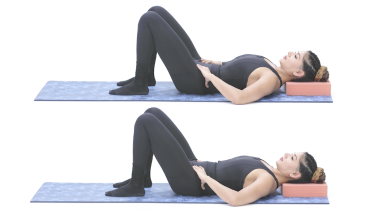 Transverse abdominis activation
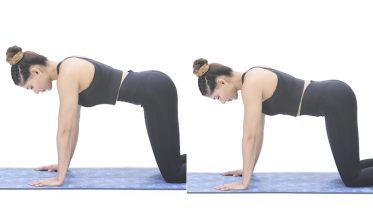 Hands and knees core activation
Stage 2: Keep the squeeze while you move
When you can do your long holds and quick squeezes lying and sitting. These add a leg or hip movement, or a steady press of the knee against your hand, while you hold a gentle pelvic floor squeeze and keep breathing. If you leak, bear down or lose the squeeze, go back to the smaller movement for now.
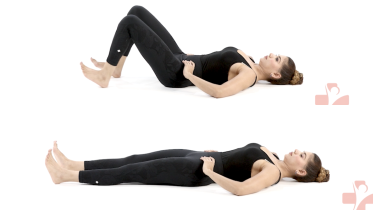 Double heel slide
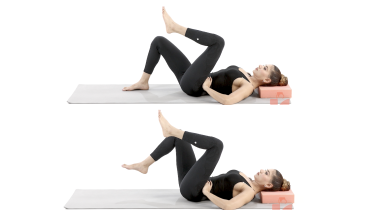 Tabletop leg lift
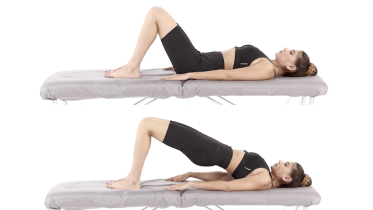 Glute bridge
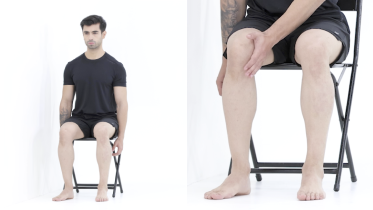 Seated isometric hip adduction
Stage 3: Squeeze in everyday movements
For harder bridging and for standing up. These keep the squeeze going under more load, and the squat and sit to stand practice the kind of movements that often bring on a leak. Sit to stand is a good place to practice the knack: squeeze just before you push up. Stay with stage 2 if these make you leak or feel heaviness low down.
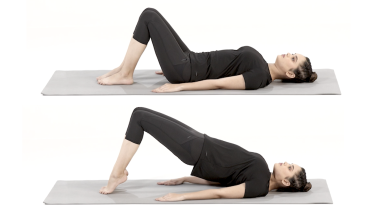 Bridge with heel raise
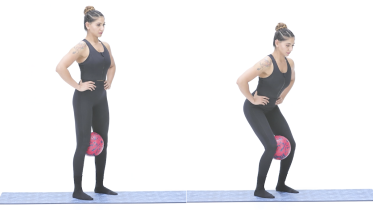 Squat with ball squeeze
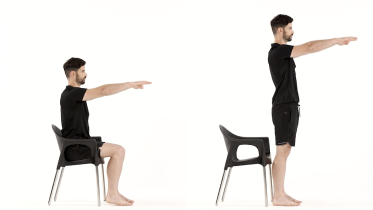 Sit to stand
The knack: squeeze before you cough
The knack is a simple habit: tighten your pelvic floor just before you cough, sneeze, laugh or lift, and hold it until the effort is over. In a small study of 27 older women with mild to moderate stress incontinence, the women leaked much less during a medium cough when they used the knack than when they did not, one week after learning it (Miller 1998). It was a short, small study, so treat it as a useful habit alongside your daily squeezes rather than a cure.
The NHS gives the same advice for lifting: tighten your pelvic floor before you lift and keep it tight while you lift. Practice the timing in easy moments first, such as standing up from a chair, so it is automatic when a sneeze catches you out.
Everyday habits that can help
Weight makes a difference. NICE advises women with incontinence who have a BMI over 30 to lose weight, and the NHS explains that extra weight puts pressure on the bladder and pelvic floor.
Do not cut right down on drinks to avoid leaks. The NHS says limiting fluids makes incontinence worse because it reduces how much your bladder can hold, and NICE suggests adjusting how much you drink if your intake is very high or very low. The NHS also says caffeine irritates the bladder and can make leaking worse, so swapping some tea, coffee or cola for decaffeinated drinks is worth trying.
Straining on the toilet puts load on the pelvic floor, so the NHS advises treating constipation promptly. If you smoke, the NHS notes that coughing strains the pelvic floor, which is one more reason to stop.
What to avoid or change
The NHS says high-impact exercise and sit-ups put pressure on the pelvic floor and can increase leaks. That is why this program leaves out jumping, running drills, sit-ups and crunches. If you want to get back to running or jumping sports, build your pelvic floor strength first and ask a pelvic health physio how to return step by step.
Stop an exercise and tell your physio if it brings on pain in your pelvis, or a feeling of heaviness or bulging low down. If you have pelvic pain or pain during sex, see a pelvic health physio before you start, so they can check how your muscles tighten and relax. If you have a condition that affects the nerves, such as multiple sclerosis, Parkinson's disease or a spinal cord injury, ask your doctor first, as bladder problems then need their own assessment.
If you are pregnant, or have given birth recently, this is not your program: check with your midwife or a pelvic health physio first. After prostate surgery, follow the plan from your surgical team, including when to start pelvic floor exercises. After surgery for incontinence or prolapse, or other pelvic surgery, follow your surgeon's program. The program is written for adults, so if a child or teenager has daytime wetting or leaks, get them checked by a doctor first.
When to see a physio or doctor
See your doctor about any kind of leaking, as the NHS advises. It is worth an appointment early rather than after years of pads. A doctor can refer you to a pelvic health physio or a continence service, and in some areas you can refer yourself.
See a pelvic health physio if you cannot feel the muscles working, if you are not improving after about 3 months of regular squeezes, or if leaking stops you exercising or going out. See your doctor if your main problem is a sudden, strong need to pee that you cannot hold, as bladder training, usually for at least 6 weeks, is one of the first treatments for urge incontinence.
New leaking of poo or wind that you cannot control also needs a doctor's check. So does leaking with a weak or stop-start stream, straining to pee or a feeling that you have not finished, which can be a sign of a bladder that does not empty fully (overflow incontinence). The same goes for leaking all the time, rather than with effort or a sudden urge.
If it hurts or burns when you pee, see a pharmacist or doctor, as this can be a urine infection. If you are a man, are 65 or over, or have diabetes, ask for an urgent doctor's appointment instead. The urgent warning signs are listed below.
For physiotherapists
This page is a starting point for patients, not a full plan. NG123 recommends supervised pelvic floor muscle training of at least 3 months as first-line treatment for women with stress or mixed incontinence, with programs of at least 8 contractions performed 3 times a day, continued if beneficial. NG123 also recommends routine digital assessment to confirm a pelvic floor contraction before supervised training starts. For symptomatic POP-Q stage 1 or 2 prolapse, it suggests considering supervised training for at least 16 weeks. The Cochrane review (Dumoulin 2018) rated the evidence for cure in stress incontinence as high quality and most other outcomes as moderate.
See a doctor promptly if
- Emergency: numbness, tingling or altered feeling around or under your genitals, between your inner thighs, or around your bottom (anus), for example it feels different when you wipe after using the toilet. Call emergency services or go to an emergency department straight away. This can be a sign of pressure on the bundle of nerves at the base of the spine (cauda equina syndrome), which needs emergency treatment.
- Emergency: you suddenly cannot control your bladder or bowels at all. The same applies to new leaking of pee or poo, new trouble starting to pee, not being able to feel yourself peeing, not noticing when you need to poo, a new change in how your genitals feel during sex, or new trouble getting an erection or ejaculating, if it comes with back pain, sciatica, or pain, tingling, numbness or weakness in one or both legs. Call emergency services or go to an emergency department straight away. These can also be signs of cauda equina syndrome.
- Emergency: you cannot pee at all, especially if your lower tummy feels full and painful. Call emergency services or go to an emergency department straight away.
- Emergency: leaking that starts suddenly in an older person who is also newly confused or agitated, very drowsy, or has trouble speaking. Call emergency services or go to an emergency department straight away. This can be a sign of a serious infection or another illness that needs urgent treatment.
- Pain or burning when you pee together with a high or very low temperature, feeling hot or cold and shivery, or pain in your back just under the ribs. Get medical advice the same day, as this can be a kidney infection. If you also become confused, very drowsy or have trouble speaking, call emergency services or go to an emergency department straight away.
- Leaking that starts suddenly or gets much worse over a few days in an older person, without any of the signs above. Get medical advice the same day, as this can be caused by a urine infection or a medicine.
- Blood in your pee, which may look pink, red or dark brown, even a small amount, even once, and even with no pain. Get medical advice the same day. It needs checking even if it goes away.
- A bulge or lump you can feel or see inside or coming out of your vagina, or a feeling of heaviness or pressure in your lower tummy or vagina. Book an appointment with your doctor. This can be a sign of pelvic organ prolapse, and pelvic floor exercises are often part of the treatment once it has been checked.
Common questions
How long does it take for pelvic floor exercises to work?
Usually months, not weeks. NICE advises women with stress incontinence to do supervised training for at least 3 months as a first treatment, and POGP, the UK group of pelvic health physios, says you should notice an improvement in 3 to 5 months. Keep going even if the first few weeks feel slow. Once it has helped, POGP suggests doing the exercises once a day to keep the improvement.
How do I know if I am doing pelvic floor exercises correctly?
You should feel a squeeze and a lift inside, as if you are holding in wind and stopping yourself peeing at the same time, and then feel the muscles let go. Your buttocks, thighs and tummy stay fairly relaxed, and you keep breathing. If you feel a push down or bulge instead of a lift, or you feel nothing at all after a few weeks, ask a pelvic health physio to check. NICE recommends that a trained professional checks you can tighten these muscles, usually with a gentle internal exam, before supervised training starts.
Should I practice by stopping my pee midstream?
No. POGP advises against practicing by stopping your flow of pee. Imagining that you are stopping it is a good way to find the muscles, but do the actual exercises when you are not on the toilet.
Can men do pelvic floor exercises?
Yes. Men have pelvic floor muscles too, and POGP publishes a separate exercise leaflet for men. It uses the same long and quick squeezes, at least 3 times a day, and says to expect an improvement in 3 to 6 months. Most of the research on pelvic floor training for leaking has been done in women, so there is less evidence for men who have not had an operation. After prostate surgery, follow the plan from your surgical team, including when to start these exercises.
Are Kegel exercises the same as pelvic floor exercises?
Yes. Kegel exercises is another name for pelvic floor muscle exercises. The squeezes described on this page are the same thing.
References
- National Institute for Health and Care Excellence. Urinary incontinence and pelvic organ prolapse in women: management (NG123). Published 2019. https://www.nice.org.uk/guidance/ng123
- Dumoulin C, Cacciari LP, Hay-Smith EJC. Pelvic floor muscle training versus no treatment, or inactive control treatments, for urinary incontinence in women. Cochrane Database of Systematic Reviews. 2018;(10):CD005654. https://doi.org/10.1002/14651858.CD005654.pub4
- Miller JM, Ashton-Miller JA, DeLancey JO. A pelvic muscle precontraction can reduce cough-related urine loss in selected women with mild SUI. Journal of the American Geriatrics Society. 1998;46(7):870-874. https://doi.org/10.1111/j.1532-5415.1998.tb02721.x
- Pelvic, Obstetric and Gynaecological Physiotherapy (POGP). Pelvic floor muscles. https://thepogp.co.uk/patients/pelvic_health_advice/pelvic_floor_muscles.aspx
- Pelvic, Obstetric and Gynaecological Physiotherapy (POGP). Pelvic floor muscle exercises (for men). 2021. https://thepogp.co.uk/Resources/122/pelvic_floor_muscle_exercises_for_men/
- NHS. Urinary incontinence. https://www.nhs.uk/conditions/urinary-incontinence/
- NHS. Urinary incontinence: causes. https://www.nhs.uk/conditions/urinary-incontinence/causes/
- NHS. Urinary incontinence: treatment. https://www.nhs.uk/conditions/urinary-incontinence/treatment/
- NHS. Urinary incontinence: 10 ways to stop leaks. Page last reviewed 15 June 2023. https://www.nhs.uk/conditions/urinary-incontinence/10-ways-to-stop-leaks/
- NHS. Urinary tract infections (UTIs). https://www.nhs.uk/conditions/urinary-tract-infections-utis/
- NHS. Blood in urine. https://www.nhs.uk/conditions/blood-in-urine/
- NHS. Pelvic organ prolapse. https://www.nhs.uk/conditions/pelvic-organ-prolapse/
- NHS. Sudden confusion (delirium). https://www.nhs.uk/symptoms/confusion/
- Getting It Right First Time (GIRFT), NHS England. National suspected cauda equina syndrome (CES) pathway. February 2023, updated March 2026. https://gettingitrightfirsttime.co.uk/wp-content/uploads/2026/04/National-Suspected-Cauda-Equina-Pathway-March-2026.pdf
- Patient.info. Urinary retention. Last updated 16 September 2024. https://patient.info/mens-health/prostate-and-urethra-problems/urinary-retention
Written and checked by the PocketPhysio editorial team. Last updated 2026-09-26.
This page is general education, not a diagnosis or a personal treatment plan. See a physiotherapist or doctor for advice about your own situation.