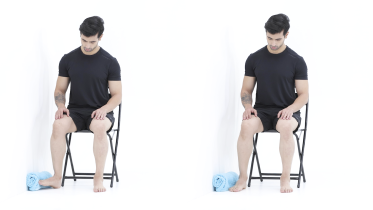
Seated isometric hip adduction
Seated isometric hip adduction works the muscles on the inside of your thigh (adductors) without any movement. You sit on a chair, put the opposite hand on the inside of one knee, and press that knee inward against your hand for about 10 seconds. Your hand gives the resistance, so you choose how hard to push, and you work one side at a time.
How to do the seated isometric hip adduction
- Sit upright on a firm chair with both feet flat on the floor, about hip width apart, and your knees bent to about a right angle.
- Reach across with the opposite hand and place it on the inner side of the knee you are working. In the video, the left hand rests on the inside of the right knee.
- Press the knee inward against your hand while your hand holds it where it is, so the knee does not move. Keep the foot planted and the ankle still.
- Hold the press for about 10 seconds, breathing steadily the whole time.
- Relax, rest for a few seconds, and repeat. Change sides if your program includes both legs.
What you should feel
A firm tightening along the inside of the thigh, up toward the groin, on the leg that presses. Your arm works a little too.
Common mistakes
- Letting the knee actually move inward. Your hand should match the push so nothing moves.
- Twisting the foot or lifting the heel to push harder.
- Holding your breath during the press.
- Slumping sideways as you reach across. Stay tall and lean only as far as you need to.
How often
Holds of about 10 seconds, repeated 5 to 10 times on each side, once or twice a day, are a common starting point, beginning with a moderate press. Your physio will adjust this.
Stop and check with your physio if
- Sharp pain in the groin or inner thigh during the press.
- Pain over the pubic bone at the front of your pelvis, or groin pain that is worse the next day.
From the clinic
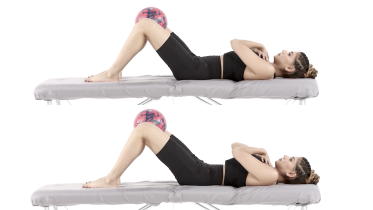
This is not the same as the adductor ball squeeze. That one squeezes both knees together into a ball, usually lying on your back. Here you sit, work one leg at a time, and use your own hand instead of a ball, so you can ease off the moment your groin complains. That makes it handy when only one side is sore, or when you have no ball with you.
If you have high blood pressure, breathe steadily through every hold and never hold your breath. Counting the seconds out loud is a simple way to keep the air moving.
If you have had a hip replacement, get the go-ahead from your surgeon or physio before you try seated isometric hip adduction. Some operations limit this kind of work for the first months, so the timing depends on your surgery. If you are pregnant or have pain over the pubic bone, check with your physio first, since pressing the knee inward puts effort through the joint at the front of the pelvis. Once the holds are easy, side lying hip adduction works the same muscles through a movement.
Written and checked by the PocketPhysio editorial team. Last updated 2026-09-26.
This page is general education, not a diagnosis or a personal treatment plan. If you have pain, an injury or a health condition, see a physiotherapist or doctor before starting new exercises.