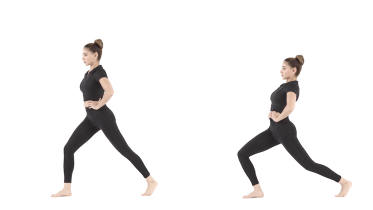
Backward step-down
A backward step-down trains the thigh and buttock to control your weight as the knee bends. You stand on a low step on one leg, slowly bend that knee until the toes of your other foot touch the floor behind the step, then straighten up again. It appears in a lot of knee and hip programs.
How to do the backward step-down
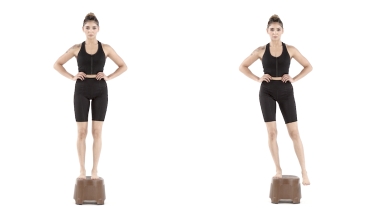
- Stand on a low, sturdy step near its back edge, next to a wall or rail you can touch for balance. Start with a step no higher than a single stair.
- Put your weight on the leg you are working. Keep that whole foot flat on the step.
- Slowly bend the working knee and let your other foot reach back and down behind the step.
- Touch the floor lightly with the toes of that foot. Most of your weight stays on the leg on the step.
- Straighten the working leg to lift yourself back up, bring the free foot back onto the step, and stand tall.
- Do your reps on one leg, then switch.
What you should feel
Work in the front of the thigh and the buttock of the leg on the step. The other leg only touches down lightly.
Common mistakes
- Dropping down fast instead of lowering with control.
- Letting the working knee fall inward. Keep it in line with your second toe.
- Putting weight onto the back foot and pushing off it to get back up.
- Using a step so high that you wobble or your knee hurts.
How often
Programs often start with 2 to 3 sets of 8 to 12 on each leg, on a step low enough to control. Your physio will adjust the height and the numbers for you.
Stop and check with your physio if
- You feel sharp pain in the knee, or the knee gives way.
- Pain at the front of the knee builds with each rep.
- You feel unsteady enough that you might fall. Stop and hold on to something solid.
From the clinic
You cannot see where your foot lands when you step backward, so set up beside a wall or a stair rail before you start. The voice guide talks about a stair, while the video uses a single low step and the floor. Either works if the step is low and solid.
A few slow, steady reps on a low step beat a wobbly drop from a high one. If the front of your knee aches, go lower. It pairs well with the step up, where the same leg does the work on the way up.
If you have had a hip replacement, get the go-ahead from your surgeon or physio before you try backward step-downs. Some operations limit this kind of work for the first months, so the timing depends on your surgery. The same goes after knee surgery. Your surgeon or physio will also tell you what step height is right for you.
Written and checked by the PocketPhysio editorial team. Last updated 2026-09-26.
This page is general education, not a diagnosis or a personal treatment plan. If you have pain, an injury or a health condition, see a physiotherapist or doctor before starting new exercises.