
Patellar tendinopathy (jumper's knee) exercises and physiotherapy
What is patellar tendinopathy?
The patellar tendon is the thick band that runs from the bottom of your kneecap to the bony bump at the top of your shin. Your thigh muscles (quadriceps) pull through it every time you jump, land, climb stairs or get up from a squat. Patellar tendinopathy is pain in that tendon when it takes load. It got the name jumper's knee because it is so common in volleyball, basketball and other sports with lots of jumping and landing.
Two things point to it. The pain sits at a small spot at the bottom tip of the kneecap, and it gets worse the harder the thigh muscles work, most of all when you jump or bound (Malliaras and colleagues, 2015). It often builds up after a few weeks of more jumping or training than the tendon was used to. The NHS describes it as pain between the kneecap and shin, often caused by repetitive running or jumping (NHS Knee pain).
Your physio or doctor can usually tell from what you describe and from examining the knee. Scans can help rule out other problems. But plenty of people with no pain at all show tendon changes on a scan, so the scan alone does not make the diagnosis (Malliaras and colleagues, 2015).
Is it patellar tendinopathy or patellofemoral pain?
Both hurt at the front of the knee, so people mix them up all the time. Patellar tendinopathy hurts at the tendon, just below the kneecap, and you can often put one finger on the sore spot. Patellofemoral pain is a more spread out ache around or behind the kneecap, often brought on by stairs, squats or long spells of sitting. If your ache is around the kneecap rather than below it, go to that page and its program instead.
The treatment differs too. Both programs build thigh and hip strength. This one follows the tendon loading stages and finishes with jumping and hopping, since the tendon has to cope with that load again before you go back to sport.
Teenagers with pain below the kneecap
Everything on this page is written for adults. In children and teenagers who are still growing, pain below the kneecap often comes from where the tendon attaches to growing bone. Osgood-Schlatter disease causes pain at the bony bump just below the knee (AAOS OrthoInfo). Sinding-Larsen-Johansson disease causes pain at the bottom tip of the kneecap and mostly affects active young people aged about 9 to 17 (Wilczynski and colleagues, 2024). A child or teenager with pain below the kneecap should be checked by a doctor or physio before starting any program.
Why does exercise help patellar tendinopathy?
A tendon learns to take load by being loaded, a bit more at a time. Malliaras and colleagues (2015) describe treatment as building the load tolerance of the tendon, the thigh muscles and the rest of the leg step by step, while dealing with the things that overload it. Their staged plan runs from held contractions (isometric), to heavy strength work, to springy energy storage work, and then back to sport.
This plan has been put to the test. In a randomized trial of 76 athletes aged 18 to 35, most with long-standing pain, Breda and colleagues (2021) compared it with a program of painful slow lowering on a decline board (eccentric training). After 24 weeks, the staged loading group had better scores for pain and function. More of them were back to their sport at their old level, 43% against 27%, although that difference could have been down to chance.
Heavy slow resistance training has support too. In a trial of 39 men, heavy slow resistance training and eccentric decline squats both kept their benefit at 6 months, while steroid injections helped only in the short term (Kongsgaard and colleagues, 2009). People in the heavy slow group were the most satisfied with their treatment. A network analysis of 37 trials found that most of the evidence in patellar tendinopathy is of low or very low quality (Challoumas and colleagues, 2021), so treat these results as good guidance, not proof.
How to use this program
Start at the stage that fits how your knee feels now. Not sure? Begin with stage 1. Move on when the current stage feels easy and the tendon is no worse the next morning. In the Breda trial, people moved up a stage once they had done at least a week of the current stage and a single leg squat hurt 3 out of 10 or less. The stage signs on this page follow common practice and are a rough guide, not fixed rules.
You will find a typical starting dose on each exercise page. In research, the held contractions were 5 fairly hard holds of 45 seconds, one leg at a time, on a leg press or leg extension machine, done daily. At home, most people use a wall sit instead. It shares the load between both legs, so it is lighter, and the single leg wall sit comes closer to the research version.
The strength work started at 4 sets of 15 and moved over the weeks to 4 sets of 6 with a heavier weight, every second day. The springy work started at 3 sets of 10 on both legs and built to more sets on one leg (Breda and colleagues, 2021). Your physio will adjust the exercises, the numbers and the weight to your tendon and your sport.
If you have high blood pressure, breathe steadily through every hold and repetition and never hold your breath. With a heart condition or high blood pressure, check with your doctor before you start.
The exercise program
Stage 1: Held contractions to settle the tendon
For a tendon that is sore on stairs, squats or jumping, or too irritable for moving strength work yet. Jumping and landing are usually cut right back at this stage. In these exercises the thigh muscles work while the knee stays still, and many people find that easier on the tendon than bending and straightening under load. Start high on the wall with a short hold, and only slide lower if the tendon stays calm. The single leg wall sit comes last, once the two-legged holds feel easy.
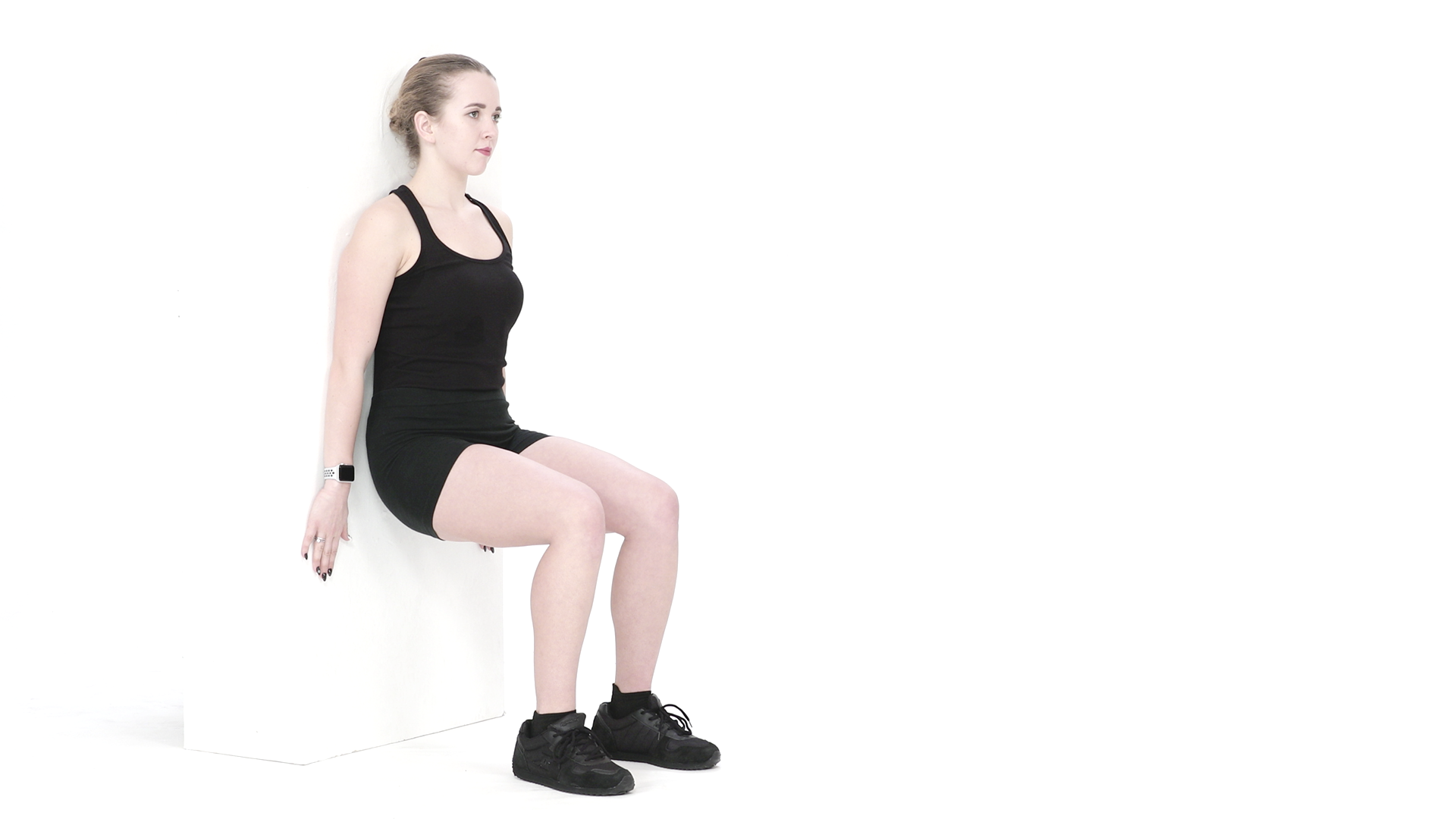 Wall sit
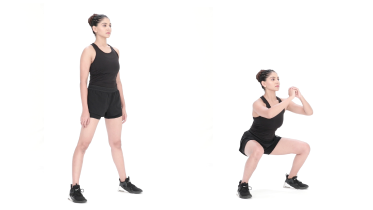 Squat hold
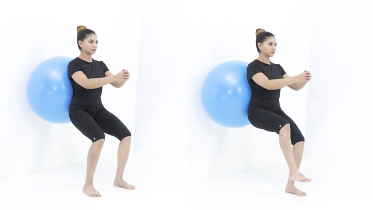 Single leg wall sit with a ball
Stage 2: Heavy, slow strength work
When the holds are comfortable and the tendon is no worse the next morning. This is the main part of the program. Move slowly on the way down and on the way up, add weight as the sets get easy, and keep the pain during the exercise mild, at about 3 out of 10 or less. In the Breda trial, this heavy work was done every second day, with only the holds on the days in between. Start the squats and step ups with a shallow knee bend and go deeper over the weeks as the tendon allows.
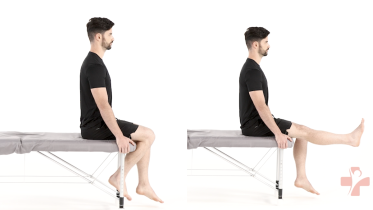 Seated knee extension
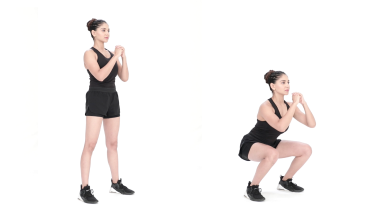 Squat
Squat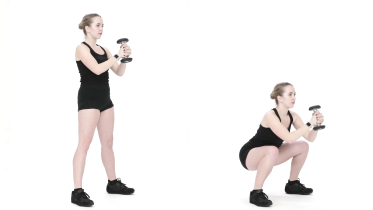 Goblet squat
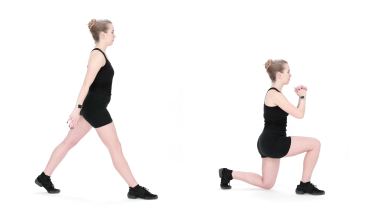 Split squat
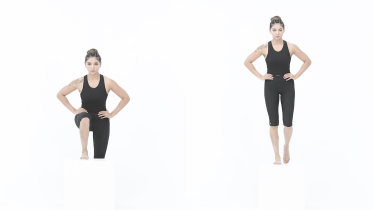 Step up
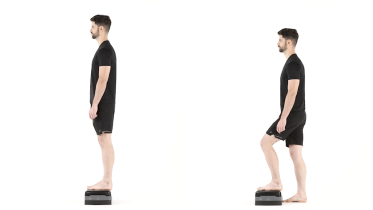 Backward step-down
Stage 3: Jumping and hopping
When heavy strength work feels strong and the tendon is steady the morning after. Jumping and hopping make the tendon store and release energy like a spring. That is usually the load that brought the pain on, so build this stage up slowly. Start with low hops and jumps on both feet, then move to one leg. Keep landings soft and quiet. In the Breda trial, this work was done every third day, so the tendon had time to recover, and the holds and strength work carried on between those days. Jumping and hopping also load the joints, the bones and the pelvic floor. Read the safety notes on each exercise page, and ask your physio or doctor first if you have osteoporosis, have fallen in the past year, are pregnant or have had a baby in the past year, or leak urine when you jump. If you have had a hip or knee replacement, get the go-ahead from your surgeon before you try jumping or hopping. Many surgeons advise against jumping and hopping after a joint replacement for good, not just for the first months, because each landing sends high impact through the new joint.
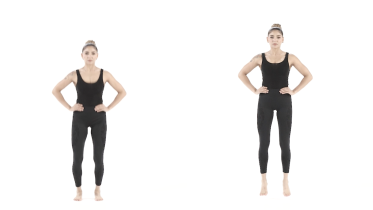 Pogo hops
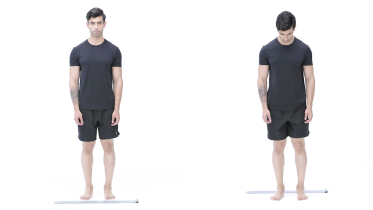 Line jumps
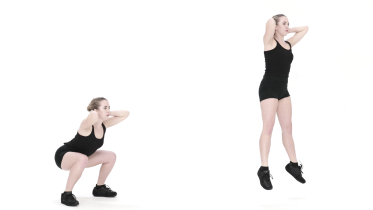 Jump squats
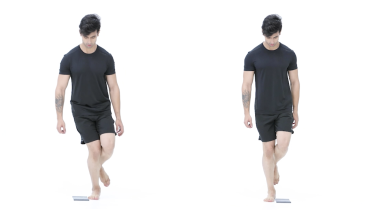 Single leg hops over a line
Stage 4: Back to your sport
When hopping on one leg is comfortable and the tendon settles by the next morning. Skater hops add sideways landings on one leg, much like cutting and changing direction in sport. From here your physio will add the drills your sport needs, such as run-ups, repeated jumps and quick changes of direction, and build up training time before full matches. In the Breda trial, people kept doing the holds and strength exercises twice a week once they were back to competition.
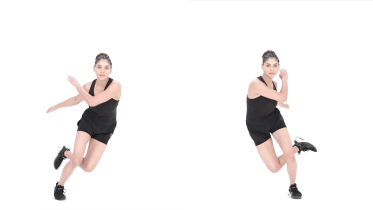 Skater hops
Pain during exercise: what is normal?
A tendon that aches a little while you work it is normal, and usually fine. In the Breda trial, the loading exercises and sport were kept within pain of about 3 out of 10. Many physios also use the next morning as a check: if the tendon is clearly sorer or stiffer than usual, the load the day before was too much. This way of guiding activity by pain comes from the pain-monitoring model, first tested in Achilles tendinopathy (Silbernagel and colleagues, 2007), and the Breda trial used it to guide sport and daily activity.
If the tendon flares, drop back a step rather than stopping everything. Use a shallower squat, fewer jumps or a lighter weight for a few sessions, then build again. Sharp pain, pain that climbs with every repetition, or a tendon that stays worse for several days means the jump in load was too big.
Managing load: jumping, training and daily life
Your training and sport need adjusting too, alongside the exercises. In the Breda trial, sports that caused a lot of tendon pain were cut back sharply or stopped for at least 4 weeks, and people were encouraged to stay active within acceptable pain. For a volleyball or basketball player, that might mean fewer jumping sessions and less time on hard courts for a while, with cycling, swimming or upper body work to keep fit.
Stopping everything usually does not help. A small pilot trial in patellar tendinopathy found that guiding sport and activity with the pain-monitoring model was workable, and people in that group kept up more of their treatment sessions (Sprague and colleagues, 2021). It was a small study, so the evidence here is still early. When you return to jumping, add it back in small steps and keep watching the next-morning response.
Malliaras and colleagues (2015) caution against relying on passive treatments. Ice and painkillers can ease pain for a while, and the NHS suggests them for tendon pain (NHS Tendonitis), but the loading program is what changes how much the tendon can take.
When to see a physio or doctor
See a physio or doctor if the pain does not improve within a few weeks (NHS Knee pain), if it stops you training or playing, or if you are not sure the pain is coming from the tendon. A physio can confirm the diagnosis, set your starting stage and plan your return to sport. That matters more with patellar tendinopathy than with many knee problems, because the jumping load needs careful timing.
If you have had knee surgery, including a knee replacement or a ligament repair, follow your surgeon's program rather than this page. A child or teenager who is still growing should be assessed before starting. For any of the warning signs listed below, get medical help within the time given there.
For physiotherapists
This page gives patients a starting framework based on the staged loading approach of Malliaras and colleagues (2015), as tested by Breda and colleagues (2021): isometric, isotonic, energy storage, then sport-specific loading. In that trial, the PTLE group used single leg isometrics at 60 degrees of knee flexion and about 70% of maximal voluntary contraction daily, isotonic loading every second day progressing in range and load, and plyometric work every third day, with progression at a pain of 3 out of 10 or less after at least a week at each stage. The fastest possible return to sport was 4 weeks, and outcomes were measured with the VISA-P.
Evidence that isometrics give immediate pain relief comes mainly from a crossover study of 6 volleyball players (Rio and colleagues, 2015). A later meta-analysis found no superiority of isometric over isotonic exercise for pain (Clifford and colleagues, 2020), and Breda and colleagues note that well-designed studies have not reproduced the effect. Use isometrics where the tendon is too irritable for isotonic loading, not as a required first step for everyone.
Challoumas and colleagues (2021) found low to very low certainty evidence across most comparisons, and shockwave added to eccentric exercise was no better than sham. They still named eccentric loading as the first-line treatment, while Breda and colleagues found staged loading better than eccentric training on the VISA-P at 24 weeks. Keep patellofemoral pain in the differential, and in adolescents Osgood-Schlatter and Sinding-Larsen-Johansson disease. Malliaras and colleagues list systemic comorbidities among the challenging presentations. Ask about recent fluoroquinolone use as well (MHRA, 2024).
See a doctor promptly if
- You felt a sudden pop or tearing feeling below your kneecap, the kneecap seems to have moved up toward the thigh, or you suddenly cannot straighten your knee or lift your leg out straight. Stop exercising and go to an emergency department straight away, even if you can still walk, as this can be a torn patellar tendon. Do not drive yourself. A repair usually does better if it is done soon after the injury.
- The pain started with a fall, a twist or a blow to the knee, or you cannot put weight on the leg. Get medical advice the same day. If the knee has changed shape, swelled up very quickly or you felt a pop or snap, or your foot turns cold, pale or blue or you have tingling or no feeling in the leg or foot, go to an emergency department straight away, and do not drive yourself.
- The knee is hot, red and swollen, or you have knee pain with a high temperature or feel hot, cold or shivery. Get medical advice the same day, and go to an emergency department if you feel very unwell. This can be a sign of infection in the joint, which needs treatment quickly.
- The knee locks and you cannot straighten it, or it keeps giving way under you. Get medical advice the same day.
- The knee swells up with no clear reason. Get medical advice the same day.
- A calf or thigh that is newly swollen, warm, tender, red or darker than usual, has swollen veins that are sore to touch, or has a throbbing or cramping pain that does not fit your injury or condition, or that feels different from normal muscle soreness after exercise. This can be a sign of a blood clot (deep vein thrombosis), especially after surgery, an injury, time in a cast or boot, a long trip or a spell of being much less mobile than usual. Get medical advice the same day. If you are also short of breath or have chest pain, call emergency services.
- Your tendon pain or swelling started while you were taking a fluoroquinolone antibiotic, such as ciprofloxacin or levofloxacin, or in the months after a course. Contact your doctor straight away. The UK medicines regulator (MHRA) advises stopping the antibiotic at the first sign of tendon pain or swelling and talking to your doctor. Hold off the knee exercises until you have been checked.
- Pain at night or at rest that keeps getting worse. See your doctor within a few days. If you have had cancer, now or in the past, see your doctor sooner, within a day or two, and mention it, even if the pain is not getting worse. Do the same if you have knee pain and are losing weight without trying, even if it does not hurt at night. If you are being treated for cancer now, contact your cancer team the same day.
- You are a teenager who is still growing and you have a limp, or pain in the hip, groin or thigh as well as the knee. Get an urgent appointment with a doctor the same day, and stay off sport and these exercises until you have been checked. If you cannot put weight on the leg, have a high temperature or feel very unwell, go to an emergency department. Some hip problems in growing teenagers, such as a slipped growth plate at the top of the thigh bone (slipped capital femoral epiphysis), are felt in the knee and need checking quickly.
- You are still growing and have pain that wakes you at night, pain at rest that keeps getting worse, or a lump or swelling around the knee or thigh that keeps growing. See a doctor within a day or two. Do the same if the pain comes with looking pale, unusual tiredness, fevers with no clear cause, bruising or bleeding easily, or weight loss. If you also have a rash that does not fade when you press it, call emergency services or go to an emergency department. Bone pain that is worse at night, or a new lump, needs checking to rule out rarer causes such as a bone tumor or a blood cancer (leukemia).
Common questions
How long does patellar tendinopathy take to heal?
Usually months. In the Dutch trial by Breda and colleagues (2021), people followed their loading program for 24 weeks, and even then fewer than half were back to their sport at the level they played before. A clinical review by Malliaras and colleagues (2015) describes rehab as slow and sometimes frustrating, and warns against unrealistic timelines. Judge your progress over weeks, not from one session to the next.
Can I keep playing sport with jumper's knee?
Often you can keep some activity, but the jumping load usually has to come down first. In the Breda trial, sports that caused a lot of tendon pain were cut back sharply or stopped for at least 4 weeks, and people were encouraged to stay active within a pain of about 3 out of 10. A small pilot trial found that guiding sport with a pain-monitoring model was workable in patellar tendinopathy (Sprague and colleagues, 2021). Your physio will help you decide how much training your tendon can take.
What is the difference between patellar tendinopathy and patellofemoral pain?
Where it hurts is the main clue. Patellar tendinopathy hurts at a small spot at the bottom tip of the kneecap, where the tendon starts, and is usually brought on by jumping and landing. Patellofemoral pain is a more spread out ache around or behind the kneecap, often worse on stairs, squatting or after long sitting. The programs overlap, but the jumping stages here are specific to the tendon, so a physio's assessment helps if you are not sure which you have.
Do isometric exercises help patellar tendinopathy?
They can help some people, but they are not the magic fix they were once thought to be. A small study of 6 volleyball players found that heavy held contractions eased tendon pain straight away, more than moving exercise did (Rio and colleagues, 2015). Later reviews of the trials found that held contractions were no better than moving strength exercise for pain (Clifford and colleagues, 2020; Challoumas and colleagues, 2021). They are a reasonable way to start when the tendon is irritable, and the strength work that follows matters more.
Are steroid injections good for patellar tendinopathy?
They are not a first choice. In a trial of 39 men, steroid injections helped in the short term, but the benefit had faded by 6 months, while heavy slow resistance training kept its benefit (Kongsgaard and colleagues, 2009). The American Academy of Orthopaedic Surgeons also links steroid injections with a weaker tendon and a higher chance of it tearing. The loading program remains the main treatment. If you are thinking about an injection, talk it through with your doctor.
References
- Malliaras P, Cook J, Purdam C, Rio E. Patellar Tendinopathy: Clinical Diagnosis, Load Management, and Advice for Challenging Case Presentations. Journal of Orthopaedic and Sports Physical Therapy. 2015;45(11):887-898. https://doi.org/10.2519/jospt.2015.5987
- Kongsgaard M, Kovanen V, Aagaard P, Doessing S, Hansen P, Laursen AH, Kaldau NC, Kjaer M, Magnusson SP. Corticosteroid injections, eccentric decline squat training and heavy slow resistance training in patellar tendinopathy. Scandinavian Journal of Medicine and Science in Sports. 2009;19(6):790-802. https://doi.org/10.1111/j.1600-0838.2009.00949.x
- Breda SJ, Oei EHG, Zwerver J, Visser E, Waarsing E, Krestin GP, de Vos RJ. Effectiveness of progressive tendon-loading exercise therapy in patients with patellar tendinopathy: a randomised clinical trial. British Journal of Sports Medicine. 2021;55(9):501-509. https://doi.org/10.1136/bjsports-2020-103403
- Rio E, Kidgell D, Purdam C, Gaida J, Moseley GL, Pearce AJ, Cook J. Isometric exercise induces analgesia and reduces inhibition in patellar tendinopathy. British Journal of Sports Medicine. 2015;49(19):1277-1283. https://doi.org/10.1136/bjsports-2014-094386
- Clifford C, Challoumas D, Paul L, Syme G, Millar NL. Effectiveness of isometric exercise in the management of tendinopathy: a systematic review and meta-analysis of randomised trials. BMJ Open Sport and Exercise Medicine. 2020;6(1):e000760. https://doi.org/10.1136/bmjsem-2020-000760
- Challoumas D, Pedret C, Biddle M, Ng NYB, Kirwan P, Cooper B, Nicholas P, Wilson S, Clifford C, Millar NL. Management of patellar tendinopathy: a systematic review and network meta-analysis of randomised studies. BMJ Open Sport and Exercise Medicine. 2021;7(4):e001110. https://doi.org/10.1136/bmjsem-2021-001110
- Silbernagel KG, Thomee R, Eriksson BI, Karlsson J. Continued sports activity, using a pain-monitoring model, during rehabilitation in patients with Achilles tendinopathy: a randomized controlled study. American Journal of Sports Medicine. 2007;35(6):897-906. https://doi.org/10.1177/0363546506298279
- Sprague AL, Couppe C, Pohlig RT, Snyder-Mackler L, Silbernagel KG. Pain-guided activity modification during treatment for patellar tendinopathy: a feasibility and pilot randomized clinical trial. Pilot and Feasibility Studies. 2021;7:58. https://doi.org/10.1186/s40814-021-00792-5
- Wilczynski B, Taraszkiewicz M, de Tillier K, Bialy M, Zorena K. Sinding-Larsen-Johansson disease. Clinical features, imaging findings, conservative treatments and research perspectives: a scoping review. PeerJ. 2024;12:e17996. https://doi.org/10.7717/peerj.17996
- American Academy of Orthopaedic Surgeons. Patellar Tendon Tear. OrthoInfo. https://www.orthoinfo.org/en/diseases--conditions/patellar-tendon-tear/
- American Academy of Orthopaedic Surgeons. Osgood-Schlatter Disease (Knee Pain). OrthoInfo. https://www.orthoinfo.org/en/diseases--conditions/osgood-schlatter-disease-knee-pain/
- American Academy of Orthopaedic Surgeons. Slipped Capital Femoral Epiphysis. OrthoInfo. https://www.orthoinfo.org/en/diseases--conditions/slipped-capital-femoral-epiphysis-scfe
- NHS. Knee pain. Page last reviewed 21 December 2023. https://www.nhs.uk/symptoms/knee-pain/
- NHS. Tendonitis. Page last reviewed 9 June 2023. https://www.nhs.uk/conditions/tendonitis/
- NHS. Deep vein thrombosis (DVT). Page last reviewed 30 April 2026. https://www.nhs.uk/conditions/deep-vein-thrombosis-dvt/
- Medicines and Healthcare products Regulatory Agency. Fluoroquinolone antibiotics: must now only be prescribed when other commonly recommended antibiotics are inappropriate. Drug Safety Update. 22 January 2024. https://www.gov.uk/drug-safety-update/fluoroquinolone-antibiotics-must-now-only-be-prescribed-when-other-commonly-recommended-antibiotics-are-inappropriate
Written and checked by the PocketPhysio editorial team. Last updated 2026-09-28.
This page is general education, not a diagnosis or a personal treatment plan. See a physiotherapist or doctor for advice about your own situation.