
Patellofemoral pain exercises and physiotherapy
What is patellofemoral pain?
Patellofemoral pain is pain around or behind the kneecap (patella). The international consensus definition says it gets worse with at least one activity that loads the knee while it is bent and taking your weight, such as squatting, climbing stairs, running, or hopping and jumping (Crossley and colleagues, 2016). Many people also feel it after sitting for a long time with their knees bent, or when they get up from a chair. You may hear it called runner's knee or chondromalacia patella. The consensus prefers the plain name, patellofemoral pain.
It usually builds up gradually rather than starting with one injury. It is especially common in teenagers, and it often turns up in runners and people who play jumping sports. Some people notice grinding or crackling under the kneecap too.
A physio or doctor usually makes the diagnosis from your story and an examination. In the consensus, a squat that brings on your familiar pain is the most useful single test, and tenderness along the edges of the kneecap supports it.
This page is for teenagers aged 16 and over and for adults. Knee pain in younger children who are still growing has other possible causes, so a child should be assessed by a physio or doctor before starting any program.
Why does exercise help patellofemoral pain?
Exercise is the main treatment, and the guidance on this is consistent. The 2016 international consensus on treatment recommends exercise to reduce pain in the short, medium and long term, and to improve function in the medium and long term (Crossley and colleagues, 2016). It also recommends combining hip and knee exercises in preference to knee exercises alone. The 2018 consensus update and the US physical therapy guideline point the same way (Collins and colleagues, 2018; Willy and colleagues, 2019).
A Cochrane review of 31 trials came to a similar conclusion. The evidence was very low quality but consistent, and there was not enough of it to say which type of exercise works best (van der Heijden and colleagues, 2015). So for now, the exact exercises probably matter less than doing a program that works both the hip and the thigh, regularly, for long enough to build strength.
Why the hip, when the pain is at the knee? The muscles at the side and back of your hip help control how your thigh turns and where your knee sits over your foot as you climb stairs or land from a jump. A summary of the US guideline notes that hip weakness seems to follow the pain rather than cause it. Training the hip and thigh together eases symptoms all the same (Marra 2020).
How to use this program
Pick the stage that matches your knee today. If you are unsure, start at stage 1, and move up when the current stage feels easy and your knee is no worse the next morning.
Each exercise page gives a typical starting dose. As a rough guide, many programs use 2 to 3 sets of 10 to 15 repetitions for the strength exercises, done at least 3 days a week. Wall sit holds often start at 10 to 30 seconds, and it helps to breathe normally during holds rather than holding your breath. Stretches are often held for about 30 seconds, 2 to 3 times. Your physio will adjust the exercises and the numbers to suit your knee and what you want to get back to.
Some discomfort at the front of the knee during or after exercise is common. It is usually acceptable if it is mild, settles within a day and is not building up from week to week. Sharp pain, pain that climbs with every repetition, or a knee that is sorer or more swollen the next morning means the load was too much. Drop back a step, such as a shallower squat or a lower step, rather than stopping altogether. One of the early exercise programs for patellofemoral pain used a pain monitoring system like this to decide how hard to push (Thomeé 1997).
The exercise program
Stage 1: Wake up the hip and thigh muscles
For a knee that is sore on stairs and when squatting, and for anyone new to exercise. These are done lying down, so the kneecap carries very little load while the muscles at the side and back of your hip (gluteus medius and gluteus maximus) and the front of your thigh (quadriceps) start working again. Because the knee is not taking your body weight, this is often the easiest place to start when the kneecap is sore.
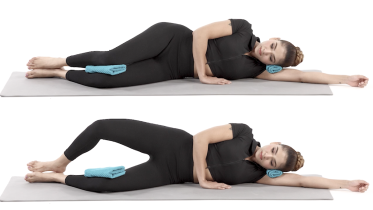 Clamshell
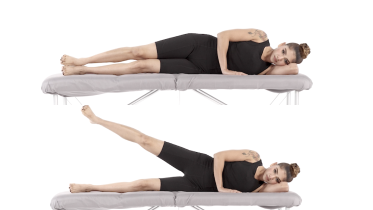 Side lying hip abduction
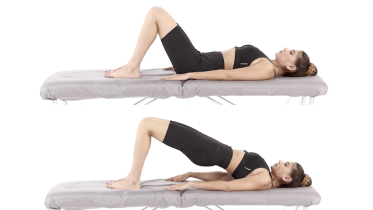 Glute bridge
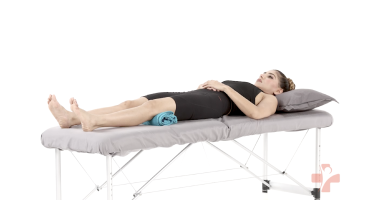 Quad sets (towel under knee)
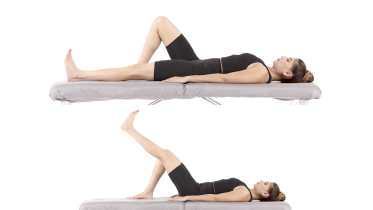 Straight leg raise
Stage 2: Load the knee standing up
When stage 1 feels easy and your knee settles well afterwards. The mini squat and wall sit work the front of the thigh with the knee bent, so start shallow and only go as deep as you can without pain at the kneecap. Use a low step for the step up, about the height of one stair, and watch that your knee stays in line with your second toe instead of drifting inward. Hold a counter for the standing exercises if your balance is not steady. The quad and calf stretches are extras your physio may add if those muscles feel tight, but leave the quad stretch out if pulling your heel toward your bottom hurts the kneecap.
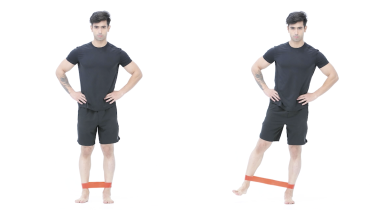 Standing hip abduction with band
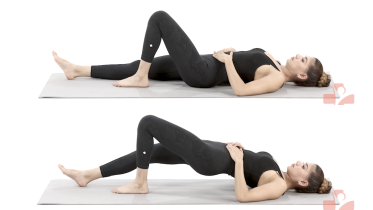 Single leg bridge
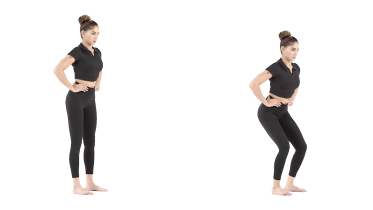 Mini squat
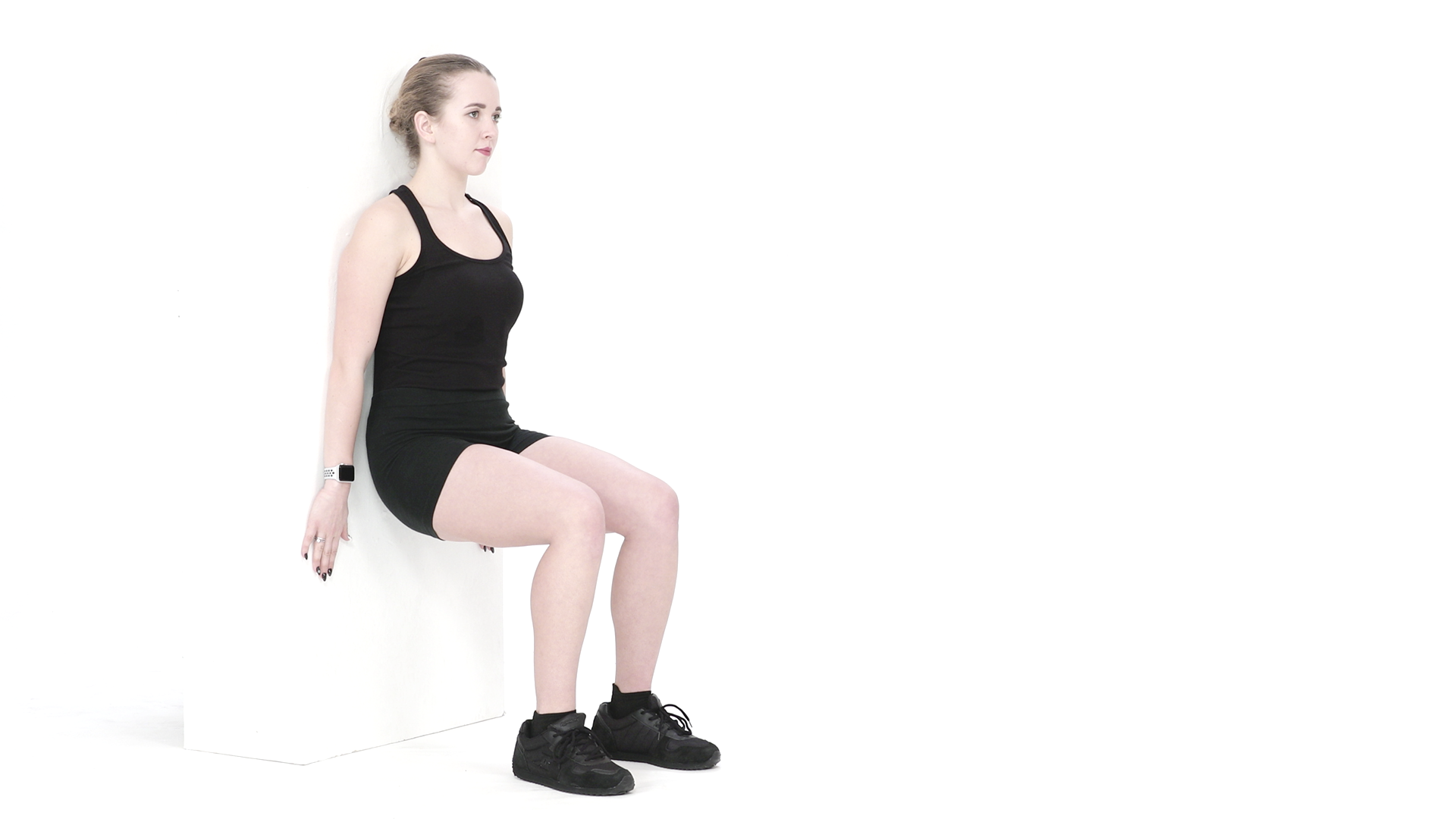 Wall sit
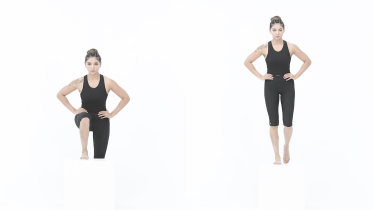 Step up
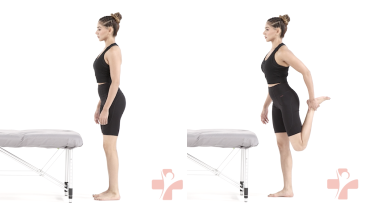 Standing quad stretch
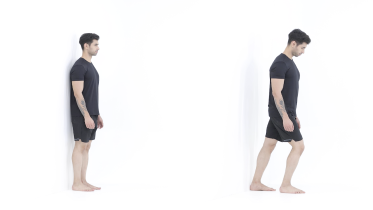 Calf stretch
Stage 3: Deeper bending and single leg strength
When stage 2 feels easy and the knee is no worse the next morning. These bring back the deeper knee bends that usually provoke kneecap pain, but in a controlled way. Start with the split squat, where your feet stay still, then move on to the lunges, where you step in and out of the position. The reverse lunge usually comes first, because stepping forward asks more of the front of the knee as you stop. If you run or play sport, your physio can add hopping and landing work and plan your return.
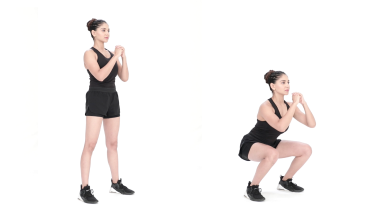 Squat
Squat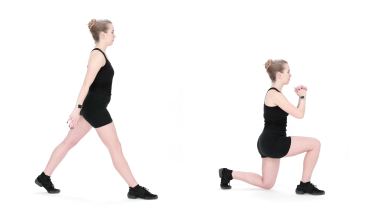 Split squat
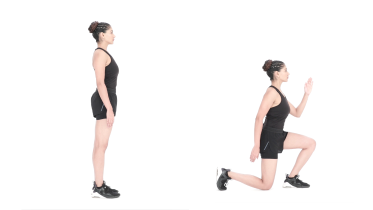 Reverse lunge
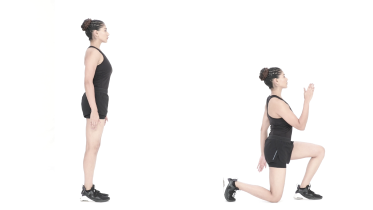 Forward lunge
What to change while your knee settles
You rarely need to stop everything. If the pain began after a sudden increase in training, or after overdoing it, the US guideline summary suggests relative rest as a first step (Marra 2020). That means cutting back the activities that flare the knee, not resting in bed. For a runner it might mean shorter, flatter runs for a while and fewer hills and stairs, with some cycling or swimming in their place if those feel comfortable.
Build back up in small steps as the strength work progresses. The same summary says that for runners, changing the way you run (gait retraining) may improve symptoms, while the 2018 consensus rated the evidence for it as uncertain. A physio who works with runners can watch you run and help you decide whether it is worth trying.
If sitting for a long time hurts, stand up every so often and move about, or sit with the sore leg a little straighter.
Do taping, insoles or a knee brace help?
Think of these as add-ons to exercise, not replacements for it. The 2016 consensus recommends foot orthoses (shoe inserts) to reduce pain in the short term. The US guideline summary adds that they help most in people whose feet roll in (pronation), and that custom inserts are no better than cheaper ready-made ones (Marra 2020).
Evidence on taping is mixed. The US guideline summary says taping the kneecap alongside exercise eases pain in the short term (Marra 2020). The 2016 and 2018 international consensus statements were less sure and listed taping as an area of uncertainty. So taping may help some people for a few weeks while they build up the exercises, but its effect beyond the short term is unclear, and it does not replace the exercises. The same US summary says knee braces and sleeves do not add benefit to exercise.
The international consensus does not recommend mobilizing the knee or lower back on its own, or machine treatments such as ultrasound (electrophysical agents), because they may not improve outcomes (Crossley and colleagues, 2016; Collins and colleagues, 2018).
When to see a physio or doctor
See a physio or doctor if your knee pain does not improve within a few weeks (NHS), or if pain is stopping you sleeping, working, studying or playing sport. It is also worth getting help at the start if you are not sure which stage suits you. A physio can check your knee and hip, watch how you squat and step, and adjust the program to you.
If the pain started with a fall, a twist or a blow to the knee, get it checked before you start this program, because that points to an injury rather than patellofemoral pain. If you have had knee surgery, follow the plan from your surgeon and physio rather than this program. The warning signs below need prompt medical attention. Check with your doctor before you start if you have a heart or lung condition, or blood pressure that is not under control.
For physiotherapists
This page gives patients a starting framework. The 2016 consensus defines patellofemoral pain as retropatellar or peripatellar pain aggravated by at least one loaded flexion activity, names the squat as the most useful clinical test, and treats patellar edge tenderness as supportive (Crossley and colleagues, 2016, part 1).
The AFP summary of the 2019 JOSPT guideline gives combined posterior hip and quadriceps exercise as the primary treatment and reports weight-bearing and non-weight-bearing exercise as similarly effective. It describes high-volume dosing as most effective, for example 3 sets of 30 or more repetitions 3 times a week as tolerated (Marra 2020). The Cochrane review found only one trial comparing higher and lower intensity programs (van der Heijden and colleagues, 2015), so we give a general starting range here and leave volume progression to the treating physio. Hip weakness appears to be a consequence of the pain rather than its cause, which is worth keeping in mind when you explain hip work to patients.
Short-term adjuncts with support are foot orthoses in people with increased pronation, and taping alongside exercise. The guideline's decision tree grades muscle stretching (hamstrings, quadriceps, calf and iliotibial band) as expert opinion for people with mobility deficits (Willy and colleagues, 2019), which is why the quad and calf stretches appear here as optional extras. In adolescents, examine the hip: slipped capital femoral epiphysis can present as knee pain, with a limp after activity (AAOS OrthoInfo).
See a doctor promptly if
- The pain started with a fall, a twist or a blow to the knee, or you cannot put weight on the leg. Get medical advice the same day. If the knee has changed shape, swelled up very quickly or you felt a pop or snap, or your foot turns cold, pale or blue or you have tingling or no feeling in the leg or foot, go to an emergency department straight away, and do not drive yourself.
- The kneecap has slipped out of place, even if it went back by itself. If it is still out of place, go to an emergency department straight away, and do not drive yourself. If it went back by itself, get medical advice the same day.
- The knee locks and you cannot straighten it, or it keeps giving way under you. Get medical advice the same day.
- The knee swells up with no clear reason. Get medical advice the same day.
- The knee is hot, red and swollen, or you have knee pain with a high temperature or feel hot, cold or shivery. Get medical advice the same day, and go to an emergency department if you feel very unwell. This can be a sign of infection in the joint, which needs treatment quickly.
- Pain at night or at rest that keeps getting worse. See your doctor within a few days. If you have had cancer, now or in the past, see your doctor sooner, within a day or two, and mention it, even if the pain is not getting worse. Do the same if you have knee pain and are losing weight without trying, even if it does not hurt at night. If you are being treated for cancer now, contact your cancer team the same day.
- You are a teenager who is still growing and you have a limp, or pain in the hip, groin or thigh as well as the knee. Get an urgent appointment with a doctor the same day, and stay off sport and these exercises until you have been checked. If you cannot put weight on the leg, have a high temperature or feel very unwell, go to an emergency department. Some hip problems in growing teenagers, such as a slipped growth plate at the top of the thigh bone (slipped capital femoral epiphysis), are felt in the knee and need checking quickly.
- You are still growing and have pain that wakes you at night, pain at rest that keeps getting worse, or a lump or swelling around the knee or thigh that keeps growing. See a doctor within a day or two. Do the same if the pain comes with looking pale, unusual tiredness, fevers with no clear cause, bruising or bleeding easily, or weight loss. If you also have a rash that does not fade when you press it, call emergency services or go to an emergency department. Bone pain that is worse at night, or a new lump, needs checking to rule out rarer causes such as a bone tumor or a blood cancer (leukemia).
Common questions
Can patellofemoral pain go away on its own?
It can, but it often lingers. The 2016 international consensus notes that it was once seen as a problem that settles by itself, but that it can persist for many years, which is one reason exercise is recommended over waiting it out. A Cochrane review found that exercise may also help long-term recovery, although the quality of that evidence was very low (van der Heijden 2015).
Should I avoid squats and stairs with patellofemoral pain?
Not completely. These are the movements that usually provoke kneecap pain, and the program brings them back gradually. Start with shallow squats and a low step, and go deeper as your knee tolerates it. Mild discomfort that settles within a day is usually fine. Sharp pain, or a knee that is worse the next morning, means you should drop back a step. Your physio will help you find the right level.
Can I keep running with patellofemoral pain?
Often yes, at a lower amount. Cut back to a distance and pace that do not flare the knee during the run or the next morning, and build up in small steps as the strength work progresses. If running hurts from the first few minutes or makes you limp, stop running for now and get advice from a physio.
Does a knee brace help patellofemoral pain?
A summary of the US physical therapy guideline says braces and sleeves do not add benefit when used with exercise, while taping combined with exercise can ease pain in the short term (Marra 2020). Shoe inserts may also help in the short term, mainly if your feet roll in. None of these replace the exercises.
Why does my knee hurt when I sit for a long time?
Sitting with your knees bent for a long spell, for example on a long drive or in a cinema, is a common trigger. The 2016 consensus lists pain with sitting, or when getting up from sitting, as a feature that supports the diagnosis. Straightening the leg out every so often, or standing up for a minute, often helps.
References
- Crossley KM, Stefanik JJ, Selfe J, et al. 2016 Patellofemoral pain consensus statement from the 4th International Patellofemoral Pain Research Retreat, Manchester. Part 1: Terminology, definitions, clinical examination, natural history, patellofemoral osteoarthritis and patient-reported outcome measures. British Journal of Sports Medicine. 2016;50(14):839-843. https://doi.org/10.1136/bjsports-2016-096384
- Crossley KM, van Middelkoop M, Callaghan MJ, Collins NJ, Rathleff MS, Barton CJ. 2016 Patellofemoral pain consensus statement from the 4th International Patellofemoral Pain Research Retreat, Manchester. Part 2: recommended physical interventions (exercise, taping, bracing, foot orthoses and combined interventions). British Journal of Sports Medicine. 2016;50(14):844-852. https://doi.org/10.1136/bjsports-2016-096268
- Collins NJ, Barton CJ, van Middelkoop M, et al. 2018 Consensus statement on exercise therapy and physical interventions (orthoses, taping and manual therapy) to treat patellofemoral pain: recommendations from the 5th International Patellofemoral Pain Research Retreat, Gold Coast, Australia, 2017. British Journal of Sports Medicine. 2018;52(18):1170-1178. https://doi.org/10.1136/bjsports-2018-099397
- Willy RW, Hoglund LT, Barton CJ, et al. Patellofemoral Pain: Clinical Practice Guidelines Linked to the International Classification of Functioning, Disability and Health From the Academy of Orthopaedic Physical Therapy of the American Physical Therapy Association. Journal of Orthopaedic and Sports Physical Therapy. 2019;49(9):CPG1-CPG95. https://doi.org/10.2519/jospt.2019.0302
- Marra J. Patellofemoral Pain: Guidelines from the American Physical Therapy Association. American Family Physician. 2020;102(7):442-443. https://www.aafp.org/afp/2020/1001/p442
- van der Heijden RA, Lankhorst NE, van Linschoten R, Bierma-Zeinstra SM, van Middelkoop M. Exercise for treating patellofemoral pain syndrome. Cochrane Database of Systematic Reviews. 2015;(1):CD010387. https://doi.org/10.1002/14651858.CD010387.pub2
- Thomeé R. A comprehensive treatment approach for patellofemoral pain syndrome in young women. Physical Therapy. 1997;77(12):1690-1703. https://doi.org/10.1093/ptj/77.12.1690
- NHS. Knee pain. https://www.nhs.uk/symptoms/knee-pain/
- American Academy of Orthopaedic Surgeons. Slipped Capital Femoral Epiphysis. OrthoInfo. https://www.orthoinfo.org/en/diseases--conditions/slipped-capital-femoral-epiphysis-scfe
Written and checked by the PocketPhysio editorial team. Last updated 2026-09-28.
This page is general education, not a diagnosis or a personal treatment plan. See a physiotherapist or doctor for advice about your own situation.