
Forward lunge
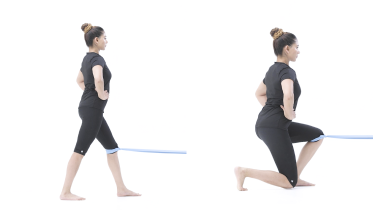
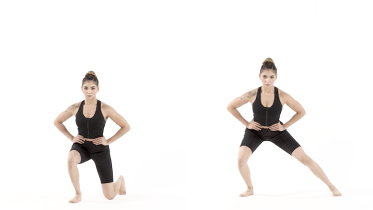
In a forward lunge you step forward, lower your back knee toward the floor, then push back to where you started. It works the thigh and buttock of one leg at a time. Physios often bring it in at a later stage of knee, hip or sports rehab.
How to do the forward lunge
- Stand tall with your feet about hip width apart and your arms relaxed by your sides.
- Step forward with one leg and plant the whole foot on the floor. Choose a distance where you still feel balanced and have room to lower down.
- Bend both knees and lower your body straight down, not forward, until the back knee is just above the floor. The back heel lifts and you balance on the ball of that foot. Your arms can come forward to help your balance.
- Keep your chest up and your eyes looking ahead. The front knee stays roughly over the ankle, not far out past the toes, and in line with your second toe.
- Push off through the front foot to step back to the start. Switch legs, or do all your reps on one side first.
What you should feel
Hard work in the thigh and buttock of the front leg. A mild stretch at the front of the hip on the back leg is common.
Common mistakes
- Taking too short a step, so the front knee shoots forward past the toes and the front heel lifts.
- Lunging forward instead of dropping straight down.
- Letting the front knee fall inward.
- Leaning the trunk forward over the front thigh.
- Dropping too fast and knocking the back knee on the floor.
How often
Many programs start with 2 to 3 sets of 6 to 10 on each leg, with a wall or chair nearby for balance. Your physio will adjust this to you.
Stop and check with your physio if
- Sharp pain in the knee or hip, especially at the front of the kneecap.
- The knee gives way, or you lose your balance more than once.
From the clinic
Every time you step forward, the front leg has to catch your body weight and slow it down. That is why many physios start with the reverse lunge and add this one later.
Wobbling is normal at first, and going only halfway down is fine. If stepping in is the hard part, start with one foot already out in front and just lower and rise. When a full set feels steady, add a little depth.
Reviewed by the PocketPhysio by VirtueLife expert physiotherapy team. Last reviewed 2026-09-25.
This page is general education, not a diagnosis or a personal treatment plan. If you have pain, an injury or a health condition, see a physiotherapist or doctor before starting new exercises.
.png)