
Hamstring strain exercises and physiotherapy
What is a hamstring strain?
The hamstrings are the three muscles at the back of your thigh. They run mostly from the bony point you sit on (the ischial tuberosity) to just below the knee, and they bend the knee and pull the thigh back when you walk and run. A hamstring strain, often called a pulled hamstring, is a tear of some of the muscle fibers.
It usually happens in a moment. The NHS describes a sharp pain in the back of the leg, sometimes with a snapping feeling or a pop, then tenderness, swelling, bruising and trouble moving the leg. Sprinting is the classic cause. A high kick or a slide into the splits can also strain the muscle by stretching it a long way, and in a trial in elite soccer players these stretch-type strains took longer to recover than sprinting strains (Askling and colleagues, 2013).
This page covers mild to moderate strains (grade 1 to 2), where part of the muscle is torn and the injury is treated without surgery. It is for adults and teenagers aged 16 and over. It does not cover a tendon pulled off the bone near the buttock (a proximal hamstring avulsion), or rehab after hamstring surgery. If either applies to you, get urgent assessment or follow your surgeon's plan. A younger child or teenager with a thigh injury should be checked by a doctor or physio before starting any program.
Is it a hamstring strain or something else?
A few other problems cause pain in the same place. A review by Hickey and colleagues (2022) advises that pain at the back of the thigh that did not start with a typical injury, or that came on slowly, needs a proper assessment to rule them out.
Pain from the lower back can be felt in the back of the thigh when the sciatic nerve or a nerve root in the back is irritated. The NHS lists sharp or burning pain down the back of the leg, pins and needles, numbness and weakness as the signs of sciatica. If that sounds more like you, the muscle program on this page is not the right starting point.
The injury not to miss is the tendon pulling away from the sitting bone. People usually hear or feel a pop or snap high up, then get extensive bruising over the back of the thigh and often walk stiff-legged; sometimes a gap can be felt where the tendon should be (Degen, 2019). These injuries are often missed. Surgeons favor repair within the first 4 weeks over later repair (Degen, 2019), and a review of mostly lower-quality studies found that early repairs led to more satisfied patients and less pain than delayed ones (Bodendorfer and colleagues, 2018). If this sounds like your injury, get it checked the same day.
Pain at the sitting bone that built up gradually, rather than starting at one moment, is often a tendon problem (proximal hamstring tendinopathy). That is managed differently, and a physio can tell the two apart.
Why does exercise help a hamstring strain?
A strained hamstring is weak and sore when it has to work at longer lengths. Running and kicking ask for exactly that. The rehab guide by Heiderscheit and colleagues (2010) says there is growing evidence that the risk of straining it again can be lowered by rehab that includes movement control exercises (neuromuscular control) and slow lowering strength work (eccentric training), checked with objective measures of recovery.
Two trials sit behind that advice. In a trial of 24 athletes, a program of agility and trunk stability exercises was compared with one of hamstring stretching and isolated strengthening (Sherry and Best, 2004). Time back to sport was not clearly different. In the first 2 weeks back, though, 6 of 11 in the stretching group strained the hamstring again, against none of 13 in the agility group, and at 1 year it was 7 of 10 against 1 of 13. It was a small trial, so treat the numbers with some caution.
Later, a Swedish trial of 75 elite soccer players with a hamstring strain confirmed on MRI compared exercises that load the hamstring while it lengthens with a conventional program (Askling and colleagues, 2013). The lengthening group returned to full training in 28 days on average, against 51 days in the conventional group.
And repeat strains are common. A review by Erickson and Sherry (2017) notes that about a third of hamstring strains come back, with the highest risk in the first 2 weeks after returning to sport.
The first few days after a hamstring strain
For the first 2 to 3 days, the NHS advises PRICE: protection, rest, ice, compression and elevation. Protect the leg from further injury: stop exercise and sport and try not to put weight on it. Put an ice pack wrapped in a towel on the back of the thigh for up to 20 minutes every 2 to 3 hours. A tubular or elastic bandage can support it during the day, taken off before you go to sleep, and keep the leg raised on a pillow when you can.
The NHS also advises avoiding heat (such as hot baths and heat packs), massage and alcohol for the first 3 days. A pharmacist can advise on painkillers that suit you.
Once you can move the leg without pain stopping you, keep it moving so the hamstring does not get stiff. That is where stage 1 below starts.
How to use this program
Pick the stage that matches your leg today. If you are unsure, start at stage 1, and move up when the current stage feels easy and your leg is no more sore the next morning. The signs for moving between stages follow the rehab guide by Heiderscheit and colleagues (2010), such as a normal walking stride without pain, but they are a rough guide rather than fixed rules.
Each exercise page gives a typical starting dose. As a rough guide, many programs do the early exercises once or twice a day, and use 2 to 3 sets of 6 to 15 for the strength exercises a few days a week once they get harder. Your physio will adjust the exercises and the numbers to your leg and to what you need to get back to.
How much pain is acceptable during the exercises is still debated. Older guides advise progressing only as far as the exercises stay pain free (Heiderscheit and colleagues, 2010). In a small, newer trial of 43 men with a hamstring strain, one group kept their rehab pain free and the other was allowed some pain (Hickey and colleagues, 2020). Both got back to sport in a similar time, and the group allowed some pain regained more strength. A later review by the same team considers pain up to 4 on a 0 to 10 scale safe during hamstring rehab (Hickey and colleagues, 2022).
A home program has no one checking your leg, so this one takes the cautious side, and your physio may allow a little more once they have examined it. Keep stage 1 pain free. From stage 2 on, mild discomfort is usually fine if it settles soon after the session and the leg is no worse the next morning. A sharp or tearing pain, pain that builds with every repetition, or a leg that is more sore the next day means the load was too much. Drop back a step rather than stopping altogether.
Be careful with stretching in the first stage. Hard stretching of a freshly injured hamstring can lead to dense scarring, so let the first sign of pain set the limit of your range (Heiderscheit and colleagues, 2010).
The exercise program
Stage 1: Protect the muscle and keep moving
For the first days, while walking is sore or you are limping: follow the rest and protection advice above for 2 to 3 days, then start gently once you can move the leg without pain stopping you. The heel dig tightens the hamstring without the knee moving, at a light to moderate effort, and the glute bridge keeps the knees bent so the muscle works at a short, comfortable length. Side stepping, single leg stance and the two planks work your balance and the muscles around your hips and trunk, which was one part of a program that cut repeat strains in a small trial; stand by a counter for the single leg stance and hold on if you wobble. Many programs start with about 10 heel digs held for 5 to 10 seconds once or twice a day, plus 2 to 3 sets of 10 bridges and plank holds of 10 to 30 seconds a few days a week, and your physio will adjust this. Keep all of it pain free and leave out hamstring stretches and long strides until you move on: that is when you can walk with a normal stride without pain and a firm heel dig no longer hurts.
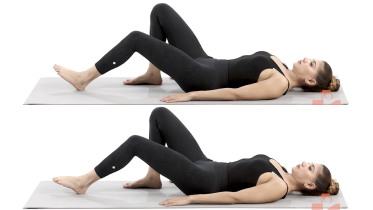 Hamstring sets (heel dig)
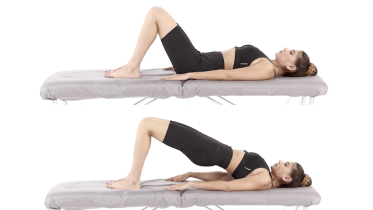 Glute bridge
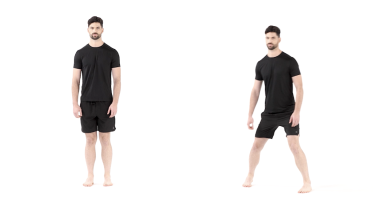 Side stepping
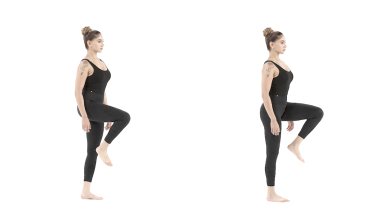 Single leg stance
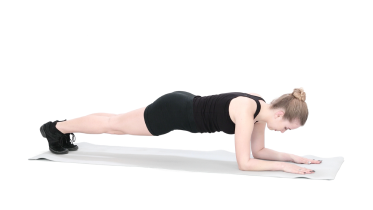 Plank
Plank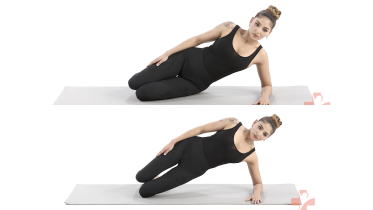 Kneeling side plank
Stage 2: Build strength through the middle of the range
Once you can walk normally without pain, the curls bend the knee against your leg's weight and then a light band, and the hamstring bridge and single leg bridge put more load through the back of the thigh. Keep the curls and bridges short of the fully lengthened position while the muscle still feels weak, and take the two stretches, which can start now, only to a gentle pull and never into pain: rehab guides warn against hard stretching of a healing hamstring. Many programs use 2 to 3 sets of 6 to 15 for the strength exercises and stretch holds of 20 to 30 seconds, 2 to 4 times each side, and your physio will adjust this. If you want to run again, rehab guides bring in a very slow, pain-free jog on flat ground around this stage; if running is not one of your goals, you do not need to jog, and brisk walking on the flat takes its place. Move on when the curls feel as strong as on the other leg and a moderate-pace jog is pain free, or brisk walking and stairs if you do not run.
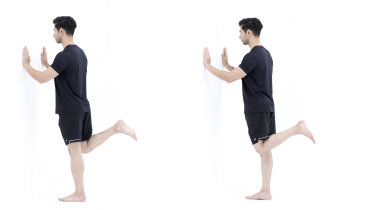 Standing hamstring curl
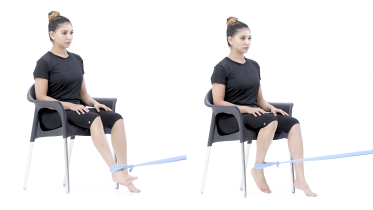 Seated hamstring curl with band
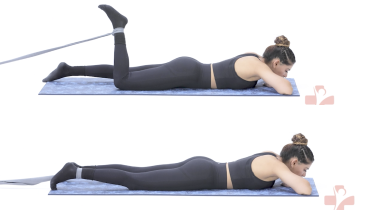 Lying hamstring curl with band
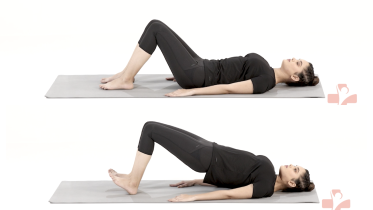 Hamstring bridge
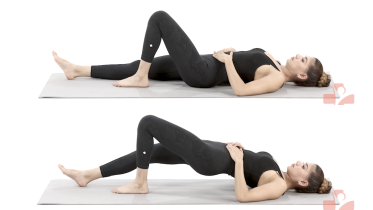 Single leg bridge
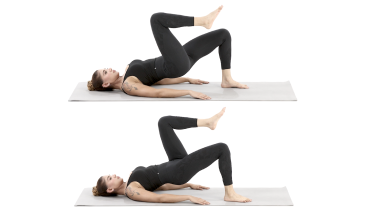 Marching bridge
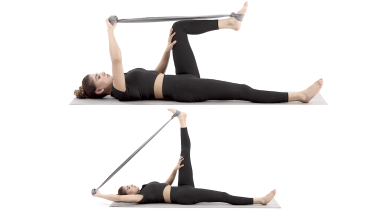 Supine hamstring stretch
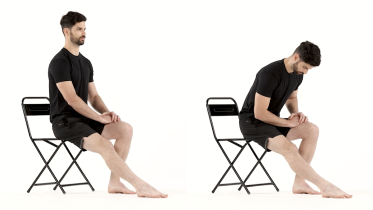 Seated hamstring stretch
Stage 3: Strength at longer lengths and slow lowering
When the stage 2 exercises feel strong and moderate jogging (or brisk walking and stairs, if you do not run) is comfortable, add exercises that load the hamstring while it lengthens under control; work like this shortened time away from sport in a trial in elite soccer players, although that trial used its own exercises. The eccentric curl is the slow lowering half of a curl, the step bridge and ball curl work the muscle with a straighter knee, and the lunges build the leg back up for running. The diver and single leg deadlift hinge you forward on one leg, so the hamstring works at a long length and your balance has to hold you steady: do them next to a counter or sturdy chair you can touch if you wobble. Go only as deep as you stay in control; a mild pull is common, but a sharp or tearing pain means stop and drop back. Many programs use 2 to 3 sets of 6 to 12, a few days a week, and your physio will adjust this.
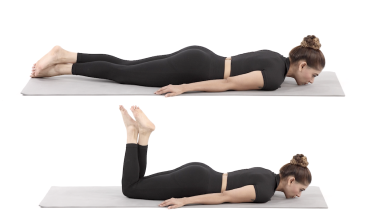 Eccentric hamstring curl
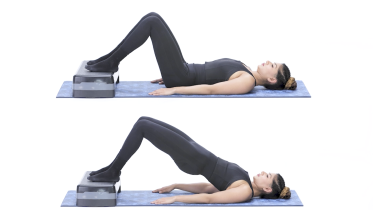 Bridge with feet on a step
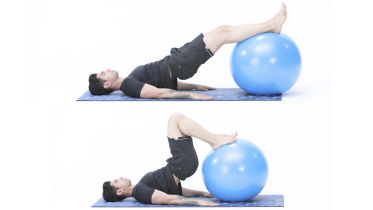 Stability ball hamstring curl
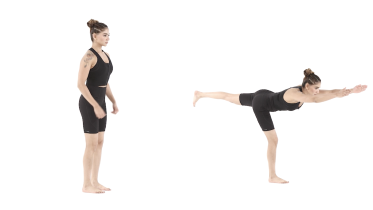 Diver hamstring exercise
.png) Single leg deadlift
Single leg deadlift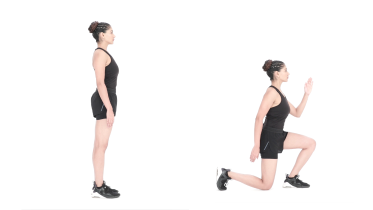 Reverse lunge
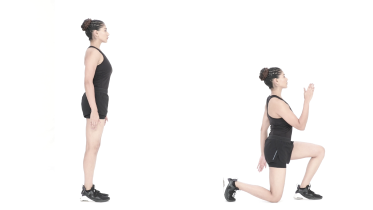 Forward lunge
Stage 4: Faster running and getting back to sport
This stage is for people going back to running or sport; if you do not run, keep doing the stage 3 exercises 2 to 3 times a week instead. Start when the stage 3 exercises feel strong, you can jog without pain, and the back of the thigh is no longer tender to press. Butt kicks and high knees are running drills that bring back quicker leg movements in place, before you take them onto the track or field. Build running speed in small steps, smallest as you get close to full sprinting, and your physio will fit the running plan to your sport. Keep the stage 3 strength work going 2 to 3 times a week even after you are back at sport, because repeat strains are most likely in the first weeks back.
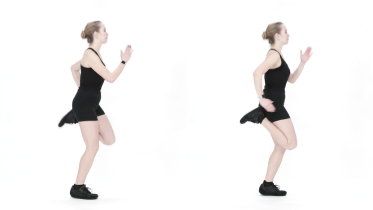 Butt kicks
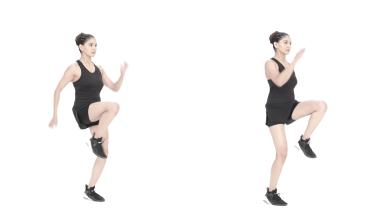 High knees running in place
How to prevent another hamstring strain
One prevention exercise tested in trials is the Nordic hamstring exercise. You kneel with your ankles held down by a partner or a bar and slowly lower your upper body toward the floor, with the hamstrings braking the fall. In a trial of 579 male amateur soccer players from 40 teams, teams that did 25 sessions of it over 13 weeks had fewer hamstring injuries than teams that trained as usual (van der Horst and colleagues, 2015). It did not make the injuries that still happened any less severe.
That trial tested prevention across whole teams, not rehab after a strain. The Nordic is also a hard exercise, and it is not part of this program, so ask your physio whether and when it suits you.
The NHS adds some everyday advice: warm up before exercise, build your fitness gradually, stop if you start to feel pain, and avoid exercising when you are tired. Keep the strength work going after you are back at sport, because the weeks right after a return carry the highest risk of straining it again (Erickson and Sherry, 2017).
When to see a physio or doctor
The NHS advises getting help if the pain is very bad or getting worse, the swelling or bruising is large or getting worse, it is hard to walk or stand on the leg, the leg feels very stiff or is hard to move, or it is not getting better after looking after it yourself. The same goes for a very high temperature, or feeling hot but also cold and shivery.
It is also worth seeing a physio if you play a sport with sprinting or kicking, if you have strained the same hamstring before, or if you are not sure the pain is coming from the muscle. A physio can check the strain, rule out a nerve or back problem, set your starting stage and plan your return to running.
If you think the tendon has pulled off the bone near the buttock, or you have had hamstring surgery, go to urgent care or back to your surgeon rather than using this page. The warning signs below need prompt medical attention.
For physiotherapists
This page gives patients a starting framework for grade 1 to 2 hamstring strain injury without tendon avulsion, with the stage structure and progression criteria taken from Heiderscheit and colleagues (2010). Stage 1 moves on with a normal walking stride without pain, a very low speed jog without pain, and a pain-free isometric prone knee flexion contraction against submaximal (50 to 70%) resistance. Stage 2 moves on with full strength without pain on prone knee flexion manual testing and pain-free forward and backward jogging at 50% of maximum speed. The guide advises avoiding excessive active or passive lengthening in phase 1, and end-range lengthening while weakness is present in phase 2. Return to sport criteria in Erickson and Sherry (2017) include no pain on palpation, full range, strength and functional ability without pain, and a bilateral strength deficit under 5% on isokinetic testing where available.
Hickey and colleagues (2020) found no difference in time to return to play clearance between pain-free and pain-threshold rehabilitation, with better recovery of isometric knee flexor strength in the pain-threshold group. The 2022 review by the same group considers pain up to 4 out of 10 during rehab exercise safe. It suggests submaximal eccentric work, such as the bilateral slider, can begin early, and treats a progressive return to high-speed running as likely the most important part of rehab. It also notes that a previous hamstring strain raises the risk of another by about 2.7 times. For an unsupervised general audience, this page is more cautious than that review: stage 1 stays pain free, stretching starts in stage 2, lengthening exercises start in stage 3, jogging is optional for people who do not run, and the Nordic hamstring exercise is mentioned for prevention only.
The Askling L-protocol (2013) used lengthening exercises and shortened return to full training compared with a conventional protocol, and stretch-type injuries took longer than sprint-type in both arms. The diver video in this program keeps the lifted leg straight, whereas the L-protocol diver keeps the standing knee at 10 to 20 degrees and the lifted knee at about 90 degrees, so it is a similar hip hinge rather than the trial exercise. Heiderscheit and colleagues (2010) describe the active slump test for posterior thigh pain with neural features, and report that adding slump stretching reduced time away from sport in grade 1 strains with a positive slump test.
Screen for proximal avulsion in anyone with a pop near the ischial tuberosity from forceful hip flexion with the knee extended, extensive posterior thigh ecchymosis, a stiff-legged gait or a palpable defect (Degen, 2019; Hickey and colleagues, 2022). Refer urgently for imaging and surgical opinion, as acute repair within 4 weeks is favored and, in a meta-analysis of mostly low-quality studies, acute repairs outperformed chronic ones on satisfaction, pain and strength (Bodendorfer and colleagues, 2018). Other differentials include lumbar referred pain, proximal hamstring tendinopathy and adductor injury.
See a doctor promptly if
- Urgent: you felt or heard a pop or snap high at the back of your thigh, near the buttock or the bone you sit on, and now have large bruising spreading down the back of the thigh, a gap or dip you can feel, a stiff-legged walk, or clear weakness when you bend the knee. Get assessed the same day at urgent care or an emergency department, and ask whether you need a scan and a surgeon's opinion. The tendon may have pulled away from the bone (proximal hamstring avulsion). When surgery is needed, repair within the first 4 weeks is favored over later repair, so do not wait to see if it settles. This page does not cover this injury.
- A calf or thigh that is newly swollen, warm, tender, red or darker than usual, has swollen veins that are sore to touch, or has a throbbing or cramping pain that does not fit your injury or condition, or that feels different from normal muscle soreness after exercise. This can be a sign of a blood clot (deep vein thrombosis), especially after surgery, an injury, time in a cast or boot, a long trip or a spell of being much less mobile than usual. Get medical advice the same day. If you are also short of breath or have chest pain, call emergency services.
- Emergency: pain, tingling, numbness or weakness in both legs, numbness or altered feeling around your genitals or bottom, or new trouble peeing or controlling your bladder or bowels. The same applies if you lose feeling in one leg. Call emergency services or go to an emergency department straight away. These can be signs of pressure on the nerves at the base of the spine (cauda equina syndrome).
- Numbness, tingling, pins and needles or burning pain spreading down the leg, below the knee or into the foot, or thigh pain that comes with back pain. This can come from the sciatic nerve or your lower back rather than the muscle. It is not an emergency, but book an assessment with a physio or doctor in the next week or two. If your leg or foot is getting weaker, get medical advice the same day. If the tingling started with a pop or snap high up near the buttock, get assessed the same day, because a tendon pulled off the bone can also irritate the sciatic nerve.
- The pain is very bad or getting worse, the swelling or bruising is large or growing, you find it very hard to stand or walk on the leg, the leg is very stiff and hard to move, or you have a very high temperature or feel hot but also cold and shivery. Get medical advice the same day.
- The strain is not getting any better after a week or so of looking after it yourself, or your hamstring keeps getting strained again. This is not an emergency, but book an assessment with a physio or doctor in the next few days.
Common questions
How long does a pulled hamstring take to heal?
It depends on how bad the strain is. The NHS says mild hamstring injuries usually get better in a few days, while severe ones can take weeks or months. A review by Hickey and colleagues (2022) notes that athletes often complete rehab and return to sport within about 3 weeks, but that repeat injuries often happen soon after. In a trial in elite soccer players, strains caused by a long stretch, such as kicking or the splits, took longer to recover than sprinting strains (Askling and colleagues, 2013).
Should I stretch a pulled hamstring?
Gently, and not into pain. A rehab guide by Heiderscheit and colleagues (2010) says excessive stretching of an injured hamstring should be avoided because it can lead to dense scarring, and suggests letting the start of pain set the limit of your range. A review by Hickey and colleagues (2022) notes that lost range usually comes back within about 2 weeks, and that in one trial, passive stretching 4 times a day from 48 hours after the injury brought the range back a little faster than stretching once a day. To stay on the safe side, the program on this page adds stretches in stage 2, once you walk normally. Your physio may start them sooner.
Can I walk with a pulled hamstring?
For the first 2 to 3 days, the NHS advises rest and trying not to put weight on the leg. After that, once you can move the leg without pain stopping you, keep it moving so the hamstring does not get stiff. A normal walking stride without pain is one of the signs rehab guides use before moving to harder exercises. If you cannot stand or walk on the leg at all, get it checked the same day.
Should I use ice or heat on a hamstring strain?
Ice, not heat, at first. The NHS advises an ice pack wrapped in a towel for up to 20 minutes every 2 to 3 hours in the first 2 to 3 days, and says to avoid heat (such as hot baths and heat packs), massage and alcohol for the first 3 days. Ice eases pain, but the exercises are what rebuild the muscle.
When can I run again after a hamstring strain?
Running comes back in steps, and full sprinting comes last. The review by Hickey and colleagues (2022) suggests slow jogging can begin once you can walk with minimal pain, with speed built up in small steps. Before a return to sport, a review by Erickson and Sherry (2017) lists no pain when the muscle is pressed and full range, strength, running, jumping and turning without pain. Your physio will adjust the running plan to your sport.
How do I know if I have torn my hamstring tendon?
A tendon pulled off the bone near the buttock usually comes with a pop or snap high up, then extensive bruising over the back of the thigh, and often a stiff-legged walk. Sometimes you can feel a gap (Degen, 2019). These injuries are often missed, so if this sounds like you, get assessed the same day and ask whether you need a scan and a surgeon's opinion. Repairs done early tend to do better than delayed ones.
References
- Heiderscheit BC, Sherry MA, Silder A, Chumanov ES, Thelen DG. Hamstring strain injuries: recommendations for diagnosis, rehabilitation, and injury prevention. Journal of Orthopaedic and Sports Physical Therapy. 2010;40(2):67-81. https://doi.org/10.2519/jospt.2010.3047
- Askling CM, Tengvar M, Thorstensson A. Acute hamstring injuries in Swedish elite football: a prospective randomised controlled clinical trial comparing two rehabilitation protocols. British Journal of Sports Medicine. 2013;47(15):953-959. https://doi.org/10.1136/bjsports-2013-092165
- Hickey JT, Opar DA, Weiss LJ, Heiderscheit BC. Hamstring strain injury rehabilitation. Journal of Athletic Training. 2022;57(2):125-135. https://doi.org/10.4085/1062-6050-0707.20
- Hickey JT, Timmins RG, Maniar N, Rio E, Hickey PF, Pitcher CA, Williams MD, Opar DA. Pain-free versus pain-threshold rehabilitation following acute hamstring strain injury: a randomized controlled trial. Journal of Orthopaedic and Sports Physical Therapy. 2020;50(2):91-103. https://doi.org/10.2519/jospt.2020.8895
- Erickson LN, Sherry MA. Rehabilitation and return to sport after hamstring strain injury. Journal of Sport and Health Science. 2017;6(3):262-270. https://doi.org/10.1016/j.jshs.2017.04.001
- Sherry MA, Best TM. A comparison of 2 rehabilitation programs in the treatment of acute hamstring strains. Journal of Orthopaedic and Sports Physical Therapy. 2004;34(3):116-125. https://doi.org/10.2519/jospt.2004.34.3.116
- van der Horst N, Smits DW, Petersen J, Goedhart EA, Backx FJ. The preventive effect of the Nordic hamstring exercise on hamstring injuries in amateur soccer players: a randomized controlled trial. American Journal of Sports Medicine. 2015;43(6):1316-1323. https://doi.org/10.1177/0363546515574057
- Degen RM. Proximal hamstring injuries: management of tendinopathy and avulsion injuries. Current Reviews in Musculoskeletal Medicine. 2019;12(2):138-146. https://doi.org/10.1007/s12178-019-09541-x
- Bodendorfer BM, Curley AJ, Kotler JA, Ryan JM, Jejurikar NS, Kumar A, Postma WF. Outcomes after operative and nonoperative treatment of proximal hamstring avulsions: a systematic review and meta-analysis. American Journal of Sports Medicine. 2018;46(11):2798-2808. https://doi.org/10.1177/0363546517732526
- NHS. Hamstring injury. Page last reviewed 28 July 2025. https://www.nhs.uk/conditions/hamstring-injury/
- NHS. Sciatica. Page last reviewed 3 December 2024. https://www.nhs.uk/conditions/sciatica/
- NHS. Deep vein thrombosis (DVT). Page last reviewed 30 April 2026. https://www.nhs.uk/conditions/deep-vein-thrombosis-dvt/
Written and checked by the PocketPhysio editorial team. Last updated 2026-09-28.
This page is general education, not a diagnosis or a personal treatment plan. See a physiotherapist or doctor for advice about your own situation.