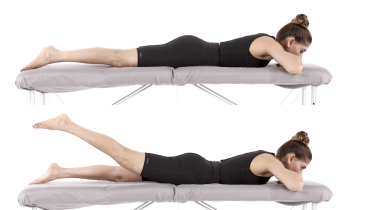
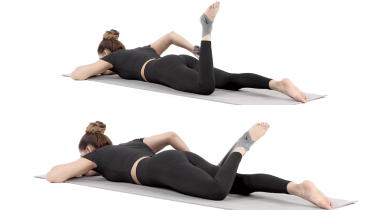
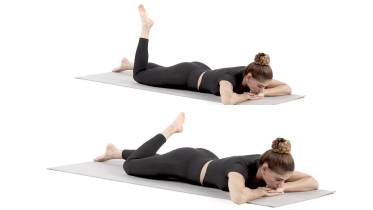
Eccentric hamstring curl
An eccentric hamstring curl works the muscles at the back of the thigh (hamstrings) while they lengthen under control. You lie on your front and let your stronger leg help lift the working leg's heel up. Then you take that help away and lower the working leg slowly by itself. The slow lowering is the exercise.
How to do the eccentric hamstring curl
- Lie face down on a mat with your legs straight and your arms by your sides, as in the video. A folded towel under your forehead can make your neck more comfortable.
- Cross your ankles so the front of your stronger ankle sits under the back of the ankle on the leg you are working.
- Bend both knees together and bring your heels up toward your buttocks, letting the stronger leg do most of the lifting. Stop when your lower legs point at the ceiling, as the video does.
- Unhook the stronger leg and put it back down on the mat. The working leg stays up with the knee bent.
- Lower the working leg slowly on its own, taking several seconds to reach the mat. Keep the front of your hips pressed down the whole way.
- Relax for a moment, then hook the ankles again and repeat.
What you should feel
Steady work at the back of the thigh on the leg that lowers, usually hardest as the foot gets close to the mat. The stronger leg does almost nothing once it lets go.
Common mistakes
- Controlling the first half, then letting the leg drop the rest of the way.
- Lifting the hips off the mat or arching the lower back.
- Rushing the lowering. It should take several seconds, not one.
How often
Many programs use 2 to 3 sets of 8 to 12 slow lowers on each leg, each taking about 3 to 5 seconds, on 2 to 3 days a week with a rest day in between. Your physio will adjust this and tell you when an ankle weight makes sense.
Stop and check with your physio if
- A sudden sharp pain, pop or snap at the back of your thigh. Stop straight away. If you then get large bruising spreading down the back of the thigh, a gap or dip you can feel, a stiff-legged walk, or clear weakness when you bend the knee, get assessed the same day at urgent care or an emergency department, as the tendon may have pulled away from the bone near the buttock.
- Sharp pain behind the knee or high up near the buttock.
- Lower back pain while you lie on your front or lower the leg.
From the clinic
Slow lowering work often leaves the back of the thigh feeling sore for a day or two after the first few sessions. That ache fades as you get used to it. Pain while you are lowering is different, and it is a reason to stop. If the hamstring cramps, straighten the leg on the mat and let it settle before you carry on.
After a recent hamstring strain, start this only when your physio says the muscle is ready for it. Gentler work usually comes first, such as the standing hamstring curl with no weight. The same applies after an ACL reconstruction that used a hamstring graft, so ask your surgeon or physio before adding this one. Once the lowering is easy, the prone hamstring curl adds a band.
Written and checked by the PocketPhysio editorial team. Last updated 2026-09-28.
This page is general education, not a diagnosis or a personal treatment plan. If you have pain, an injury or a health condition, see a physiotherapist or doctor before starting new exercises.