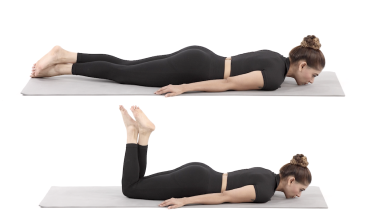
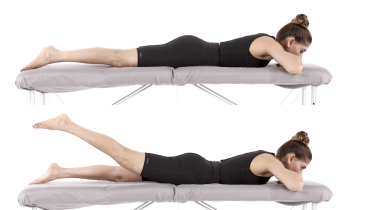
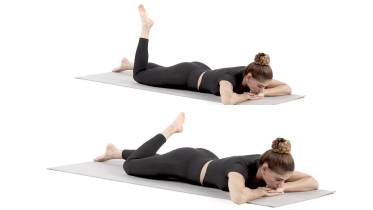
Prone hip external rotation stretch with a strap
This stretch is used for a hip that is stiff turning outward. You lie on your stomach with one knee bent to a right angle and a strap looped around that ankle, then use the strap to ease the foot gently across toward the other leg. The strap adds a little help at the end of the movement, which physios call active assisted range of motion.
How to do the prone hip external rotation stretch with a strap
- Loop a strap or exercise band around the ankle of the leg you are working, then lie on your stomach on a mat. Rest your head on your folded forearm or a small pillow.
- Bend that knee so your lower leg is upright, with the foot toward the ceiling. Keep the thigh down on the mat and your knees close together.
- Hold the other end of the strap in the hand on the opposite side, as the voice guide describes, and rest that hand near your hip or lower back.
- Let the foot move slowly across toward the other leg. Where it stops on its own, pull gently on the strap to take it a little further, until you feel a mild stretch in the hip.
- Pause for a few seconds with both hip bones still on the mat, then ease off and let the foot come back upright.
- Repeat slowly, then move the strap to the other ankle if both sides are in your program.
What you should feel
A mild stretch deep in the hip on the bent-knee side, often toward the front or outer side of the hip. The knee should feel comfortable throughout.
Common mistakes
- Yanking on the strap. Pull only enough to add a little range.
- Letting your pelvis twist or one hip bone lift off the mat as the foot crosses.
- Letting the bent knee slide out to the side, so the thigh moves instead of rolling in place.
- Bouncing the foot at the end.
How often
Most programs use about 10 to 15 slow, gentle repetitions on each side you are working, with a pause of 3 to 5 seconds at the end of each, once or twice a day. Your physio will adjust this.
Stop and check with your physio if
- A sharp or pinching feeling in the hip joint or groin.
- Pain on the inner or outer side of the knee as the strap pulls on your lower leg.
- Pain, numbness or tingling spreading down the leg, or your lower back aches while you lie face down.
From the clinic
The name says stretch, but the video shows a slow, repeated movement with a short pause at the end rather than one long hold, and the steps follow that. Bringing the foot toward the other leg is what turns the hip outward, the movement physios call external rotation. The deep muscles at the back of the hip do the turning, and at the end of the range the muscles that turn the hip inward (tensor fasciae latae, gluteus minimus and the front of gluteus medius) get a gentle stretch. The strap is there to add a small amount of range at the end, not to force it. To move the hip both ways without a strap, see prone hip rotation.
The strap pulls on your ankle, and the knee sits between that pull and the hip. Keep the pull light, and let go if you feel it in the knee rather than the hip. After a knee ligament injury or knee surgery, ask your physio before you use a strap in this position, because pulling the lower leg across twists the knee as well as turning the hip.
Slide a thin pillow under your belly if your lower back complains, and pad the bent knee with a folded towel if the mat is hard. As pregnancy goes on, lying on your front becomes uncomfortable, so if you are pregnant, ask your physio about another position.
If you have had a hip replacement, get the go-ahead from your surgeon or physio before you try this stretch. Pulling the foot across turns the hip outward, and many surgeons ask you to avoid that for the first months after some operations. The operations that limit turning outward are not the same ones that limit turning inward, so your own team is the one to ask.
Written and checked by the PocketPhysio editorial team. Last updated 2026-09-28.
This page is general education, not a diagnosis or a personal treatment plan. If you have pain, an injury or a health condition, see a physiotherapist or doctor before starting new exercises.