Prone hip rotation
Prone hip rotation moves your hip through its turning range while you lie on your stomach. With one knee bent to a right angle, you let the foot move out to the side and then back across, while your thigh and pelvis stay flat on the mat. It is often used for a stiff hip.
How to do the prone hip rotation
- Lie on your stomach on a mat. Fold your hands under your forehead and let your legs rest straight.
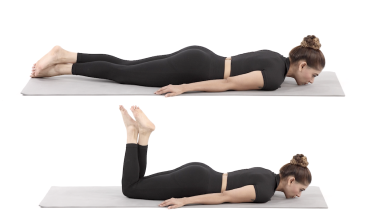
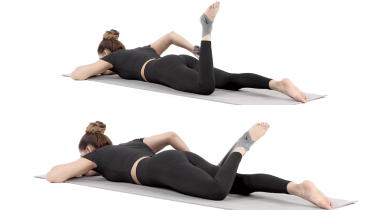
- Bend one knee to a right angle so the sole of that foot faces the ceiling. The thigh stays resting on the mat.
- Keep your knees close together and both hip bones resting evenly on the mat.
- Slowly let your foot move out to the side, away from the other leg. Go only as far as your pelvis stays flat.
- Bring the foot back to upright, then move it across toward the other leg. Stop before the hip on that side starts to lift.
- Keep the movement slow in both directions, then switch legs.
What you should feel
A turning movement deep in the hip, sometimes with a mild stretch at the end of the range. The movement comes from the hip, not from the knee or the lower back.
Common mistakes
- Letting one side of the pelvis lift off the mat so the foot can go further.
- Twisting at the knee instead of the hip. The thigh stays on the mat and simply rolls in place.
- Swinging the foot quickly. Move slowly and stop at the end of the comfortable range.
How often
Many programs use 1 to 2 sets of 10 to 15 slow movements in each direction, once or twice a day. Your physio will adjust this to you.
Stop and check with your physio if
- You feel sharp or pinching pain in the hip or groin.
- Your knee or lower back hurts in this position.
- Pain spreads down the leg, or you notice numbness or tingling.
From the clinic
The short video shows the foot moving out to the side and ends there. The voice guide adds the movement back across, which is the usual way to do this exercise, so the steps cover both.
It helps to know which way is which. When the foot moves out to the side, the hip turns inward (internal rotation). When the foot moves across toward the other leg, the hip turns outward (external rotation). One direction is often stiffer than the other, so tell your physio if you notice a big difference between sides.
If lying on your stomach strains your lower back, a thin pillow under your stomach can ease it. A folded towel under the bent knee takes pressure off the kneecap.
If you have had a hip replacement, get the go-ahead from your surgeon or physio before you try prone hip rotation. Moving the foot out or across turns the hip inward or outward, and many surgeons ask you to avoid that for the first months after some operations. Some operations limit turning inward and others limit turning outward, so the safe direction depends on your surgery. For a gentle stretch of the outer buttock once you are cleared, see the piriformis stretch.
Written and checked by the PocketPhysio editorial team. Last updated 2026-09-26.
This page is general education, not a diagnosis or a personal treatment plan. If you have pain, an injury or a health condition, see a physiotherapist or doctor before starting new exercises.