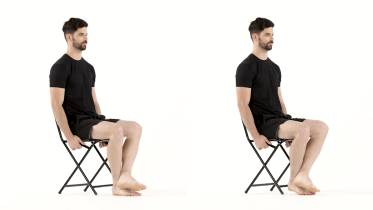
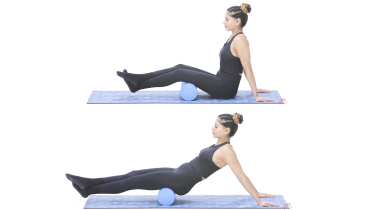
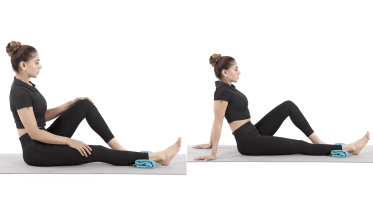
Seated hamstring curl with band
Sitting on a chair, you bend your knee against a resistance band so your foot travels back under the seat. It works the muscles at the back of the thigh (hamstrings) and is easy to set up at home, which makes it handy if getting down to the floor or lying on your front is difficult.
How to do the seated hamstring curl with band
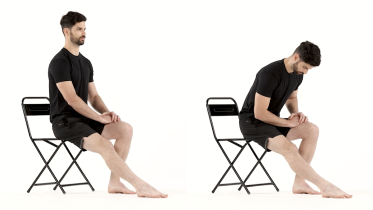
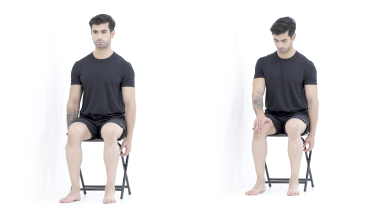
- Sit up tall on a sturdy chair with space under the seat and your feet on the floor.
- Tie one end of the band to something solid in front of you, at about the height of your shin. Loop the other end around the ankle of the leg you are working.
- Shift the chair back until the band is just taut with your foot in front of you.
- Keep your thigh resting on the seat and bend your knee, pulling your foot back under the chair against the band.
- Let the foot return forward slowly, controlling the band all the way, and repeat. Move the band to the other ankle if your physio has asked you to work both legs.
What you should feel
Effort at the back of the thigh, and perhaps a little in the calf. The thigh itself stays still on the chair.
Common mistakes
- Lifting the thigh or leaning back to get the foot further under the seat.
- Letting the band yank the foot forward on the way back.
- Slumping in the chair as you tire.
How often
Often 2 to 3 sets of 10 to 15 on each leg, starting with a light band. Your physio will adjust this, including when to move to a stronger band.
Stop and check with your physio if
- Your hamstrings cramp.
- A sudden sharp pain, pop or snap at the back of your thigh. Stop straight away. If you then get large bruising spreading down the back of the thigh, a gap or dip you can feel, a stiff-legged walk, or clear weakness when you bend the knee, get assessed the same day at urgent care or an emergency department, as the tendon may have pulled away from the bone near the buttock.
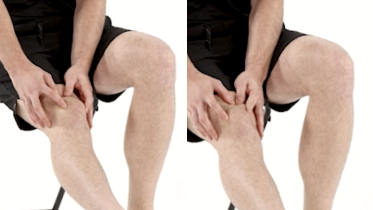
- Sharp pain in or behind the knee as you bend it.
From the clinic
This is a sitting option alongside the lying hamstring curl with band. With no band at all, the standing hamstring curl works the same muscles. Check the anchor before each set, because a band that slips can flick back at your leg.
After a recent hamstring strain, resisted curls load the healing muscle directly, so let your physio decide when the band comes in and how strong it is. The same caution applies after an ACL reconstruction that used a hamstring graft, where resisted hamstring work is usually held back for the first weeks.
Written and checked by the PocketPhysio editorial team. Last updated 2026-09-28.
This page is general education, not a diagnosis or a personal treatment plan. If you have pain, an injury or a health condition, see a physiotherapist or doctor before starting new exercises.