Long sitting knee extension
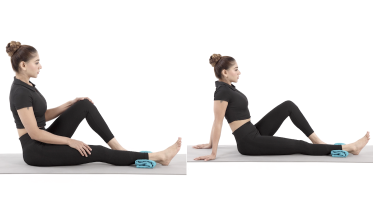
Long sitting knee extension works on getting the last bit of straightening back into a stiff knee. You sit with your legs out in front and a rolled towel under the ankle of the stiff leg, then tighten your thigh to push the knee down toward the surface, hold, and relax. The towel leaves the back of the knee unsupported, so each press takes the knee a little further toward straight.
How to do the long sitting knee extension
- Sit on a firm bed or mat with your legs out in front. Lean back onto your hands placed behind your hips, as in the video, or sit with your back against a headboard or wall.
- Bend the other knee and set that foot flat. Put a rolled towel under the ankle of the leg you are working, so nothing sits under the knee.
- Tighten the muscle on the front of your thigh and push the back of the knee down toward the surface, straightening the knee as far as it will go.
- Hold the push for about 5 to 10 seconds, as the video does, and keep breathing.
- Let the thigh relax completely so the knee eases up again, then repeat.
What you should feel
The front of the thigh working hard, with a stretch or pressure behind the knee as it straightens. With a stiff knee some discomfort is common, but it should fade when you relax.
Common mistakes
- Lifting the heel off the towel or raising the whole leg, instead of pushing the knee down.
- Pressing on the knee with your hands to force it straight.
- Holding your breath while the knee is pressed down.
How often
Many programs use 10 to 15 presses with a hold of about 5 to 10 seconds, a few times a day. Your physio will adjust this.
From the clinic
The voice guide describes this lying on your back. The video shows it sitting up, propped on the hands. Both work, so pick whichever suits your back and shoulders better.
What separates this from a stretch is who does the pushing. Your own thigh presses the knee down, in short efforts you start and stop, so nothing is being held against your will and you can come out of any one press the moment it bites. A knee that is still guarded often accepts that better than being left to hang in a long hold.
The towel position is not a detail. Under the ankle, the back of the knee is left in mid-air with nothing to rest on, and that is the only reason the press takes the joint anywhere. Slide the roll under the calf or under the knee itself and you have propped the joint in the bent position you were trying to undo.
The knee extension stretch uses the same towel under the heel, but there you relax and let the knee sink for minutes at a time. Here the thigh does the work in short presses. Your physio may give you one or both. Quad sets are a similar squeeze with the towel under the knee instead of the ankle.
Between sessions, rest with the leg flat rather than on a pillow tucked under the knee, so the knee does not settle into a bent position.
Before you start
- After a knee fracture or knee surgery, including a knee replacement, follow your surgeon's or physio's plan, and start this exercise only when they have cleared you.
When to stop and get help
- Sharp pain in the knee, or pain that keeps climbing with each press.
- Your calf or thigh is getting more swollen, or becomes warm, tender, red or darker than usual, or has a new throbbing or cramping pain. This can be a blood clot, especially after an operation, an injury, time in a cast, boot or brace, or a spell of being much less mobile than usual, and after an operation it can also be an infection. Stop and contact your medical team or get medical advice the same day. If you are also short of breath or have chest pain, call emergency services.
- Your wound becomes more red, hot, swollen or painful, or starts to leak. Contact your medical team the same day.
Written and checked by the PocketPhysio editorial team. Last updated 2026-10-11.
This page is general education, not a diagnosis or a personal treatment plan. If you have pain, an injury or a health condition, see a physiotherapist or doctor before starting new exercises.