
Knee stiffness after surgery: bending, straightening and what has stalled
Warning signs, and when to get help
Why is my knee stiff after surgery?
Three things are usually going on at once, and none of them starts out as scar tissue. The joint is swollen, and the fluid inside it has to go somewhere, so the knee runs out of room before it reaches the end of the bend. The tissues around the knee are healing, which means they are laying down new material and tightening while they do it. And the thigh muscle has been switched off, by the operation and by the swelling together, so even the movement you still have is hard to use.
A fourth thing then quietly makes it worse. A knee that hurts gets held still, and a knee held still stiffens, which is why the first bends of the morning feel like ground lost overnight and why twenty minutes of moving about usually hands it back.
That is the ordinary version, and it loosens as those four improve. The rest of this page is about telling it apart from the version that does not.
Three kinds of stiffness, and which one you have
One word covers three situations, and only one of them needs a phone call this week.
The first is a knee that feels set after you have been still and frees up once you are moving. That one is expected after an operation, and it settles.
The second is a range that is short of where your team wants it, while still creeping forward from week to week. That is usually not a problem, it is the work, and in the early months it is most of what rehabilitation after a knee operation actually consists of.
One question belongs with that second kind, though, and most people never ask it: what range does your team expect, and by when. Slow improvement only reassures you if it is on course for that number by that date. The timetables further down this page are counted in weeks and in months, not in years, so a knee creeping forward too slowly to get there is worth raising while it is still creeping, not once it has stopped. If nobody has given you a number and a date, ask for both at your next contact, and until you have them go by direction instead: the plateau rule further down this page works without a target.
The third is a range that has stopped changing, or one that is going backward. That is the one to raise with your physio, physical therapist (PT) or surgeon now rather than at your next routine appointment, and the warning lines at the end of this page give the wording.
Judging which you have takes a bit of discipline about measuring. Read your knee over weeks, not days: day to day it tells you about yesterday's walking and this morning's swelling and nothing else. Take your reading at the same time of day, after you have been up and about, or you will keep recording the worst version of your knee and conclude you are going backward. Writing one thing down once a week, the same task at the same time, is enough, and it is what makes the phone call useful if you end up making one.
The straightening, which is the half that gets dropped
Almost everything written about a stiff knee is about the bend. Patients ask about the bend, exercise sheets count the bend, and the number someone wrote down for you at your last appointment was probably the bend. Meanwhile the surgical literature goes the other way: older definitions of arthrofibrosis required a loss of straightening before the label applied at all, which left out people whose problem was pain and a lost bend, while the international consensus definition in use now counts restricted movement in flexion, extension or both (Usher and colleagues, 2019; Kalson and colleagues, 2016).
A few lost degrees sound like nothing, and the long-term figures say otherwise. In 502 people followed for a mean of 14 years after an ACL reconstruction, the factor most strongly linked to lower patient-reported scores was lack of normal knee extension, with normal taken from their own uninvolved knee and hyperextension counted as part of it. Losses of about 3 to 5 degrees were enough to show up, and they counted for more in the people who had also had part of a meniscus removed or had damage to the joint cartilage (Shelbourne and Gray, 2009). Those are results from one operation and one group of patients, so they are not a rule for every knee. They are a reason to stop treating the straightening as the optional exercise.
Stand with one knee slightly bent and hold it there: the thigh has to work the whole time. A knee that will not come flat asks for that on every step you take all day, so the leg tires early and the limp outlasts the pain.
You can see it for yourself at home, and the comparison that counts is with your own other knee, not with a number off a web page. One exception comes first. If your knee is held in a brace, a cast or an immobilizer, leave the measuring to your team and do not take the device off to compare.
Otherwise, lie on your back on a firm bed with both legs out straight and the thigh muscles soft, then prop yourself up on your elbows so you are looking down the length of both legs. Compare the two heels. On the stiff side the heel sits higher off the bed, because the knee is not reaching the surface. Then slide a flat hand under the back of each knee in turn, without pressing down, and compare how much room there is. Sitting with both heels up on a stool and letting both thighs go soft shows you the same difference from the side, and it is the easier one to set up on your own, so use whichever suits you; use the stool if lying flat on your back is uncomfortable or you have been told to avoid it.
A single reading means little. Do the same check, in the same place, at the same time of day, once a week, and write it down next to the bend. That is what turns a feeling into something your physio can act on, and it is also how you find out that a knee which looks straight to you is a few degrees short, which is the size of loss that showed up in those 14 year results.
The exercises for it are the dull ones, and they are dull in a specific way. The knee extension stretch and the seated heel prop ask you to let the leg hang and wait, building up the time rather than the force, and long sitting knee extension adds the thigh pressing the knee down toward the surface. The first two are the same exercise in two positions, on the floor and between two chairs, so do one of them and not both, whichever one you can get into and out of without help. The hold times on their pages are for one exercise, not a total for the pair. Nothing to count, and nothing visibly improving.
Quad sets and short arc quads are there to make the muscle hold the position once you have won it, because range you cannot hold does not stay.
The pillow is where a lot of that work comes undone. If you are raising the leg for swelling, support it from thigh to heel and leave the knee out straight, rather than putting the pillow under the knee itself. An evening with the knee propped half bent, or a night of it, pulls against everything the day's exercises did.
There is one exception to raising the leg. If your toes are numb, tingling or burning, or the bandage or brace feels tight, do not prop the leg higher than your hip and do not put ice on it, and read the warning signs below for what to do instead.
Scar tissue, and why forcing it is not the answer
"Breaking up scar tissue" is one of the most searched phrases on this subject and one of the most unhelpful, because it describes a knee as a lump of glue and forcing as the solvent.
A review of arthrofibrosis across joints puts the argument the other way round. Exercise itself sets off an inflammatory response; the authors state that aggressive exercise can start or worsen arthrofibrosis, and their own guidance is that intensity has to be matched to the inflammation it produces in that individual, with more inflammation and more fibrosis when the limits are passed (Usher and colleagues, 2019). That is a review arguing from mechanism, not a trial, and they say plainly that the risk factors and the best management are still not well understood. It is enough, though, to retire the idea that pain means progress.
So the test is the morning after, not the moment. Feeling the stretch at the end of the range is part of the exercise working, and an ache for a while afterward goes with it. If that has gone by the next morning, the session was fair. If pain builds with each repetition, or the knee is hotter and more swollen the following day, it asked too much, and the fix is to come back a step rather than abandon the work, because a knee that gets no range work at all stiffens faster than one that gets a little. The pain monitoring model is the clinician-facing version of that rule.
Three things to rule out of your week: weights hung from the shin, a relative pressing down on the knee, and any session you have to grit your teeth through. Your own good leg giving the stiff one a little help, the way the assisted seated knee bend in stage 2 does, is a different thing, because your own leg lets go the instant the knee objects and another person's hands do not. Tissue does get divided deliberately in one place, and that place is an operating room, under anesthetic, by a surgeon who is controlling where the force goes.
How to use this program
Your own instructions come first, every time. If you have been told how much weight to put through the leg, how far to bend the knee, or how long to wear a brace, those limits beat anything on this page, and they are usually tighter after a meniscus repair, a cartilage repair or a fracture than after a simple arthroscopy. If you are in the weeks or months after an operation and nobody gave you limits, or the leaflet has gone missing, do not guess and do not work them out from how the leg feels. Ring your surgical team or your physio and ask them two things: how much weight you may put through the leg, and how far the knee may bend.
If nobody picks up, the number on your discharge letter, the ward or day unit that sent you home, the hospital physiotherapy department and your own doctor are all worth trying, and say when you ring that you have no instructions at all, because that is what moves the call up a list. Until somebody answers, carry on with what you were shown and told to do after your operation and nothing beyond it. Every exercise here asks for your surgeon's or physio's go-ahead first, so stage 1 is where you wait rather than somewhere to start on your own.
Two checks before you start the program. If you have had a hip replacement or other hip surgery, get the go-ahead from your surgeon or physio first, because several of these exercises bend the hip past a right angle and one of them is done sitting on the floor, which means getting down there and back up again. And if your knee operation came with limits on weight or bending that nobody has lifted yet, those limits decide which stage you are on, not how the knee feels.
This page is for adults. A child or teenager who has had a knee operation should follow the plan from their surgeon and physio, and ask them before trying any exercise on this page. If you are pregnant, check with your midwife or physio before you start. Several of these exercises are done lying on your back.
Range work is done little and often rather than saved for one long session in the evening. Each exercise page carries its own starting dose as a guide, and your physio will adjust the numbers, the frequency and which exercises suit your operation. Read those numbers as a starting point for one exercise at a time rather than a total to add up. Each stage holds more exercises than most people need in one day, and if a session leaves the knee more swollen the next morning, the first thing to cut is how many of them you are doing, not the range on the ones you keep. The Aspetar guideline on rehabilitation after ACL reconstruction recommends starting active knee movement immediately after surgery while following any instructions from the surgeon, and reports that early movement can improve both bending and straightening in the early phase whatever the graft, while rating the certainty of that evidence as very low (Kotsifaki and colleagues, 2023).
The stages are not stacked on top of each other either. Stage 2 takes over the range work from stage 1 rather than being added to it, and stage 3 is standing work that goes alongside whatever range work you still need, not instead of it, because a knee that is still short of range keeps working the range.
If you have high blood pressure, breathe steadily through every repetition and never hold your breath. Check with your doctor before you start if you have a heart or lung condition, or blood pressure that is not under control.
The exercise program
The exercises below carry their own stop signs and precautions. Open the line under an exercise and read them before you try it.
Stage 1: Get the knee moving, with the leg supported
For the early weeks, and only inside the limits your surgeon or physio gave you for weight bearing, for how far to bend, and for any brace. Nothing here puts your body weight through the knee. Ankle pumps keep the blood moving in the calf. Quad sets ask the thigh to switch on, which is the muscle a swollen knee gives up first. Heel slides and the seated knee bend work the bend, and the seated heel prop lets the weight of your own leg ease the knee toward straight. Kneecap glides are for a kneecap that feels stuck, because a kneecap that will not move limits the bend by itself. A stretch, a tight feeling or a mild ache that settles soon afterward is expected. Sharp pain, or more swelling the next morning, is not.
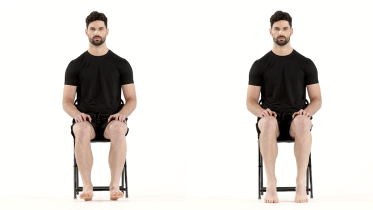 Ankle pumps
Stop signs and precautions for the ankle pumps
Before you start
- Had surgery on your foot or ankle, or wearing a cast or boot? Check which movements are allowed before you start.
When to stop and get help
- Your calf or thigh is getting more swollen, or becomes warm, tender, red or darker than usual, or has a new throbbing or cramping pain. This can be a blood clot, especially after an operation, an injury, time in a cast, boot or brace, or a spell of being much less mobile than usual, and after an operation it can also be an infection. Stop and contact your medical team or get medical advice the same day. If you are also short of breath or have chest pain, call emergency services.
- You suddenly become short of breath, get chest pain or pain in your upper back that may be worse when you breathe in, cough up blood, your heart beats very fast, or you faint. Call emergency services straight away, even if your leg looks normal, as this can be a blood clot in the lungs (pulmonary embolism).
- Any sharp pain in the foot or ankle.
- Emergency: while you are in a cast or boot, your toes turn blue, white or pale, or feel cold. Do not wait to see if raising your leg helps. Go to an emergency department straight away, and do not drive yourself. The cast or boot may be cutting off the blood supply, or pressure may be building up inside the leg (compartment syndrome), and both need checking quickly.
- In a cast or boot, the pain gets worse, your toes feel numb, tingle or burn or look more swollen, or the cast or boot feels too tight. Stop, raise your foot to about hip level and no higher, keep moving your toes and contact your fracture clinic or get medical advice straight away. If you wear a boot, loosen the straps but keep it on. Do not prop the foot higher than that and do not put ice on it, because if pressure is building up inside the lower leg both of those cut down the blood reaching your foot. If you cannot move your toes, the pain is severe even after painkillers, or the numbness, tingling, burning or swelling has not settled within 30 minutes of raising your foot, go to your fracture clinic or an emergency department straight away, and do not drive yourself.
- Since the fracture or cast, the foot or ankle is getting more painful rather than less, the skin becomes very sensitive to light touch, or the foot changes color, temperature, swelling or sweating compared with the other one, or looks shiny. See your doctor or physio as soon as you can, within a few days at most, as this can be complex regional pain syndrome (CRPS) and early treatment may help.
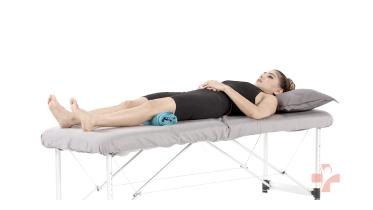 Quad sets (towel under knee)
Stop signs and precautions for the quad sets (towel under knee)
Before you start
- After a knee fracture or knee surgery, including a knee replacement, follow your surgeon's or physio's plan, and start this exercise only when they have cleared you.
When to stop and get help
- Your knee pain goes up sharply.
- Your calf or thigh is getting more swollen, or becomes warm, tender, red or darker than usual, or has a new throbbing or cramping pain. This can be a blood clot, especially after an operation, an injury, time in a cast, boot or brace, or a spell of being much less mobile than usual, and after an operation it can also be an infection. Stop and contact your medical team or get medical advice the same day. If you are also short of breath or have chest pain, call emergency services.
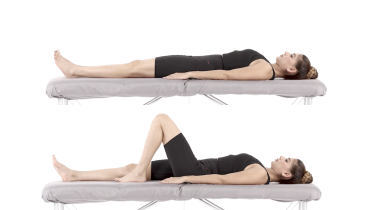 Heel slides
Stop signs and precautions for the heel slides
Before you start
- After a knee fracture or knee surgery, including a knee replacement, follow your surgeon's or physio's plan, and start this exercise only when they have cleared you.
- If you have had a hip replacement or other hip surgery, get the go-ahead from your surgeon or physio before you try heel slides. Sliding the heel toward you bends the hip, and many surgeons set a limit on how far it can bend for the first months after some operations, so find out what yours is.
- If you are pregnant and past the first three months, check with your physio before exercising flat on your back.
When to stop and get help
- Pain in the knee or hip becomes sharp or keeps increasing with each rep.
- Your calf or thigh is getting more swollen, or becomes warm, tender, red or darker than usual, or has a new throbbing or cramping pain. This can be a blood clot, especially after an operation, an injury, time in a cast, boot or brace, or a spell of being much less mobile than usual, and after an operation it can also be an infection. Stop and contact your medical team or get medical advice the same day. If you are also short of breath or have chest pain, call emergency services.
- Your wound becomes more red, hot, swollen or painful, or starts to leak. Contact your medical team the same day.
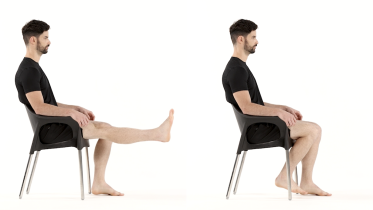 Seated knee bend
Stop signs and precautions for the seated knee bend
Before you start
- After a knee fracture or knee surgery, including a knee replacement, follow your surgeon's or physio's plan, and start this exercise only when they have cleared you. After a meniscus repair and some other operations, the knee may only bend to a set angle for a while, so ask what your limit is before you slide the foot all the way back.
When to stop and get help
- Sharp or catching pain in the knee, the knee locks, or it swells and stays more painful into the next day.
- Your calf or thigh is getting more swollen, or becomes warm, tender, red or darker than usual, or has a new throbbing or cramping pain. This can be a blood clot, especially after an operation, an injury, time in a cast, boot or brace, or a spell of being much less mobile than usual, and after an operation it can also be an infection. Stop and contact your medical team or get medical advice the same day. If you are also short of breath or have chest pain, call emergency services.
- Your wound becomes more red, hot, swollen or painful, or starts to leak. Contact your medical team the same day.
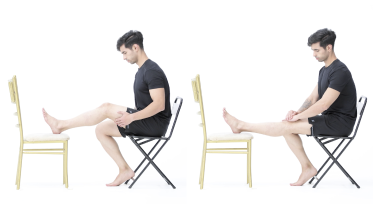 Seated heel prop
Stop signs and precautions for the seated heel prop
Before you start
- After a knee fracture or knee surgery, including a knee replacement, follow your surgeon's or physio's plan, and start this exercise only when they have cleared you.
When to stop and get help
- Sharp knee pain, or an ache that grows stronger through the hold instead of settling.
- Numbness, tingling or pins and needles in your foot or lower leg.
- Your calf or thigh becomes swollen, warm, tender, red or darker than usual, or has a throbbing or cramping pain that feels different from normal muscle ache. Stop and get medical advice the same day, as this can be a blood clot. If you are also short of breath or have chest pain, call emergency services.
- Your wound becomes more red, hot, swollen or painful, or starts to leak. Contact your medical team the same day.
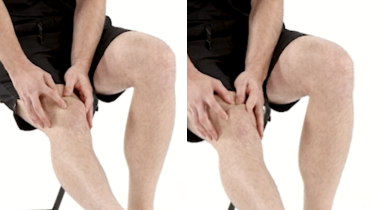 Kneecap glides
Stop signs and precautions for the kneecap glides
Before you start
- If you have had knee surgery, or your kneecap has ever dislocated or partly slipped out of place, check with your surgeon or physio before you try this. Kneecaps usually dislocate toward the outside of the knee, so your physio may ask you to leave out the outward glide.
When to stop and get help
- The kneecap feels as if it might slip out of place, or you feel a sudden sharp pain.
- The knee becomes more swollen, warm or painful after the glides.
- Your calf or thigh is getting more swollen, or becomes warm, tender, red or darker than usual, or has a new throbbing or cramping pain. This can be a blood clot, especially after an operation, an injury, time in a cast, boot or brace, or a spell of being much less mobile than usual, and after an operation it can also be an infection. Stop and contact your medical team or get medical advice the same day. If you are also short of breath or have chest pain, call emergency services.
Stage 2: Work both ends of the range
When stage 1 is comfortable and your team is happy for you to push the range further. This stage deliberately splits the work in two. The knee extension stretch and long sitting knee extension are the straightening half, done as low effort holds that you build up in time rather than in force; if stage 1's seated heel prop suited you better, keep using that instead of the knee extension stretch rather than as well, because the two are one stretch in two positions. Short arc quads and the straight leg raise train the thigh to hold the position once you have it, and the straight leg raise comes in only when you can lift the leg without the knee bending. The assisted seated knee bend works the bend, with your other leg giving the stiff knee a little help, and it takes over from stage 1's seated knee bend rather than being added to it, because the two work the same bend in the same chair. The seated knee extension takes the knee through its whole range in sitting, from as far back as it will tuck to fully straight. The prone knee bend uses the weight of your lower leg instead, so leave it out if lying on your front is uncomfortable or if you have been told to keep the knee straight. After a meniscus repair, a cartilage repair or a fracture, ask your surgeon or physio how far you may bend before you start this stage, because those limits are usually tighter and last longer than the ones on walking.
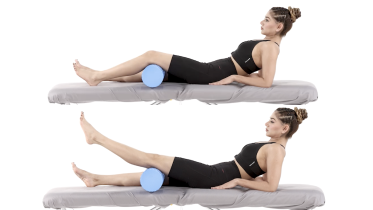 Short arc quads
Stop signs and precautions for the short arc quads
Before you start
- After a knee fracture or knee surgery, including a knee replacement, follow your surgeon's or physio's plan, and start this exercise only when they have cleared you.
When to stop and get help
- Knee pain increases sharply during the set.
- Your calf or thigh is getting more swollen, or becomes warm, tender, red or darker than usual, or has a new throbbing or cramping pain. This can be a blood clot, especially after an operation, an injury, time in a cast, boot or brace, or a spell of being much less mobile than usual, and after an operation it can also be an infection. Stop and contact your medical team or get medical advice the same day. If you are also short of breath or have chest pain, call emergency services.
- Your wound becomes more red, hot, swollen or painful, or starts to leak. Contact your medical team the same day.
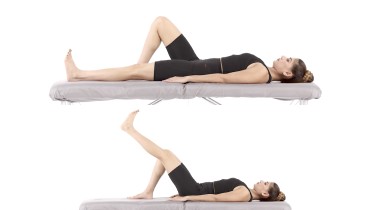 Straight leg raise
Stop signs and precautions for the straight leg raise
Before you start
- After a knee fracture or knee surgery, including a knee replacement, follow your surgeon's or physio's plan, and start this exercise only when they have cleared you.
- If you have had a hip replacement or other hip surgery, get the go-ahead from your surgeon or physio before you try this exercise. Some operations limit this kind of work for the first months, so the timing depends on your surgery. Lifting a straight leg is the heaviest way to use the muscles at the front of the hip, and after a periacetabular osteotomy a North American physiotherapy consensus panel asks for this exact movement, a straight leg lift while you are on your back, to be left out for 8 to 12 weeks.
- If you are pregnant and past the first three months, check with your physio before exercising flat on your back.
When to stop and get help
- Your lower back hurts.
- Knee pain increases during the set.
- You feel sharp pain in the front of the hip or groin.
- Your calf or thigh is getting more swollen, or becomes warm, tender, red or darker than usual, or has a new throbbing or cramping pain. This can be a blood clot, especially after an operation, an injury, time in a cast, boot or brace, or a spell of being much less mobile than usual, and after an operation it can also be an infection. Stop and contact your medical team or get medical advice the same day. If you are also short of breath or have chest pain, call emergency services.
- Your wound becomes more red, hot, swollen or painful, or starts to leak. Contact your medical team the same day.
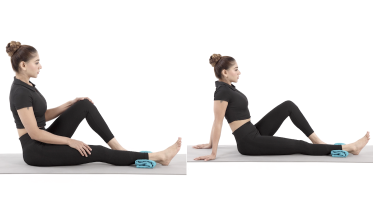 Knee extension stretch
Stop signs and precautions for the knee extension stretch
Before you start
- After a knee fracture or knee surgery, including a knee replacement, follow your surgeon's or physio's plan, and start this exercise only when they have cleared you.
- If you rest an ice pack on the knee during the hold, check first that you have normal feeling in the leg and no numbness, and look at the skin before, during and after. Numb skin cannot tell you it is being burned, and feeling can still be coming back for a while after an operation or a nerve block.
When to stop and get help
- Pain that is sharp or keeps building the longer you hold.
- Your calf or thigh becomes swollen, warm, tender, red or darker than usual, or has a throbbing or cramping pain that feels different from normal muscle ache. Stop and get medical advice the same day, as this can be a blood clot. If you are also short of breath or have chest pain, call emergency services.
- Numbness or tingling in the foot.
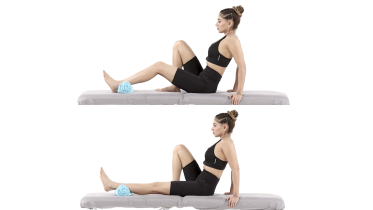 Long sitting knee extension
Stop signs and precautions for the long sitting knee extension
Before you start
- After a knee fracture or knee surgery, including a knee replacement, follow your surgeon's or physio's plan, and start this exercise only when they have cleared you.
When to stop and get help
- Sharp pain in the knee, or pain that keeps climbing with each press.
- Your calf or thigh is getting more swollen, or becomes warm, tender, red or darker than usual, or has a new throbbing or cramping pain. This can be a blood clot, especially after an operation, an injury, time in a cast, boot or brace, or a spell of being much less mobile than usual, and after an operation it can also be an infection. Stop and contact your medical team or get medical advice the same day. If you are also short of breath or have chest pain, call emergency services.
- Your wound becomes more red, hot, swollen or painful, or starts to leak. Contact your medical team the same day.
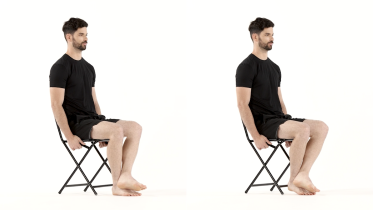 Assisted seated knee bend
Stop signs and precautions for the assisted seated knee bend
Before you start
- After knee surgery, follow the range your surgeon and physio have set. Some operations, such as a meniscus repair, come with a limit on how far the knee may bend in the first weeks. If you have had a hip replacement, get the go-ahead from your surgeon or physio before you try this exercise. Crossing your legs takes one leg across the middle of your body, even when only the ankles cross, and many surgeons ask you to avoid that for the first months after some operations. Until they say yes, skip this exercise.
When to stop and get help
- Sharp or stabbing pain in the knee, or pain that stays much worse for hours afterward.
- The knee becomes more swollen, hot or red, or it locks or catches.
- Your calf or thigh is getting more swollen, or becomes warm, tender, red or darker than usual, or has a new throbbing or cramping pain. This can be a blood clot, especially after an operation, an injury, time in a cast, boot or brace, or a spell of being much less mobile than usual, and after an operation it can also be an infection. Stop and contact your medical team or get medical advice the same day. If you are also short of breath or have chest pain, call emergency services.
- Your wound becomes more red, hot, swollen or painful, or starts to leak. Contact your medical team the same day.
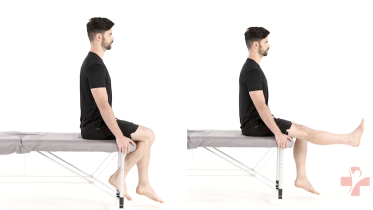 Seated knee extension
Stop signs and precautions for the seated knee extension
Before you start
- After knee ligament surgery, such as an ACL reconstruction, get the go-ahead from your surgeon or physio before you do this one. Many protocols limit how far the knee may straighten against resistance in sitting during the early stage.
- After a knee fracture or knee surgery, including a knee replacement, follow your surgeon's or physio's plan, and start this exercise only when they have cleared you. Ask again before you add an ankle weight.
When to stop and get help
- You feel sharp pain at the front of the knee or under the kneecap.
- The knee swells up or is clearly more painful later that day or the next morning.
- Chest pain or pressure, dizziness or feeling faint, a racing or irregular heartbeat, or being far more out of breath than the effort should cause.
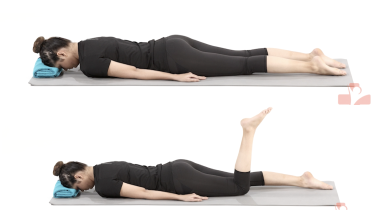 Prone knee bend
Stop signs and precautions for the prone knee bend
Before you start
- After a knee fracture or knee surgery, including a knee replacement, follow your surgeon's or physio's plan, and start this exercise only when they have cleared you. Some operations limit how far the knee may bend for a while, so ask your physio how far to go, and stop at a right angle if that is your limit.
- If you have had recent heart or chest surgery, do not lie face down on a healing chest wound. The weight of your chest presses on the wound for as long as you are down there, and pushing up through your arms to get off the bed pulls across the breastbone. Ask your surgeon or surgical team when lying on your front is allowed, and until then ask your physio for another way to do this while you lie on your side, sit or stand. If the breastbone clicks, grinds, shifts or feels as if it is moving while you do it, stop, and contact your surgical team the same day.
When to stop and get help
- A sharp knee pain, knee pain that grows rep by rep, or a knee that swells up or locks afterward.
- Your wound becomes more red, hot, swollen or painful, or starts to leak. Contact your medical team the same day.
- Your lower back starts to hurt in the face-down position or each time the leg comes up.
- Your calf or thigh is getting more swollen, or becomes warm, tender, red or darker than usual, or has a new throbbing or cramping pain. This can be a blood clot, especially after an operation, an injury, time in a cast, boot or brace, or a spell of being much less mobile than usual, and after an operation it can also be an infection. Stop and contact your medical team or get medical advice the same day. If you are also short of breath or have chest pain, call emergency services.
Stage 3: Carry the range into standing
When you are cleared to take your full weight, stage 2 feels easy and the knee settles well afterward. Range you cannot use in standing does not help you much, which is what this stage is for. Terminal knee extension is the standing version of the straightening work. The mini squat, sit to stand and the step up load the knee through the range you have won, and calf raises and the glute bridge work the rest of the leg that has been quietly getting weaker. Stair climbing goes last, with a hand on the handrail every trip, and coming down is harder than going up. Add these in a couple at a time over a week or two rather than starting all seven on the same day, because a knee newly back on full weight answers you the next morning and not during the session. Only go as deep into the squat as you can control, and keep a chair behind you to touch down on. If you have fallen in the past year, feel unsteady on your feet, or take medicines that make you dizzy, keep a hand on a kitchen counter, a handrail or a sturdy chair back for the whole of the standing exercises, practice only when someone else is at home, and ask your doctor or physio about a falls check. If you live alone, that rule still stands, so plan around it rather than ignoring it. Do the exercises that ask for someone to be at home at your physio appointments or in a class instead, keep to the seated and supported work of stages 1 and 2 when you are on your own, and ask your physio which of the standing exercises you may do alone. Keep your phone in a pocket rather than in another room, so you can reach it from the floor, and ask about an alarm you wear.
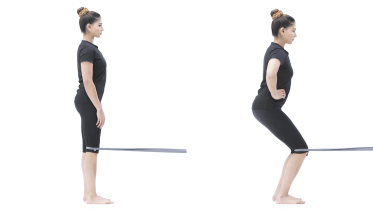 Terminal knee extension with band
Stop signs and precautions for the terminal knee extension with band
Before you start
- After a knee fracture or knee surgery, including a knee replacement, follow your surgeon's or physio's plan, and start this exercise only when they have cleared you.
When to stop and get help
- Pain at the front of the knee or behind the kneecap that builds during the set.
- The knee gives way, locks or catches.
- The knee is more swollen after the session than before it.
- You feel dizzy, lightheaded, faint or sick, or the room seems to spin. Stop, sit down and get medical advice the same day before you exercise again. If you faint, it does not settle within a few minutes of sitting still, your vision suddenly blurs or goes double, or you cannot stand or walk steadily, call emergency services.
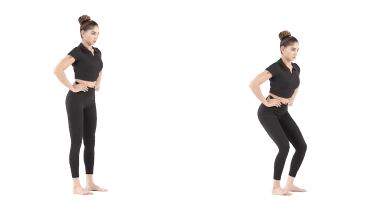 Mini squat
Stop signs and precautions for the mini squat
Before you start
- If you have had a hip replacement or other hip surgery, get the go-ahead from your surgeon or physio before you try mini squats. Some operations limit this kind of work for the first months, so the timing depends on your surgery.
- After a knee replacement, including a partial one, or other knee surgery, get the go-ahead from your surgeon or physio and ask how deep you may go. A squat bends the knee and loads it at the same time, so if you have been given a limit on how far the knee may bend, this is the exercise it applies to first. Keep it shallow and controlled until they say otherwise.
When to stop and get help
- Knee pain is sharp or keeps getting worse through the set.
- The knee swells, gives way or feels unstable afterwards.
- You feel dizzy, lightheaded, faint or sick, or the room seems to spin. Hold your support, sit down and get medical advice the same day before you practice again. If you faint, it does not settle within a few minutes of sitting still, your vision suddenly blurs or goes double, or you cannot stand or walk steadily, call emergency services.
- You feel unsteady enough that you might fall. Hold on to something firm and sit down.
- Your calf or thigh is getting more swollen, or becomes warm, tender, red or darker than usual, or has a new throbbing or cramping pain. This can be a blood clot, especially after an operation, an injury, time in a cast, boot or brace, or a spell of being much less mobile than usual, and after an operation it can also be an infection. Stop and contact your medical team or get medical advice the same day. If you are also short of breath or have chest pain, call emergency services.
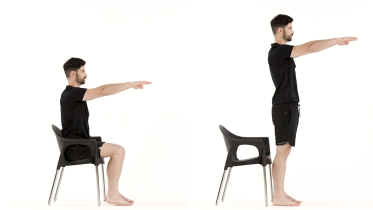 Sit to stand
Stop signs and precautions for the sit to stand
Before you start
- After a knee fracture or knee surgery, including a knee replacement, follow your surgeon's or physio's plan, and start this exercise only when they have cleared you.
- If you have had a hip replacement or other hip surgery, get the go-ahead from your surgeon or physio before you try sit to stand. Standing up from a low seat bends the hip past a right angle, and many surgeons ask you to avoid that for the first months after some operations. Ask them how high your seat should be. If you are pregnant, check with your midwife or physio before you start.
- Set up before the first stand: use a chair that will not slide, ideally with its back against a wall, and have someone nearby, or set the chair beside a kitchen counter you can reach, if you are not sure of your balance or you have fallen in the past year. Wear flat shoes that fit well and grip the floor, not socks, tights or bare feet.
When to stop and get help
- You feel dizzy, lightheaded or faint as you get up. Sit back down and wait for it to pass. If it does not pass within a minute or two, or it keeps happening, get medical advice the same day before you practice again. If you faint, or it does not settle within a few minutes of keeping still, call emergency services.
- Sharp pain in the knee, hip or lower back.
- Your knee gives way or you feel you might fall.
- Chest pain or pressure, dizziness or feeling faint, a racing or irregular heartbeat, or being far more out of breath than the effort should cause.
- You are pregnant and notice bleeding or fluid leaking from your vagina, regular painful tightenings, tummy pain that does not settle when you rest or comes with lower back pain, or a change in your baby's usual movements, such as moving less than usual. Stop and contact your midwife or maternity unit straight away. Do the same for a severe headache, problems with your vision such as blurring or flashing lights, pain just below your ribs, or sudden swelling of your face, hands or feet, which can be signs of pre-eclampsia. Call emergency services if the bleeding is heavy, the tummy pain is severe, bleeding or tummy pain comes with pain in your shoulder or feeling sick, faint or dizzy, or a headache comes on suddenly and is very severe.
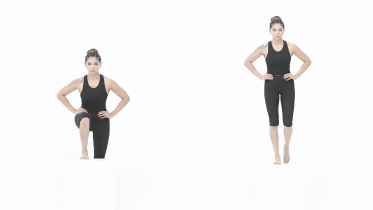 Step up
Stop signs and precautions for the step up
Before you start
- If you have had a hip or knee replacement, or other hip or knee surgery, get the go-ahead from your surgeon or physio before you try step ups. Some operations limit this kind of work for the first months, so the timing depends on your surgery. Your surgeon or physio will also tell you what step height is right for you.
- With a heart condition or high blood pressure, check with your doctor before you start.
- If you have fallen in the past year, have osteoporosis or feel unsteady on your feet, set the step beside a handrail, a kitchen counter or a sturdy chair back, keep one hand on it for every repetition, and ask your physio whether to start with step ups at all or to build up on a single stair first.
When to stop and get help
- You feel sharp pain in the knee or the knee gives way.
- Pain at the front of the knee builds with each rep.
- You feel dizzy, lightheaded, faint or sick, or the room seems to spin. Hold your support, sit down and get medical advice the same day before you practice again. If you faint, it does not settle within a few minutes of sitting still, your vision suddenly blurs or goes double, or you cannot stand or walk steadily, call emergency services.
- You feel unsteady enough that you might fall. Stop and sit down.
- Chest pain or pressure, dizziness or feeling faint, a racing or irregular heartbeat, or being far more out of breath than the effort should cause.
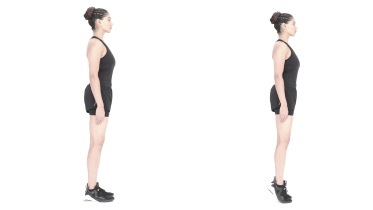 Calf raises
Stop signs and precautions for the calf raises
Before you start
- After an Achilles tendon repair or ankle surgery, calf raises usually come in at a set stage of your surgeon's protocol, often on both feet before one. Check with your physio before you start.
- After a knee or hip replacement, or other leg surgery, follow your surgeon's or physio's plan, and hold a counter or a sturdy chair back for the whole set. Rising onto your toes puts your weight forward onto a smaller base, which is where the balance goes.
When to stop and get help
- Sharp pain in the Achilles tendon, heel or arch.
- A sudden pop or snap at the back of your ankle or heel, a feeling that someone kicked you there, or sudden pain there after which you cannot push off or rise onto your toes on that leg. Stop, take the weight off that leg carefully and go to an urgent care center or emergency department the same day, even if you can still walk, as this can be a torn Achilles tendon.
- Achilles or heel pain that is clearly worse the next morning. Ease off and check with your physio.
- Your calf or thigh becomes swollen, warm, tender, red or darker than usual, or has a throbbing or cramping pain that feels different from normal muscle ache. Stop and get medical advice the same day, as this can be a blood clot. If you are also short of breath or have chest pain, call emergency services.
- Your ankle gives way, or you lose your balance.
- Since the fracture or cast, the foot or ankle is getting more painful rather than less, the skin becomes very sensitive to light touch, or the foot changes color, temperature, swelling or sweating compared with the other one, or looks shiny. See your doctor or physio as soon as you can, within a few days at most, as this can be complex regional pain syndrome (CRPS) and early treatment may help.
- You feel dizzy, lightheaded, faint or sick, or the room seems to spin. Stop, sit down and get medical advice the same day before you exercise again. If you faint, it does not settle within a few minutes of sitting still, your vision suddenly blurs or goes double, or you cannot stand or walk steadily, call emergency services.
- Chest pain or pressure, dizziness or feeling faint, a racing or irregular heartbeat, or being far more out of breath than the effort should cause.
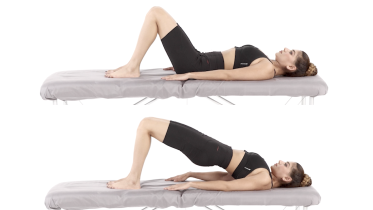 Glute bridge
Stop signs and precautions for the glute bridge
Before you start
- After hip, knee or back surgery, your surgeon's protocol decides when you can start bridges. Once you are past the first three months of pregnancy, check with your physio before exercising flat on your back.
- A bridge needs the knee bent to about 90 degrees before you lift, so if you have had knee surgery and been given a limit on how far the knee may bend, leave this one out and ask your surgeon or physio whether the bend it needs is allowed yet.
When to stop and get help
- You feel back pain rather than buttock work, even when you lift a little lower.
- Pain spreads down the leg or you get numbness or tingling.
- Your hamstrings (the back of the thighs) cramp. This is a common complaint with bridges, and bringing your feet a little closer to your bottom often eases it.
- Pain in the knee itself, or a knee that swells or is clearly more painful the next morning. The position holds the knee bent throughout, so after knee surgery stop and check with your surgeon or physio before you try it again.
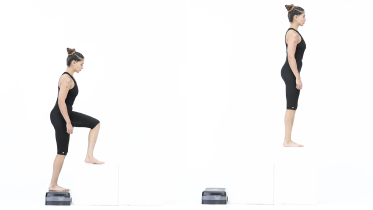 Stair climbing
Stop signs and precautions for the stair climbing
Before you start
- If you have had a hip or knee replacement, or other hip or knee surgery, get the go-ahead from your surgeon or physio before you try stair climbing. Some operations limit this kind of work for the first months, so the timing depends on your surgery.
- With a heart condition or high blood pressure, check with your doctor before you start.
- If you have fallen in the past year, have osteoporosis or feel unsteady on your feet, have someone with you for the first sessions and ask your physio whether to start on a single step.
When to stop and get help
- A sharp pain in your knee or hip, or a knee that gives way.
- The knee or hip is more swollen, or clearly more painful, the next morning. Stairs load the thigh harder than anything else in a home program, so cut the number of trips rather than pushing on, and after knee or hip surgery check with your physio before you build it up again.
- You feel unsteady or catch your foot on a step. Hold the rail, stop, and sit down on a step until you feel settled.
- Chest pain or pressure, dizziness or feeling faint, a racing or irregular heartbeat, or being far more out of breath than the effort should cause.
- You feel dizzy, lightheaded, faint or sick, or the room seems to spin. Hold your support, sit down and get medical advice the same day before you practice again. If you faint, it does not settle within a few minutes of sitting still, your vision suddenly blurs or goes double, or you cannot stand or walk steadily, call emergency services.
Is this arthrofibrosis?
Possibly, and possibly not, and the honest answer is that it is not a word you can apply to your own knee from a web page.
The international consensus definition is deliberately plain: restricted movement in bending, straightening or both, caused by soft tissue fibrosis that was not there before the operation. The same consensus excludes stiffness caused by other things, and the list is worth reading if your knee was not replaced: a bone block to movement, implants that are the wrong size or position, metal hardware, the ligament reconstruction itself, infection, pain and complex regional pain syndrome (Kalson and colleagues, 2016). Read that twice, because the exclusions are the useful part. Arthrofibrosis is what is left when the other causes have been looked for and ruled out. It is not the first explanation for a stiff knee, and it is not something a scan hands you on its own.
The same review that argues against forcing also proposes a distinction patients rarely hear: an active phase, where inflammation and new tissue are still being laid down, and a residual phase, where that process has finished and the joint is simply left stiff (Usher and colleagues, 2019). The authors are clear that more work is needed to tell the two apart. It does explain why a knee can stop changing without anything new going wrong, and why what gets offered at four months is not what gets offered at four years.
How common it is depends almost entirely on who is counting and what definition they used, which is why the numbers in the literature are so far apart. One systematic review describes it as the most common complication after ACL reconstruction and found the definitions varied widely between studies (Ekhtiari and colleagues, 2017). In one published series from two hospitals, 8 of the 166 patients who completed follow-up after an ACL reconstruction, about 5%, met those authors' definition at six weeks, which they had set as losing 15 degrees or more of straightening compared with the other knee (Rushdi and colleagues, 2019). That is the point about definitions in practice: a figure like 5% means nothing until you know what had to be true to be counted. Both of those papers are about one operation, and neither transfers to yours.
You do not need the word in order to act. A range that has stopped moving goes to your team whether anybody has called it arthrofibrosis or not.
Stiffness after an arthroscopy or a meniscus operation
This is the reader most badly served online, because almost everything written about a stiff knee after an operation is written about knee replacements.
The NHS says a joint is likely to be painful and stiff at first after an arthroscopy, and puts full recovery anywhere from around one week to several months. OrthoInfo, the patient information service of the American Academy of Orthopaedic Surgeons, lists knee stiffness among the possible complications of knee arthroscopy. Unless you had a ligament reconstruction, a meniscus repair or cartilage restoration, its figure for getting back to most everyday physical activity is 6 to 8 weeks, and sometimes a good deal sooner than that. It asks you to exercise the knee regularly for several weeks, and notes that a formal physical therapy program may improve the final result. It also gives one timing instruction that often goes unread: contact your doctor if the pain has not started to improve within a few days of the operation.
Two traps here. One is assuming a small operation means a small recovery: the keyhole scars heal fast while the joint inside them still swells, and swelling costs you range on its own. The other is reading a trim and a repair as the same operation. If the meniscus was repaired rather than trimmed, your limits on bending, kneeling and weight are usually tighter and run for longer, and they come from your surgeon, not from a general program. Meniscus tear covers that difference in more detail.
We could find no dependable figure for how often a knee stays stiff after an arthroscopy or a meniscectomy. Nobody should be giving you one, including this page.
Stiffness after an ACL reconstruction
Here the guidance is clearer, and it starts earlier than most people expect. The Aspetar guideline recommends active knee movement from immediately after surgery within the surgeon's instructions, and it recommends against routine use of machines that bend the knee for you, having found no extra benefit for movement compared with active exercise (Kotsifaki and colleagues, 2023). The same guideline lists full extension among the things to have before returning to running, and full range before returning to sport, while stating openly that there is no research supporting those particular criteria.
Timetables do exist in practice, and they are measured in weeks. One published pathway from two hospitals escalated physiotherapy at six weeks for knees that had not reached their targets, which were 90 degrees of bend and less than a 5 degree lag in straightening, and considered an arthroscopic release at twelve weeks if there was still no improvement; five of their eight affected knees had that release and regained their movement (Rushdi and colleagues, 2019). It is a retrospective report of two centers' own protocol, not a standard anyone has to follow. The reason to know it exists is that it tells you the unit of time your surgeon is thinking in, and it is not years.
One specific cause deserves naming, because it feels different from ordinary tightness. A small nodule of scar tissue at the front of the knee, known as a cyclops lesion, can block the last few degrees of straightening. In an international survey of 250 knee surgeons, symptoms typically appeared within 3 to 6 months of the reconstruction, loss of extension beyond about 5 degrees was consistently the key finding, and initial management was mostly an extension-focused rehabilitation trial before any surgery was considered (D'Ambrosi and colleagues, 2026). If your knee feels blocked, clunky or sore right at the end of straightening rather than simply tight, that is the detail to report, and it is written into the warning lines below. ACL reconstruction rehab carries the staged program.
If you are one, two or five years out, with a knee that stiffens after sitting and aches by the evening, you are reading the right section but you are not in a post-operative pathway any more, and nobody is checking your movement unless you ask. Ask for both bending and straightening to be measured and compared with your other knee. A long-settled knee that has quietly lost a few degrees is worth more attention than it usually gets, for the reasons in the straightening section above, and persistent symptoms years after an injury belong with knee osteoarthritis or patellofemoral pain, not with a stretching program you design for yourself.
Stiffness after a fracture around the knee
Two things make this group different. The bone sets the timetable, not the soft tissue, so your surgeon's instructions about weight and movement are not negotiable in the way a general exercise progression is. The review of tibial plateau complications quoted later in this section lists going onto the leg early among the reported risk factors for the bone joining in the wrong position, which is the plainest reason to hold the limit you were given even on a day the knee feels ready for more (Gálvez-Sirvent and colleagues, 2022). And the stiffness has more possible sources, because the injury affected more than the joint lining.
The readable evidence here is about one fracture in particular. A review of complications after surgery for tibial plateau fractures reports the incidence of knee stiffness as 3% to 18% depending on the series, while the need for further surgery because of it is low, 0% to 5%. It describes the causes as multifactorial, inside the joint as adhesions, inflammation and scarring, and outside it as scarring of the extensor apparatus, the skin and the surrounding soft tissue, with bone irregularity after a malunion also blocking movement. Its listed risk factors include an external fixator, an open fracture, polytrauma, fasciotomies, wound problems that meant longer in a splint, an injury to the extensor apparatus at the front of the knee, and having had more than two operations. The common thread the authors draw out is time spent not moving (Gálvez-Sirvent and colleagues, 2022).
That split between inside the joint and outside it is worth noticing, because it changes what helps. When the block is outside the joint, in the thigh muscle and the scar around it rather than in the lining of the knee, the tightness tends to feel like something tethering the front of the thigh rather than something caught inside the knee, and the bend is often worse when you are lying flat or standing than when you are sitting, because the thigh muscle is stretched over the hip as well as the knee. Stretching the joint harder does not free that kind of block, and the part of the operating list that reaches it is different. So if that is the pattern you notice, describe it to your physio or surgeon in those words rather than treating it as a reason to push harder.
Those numbers are for surgery on tibial plateau fractures. They do not describe a kneecap fracture, a thigh bone fracture or any other operation, and the point of this page is that figures from one operation should not be handed to someone who had a different one.
The same review sets out the surgical ladder by how long the stiffness has lasted: manipulation under anesthetic for early cases, under about three months; arthroscopic release once it has run longer than that, and preferably before six months have passed, though the authors add that improvement has also been reported in releases done later than that; and open release for cases that have gone beyond six months or have not responded. Two surgical papers on post-traumatic stiffness more generally put the window in the same place. One states its own practice as considering arthroscopic release between three and six months after the fracture was fixed, in knees that have lost a lot of movement (Kukreja and colleagues, 2019). The other describes arthroscopic release as the standard option from about three months after the injury, or earlier if the range has clearly stopped improving (Rinaldi and colleagues, 2024). So the figures are not tied to one fracture, but all of them are about knees stiff after an injury, and none of them describes a reconstruction or a replacement.
One thing in that literature is not about timing at all, and it is the part a healing fracture most needs to know. The review of open release says the fracture has to have healed before the knee is released, which in practice means a wait of about three to six months, and puts it as a compromise between treating the stiffness and getting the bone to join (Rinaldi and colleagues, 2024).
Read the test rather than the number. What has to be true is that the bone has joined, and three to six months is how long that usually takes rather than a date the operation is booked for. Some fractures join sooner and some take longer, and the tibial plateau review above reports that failure to join, uncommon after these fractures in general, becomes more likely after a high energy injury with a lot of damage to the blood supply and the soft tissue around it (Gálvez-Sirvent and colleagues, 2022). So it is the X-rays that move this along rather than the diary, and the question to ask at a fracture clinic appointment is whether the bone has joined yet, because that is the gate.
That is not the same as nothing being possible before then. The same review describes gentle manipulation, not a release, as an option inside three months in selected cases, and its example is narrow: a break in the shaft of the thigh bone, well away from the knee, fixed with a rod down the inside of the bone, already showing signs of uniting on X-ray, where the contracture is not yet severe and the fixation is unlikely to fail. A plate across the top of the shin bone or the lower end of the thigh bone, right beside the knee, is not that situation, because the manipulation puts its force through the fracture and the metal rather than past them. Which of those applies to your knee depends on your fracture, your X-rays and your metalwork, and it is a surgeon's call rather than a physio's.
A waiting period is also not an empty one. The part of the ladder that is not surgery is what runs inside it, so a wait for the bone to join is a reason to stay in regular contact and have the range measured while it passes, not a reason to leave the conversation until the date comes round.
Read that ladder for what it is. It is not a deadline you have to beat, and it is not a reason to force a healing knee. It is the reason a stalled range gets mentioned early, because the options that need the least surgery sit at the near end of it. A paper on surgical technique for severe post-traumatic stiffness makes the same point from the other side, that what is offered is guided by the original injury, how much movement has been lost, how long it has been since the injury, and the state of the cartilage (Kukreja and colleagues, 2019).
Stiffness after a knee replacement
If your operation was a knee replacement, this page is not your page. That situation has its own expected ranges, its own timetable for manipulation and its own infection warnings, all of which differ from the ones above. Stiff knee after a knee replacement covers the bend, the plateau and what to ask, and total knee replacement rehab carries the staged program and the doses.
How long does knee stiffness last after surgery?
Longer than the leaflet suggests and less predictably than you would like, and anybody giving you a single number for every knee operation is guessing.
The published recovery windows are wide even within one procedure, from about a week to several months after an arthroscopy on the NHS's own account, and larger operations run in months. We found no national guidance putting a date against a particular number of degrees for any of these operations. The week-by-week range targets you will meet online come from individual hospitals and surgeons, which is why two of them can contradict each other without either being wrong for its own patients.
Which is why this page keeps pushing you toward direction rather than duration. A knee that is slowly improving has time. A knee that has stopped has a question that needs answering, and the answer is not another month of the same.
What counts as a plateau, and when should you raise it?
A plateau is a range that is not bending or straightening any further from one week to the next, a knee that is getting stiffer, or movement you had and have lost. Not a bad day. Not a stiff morning. A flat line over weeks.
Two or three weekly readings that come out the same is enough to pick up the phone. You do not need a longer run than that to be taken seriously, and waiting for a longer one is how people arrive at the appointment later than they needed to.
When that is your knee, it goes to your physio or your surgeon within the next few days, not at your next routine appointment. Three separate pieces of the literature point the same way. A systematic review of treatment for arthrofibrosis after ACL reconstruction found that in studies using a step by step approach, more than half of patients were treated successfully without an operation, on mostly low level evidence (Ekhtiari and colleagues, 2017). A 2024 review of knee fibrosis after reconstruction puts non-surgical treatment in the early stages and surgery in the advanced stage (Liang and colleagues, 2024). And the fracture review above sets out a surgical ladder that gets longer the longer the stiffness has been there (Gálvez-Sirvent and colleagues, 2022).
None of that gives you a date. The windows in the literature belong to particular operations and often to single series, and nobody can tell from here where your knee sits in them. That is an argument for raising it now, not for frightening yourself: the cost of mentioning it early is one phone call, and the cost of waiting is that the easiest options are the ones that time takes away.
Make the call easy to act on. Say that the range has not changed for a stated number of weeks, because that sentence is what moves it up a list, and bring the numbers if you have them. Say whether it is the bending, the straightening or both. Mention it if the end of straightening feels blocked or clunky rather than tight. And ask who your point of contact is for rehabilitation problems if nobody has told you, because that question is harder to answer later.
Manipulation and release: what they are and when they are considered
These come up early in any search, usually in frightening form, so it helps to know what they actually are.
A manipulation under anesthetic means the surgeon moves your knee through its range while you are asleep or numb from the waist down, to free tissue that has tightened. A release, also called an arthrolysis or a lysis of adhesions, is keyhole surgery to divide that tissue under direct vision. An open release is not simply the bigger version of that. It is for the tissue a camera inside the joint cannot reach, chiefly the thigh muscle and its tendon stuck down to the healing bone and to the scarred tissue outside the joint, which is why a surgeon tries to work out where the block actually is before choosing (Rinaldi and colleagues, 2024). Which one is considered, if any, depends on your operation, how much movement has been lost, how long it has been lost, and what else is going on in the joint (Kukreja and colleagues, 2019).
Both are operations rather than stretches under another name, and they carry the risks of operations. A review of knee fibrosis after ACL reconstruction lists nerve and blood vessel problems, fractures and loosening of ligaments among the reported complications of manipulation and release (Liang and colleagues, 2024). In knees stiff after an injury the reported risks of a manipulation are listed as a fracture, failure of the metalwork holding a fracture, a torn tendon and damage to the cartilage, which is one reason a surgeon weighs the date against the X-rays rather than the calendar (Rinaldi and colleagues, 2024; Kukreja and colleagues, 2019). The same review says manipulation is offered less often than it used to be, for those reasons, so if yours is not offered that is not somebody being slow about it. That is also the clearest answer to anyone offering to do something similar to your knee without an anesthetic and without an operating room.
Most stiff knees never get this far. In the systematic review above, more than half of the patients in step by step programs did not need an operation at all, and in that two-hospital ACL series, 5 knees out of the 166 followed up went on to a release (Ekhtiari and colleagues, 2017; Rushdi and colleagues, 2019). The published evidence behind all of it is mostly small and retrospective, which your surgeon will be weighing along with your knee, your imaging and what you need the knee to do.
This next part frightens people who were not told about it beforehand. The movement won in the operating room is not the movement you keep. In a systematic review of open release for knees stiff after injury, every one of the thirteen included studies reported some loss of bend from the immediate post-operative period onward, averaging about 13 degrees by the first check and a couple more degrees by final follow-up, while still leaving an average bend above 90 degrees (Rinaldi and colleagues, 2024). A surgical paper on arthroscopic release with manipulation says the same thing more bluntly, that even with routine therapy the early gains may not be maintained, and that controlling pain well enough for the person to do the exercises is what turns movement gained under anesthetic into movement they still have months later (Stiefel and McIntyre, 2017). So the days and weeks straight afterward are the part that decides the result, and a knee that keeps closing up is reported rather than waited out.
If you cannot tell whether yours has eased back and settled or is still closing, say so rather than deciding alone. It is a question about two measurements a week apart, and it is far easier to answer at two weeks than at two months.
If you have already had one of these procedures, your team's plan for the weeks afterward replaces this page, and the warning lines below include the two that matter most in those weeks.
When to see a physio or surgeon
Get in touch within a few days if your bending or straightening has not changed from week to week, if you are losing movement you had, if the knee feels blocked at the end of straightening, or if pain is stopping you doing the exercises you were given. Get in touch sooner than that, the same day, for anything in the warning list on this page.
It is also reasonable to ask for help at the start rather than at the point of frustration. If nobody has measured your knee, if nobody told you what range to expect for your operation, or if you do not know who to contact when rehabilitation stalls, those are all fair things to ask for at any appointment. If your problem is pain on bending rather than lost bend, knee pain when bending covers the wider picture.
This page is education rather than advice about your knee. Your surgeon and physio have seen your operation, your imaging and your leg, and their plan comes first.
For physiotherapists
The triage that matters on this page is the three-way one, and it is worth making explicit with patients: position-dependent stiffness that resolves with movement, a deficit that is improving on serial measurement, and a plateau or regression. Only the third changes the plan, and only serial measurement at a consistent time of day distinguishes the second from the third.
Give extension its own goal and its own progression rather than treating it as a by-product of flexion work. Shelbourne and Gray's long-term cohort is the argument for holding that line early, and the cyclops survey is the reason to examine the end-range feel rather than only the number (Shelbourne and Gray, 2009; D'Ambrosi and colleagues, 2026). An end-range block, clunk or pain, as distinct from a capsular stretch, is a referral finding.
In the post-traumatic group, separate the intra-articular block from the extra-articular one before deciding how much more range work is reasonable. The same review divides it that way: adhesions, hypertrophic fibrous tissue and a thickened capsule inside the joint, against quadriceps adherent to fracture callus, the aponeurosis and the intermuscular septum, muscle retraction and deep skin adhesions outside it, and says the source of the stiffness determines which procedure is performed (Rinaldi and colleagues, 2024). It matters at the bedside too. An extra-articular contracture, with the deficit worse when the hip is extended than when it is flexed, and a quadriceps that will not glide, does not respond to intra-articular stretching however long you persist, and that pattern earns a surgical opinion rather than another block of therapy. Fixation state belongs in the same conversation, because the union requirement, not the calendar, is what gates a release, and one of the published risks of manipulation in this group is implant failure with loss of reduction, reported where the knee was moved before the fracture had healed (Rinaldi and colleagues, 2024; Gálvez-Sirvent and colleagues, 2022).
Keep complex regional pain syndrome on the list in the post-traumatic group rather than at the end of it. The consensus definition excludes it as a cause of stiffness, and the systematic review of open release says plainly that it is important to identify, that it is hard to separate from post-traumatic stiffness because the two are often interlinked, and that surgery is deferred until the quiet phase if it does not settle on its own (Kalson and colleagues, 2016; Rinaldi and colleagues, 2024). Allodynia, and asymmetry of temperature, sweating or skin appearance, carry more weight here than the range figure does, and they are the one presentation where more stretch is the wrong answer.
Three points for the referral conversation. Reported rates of arthrofibrosis are not comparable across studies because the definitions are not, so a number quoted at a patient needs its definition attached (Kalson and colleagues, 2016; Ekhtiari and colleagues, 2017). The consensus also grades the loss as mild, moderate or severe by degrees of flexion or extension deficit; those bands are research classification and are deliberately not printed here, because "mild" read off a web page is a permission, and the same page cites a cohort in which 3 to 5 degrees of lost extension changed long-term scores (Kalson and colleagues, 2016; Shelbourne and Gray, 2009). And the intervention windows are procedure specific: the post-traumatic ladder, which three of the sources above put in roughly the same place (Gálvez-Sirvent and colleagues, 2022; Kukreja and colleagues, 2019; Rinaldi and colleagues, 2024), does not transfer to a reconstruction or an arthroplasty, the arthroplasty window does not transfer back, and neither should be used to reassure a patient whose operation it does not describe.
Warning signs
Get emergency help now
- Emergency: sudden, severe pain in your lower leg that is much worse than you would expect, especially after an operation on the leg or with a tight bandage or brace on the leg. It may come with a tight, swollen leg, pain that gets worse when the muscle is stretched, numbness, pins and needles or weakness, or pain that keeps building and is not settled by painkillers that were working before. Call emergency services or go to an emergency department straight away, and do not drive yourself. This can be acute compartment syndrome, which needs urgent surgery.
- Emergency: since your operation, you suddenly become short of breath, you get chest pain or pain in your upper back that may be worse when you breathe in, you cough up blood, your heart is beating very fast, or you faint. Call emergency services straight away, even if your leg looks normal. These can be signs of a blood clot in the lungs (pulmonary embolism).
- Emergency: your foot became weak or numb at the moment of a new injury to the operated leg, for example a fall, a twist, or the knee giving way or shifting out of place, so that your foot drags, catches on the ground or slaps down when you walk (foot drop), you cannot pull your foot or toes upward, or the top of your foot has lost feeling. Go to an emergency department straight away, and do not drive yourself: ask someone to drive you, or call emergency services if you cannot get up or the leg looks out of shape. This is a different situation from a foot that has been weak since your operation itself, which goes to your surgical team the same day, and it is not one to watch at home overnight to see whether it gets worse. A foot that is weak or numb from the moment of an injury points to a bigger injury than the graft on its own, the kind where the joint has shifted out of place, and in those the artery behind the knee has to be checked on the day as well as the nerve, because a missed artery injury is the one that costs the leg (Medina and colleagues, 2014).
Get help now, day or night
- In a knee immobilizer, brace or cast, the pain gets worse, your foot or toes feel numb, tingle or burn or look more swollen, or the device feels too tight. Stop, lie down and rest the leg with the foot at about hip level and no higher, keep moving your toes and contact your surgical team or fracture clinic or get medical advice straight away. If you wear a brace with straps, loosen the straps but keep it on. Do not prop the leg higher than that and do not put ice on it, because if pressure is building up inside the leg both of those cut down the blood reaching your foot. If you cannot move your toes, the pain is severe even after painkillers, or the numbness, tingling, burning or swelling has not settled within 30 minutes, go to your fracture clinic or an emergency department straight away, and do not drive yourself.
- Since your manipulation under anesthetic, you have severe pain in the knee or thigh, you cannot put weight on the leg, you cannot straighten the knee or lift the leg straight when you could straight after the procedure, the leg looks a different shape, or the knee is heavily bruised, swollen or tight. A manipulation works by stretching and tearing tissue that has tightened, and although problems are uncommon, they are more likely while a fracture is still healing: the bone around the knee can break, the tendon at the front of the knee can be damaged, and the plate, screws or nail holding a healing fracture can loosen, pull out of the bone or break, so that the fracture shifts out of position. Contact your surgical team straight away, day or night, and if you cannot reach them, go to an emergency department the same day. Keep your weight off the leg until you have been seen.
Get help today
- Same day: a calf or thigh that is newly swollen or getting more swollen, warm, tender, red or darker than usual, has swollen veins that are sore to touch, or has a throbbing or cramping pain that does not fit your injury or condition, or that feels different from normal muscle soreness after exercise. This can be a sign of a blood clot (deep vein thrombosis), especially after surgery, an injury, time in a cast or boot, a long trip or a spell of being much less mobile than usual. Get medical advice the same day. If you are also short of breath or have chest pain, call emergency services.
- Same day: since your operation, your wound is oozing, leaking or has pus coming out of it, or its edges start to come apart, or your knee is tender, swollen, painful or red and it is not getting better or is getting worse, or you have a high temperature or feel hot and cold or shivery. Redness can be harder to see on brown or black skin. Contact your surgical team the same day, or get urgent medical advice if you cannot reach them. These can be signs of an infection in the wound or the knee joint. If you feel very unwell, go to an emergency department. If you have a very high or very low temperature, shivering you cannot control, you are breathing very fast or finding it hard to breathe, you are confused or your speech is slurred, your skin, lips or tongue look blue, gray, pale or blotchy (on brown or black skin this can be easier to see on the palms of the hands or soles of the feet), or you have a rash that does not fade when you press it, call emergency services, as this can be sepsis.
- Same day: your knee swells up quickly over a few hours and feels tight and full, with more pain than the day before, and there was no fall, twist or pop to explain it. This can happen while your temperature is normal and the wound looks fine. Contact your surgical team the same day, or get assessed the same day at urgent care or an emergency department if you cannot reach them. Bleeding into the joint and an early infection inside the joint can both look like this from the outside, and a knee that is hot to touch, or a temperature alongside it, makes an infection more likely. Do not wait for a call back if either is there. If you feel very unwell, go to an emergency department.
- Same day: since your operation, the pain in your knee is getting worse rather than slowly easing, or it has not started to improve at all within a few days of the operation, including pain at night or at rest that wakes you. Contact your surgical team or your doctor the same day, even if the wound looks fine, you have no temperature and the knee is not red. OrthoInfo's instruction after a knee arthroscopy is to talk to your doctor if your pain has not begun to improve within a few days of surgery, and pain that climbs instead of settling is one of the ways an infection inside the joint shows itself before anything else looks wrong.
- Same day: your knee gives way, or you feel a pop, a shift or a twist inside it, and it swells up within a few hours or is very painful. Keep your weight off it and contact your surgical team, or get assessed the same day at urgent care or an emergency department. A fall or a twist can damage the new ligament (graft) or a meniscus repair. If the knee looks out of shape, or your foot turns numb, cold or pale, go to an emergency department straight away, and do not drive yourself. If the knee only feels a little unsteady now and then, with no swelling or pain, it is not an emergency, but tell your physio or surgeon in the next few days. If your foot also went weak or numb from that moment, so that it drags or catches or you cannot pull your foot or toes upward, follow the emergency line above about a foot that is weak after a new injury and go to an emergency department instead of waiting for your team.
- Same day: after a fracture around the knee that was fixed with metal, standing on the leg is getting more painful rather than less, you can no longer put through it the weight you could a week ago, the knee or lower leg looks as though it is turning inward or outward or getting shorter compared with before, or you feel or hear a new grinding or clunking deep in the leg when you move or stand on it. Keep your weight off the leg and contact your surgical team or fracture clinic the same day. The metal only holds the bone while the bone joins, and the fixation can loosen or the fracture can settle out of position, which is why your surgeon's limit on how much weight to put through the leg is not a cautious suggestion: going onto the leg early is among the reported risk factors for the bone joining in the wrong position (Gálvez-Sirvent and colleagues, 2022).
- Same day: the knee is locked, which means it is stuck bent and you cannot straighten it, even after gently trying to move it, or it suddenly will not bend or straighten as far as it did before. Contact your surgical team, or get assessed the same day at urgent care or an emergency department. A torn piece of meniscus can get caught in the joint and block it. This is different from the slow, gradual stiffness of the early weeks.
- Same day: you suddenly cannot straighten your knee by yourself or lift your leg straight when you could before, often after a pop, a fall or a stumble, or you notice a dip or a gap just above or below your kneecap. Keep your weight off it and contact your surgical team, or get assessed the same day at urgent care or an emergency department. After a patellar tendon or quadriceps tendon graft, the tendon or the kneecap near where the graft was taken can rarely tear or break. It is not only grafts: the tendons above and below the kneecap, and the kneecap itself, can also give way after a fracture around the knee, after an operation on the front of the knee, or during a manipulation or a release.
- Same day: a leg or foot that is getting weaker, for example your foot drags, catches on the ground or slaps down when you walk (foot drop). Get medical advice the same day. If the weakness is getting worse by the hour, go to an emergency department.
- Same day: new numbness, tingling or burning in your lower leg or foot, beyond the numb patch of skin near your scars. Contact your surgical team or get medical advice the same day. If it started after a fall or an injury, or your foot or toes turn cold, pale, blue or gray, call emergency services or go to an emergency department straight away, and do not drive yourself.
Book an appointment
- Within a few days: since your manipulation under anesthetic, the knee is stiffening up again and has lost movement it had gained, or pain is stopping you doing the exercises you were given. Contact your physio or surgical team within the next few days rather than waiting for your next appointment. The movement the surgeon gains is held on to by moving the knee in the days and weeks straight afterward, so a knee that is closing up again is worth telling them about early. Some of the range gained during the procedure is normally lost before it settles, so this is about a knee that keeps closing up rather than one that has eased back a little.
- Within a few days: your knee will not straighten as far as the other one, or will not bend as far as your physio expects, and it is not improving from week to week, or it is slowly losing movement it had. This is not an emergency, but contact your physio or surgeon within the next few days, and tell them if the knee feels blocked at the very end of straightening, or clunks or hurts there, rather than simply feeling tight. Getting the knee fully straight is one of the first aims of rehab, and stretching harder is not the answer. A knee that is stuck bent and will not straighten however gently you try is a different problem, and it has its own warning above.
- Within a few days: since your operation or injury, the knee or lower leg is getting more painful rather than less, often with a burning pain that feels far worse than the operation would explain, the skin becomes very sensitive to light touch, bedclothes or a change in temperature, or the leg changes color, temperature, swelling or sweating compared with the other one, or looks shiny. See your doctor or physio as soon as you can, within a few days at most, as this can be complex regional pain syndrome (CRPS) and early treatment may help.
- Within a few days: pain at night or at rest that keeps getting worse. See your doctor within a few days. If you have had cancer, now or in the past, see your doctor sooner, within a day or two, and mention it, even if the pain is not getting worse. Do the same if you have knee pain and are losing weight without trying, even if it does not hurt at night. If you are being treated for cancer now, contact your cancer team the same day.
Common questions
How long does knee stiffness last after surgery?
It depends on the operation, and the honest range is wide. The NHS says recovery from an arthroscopy takes from around one week to several months, and that the joint is likely to be painful and stiff at first; after bigger knee operations the stiffness is measured in months rather than weeks. No page can tell you your own number, because nothing published puts a date against a degree of movement for these operations. The more useful question is which direction your knee is going. Improving slowly is a different situation from not improving at all, and that difference is what the warning signs on this page are built around. A range that has stopped changing, or one that is going backward, goes to your physio or surgeon within the next few days, whichever month after the operation you are in.
Why can my knee not bend after surgery?
In the early weeks, usually because three things are limiting it together: fluid inside the joint, tissue that is in the middle of healing, and a thigh muscle the operation has temporarily put out of action. All three improve, which is why the bend tends to follow them. Something is outside that picture if the bend has stopped changing from week to week, is going backward, or the knee is getting stiffer rather than looser, and that is the version to raise with your team. A knee that is stuck bent and will not straighten at all, however gently you try, is a different problem again and is in the warning signs on this page as a same day call.
Can you break up scar tissue in a knee yourself?
No, and trying is how people set themselves back. A weight hung from the shin, a helper pressing down on the knee, or a session you grit your teeth through will not bring the bend back any faster. A review of arthrofibrosis across joints argues the opposite way: that exercise sets off an inflammatory response, that aggressive exercise can start or worsen the problem, and that the intensity has to be matched to how much inflammation it produces (Usher and colleagues, 2019). Tissue does get divided deliberately in one place only, which is an operating room, by a surgeon controlling where the force goes. At home the work is frequent, unforced movement, with swelling and pain kept under control, and a knee that has stopped moving needs assessing rather than overpowering.
Is knee stiffness two years after ACL surgery normal?
A knee that is stiff after sitting and aches more as the day goes on is a common story years after a reconstruction, but common is not the same as nothing to look at, and two years out you are no longer on a post-operative pathway where somebody is checking. The point worth knowing is that small losses of movement show up in long-term results: in 502 people followed for a mean of 14 years after an ACL reconstruction, the strongest factor linked to lower patient-reported scores was not having normal knee extension, and losses of around 3 to 5 degrees compared with the other knee were enough to matter, especially in people who had also had part of a meniscus removed or had cartilage damage (Shelbourne and Gray, 2009). So it is worth an assessment rather than a stretching program you design yourself. Ask for your movement to be measured and compared with the other side, both bending and straightening.
What happens if you cannot bend your knee after surgery?
The first step is assessment, not a bigger stretch, because several of the things that block a knee cannot be changed by exercise and some of them need treating in their own right. A systematic review of treatment for arthrofibrosis after ACL reconstruction found the published options included physiotherapy, arthroscopic arthrolysis, manipulation under anesthesia, oral steroids, casting and injections, that the evidence was mostly low level, and that in the studies which used a step by step approach more than half of patients were treated successfully without an operation (Ekhtiari and colleagues, 2017). That is the reason to raise a stalled knee early rather than late: the part of the ladder that avoids surgery sits at the bottom of it.
References
- Kalson NS, Borthwick LA, Mann DA, et al. International consensus on the definition and classification of fibrosis of the knee joint. The Bone and Joint Journal. 2016;98-B(11):1479-1488. https://doi.org/10.1302/0301-620X.98B10.37957
- Usher KM, Zhu S, Mavropalias G, Carrino JA, Zhao J, Xu J. Pathological mechanisms and therapeutic outlooks for arthrofibrosis. Bone Research. 2019;7:9. https://doi.org/10.1038/s41413-019-0047-x
- Ekhtiari S, Horner NS, de Sa D, et al. Arthrofibrosis after ACL reconstruction is best treated in a step-wise approach with early recognition and intervention: a systematic review. Knee Surgery, Sports Traumatology, Arthroscopy. 2017;25(12):3929-3937. https://doi.org/10.1007/s00167-017-4482-1
- Shelbourne KD, Gray T. Minimum 10-year results after anterior cruciate ligament reconstruction: how the loss of normal knee motion compounds other factors related to the development of osteoarthritis after surgery. American Journal of Sports Medicine. 2009;37(3):471-480. https://doi.org/10.1177/0363546508326709
- Kotsifaki R, Korakakis V, King E, et al. Aspetar clinical practice guideline on rehabilitation after anterior cruciate ligament reconstruction. British Journal of Sports Medicine. 2023;57(9):500-514. https://doi.org/10.1136/bjsports-2022-106158
- Rushdi I, Sharifudin S, Shukur A. Arthrofibrosis following anterior cruciate ligament reconstruction. Malaysian Orthopaedic Journal. 2019;13(3):34-38. https://doi.org/10.5704/MOJ.1911.006
- Liang Y, Zhang Q, Fan Y. Research progress of knee fibrosis after anterior cruciate ligament reconstruction. Frontiers in Pharmacology. 2024;15:1493155. https://doi.org/10.3389/fphar.2024.1493155
- D'Ambrosi R, Helito CP, Della Villa F, et al. Practice patterns, controversies, and proposed management algorithm for cyclops syndrome after anterior cruciate ligament reconstruction: an international survey. Journal of ISAKOS. 2026;19:101165. https://doi.org/10.1016/j.jisako.2026.101165
- Gálvez-Sirvent E, Ibarzábal-Gil A, Rodríguez-Merchán EC. Complications of the surgical treatment of fractures of the tibial plateau: prevalence, causes, and management. EFORT Open Reviews. 2022;7(8):554-568. https://doi.org/10.1530/EOR-22-0004
- Kukreja M, Kang J, Curry EJ, Li X. Arthroscopic lysis of adhesions and anterior interval release with manipulation under anesthesia for severe post-traumatic knee stiffness: a simple and reproducible step-by-step guide. Arthroscopy Techniques. 2019;8(5):e429-e435. https://doi.org/10.1016/j.eats.2019.01.005
- Rinaldi VG, Sassoli I, Fogacci A, et al. Old but gold: is the Judet procedure still a viable option for posttraumatic knee stiffness in 2024? A comprehensive systematic review and meta-analysis. Journal of Experimental Orthopaedics. 2024;11(4):e70079. https://doi.org/10.1002/jeo2.70079
- Stiefel EC, McIntyre L. Arthroscopic lysis of adhesions for treatment of post-traumatic arthrofibrosis of the knee joint. Arthroscopy Techniques. 2017;6(4):e939-e944. https://doi.org/10.1016/j.eats.2017.03.001
- Medina O, Arom GA, Yeranosian MG, Petrigliano FA, McAllister DR. Vascular and nerve injury after knee dislocation: a systematic review. Clinical Orthopaedics and Related Research. 2014;472(9):2621-2629. https://doi.org/10.1007/s11999-014-3511-3
- American Academy of Orthopaedic Surgeons. Knee arthroscopy. OrthoInfo. https://www.orthoinfo.org/en/treatment/knee-arthroscopy/
- NHS. Arthroscopy. Page last reviewed 7 September 2026. https://www.nhs.uk/conditions/arthroscopy/
Written and checked by the PocketPhysio editorial team. Last updated 2026-11-02.
This page is general education, not a diagnosis or a personal treatment plan. See a physiotherapist or doctor for advice about your own situation.