
Knee pain when bending: causes, exercises and when to get help
Why does my knee hurt when I bend it?
Bending asks a lot of the joint behind the kneecap. As you bend with weight on the leg, the kneecap is pressed into a groove at the end of the thigh bone, and a review of squat research found that this pressure rises as the bend deepens (Escamilla, 2001). So crouching to a low cupboard, kneeling or getting up from a deep sofa often hurts first. The same knee may cope well with a flat walk, which needs far less bend.
Three things narrow it down: where it hurts, which bend sets it off, and whether it started with an injury. A physio will ask about these first, so it helps to have the answers ready.
What causes knee pain when bending?
Only an examination can tell which of these fits you. What follows are the patterns that tend to point to each, so you know what to mention when you get your knee checked.
Ache around or behind the kneecap: patellofemoral pain
Patellofemoral pain is an ache around or behind the kneecap. The international definition says at least one activity that loads the bent knee while you stand on it, such as squatting, stairs, running or jumping, makes it worse (Crossley and colleagues, 2016). Pain during a long sit, when you rise from a chair, or when you straighten the leg after sitting supports the picture. According to OrthoInfo, it can also make kneeling down hard, and some people hear popping or crackling on the stairs. The US physical therapy guideline describes pain that usually builds gradually, without one clear injury, though it can also start more quickly (Willy and colleagues, 2019).
Catching, locking or a bend that will not finish: meniscus tear
The meniscus is a rubbery pad of cartilage that cushions the joint between the thigh bone and the shin bone. The NHS lists pain or tenderness, stiffness or swelling, trouble bending or straightening the knee, a knee that gives way, and a crunching or clicking feeling among the symptoms of a tear. OrthoInfo also mentions catching or locking, and a knee that cannot move through its full range. Tears typically come from twisting the knee in sport, although a minor twist while standing up can be enough (NHS).
In adults aged about 36 to 60 with a wear-related (degenerative) tear, a trial of 140 people found that supervised exercise gave knee function similar to keyhole surgery over 2 years, and stronger thighs at 3 months (Kise and colleagues, 2016). The meniscus tear page covers who should be seen early instead.
Stiffness in a knee over 45: knee osteoarthritis
NICE advises that knee osteoarthritis can be diagnosed without an X-ray in people aged 45 or over with joint pain linked to activity and either no morning stiffness or stiffness that lasts no longer than 30 minutes. The NHS describes pain and stiffness that are worse after the joint has been still for a while, a reduced range of movement, and a grating or crackling feeling. In practice, kneeling or getting down to the floor is often where the knee first feels stiff and sore. NICE recommends exercise tailored to the person, such as local muscle strengthening and general aerobic fitness, for everyone with osteoarthritis.
Pain just below the kneecap: patellar tendinopathy
The patellar tendon links the lower edge of the kneecap to the top of the shin bone. With patellar tendinopathy, pain sits at the lower tip of the kneecap and grows the harder the thigh muscles have to work, most of all when jumping and landing (Malliaras and colleagues, 2015). A gentle bend to sit down may barely register. A loaded bend, such as a heavy squat or springing up out of a crouch, is what brings it on.
Tightness behind the knee on a full bend: Baker's cyst
A Baker's cyst is a fluid-filled lump at the back of the knee, and the NHS lists knee pain, tightness, stiffness and difficulty bending among its symptoms. It is commonly found alongside a problem inside the knee, such as osteoarthritis or a meniscus tear (Frush and Noyes, 2015). The same review describes pain at the very end of a bend or a straighten, and says a large cyst can physically block a full bend. Its authors advise nonsurgical care first, with rehab that keeps the knee flexible, because pain at the ends of the range can otherwise leave the knee stiff.
A warm, swollen knee after kneeling: bursitis
Small fluid-filled cushions (bursae) sit around the knee, and one of them can become inflamed. In the NHS description, a knee with bursitis is warm and red. It hurts and swells more when you kneel or bend. To stop it coming back, the NHS suggests padding when you kneel and regular breaks from kneeling, and it advises seeing a GP if bursitis has not improved, or is getting worse, after 1 to 2 weeks of self-care. A bursa can also become infected, so if the knee is hot, red and swollen, or you have a high temperature or feel hot, cold or shivery, follow the infection warning sign below.
Why can't I bend my knee all the way?
Losing the last part of the bend is common with several of these problems. A meniscus tear can stop the knee moving through its full range (OrthoInfo), osteoarthritis limits how far the joint moves (NHS), and a large Baker's cyst can get in the way at the back (Frush and Noyes, 2015). Stiffness after an operation or a long spell in a brace is a different story, and your surgical team's plan comes first there.
How it came on is what decides the urgency. A knee that has slowly stiffened over weeks is a reason to book a physio. A knee that suddenly will not bend or straighten after a twist, or that blows up with swelling, needs checking the same day or sooner, as the warning signs below explain.
Pain at the back or inside of the knee when bending
Fullness and aching at the back or back-inner corner of the knee are the typical complaints with a Baker's cyst (Frush and Noyes, 2015). Pain at the back of the knee with a calf that is also swollen, warm or red is not something to wait on, because a blood clot has to be ruled out.
Pain on the inner side has several possible sources. The pes anserine bursitis page explains how a sore spot on the upper inner shin differs from pain in the joint itself.
What helps knee pain when bending at home
When the pain first starts, the NHS suggests keeping weight off the knee as much as you can, for example by not standing for long. It also suggests a towel-wrapped ice pack on the knee for up to 20 minutes every 2 to 3 hours, and paracetamol (acetaminophen) or ibuprofen if they suit you. Once the worst has passed, keep the knee moving. Bend it as far as is comfortable several times a day instead of holding it straight to protect it.
Change the bends that flare it for a few weeks rather than cutting out bending. A higher chair or a firm cushion on a low sofa takes some of the bend out of sitting down. Break up long sits and long drives by stopping to straighten the leg or stand up. That is when kneecap pain tends to build.
If your work or hobbies mean kneeling, use a kneeling pad and take breaks. For patellofemoral pain, OrthoInfo suggests swapping some running or jumping for lower-impact options such as a stationary bike, an elliptical machine or swimming for a while.
Strength is the longer-term answer. The 2018 international consensus supports exercise for patellofemoral pain, and it favors combining hip and knee exercises (Collins and colleagues, 2018). NICE recommends exercise for osteoarthritis too.
Mild discomfort while you exercise is usually acceptable if it has settled by the next morning. If the pain turns sharp, or the knee is sorer or puffier the next day, that session was too much. Our guide to the pain monitoring model explains how physios judge this.
Exercises that can help
Start with the two bending exercises, then add the strength work as the knee calms down. The bending ones often begin at 10 to 15 slow reps, 2 or 3 times a day, and most of the strength ones at 2 to 3 sets once a day, with quad sets done little and often. Each exercise page gives its own starting dose, and your physio will adjust this to your knee.
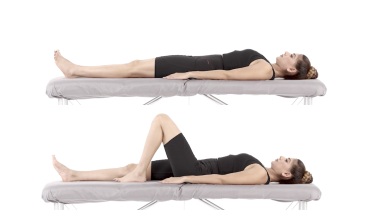 Heel slides
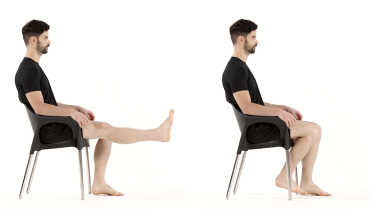 Seated knee bend
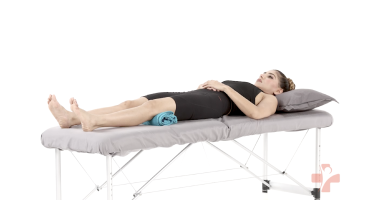 Quad sets (towel under knee)
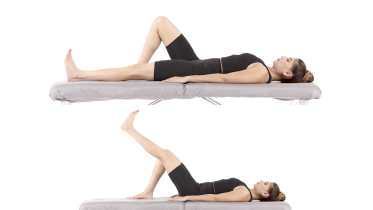 Straight leg raise
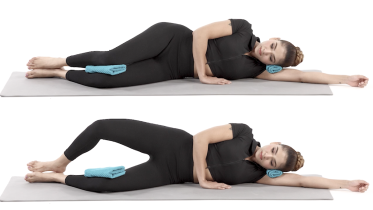 Clamshell
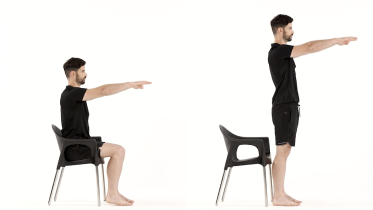 Sit to stand
Heel slides and the seated knee bend work on the bend itself, with no body weight on the knee. Quad sets and straight leg raises wake up the big muscle at the front of the thigh (quadriceps). The clamshell trains the side of the hip, which may help control the knee. Sit to stand then puts the pieces together in a movement you use all day. On the bending exercises, stop each rep where the discomfort starts rather than pushing into the last, sore part of the range.
Gym squats bring their own questions, such as how deep to go and where the knees should point. The page on knee pain when squatting covers those.
When to see a physio or doctor
Book a physio (physical therapist) or doctor if a few weeks have gone by without improvement (NHS), if the knee is stopping you sleeping, working or doing your sport, or if you cannot tell which pattern fits you. A physio will ask how it started and watch how you bend and squat. They will also feel around the kneecap, the joint line and the back of the knee. A scan is often not the first step, and for osteoarthritis with a typical pattern NICE says it is not needed to make the diagnosis.
If you have had knee surgery or a knee replacement, the plan your surgeon and physio gave you comes before anything on this page. Children and teenagers who are still growing need a doctor or physio to check the knee before they start an exercise program. The warning signs below each come with a time frame, from an emergency visit to an appointment within a few days.
Related exercise programs
See a doctor promptly if
- Emergency: you felt a sudden pop or tearing feeling just above or below your kneecap, you can see or feel a dip there, the kneecap seems to have moved up toward the thigh or to sag lower than usual, or you suddenly cannot straighten your knee or lift your leg out straight. Stop exercising and go to an emergency department straight away, even if you can still walk, as this can be a torn tendon at the front of the knee, either below the kneecap (patellar tendon) or above it (quadriceps tendon). Do not drive yourself. A repair usually does better if it is done soon after the injury.
- Same day: the pain started with a fall, a twist or a blow to the knee, or you cannot put weight on the leg. Get medical advice the same day. If the knee has changed shape, swelled up very quickly or you felt a pop or snap, or your foot turns cold, pale or blue or you have tingling or no feeling in the leg or foot, go to an emergency department straight away, and do not drive yourself.
- Same day: the kneecap has slipped out of place, even if it went back by itself. If it is still out of place, go to an emergency department straight away, and do not drive yourself. If it went back by itself, get medical advice the same day.
- Same day: the knee is locked, which means it is stuck bent and you cannot fully straighten it, even after gently trying to move it, or you cannot bend or straighten the leg at all. Get assessed the same day by a doctor, at urgent care or at an emergency department. A torn piece of meniscus can get caught in the joint and block it, and when a tear like this can be repaired, it should be done as early as possible. A knee that catches for a moment and then frees itself can happen with a meniscus tear. That is not the same as a locked knee, but tell your physio or doctor about it.
- Same day: the knee keeps giving way under you, or it gave way after a recent injury, or it gives way and is also very painful or swollen. Get medical advice the same day. If it only happens now and then, with no recent injury and no swelling, it is not an emergency, but book an assessment with a physio or doctor in the next few days.
- Same day: the knee clicks painfully when you bend or straighten it. Get medical advice the same day. Painless clicking on its own is common.
- Same day: the knee swells up with no clear reason, especially if you take medicine to thin your blood. Get medical advice the same day.
- Same day: the knee is hot, red and swollen, or you have knee pain with a high temperature or feel hot, cold or shivery. Get medical advice the same day, and go to an emergency department if you feel very unwell. This can be a sign of infection in the joint, which needs treatment quickly.
- Same day: a calf or thigh that is newly swollen, warm, tender, red or darker than usual, has swollen veins that are sore to touch, or has a throbbing or cramping pain that does not fit your injury or condition, or that feels different from normal muscle soreness after exercise. This can be a sign of a blood clot (deep vein thrombosis), especially after surgery, an injury, time in a cast or boot, a long trip or a spell of being much less mobile than usual. Get medical advice the same day. If you are also short of breath or have chest pain, call emergency services.
- Emergency: sudden, severe pain in your calf that is much worse than you would expect or keeps getting worse, especially if you take medicine to thin your blood. It may come with a tight, swollen calf, pain that gets worse when the muscle is stretched, numbness, pins and needles or weakness. Call emergency services or go to an emergency department straight away, and do not drive yourself. Rarely, bleeding from a burst cyst builds up pressure inside the calf (compartment syndrome), which needs urgent surgery.
- Same day: pain or swelling in your calf or leg that suddenly gets worse, or new bruising on your leg, even if you know you have a Baker's cyst. Get medical advice the same day. A burst cyst and a blood clot can look exactly the same, and a doctor may need a scan to tell them apart. Do not assume it is the cyst.
- Same day: new numbness, pins and needles or weakness in your calf or foot. Get medical advice the same day, as a large cyst can rarely press on a nerve. If your foot turns cold, pale or blue compared with the other side, go to an emergency department straight away, and do not drive yourself.
- Within a few days: a lump behind your knee that no doctor has checked, or a lump that is getting bigger or feels hard. See your doctor within a few days. Most lumps here are Baker's cysts, but other problems can look similar, so it is worth confirming what it is.
- Within a few days: pain at night or at rest that keeps getting worse. See your doctor within a few days. If you have had cancer, now or in the past, see your doctor sooner, within a day or two, and mention it, even if the pain is not getting worse. Do the same if you have knee pain and are losing weight without trying, even if it does not hurt at night. If you are being treated for cancer now, contact your cancer team the same day.
- Same day: you are a teenager who is still growing and you have a limp, or pain in the hip, groin or thigh as well as the knee. Get an urgent appointment with a doctor the same day, and stay off sport and these exercises until you have been checked. If you cannot put weight on the leg, have a high temperature or feel very unwell, go to an emergency department. Some hip problems in growing teenagers, such as a slipped growth plate at the top of the thigh bone (slipped capital femoral epiphysis), are felt in the knee and need checking quickly.
- Within a day or two: you are still growing and have pain that wakes you at night, pain at rest that keeps getting worse, or a lump or swelling around the knee or thigh that keeps growing. See a doctor within a day or two. Do the same if the pain comes with looking pale, unusual tiredness, fevers with no clear cause, bruising or bleeding easily, or weight loss. If you also have a rash that does not fade when you press it, call emergency services or go to an emergency department. Bone pain that is worse at night, or a new lump, needs checking to rule out rarer causes such as a bone tumor or a blood cancer (leukemia).
Common questions
Why does my knee hurt when I bend it but not when I walk?
A walk on flat ground asks the knee for only a modest bend, while crouching, kneeling or rising from a low seat ask for a lot more, with your body weight on top. The pressure behind the kneecap climbs as the bend deepens (Escamilla, 2001), so kneecap pain often shows up with bending long before it bothers you on a walk. Osteoarthritis can behave differently: the NHS says knees with osteoarthritis may be most painful when walking, particularly up or down hills and stairs.
Why does my knee hurt when I bend and straighten it?
Several of the usual causes affect both directions. The patellofemoral pain consensus lists pain on straightening the knee after a long sit as a supporting sign (Crossley and colleagues, 2016). The NHS includes trouble bending or straightening among the symptoms of a meniscus tear, and a Baker's cyst can hurt at the very end of both movements (Frush and Noyes, 2015). If the knee sticks and will not straighten at all, that is a locked knee and needs checking the same day.
Why does my knee hurt when bending and kneeling?
Kneeling combines a deep bend with pressure on the front of the knee, so it asks a lot of a sore kneecap. OrthoInfo notes that patellofemoral pain can make kneeling down difficult, and the NHS links a warm, red knee that swells more with kneeling to bursitis. A kneeling pad or a folded towel under the knee is a cheap first change. If kneeling still hurts, or the swelling has not gone down, after 1 to 2 weeks of easing off, have the knee checked.
How do I relieve knee pain when bending?
In the short term, ice and simple painkillers can take the edge off, and so can less time on your feet. The bigger change is usually how you bend: use higher seats, break up long sits, and pad the knee if you kneel, while still bending it gently through the day. Exercise that builds thigh and hip strength is the main longer-term treatment for most of these causes. A physio can tell you which bends to bring back first and how quickly.
What exercises help knee pain when bending?
Gentle range exercises such as heel slides and the seated knee bend help win back a comfortable bend. Strengthening the thigh and hip then supports the knee as it bends under load. For patellofemoral pain, an international consensus recommends combining hip and knee exercises (Collins and colleagues, 2018). NICE recommends tailored exercise, including local muscle strengthening, for everyone with osteoarthritis. The exercise list on this page is a reasonable starting set.
References
- Crossley KM, Stefanik JJ, Selfe J, et al. 2016 Patellofemoral pain consensus statement from the 4th International Patellofemoral Pain Research Retreat, Manchester. Part 1: Terminology, definitions, clinical examination, natural history, patellofemoral osteoarthritis and patient-reported outcome measures. British Journal of Sports Medicine, 2016;50(14):839-843. https://doi.org/10.1136/bjsports-2016-096384
- Collins NJ, Barton CJ, van Middelkoop M, et al. 2018 Consensus statement on exercise therapy and physical interventions (orthoses, taping and manual therapy) to treat patellofemoral pain: recommendations from the 5th International Patellofemoral Pain Research Retreat, Gold Coast, Australia, 2017. British Journal of Sports Medicine, 2018;52(18):1170-1178. https://doi.org/10.1136/bjsports-2018-099397
- Willy RW, Hoglund LT, Barton CJ, et al. Patellofemoral Pain: Clinical Practice Guidelines Linked to the International Classification of Functioning, Disability and Health From the Academy of Orthopaedic Physical Therapy of the American Physical Therapy Association. Journal of Orthopaedic and Sports Physical Therapy, 2019;49(9):CPG1-CPG95. https://doi.org/10.2519/jospt.2019.0302
- Escamilla RF. Knee biomechanics of the dynamic squat exercise. Medicine and Science in Sports and Exercise, 2001;33(1):127-141. https://doi.org/10.1097/00005768-200101000-00020
- Malliaras P, Cook J, Purdam C, Rio E. Patellar Tendinopathy: Clinical Diagnosis, Load Management, and Advice for Challenging Case Presentations. Journal of Orthopaedic and Sports Physical Therapy, 2015;45(11):887-898. https://doi.org/10.2519/jospt.2015.5987
- Kise NJ, Risberg MA, Stensrud S, Ranstam J, Engebretsen L, Roos EM. Exercise therapy versus arthroscopic partial meniscectomy for degenerative meniscal tear in middle aged patients: randomised controlled trial with two year follow-up. BMJ, 2016;354:i3740. https://doi.org/10.1136/bmj.i3740
- Frush TJ, Noyes FR. Baker's cyst: diagnostic and surgical considerations. Sports Health, 2015;7(4):359-365. https://doi.org/10.1177/1941738113520130
- National Institute for Health and Care Excellence. Osteoarthritis in over 16s: diagnosis and management (NG226). NICE, 2022. https://www.nice.org.uk/guidance/ng226
- NHS. Knee pain. Page last reviewed 21 December 2023. https://www.nhs.uk/symptoms/knee-pain/
- NHS. Meniscus tear (knee cartilage damage). Page last reviewed 2 September 2026. https://www.nhs.uk/conditions/meniscus-tear/
- NHS. Osteoarthritis: symptoms. Page last reviewed 20 March 2023. https://www.nhs.uk/conditions/osteoarthritis/symptoms/
- NHS. Baker's cyst. Page last reviewed 26 June 2025. https://www.nhs.uk/conditions/bakers-cyst/
- NHS. Bursitis. Page last reviewed 30 October 2023. https://www.nhs.uk/conditions/bursitis/
- NHS. Dislocated kneecap. Page last reviewed 10 March 2026. https://www.nhs.uk/conditions/dislocated-kneecap/
- NHS. Deep vein thrombosis (DVT). Page last reviewed 30 April 2026. https://www.nhs.uk/conditions/deep-vein-thrombosis-dvt/
- American Academy of Orthopaedic Surgeons. Patellofemoral Pain Syndrome. OrthoInfo. https://www.orthoinfo.org/en/diseases--conditions/patellofemoral-pain-syndrome/
- American Academy of Orthopaedic Surgeons. Meniscus Tears. OrthoInfo. https://www.orthoinfo.org/en/diseases--conditions/meniscus-tears/
- American Academy of Orthopaedic Surgeons. Patellar Tendon Tear. OrthoInfo. https://www.orthoinfo.org/en/diseases--conditions/patellar-tendon-tear/
- American Academy of Orthopaedic Surgeons. Quadriceps Tendon Tear. OrthoInfo. https://www.orthoinfo.org/en/diseases--conditions/quadriceps-tendon-tear/
- American Academy of Orthopaedic Surgeons. Slipped Capital Femoral Epiphysis. OrthoInfo. https://www.orthoinfo.org/en/diseases--conditions/slipped-capital-femoral-epiphysis-scfe
Written and checked by the PocketPhysio editorial team. Last updated 2026-09-29.
This page is general education, not a diagnosis or a personal treatment plan. See a physiotherapist or doctor for advice about your own situation.