
Knee pain on stairs: going up, going down and what helps
Why stairs bring on knee pain
The reason is mostly mechanical. A stair bends your knee much further than walking on the flat, while one leg carries all your weight. The big muscle at the front of your thigh (quadriceps) does most of the work, lifting you on the way up and lowering you under control on the way down. Kneecap pain, a sore patellar tendon and an arthritic knee all tend to object to that kind of load.
What causes knee pain on stairs?
Kneecap pain (patellofemoral pain)
The typical picture is a dull ache at the front of the knee, around or behind the kneecap, that comes on gradually. It flares with anything that keeps bending the knee under load, such as climbing stairs, running, jumping or squatting, and often after sitting for a while with your knees bent (OrthoInfo; Marra, 2020). Some people hear popping or crackling when they climb stairs or stand up after sitting. The patellofemoral pain program is built around it.
Knee osteoarthritis
Osteoarthritis is more common as people get older, and the NHS describes pain and stiffness, often in both knees, with mild swelling. OrthoInfo says the pain and swelling may be worse first thing in the morning or after a long sit, and that walking and stairs can become hard. Stairs are often where people first notice it: in a large study of people with or at risk of knee osteoarthritis, stairs were the first everyday activity to hurt, before walking on the flat, standing or lying in bed (Hensor and colleagues, 2015). The knee osteoarthritis program works up to stairs in stages.
Patellar tendon pain (patellar tendinopathy)
The patellar tendon runs from the bottom of your kneecap to your shin bone, and pain here is often called jumper's knee. When the tendon is irritated, the pain sits just below the kneecap, and the spot may feel sore to touch and look a little swollen (Leeds Community Healthcare NHS Trust). Jumping, landing, running or squatting can all bring it on. So can walking up or down hills or stairs, and long spells of sitting with the knee bent (Leeds Community Healthcare NHS Trust; NHS Dorset). The patellar tendinopathy program sets out a staged plan for it.
Pain that started with an injury
If the stair pain began with a twist, a fall or a blow to the knee, an injury such as a meniscus or ligament tear is more likely than the causes above. A torn meniscus hurts, and over the next hours or days the knee often stiffens and swells. It can also catch, lock or give way (NHS; OrthoInfo). Get an injured knee checked before you start exercising it, and see the warning signs below for how quickly.
Knee hurts going up stairs but not down
Going up, your leading knee starts bent and then straightens to lift your body onto the next step. In a lab study of healthy young adults, going up asked more of the hip and knee than coming down (Protopapadaki and colleagues, 2007). Kneecap pain and patellar tendon pain are both brought on by the thigh muscle working hard while the knee is bent (OrthoInfo; NHS Dorset), so either can hurt most on the way up. Leading with your less painful leg takes some of that load off the sore knee.
Knee hurts going down stairs but not up
Going down, the knee of the leg you stand on bends under your full weight while you lower the other foot to the step below. The thigh muscle acts like a brake. Patellar tendon pain can bother people walking downhill as well as on stairs (Leeds Community Healthcare NHS Trust). Kneecap pain can show up in both directions too: the US physical therapy guideline lists going up and going down stairs among the activities that make it worse (Willy and colleagues, 2019). Coming down can also feel unsafe if the knee is weak or wobbly, so hold the handrail every time, and get a knee that keeps giving way checked the same day.
None of the guidelines or reviews behind this page sort the causes by direction. They describe stair pain in general. Treat up versus down as one clue, alongside exactly where it hurts and how it started.
What helps at home
Take the stairs one at a time while the knee is sore. Step up with your less painful leg first and bring the sore leg up to join it, then go down with the sore leg first. OrthoInfo teaches this after a knee replacement as "up with the good, down with the bad", and NHS Dorset suggests the same pattern for a short time to take load off a sore patellar tendon. That way the stronger leg does the lifting and the lowering. Hold the handrail.
Slow down. In a lab study of 20 people, those with kneecap pain climbed stairs at a slower pace than those without it, which seemed to keep the pressure behind the kneecap at a normal level (Brechter and Powers, 2002). For a while, cut down on stairs you do not need, for example by keeping what you need for the day on one floor. OrthoInfo suggests easing off activities that aggravate knee arthritis, such as climbing stairs, and the US physical therapy guideline summary suggests relative rest as a first step when kneecap pain follows overuse (Marra, 2020).
For a flare, the NHS suggests ice wrapped in a towel (up to 20 minutes, every 2 to 3 hours) and paracetamol (acetaminophen) or ibuprofen, as tablets or a gel. If you have knee osteoarthritis and carry extra weight, losing some of it takes load off the knee and can mean less pain (OrthoInfo). Some discomfort on stairs is usually acceptable if it stays mild and has gone by the next morning. A limp, sharp pain or a knee that is more swollen the next day means you did more than it could take.
Exercise for knee pain on stairs
For kneecap pain, the main treatment is exercise for the hips and the front of the thigh together, and it reduces pain and improves function for at least 5 years (Marra, 2020). For knee osteoarthritis, NICE advises exercise for everyone and warns that joint pain may increase when you first start (NICE NG226). Cochrane reviewers judged that exercise probably helps pain and daily function in the short term, although the average benefit was small and of uncertain importance (Lawford and colleagues, 2024). A sore patellar tendon has its own staged loading plan, so if the pain sits just below the kneecap, use the patellar tendinopathy program rather than this list.
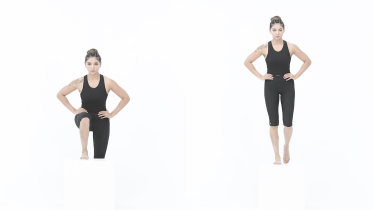
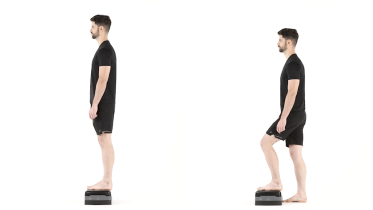
The exercises below start with the hip muscles lying down, then load the knee standing up. The step up trains the way up. The backward step-down trains the controlled bend of the way down.
Exercises that can help
Begin with the exercises done lying down and add the standing ones as the knee settles, keeping any pain mild and gone by the next morning. Most start at 2 to 3 sets of 8 to 15, with wall sit holds of 10 to 30 seconds repeated 3 to 5 times, and your physio will adjust this.
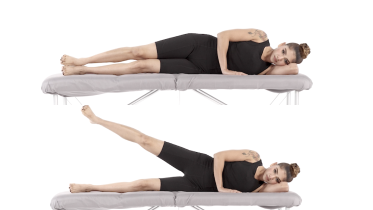 Side lying hip abduction
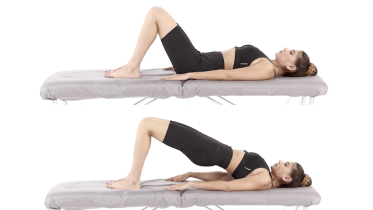 Glute bridge
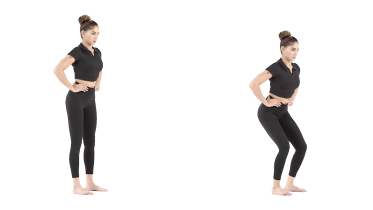 Mini squat
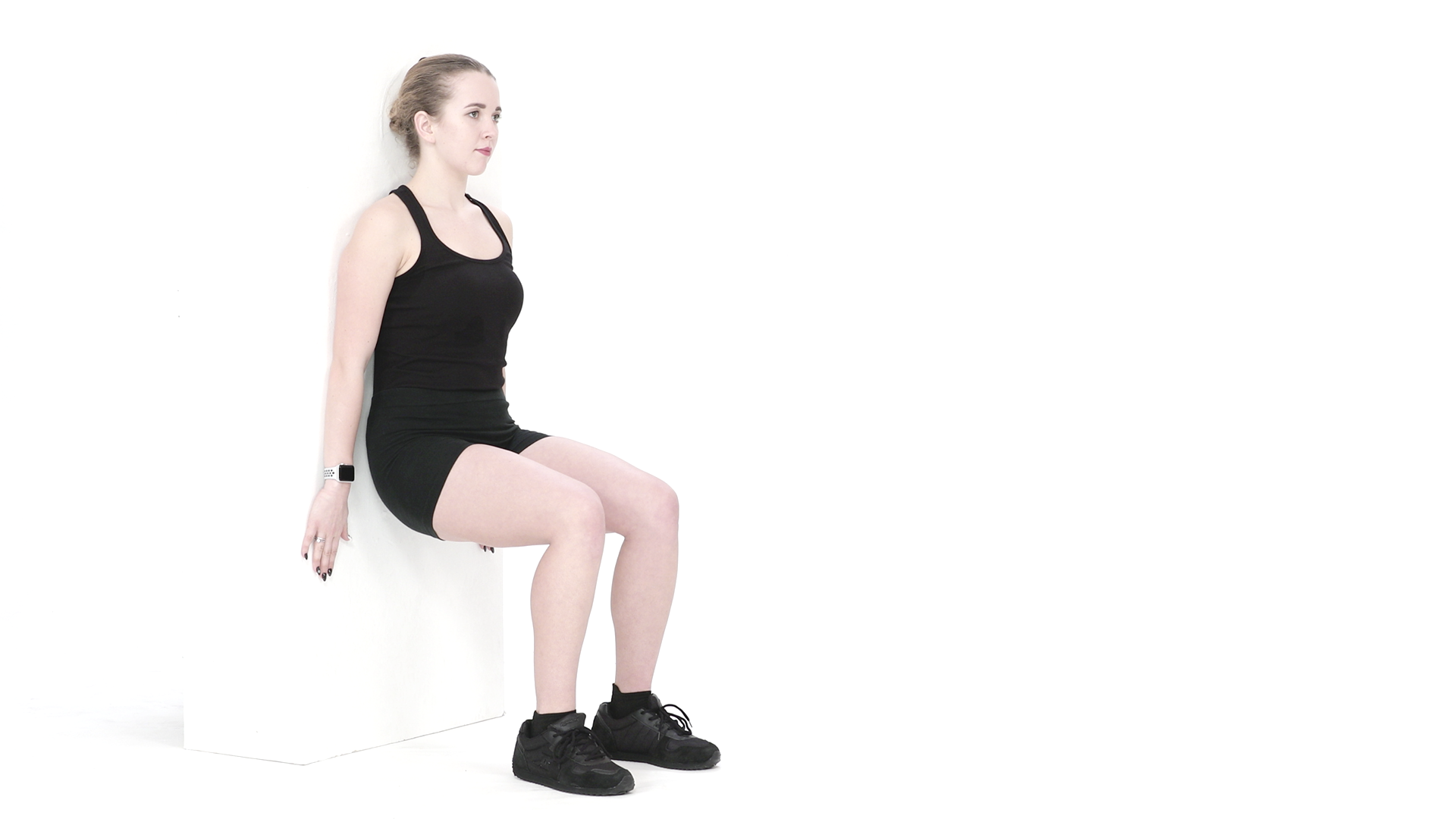 Wall sit
 Step up
 Backward step-down
Squats hurting as well? See knee pain when squatting for how deep to go and how to build back up.
When to see a physio (physical therapist)
See a physio or doctor if stair pain is getting worse, is stopping you getting around your home or work, or has not improved within a few weeks (NHS). A physio can watch you on a step, find which part of the knee is sore, and choose the exercises and the step height that suit you. A child or teenager who is still growing should be checked before starting an exercise program. After any knee surgery, stick to the plan from your surgeon and physio rather than this page.
Related exercise programs
See a doctor promptly if
- Emergency: you felt a sudden pop or tearing feeling just above or below your kneecap, you can see or feel a dip there, the kneecap seems to have moved up toward the thigh or to sag lower than usual, or you suddenly cannot straighten your knee or lift your leg out straight. Stop exercising and go to an emergency department straight away, even if you can still walk, as this can be a torn tendon at the front of the knee, either below the kneecap (patellar tendon) or above it (quadriceps tendon). Do not drive yourself. A repair usually does better if it is done soon after the injury.
- Same day: the pain started with a fall, a twist or a blow to the knee, or you cannot put weight on the leg. Get medical advice the same day. If the knee has changed shape, swelled up very quickly or you felt a pop or snap, or your foot turns cold, pale or blue or you have tingling or no feeling in the leg or foot, go to an emergency department straight away, and do not drive yourself.
- Same day: the kneecap has slipped out of place, even if it went back by itself. If it is still out of place, go to an emergency department straight away, and do not drive yourself. If it went back by itself, get medical advice the same day.
- Same day: the knee is locked, which means it is stuck bent and you cannot fully straighten it, even after gently trying to move it, or you cannot bend or straighten the leg at all. Get assessed the same day by a doctor, at urgent care or at an emergency department. A torn piece of meniscus can get caught in the joint and block it, and when a tear like this can be repaired, it should be done as early as possible. A knee that catches for a moment and then frees itself can happen with a meniscus tear. That is not the same as a locked knee, but tell your physio or doctor about it.
- Same day: the knee keeps giving way under you, or it gave way after a recent injury, or it gives way and is also very painful or swollen. Get medical advice the same day. If it only happens now and then, with no recent injury and no swelling, it is not an emergency, but book an assessment with a physio or doctor in the next few days.
- Same day: the knee clicks painfully when you bend or straighten it. Get medical advice the same day. Painless clicking on its own is common.
- Same day: the knee swells up with no clear reason, especially if you take medicine to thin your blood. Get medical advice the same day.
- Same day: the knee is hot, red and swollen, or you have knee pain with a high temperature or feel hot, cold or shivery. Get medical advice the same day, and go to an emergency department if you feel very unwell. This can be a sign of infection in the joint, which needs treatment quickly.
- Same day: a calf or thigh that is newly swollen, warm, tender, red or darker than usual, has swollen veins that are sore to touch, or has a throbbing or cramping pain that does not fit your injury or condition, or that feels different from normal muscle soreness after exercise. This can be a sign of a blood clot (deep vein thrombosis), especially after surgery, an injury, time in a cast or boot, a long trip or a spell of being much less mobile than usual. Get medical advice the same day. If you are also short of breath or have chest pain, call emergency services.
- Same day: you are a teenager who is still growing and you have a limp, or pain in the hip, groin or thigh as well as the knee. Get an urgent appointment with a doctor the same day, and stay off sport and these exercises until you have been checked. If you cannot put weight on the leg, have a high temperature or feel very unwell, go to an emergency department. Some hip problems in growing teenagers, such as a slipped growth plate at the top of the thigh bone (slipped capital femoral epiphysis), are felt in the knee and need checking quickly.
- Within a day or two: you are still growing and have pain that wakes you at night, pain at rest that keeps getting worse, or a lump or swelling around the knee or thigh that keeps growing. See a doctor within a day or two. Do the same if the pain comes with looking pale, unusual tiredness, fevers with no clear cause, bruising or bleeding easily, or weight loss. If you also have a rash that does not fade when you press it, call emergency services or go to an emergency department. Bone pain that is worse at night, or a new lump, needs checking to rule out rarer causes such as a bone tumor or a blood cancer (leukemia).
- Within a few days: pain at night or at rest that keeps getting worse. See your doctor within a few days. If you have had cancer, now or in the past, see your doctor sooner, within a day or two, and mention it, even if the pain is not getting worse. Do the same if you have knee pain and are losing weight without trying, even if it does not hurt at night. If you are being treated for cancer now, contact your cancer team the same day.
Common questions
Should I avoid stairs if I have knee pain?
Not for good. Using fewer stairs for a while can help a flared knee settle, and OrthoInfo lists stairs among the activities to cut down with knee arthritis. Stairs are also something to train back, though, which is why step ups and step downs are in the exercise list. In people with or at risk of knee osteoarthritis, exercise that loads the knee does not seem to harm the joint cartilage, although the quality of that evidence is low (Bricca and colleagues, 2019).
Is knee pain on stairs a sign of arthritis?
It can be, especially if you are 45 or older. In a study of 4,673 people with or at risk of knee osteoarthritis, pain on stairs appeared before pain when walking, standing or lying in bed (Hensor and colleagues, 2015). Kneecap pain and a sore patellar tendon also hurt on stairs, though, so stair pain alone does not confirm arthritis. A physio or doctor tells these apart mainly from your story and an examination (Bunt and colleagues, 2018). From 45 on, NICE advises diagnosing osteoarthritis without an X-ray when the pain comes with activity and any morning stiffness lasts 30 minutes or less (NICE NG226).
Is knee pain going down stairs a meniscus tear?
Stair pain on its own is not one of the typical signs of a meniscus tear in the NHS and OrthoInfo descriptions. A tear is more likely when the pain began with a twist, the knee became stiff and swollen over the next hours or days, or it catches, locks or gives way. If that sounds like your knee, get it assessed, and get it checked the same day if the knee is locked and will not straighten.
Why does my knee hurt going down stairs and when squatting?
Both movements bend the knee deeply while it takes your weight, with the thigh muscle working to control the bend. That combination tends to bring on kneecap pain (OrthoInfo), and a squat that does not hurt at all makes kneecap pain unlikely (Marra, 2020). A sore patellar tendon is also aggravated by squats and stairs (NHS Dorset), but the pain sits in a smaller spot just below the kneecap (Marra, 2020).
What exercises help knee pain on stairs?
For kneecap pain, the main recommended treatment combines exercises for the muscles at the back of the hip with exercises for the front of the thigh (Marra, 2020). For knee osteoarthritis, NICE advises exercise for everyone, and the Cochrane review found small short-term gains in pain and function, of uncertain importance (NICE NG226; Lawford and colleagues, 2024). The programs linked on this page build up in stages, from easier work such as hip exercises lying down or wall sits to harder work such as squats, step ups or stepping down under control.
References
- American Academy of Orthopaedic Surgeons. Patellofemoral Pain Syndrome. OrthoInfo. https://www.orthoinfo.org/diseases--conditions/patellofemoral-pain-syndrome/
- Marra J. Patellofemoral Pain: Guidelines from the American Physical Therapy Association. American Family Physician. 2020;102(7):442-443. https://www.aafp.org/pubs/afp/issues/2020/1001/p442.html
- Willy RW, Hoglund LT, Barton CJ, et al. Patellofemoral Pain: Clinical Practice Guidelines Linked to the International Classification of Functioning, Disability and Health From the Academy of Orthopaedic Physical Therapy of the American Physical Therapy Association. Journal of Orthopaedic and Sports Physical Therapy. 2019;49(9):CPG1-CPG95. https://doi.org/10.2519/jospt.2019.0302
- National Institute for Health and Care Excellence. Osteoarthritis in over 16s: diagnosis and management (NG226). 2022. https://www.nice.org.uk/guidance/ng226
- Bunt CW, Jonas CE, Chang JG. Knee Pain in Adults and Adolescents: The Initial Evaluation. American Family Physician. 2018;98(9):576-585. https://www.aafp.org/pubs/afp/issues/2018/1101/p576.html
- Hensor EMA, Dube B, Kingsbury SR, Tennant A, Conaghan PG. Toward a clinical definition of early osteoarthritis: onset of patient-reported knee pain begins on stairs. Data from the Osteoarthritis Initiative. Arthritis Care and Research. 2015;67(1):40-47. https://doi.org/10.1002/acr.22418
- American Academy of Orthopaedic Surgeons. Arthritis of the Knee. OrthoInfo. https://www.orthoinfo.org/en/diseases--conditions/arthritis-of-the-knee/
- NHS. Knee pain. Page last reviewed 21 December 2023. https://www.nhs.uk/symptoms/knee-pain/
- Leeds Community Healthcare NHS Trust. Patella tendinopathy. https://leedscommunityhealthcare.nhs.uk/our-services-a-z/musculoskeletal-msk/knee-problems/known-diagnosed-knee-problems/patella-tendonopathy/
- NHS Dorset Musculoskeletal Matters. Knee pain: patella tendinopathy. https://www.mskdorset.nhs.uk/knee-pain/knee-pain-patella-tendinopathy/
- NHS. Meniscus tear (knee cartilage damage). Page last reviewed 2 September 2026. https://www.nhs.uk/conditions/meniscus-tear/
- American Academy of Orthopaedic Surgeons. Meniscus Tears. OrthoInfo. https://www.orthoinfo.org/en/diseases--conditions/meniscus-tears/
- Protopapadaki A, Drechsler WI, Cramp MC, Coutts FJ, Scott OM. Hip, knee, ankle kinematics and kinetics during stair ascent and descent in healthy young individuals. Clinical Biomechanics. 2007;22(2):203-210. https://doi.org/10.1016/j.clinbiomech.2006.09.010
- Brechter JH, Powers CM. Patellofemoral joint stress during stair ascent and descent in persons with and without patellofemoral pain. Gait and Posture. 2002;16(2):115-123. https://doi.org/10.1016/s0966-6362(02)00090-5
- American Academy of Orthopaedic Surgeons. Total Knee Replacement Exercise Guide. OrthoInfo. https://www.orthoinfo.org/en/recovery/total-knee-replacement-exercise-guide/
- Lawford BJ, Hall M, Hinman RS, et al. Exercise for osteoarthritis of the knee. Cochrane Database of Systematic Reviews. 2024;12(12):CD004376. https://doi.org/10.1002/14651858.CD004376.pub4
- Bricca A, Juhl CB, Steultjens M, Wirth W, Roos EM. Impact of exercise on articular cartilage in people at risk of, or with established, knee osteoarthritis: a systematic review of randomised controlled trials. British Journal of Sports Medicine. 2019;53(15):940-947. https://doi.org/10.1136/bjsports-2017-098661
- American Academy of Orthopaedic Surgeons. Slipped Capital Femoral Epiphysis (SCFE). OrthoInfo. https://www.orthoinfo.org/en/diseases--conditions/slipped-capital-femoral-epiphysis-scfe
Written and checked by the PocketPhysio editorial team. Last updated 2026-09-29.
This page is general education, not a diagnosis or a personal treatment plan. See a physiotherapist or doctor for advice about your own situation.