
Knee pain when squatting: causes, form changes and when to stop
Why does my knee hurt when I squat?
A squat takes the knee through a large bend with your whole body weight on it. That is the load several common knee problems react to. The 2016 international consensus names pain at the front of the knee during a squat as the best test available for patellofemoral pain (Crossley and colleagues, 2016). A review of squat biomechanics found that the forces behind the kneecap, and inside the main knee joint, rise as you sink lower and fall again as you stand (Escamilla, 2001).
That leaves you with three settings you can change: how deep you go, how much weight you hold, and how many reps and sets you do. Change one at a time and you will learn quickly which one your knee cares about.
Experts do not fully agree about squatting below a right angle. One review argued that pressure behind the kneecap peaks at about 90 degrees and eases in a deeper squat, as the contact area grows, and concluded that deep squats do not raise the risk of injury to the knee's passive structures when the technique is taught well and the load builds gradually (Hartmann and colleagues, 2013). An older review preferred parallel squats to deep ones for healthy knees, because the risk to the menisci and ligaments may be higher in a deep squat, and suggested that a bend of 0 to 50 degrees, where knee forces were lowest, may suit many people in knee rehab (Escamilla, 2001). For a knee that already hurts, that shallower range is a common place to start, with depth added back as the knee settles.
What causes knee pain when squatting?
Treat these as patterns to recognize, not a diagnosis. A physio can tell them apart with a few tests, and more than one can be present at once.
Ache around the kneecap as you go down: patellofemoral pain
Patellofemoral pain is felt around or behind the kneecap, rather than at one pinpoint. Squatting, stairs, running or hopping bring it on, and pain after a long sit or when rising from a chair fits the pattern too (Crossley and colleagues, 2016). OrthoInfo describes it as an overuse problem from vigorous activities that repeatedly stress the knee, and links it with the way the kneecap tracks in its groove and with muscle imbalances. For treatment, the 2018 consensus supports exercise therapy, particularly hip-focused and knee-focused exercises combined (Collins and colleagues, 2018).
A sore spot at the lower tip of the kneecap: patellar tendinopathy
The two main signs of patellar tendinopathy are pain at the bottom tip of the kneecap and pain that rises with how hard the thigh muscles are working, most of all in jumping and landing (Malliaras and colleagues, 2015). In the gym, that tends to mean heavier squats, deeper squats and jump squats hurt more than light, shallow ones. The same review describes treatment as building the tendon's tolerance to load in steps, and is frank that rehab can be slow and sometimes frustrating. In practice, physios usually adjust the load rather than stopping it altogether.
Catching or pain deep in the joint at the bottom: meniscus tear
If squats bring on catching, a painful click, or a sense that something is in the way at the bottom, a meniscus tear is one possibility. Among the symptoms the NHS gives are swelling, the knee giving way, and a crunching or clicking feeling. OrthoInfo adds catching or locking. A tear can come from a twist in sport, or from something as ordinary as twisting while standing up (NHS).
Many physios leave deep squats out at first when a tear is suspected, then bring depth back gradually. That is common practice rather than a rule tested in trials.
A click that hurts needs checking the same day, as the warning signs below explain, and so does a knee that locks or keeps giving way.
A stiff knee that dislikes getting low: knee osteoarthritis
NICE's clinical diagnosis of knee osteoarthritis rests on age 45 or over, pain with activity and morning stiffness of 30 minutes or less, with no X-ray needed. The NHS also describes less movement in the joint and a grating or crackling feeling, which you may notice at the bottom of a squat. NICE recommends therapeutic exercise for everyone with osteoarthritis. It also advises telling people that pain may increase at first when they start, and that sticking with exercise reduces pain and improves function over time.
Is knee pain after squats normal?
Some of it is. Aching in the front of the thighs and the buttocks for a day or three after a new or harder session is delayed onset muscle soreness. Cleveland Clinic explains that lowering movements are the most likely to bring it on, that it is felt one to three days later and usually goes in a few days, and that soreness lasting a week or more may be an injury. That soreness is in the muscle, not the knee joint.
Pain in the knee itself is judged differently. Mild discomfort during the set that does not climb from rep to rep, and has settled by the next morning, is usually acceptable. A knee that is sorer, stiffer or more swollen the next morning had more load than it could handle, so drop back a step next session. Our guide to the pain monitoring model sets out how physios use this next-morning check.
There is some reassurance in the research. In one study without a comparison group, of adults over 35 with long-standing knee or hip pain, the flare of pain straight after each exercise session got smaller over 8 weeks of training, and their overall pain came down (Sandal and colleagues, 2016). Early sessions tend to feel worst.
How to squat without knee pain
Control the depth
Squat to a target, so every rep stops in the same place. A chair with a cushion on it, a box or a bench does the job, and you can remove a cushion when the current height has felt fine for a week or so. The mini squat uses a bend of only about 30 to 40 degrees, which sits inside the range Escamilla suggested for knee rehab.
Watch where the knees go
Keep each knee traveling over your second toe on the way down and the way up. Knees falling inward toward each other is one of the faults our squat pages warn about. As for knees going past the toes, a small study of 7 weight-trained men found that blocking the knees from moving past the toes lowered the load at the knee but raised the load at the hip many times over, and tipped the trunk further forward (Fry and colleagues, 2003). So sitting the hips back a little more can take some load off a sore knee for a while, but it moves that load to the hips and lower back. It is not a rule every squat must follow.
Adjust the load and the volume
Drop the weight or cut a set before you drop squats altogether. When you add weight back, add it in small jumps and check the knee the next morning each time. Holding one weight at your chest, as in the goblet squat, is an easy way to load a squat without a bar on your back.
Exercises that can help
The list runs from a held position with no knee movement to squat patterns under more load, so start with the first one that feels comfortable and work down it over the weeks. Wall sit holds often start at 10 to 30 seconds, repeated 3 to 5 times, and the squat, split squat and hip exercises at 2 to 3 sets of 8 to 15. Check each exercise page for its starting dose. Your physio will adjust this for your knee and your training.
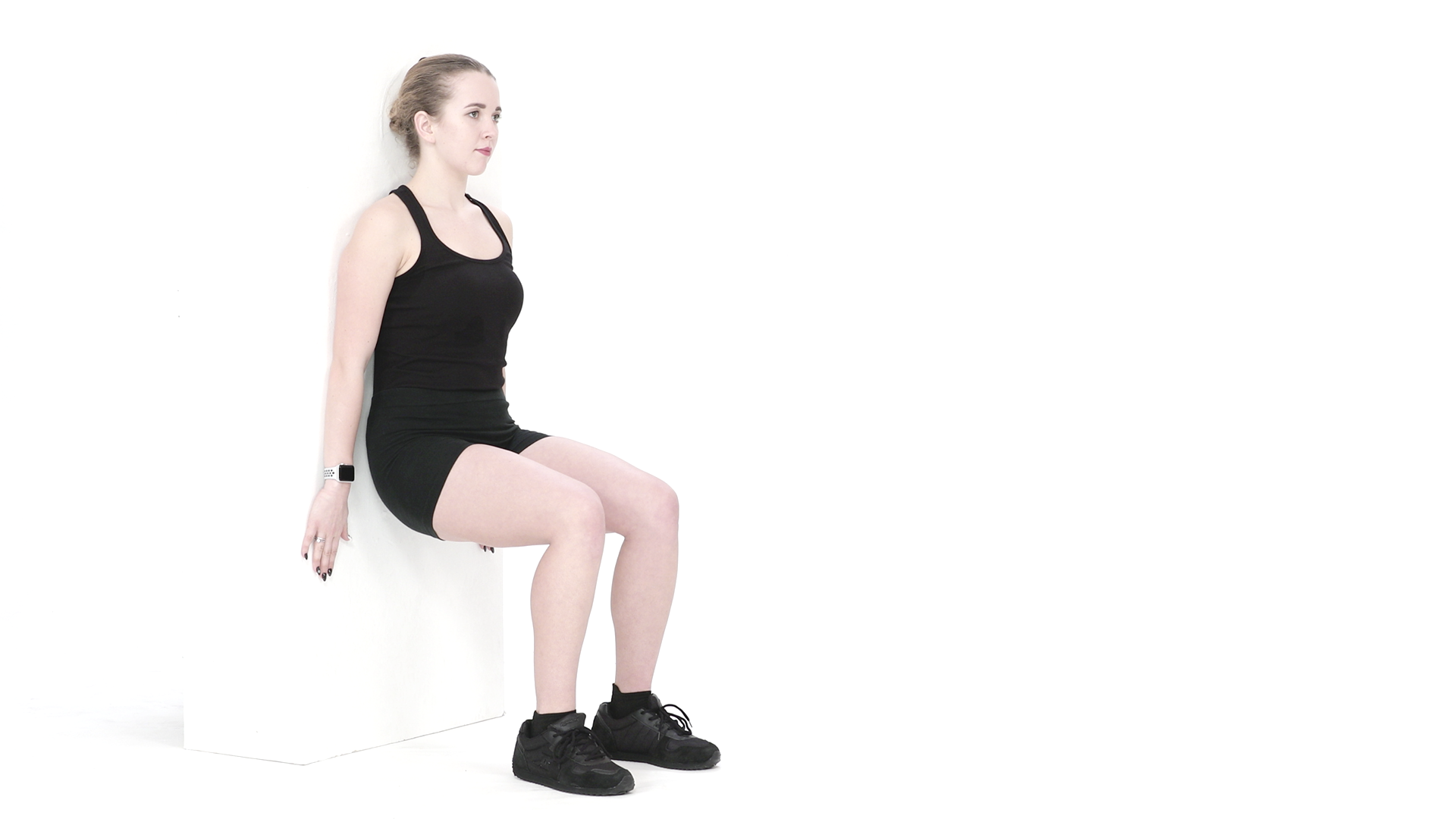 Wall sit
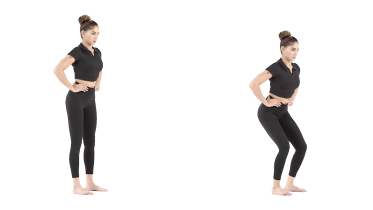 Mini squat
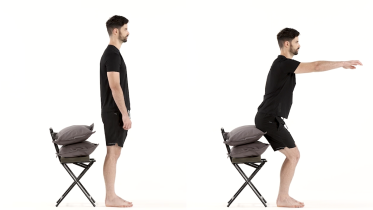 Chair squat
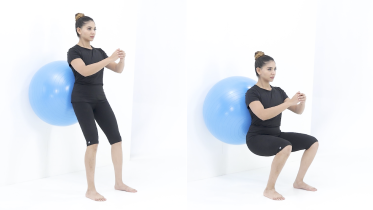 Ball wall squat
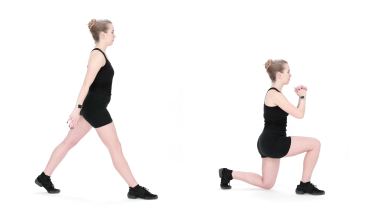 Split squat
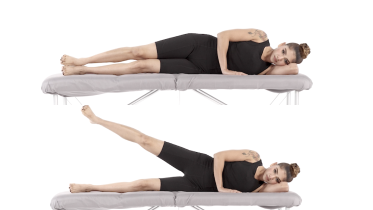 Side lying hip abduction
The wall sit comes first because the knee holds still while the thigh works, which some sore knees tolerate better than moving under load. If you have high blood pressure, breathe steadily through every hold and never hold your breath.
The mini squat and chair squat then add movement with a fixed, shallow depth. Leaning on a gym ball against the wall supports your back while you go a little lower, and the split squat trains one leg at a time. Side lying hip abduction works the muscle at the side of your hip (gluteus medius), which may help keep the knee in line. Once these feel easy and the knee is calm the next morning, move on to the bodyweight squat.
When to see a physio or doctor about squat pain
Get your knee looked at by a physio (physical therapist) or doctor if squats still hurt after a few weeks of cutting back (NHS), if the pain is spreading into everyday life such as stairs or sitting, or if a training block keeps stalling because of the knee. A physio can watch your squat from the front and side, test the kneecap, tendon and joint line, and plan a return to heavier lifting. If you train for a sport, ask them to plan the jumping and landing work too.
If you have had knee surgery, a ligament repair or a knee replacement, your surgeon's and physio's plan decides when squats return and how deep they go. Anyone who is still growing should see a doctor or physio before starting a program. For stiffness and pain with everyday bending and kneeling, read the page on knee pain when bending.
Related exercise programs
See a doctor promptly if
- Emergency: you felt a sudden pop or tearing feeling just above or below your kneecap, you can see or feel a dip there, the kneecap seems to have moved up toward the thigh or to sag lower than usual, or you suddenly cannot straighten your knee or lift your leg out straight. Stop exercising and go to an emergency department straight away, even if you can still walk, as this can be a torn tendon at the front of the knee, either below the kneecap (patellar tendon) or above it (quadriceps tendon). Do not drive yourself. A repair usually does better if it is done soon after the injury.
- Same day: the pain started with a fall, a twist or a blow to the knee, or you cannot put weight on the leg. Get medical advice the same day. If the knee has changed shape, swelled up very quickly or you felt a pop or snap, or your foot turns cold, pale or blue or you have tingling or no feeling in the leg or foot, go to an emergency department straight away, and do not drive yourself.
- Same day: the kneecap has slipped out of place, even if it went back by itself. If it is still out of place, go to an emergency department straight away, and do not drive yourself. If it went back by itself, get medical advice the same day.
- Same day: the knee is locked, which means it is stuck bent and you cannot fully straighten it, even after gently trying to move it, or you cannot bend or straighten the leg at all. Get assessed the same day by a doctor, at urgent care or at an emergency department. A torn piece of meniscus can get caught in the joint and block it, and when a tear like this can be repaired, it should be done as early as possible. A knee that catches for a moment and then frees itself can happen with a meniscus tear. That is not the same as a locked knee, but tell your physio or doctor about it.
- Same day: the knee keeps giving way under you, or it gave way after a recent injury, or it gives way and is also very painful or swollen. Get medical advice the same day. If it only happens now and then, with no recent injury and no swelling, it is not an emergency, but book an assessment with a physio or doctor in the next few days.
- Same day: the knee clicks painfully when you squat, bend or straighten it. Get medical advice the same day, and stop squatting until it has been checked. Painless clicking on its own is common.
- Same day: the knee swells up with no clear reason, including swelling that appears after a workout when you have not injured it, especially if you take medicine to thin your blood. Get medical advice the same day, and stop squatting until it has been checked.
- Emergency: dark pee (brown, red or tea-colored) after exercise, or muscles that become badly swollen, extremely painful or too weak to use, are not normal soreness. Go to an emergency department straight away, as these can be signs of serious muscle damage (rhabdomyolysis).
- Same day: the knee is hot, red and swollen, or you have knee pain with a high temperature or feel hot, cold or shivery. Get medical advice the same day, and go to an emergency department if you feel very unwell. This can be a sign of infection in the joint, which needs treatment quickly.
- Same day: a calf or thigh that is newly swollen, warm, tender, red or darker than usual, has swollen veins that are sore to touch, or has a throbbing or cramping pain that does not fit your injury or condition, or that feels different from normal muscle soreness after exercise. This can be a sign of a blood clot (deep vein thrombosis), especially after surgery, an injury, time in a cast or boot, a long trip or a spell of being much less mobile than usual. Get medical advice the same day. If you are also short of breath or have chest pain, call emergency services.
- Within a few days: pain at night or at rest that keeps getting worse. See your doctor within a few days. If you have had cancer, now or in the past, see your doctor sooner, within a day or two, and mention it, even if the pain is not getting worse. Do the same if you have knee pain and are losing weight without trying, even if it does not hurt at night. If you are being treated for cancer now, contact your cancer team the same day.
- Same day: you are a teenager who is still growing and you have a limp, or pain in the hip, groin or thigh as well as the knee. Get an urgent appointment with a doctor the same day, and stay off sport and these exercises until you have been checked. If you cannot put weight on the leg, have a high temperature or feel very unwell, go to an emergency department. Some hip problems in growing teenagers, such as a slipped growth plate at the top of the thigh bone (slipped capital femoral epiphysis), are felt in the knee and need checking quickly.
- Within a day or two: you are still growing and have pain that wakes you at night, pain at rest that keeps getting worse, or a lump or swelling around the knee or thigh that keeps growing. See a doctor within a day or two. Do the same if the pain comes with looking pale, unusual tiredness, fevers with no clear cause, bruising or bleeding easily, or weight loss. If you also have a rash that does not fade when you press it, call emergency services or go to an emergency department. Bone pain that is worse at night, or a new lump, needs checking to rule out rarer causes such as a bone tumor or a blood cancer (leukemia).
Common questions
Should I squat with knee pain or stop?
Usually you can keep squatting in some form, just less of it. Pick a depth, weight and number of sets that leave your knee no worse the next morning, and build up from there in small steps. In a review of trials in long-standing muscle and joint pain, exercise that was allowed to hurt a little did slightly better in the short term than pain-free exercise, and about the same later on (Smith and colleagues, 2017). Stop for the day if the pain turns sharp or climbs with every rep, and stop altogether and get checked for any of the warning signs on this page.
Why does my knee hurt after squats but not during?
Two different things can cause this. Aching thigh muscles a day or more after a new or harder session is ordinary muscle soreness, and it fades on its own within days. Pain in the knee itself, around the kneecap or just below it, that is worse the morning after is different: it usually means the knee was given more load than it could handle that day. Lower the depth, weight or volume next time, and if the pattern keeps repeating, have a physio look at it. A knee that swells after a session is a different matter: stop squatting and get it checked the same day.
Why does my knee hurt when I squat with weights or go deep?
Both add load to the front of the knee. Forces behind the kneecap and inside the joint climb as the knee bends, at least down to about a right angle (Escamilla, 2001; Hartmann and colleagues, 2013), and extra weight raises them again. A sore patellar tendon hurts more the harder the thigh muscles work, so heavy and deep squats tend to hurt it most (Malliaras and colleagues, 2015). Take the depth or the weight back to a level that does not flare the knee, then add it back in small steps.
Why does my knee hurt when I squat down or kneel?
Squatting down to the floor and kneeling both take the knee into a very deep bend. That end of the range is where a sore kneecap, a meniscus tear or a stiff knee with osteoarthritis can complain, and OrthoInfo lists trouble kneeling down among the problems patellofemoral pain can cause. Crouching on a low stool or putting one knee down on a cushion often gets you through daily tasks while the exercises do their work. Everyday bending and kneeling are covered on this site's knee pain when bending page.
What exercises help knee pain when squatting?
A mix of thigh and hip strengthening, with squats brought back at a depth your knee accepts. The 2018 international consensus on kneecap pain favors hip and knee exercises done together (Collins and colleagues, 2018). For knee osteoarthritis, NICE recommends muscle strengthening. Tendon pain below the kneecap follows a staged loading program instead, set out on the patellar tendinopathy page. The exercises listed on this page make a sensible first block for most people.
References
- Crossley KM, Stefanik JJ, Selfe J, et al. 2016 Patellofemoral pain consensus statement from the 4th International Patellofemoral Pain Research Retreat, Manchester. Part 1: Terminology, definitions, clinical examination, natural history, patellofemoral osteoarthritis and patient-reported outcome measures. British Journal of Sports Medicine, 2016;50(14):839-843. https://doi.org/10.1136/bjsports-2016-096384
- Collins NJ, Barton CJ, van Middelkoop M, et al. 2018 Consensus statement on exercise therapy and physical interventions (orthoses, taping and manual therapy) to treat patellofemoral pain: recommendations from the 5th International Patellofemoral Pain Research Retreat, Gold Coast, Australia, 2017. British Journal of Sports Medicine, 2018;52(18):1170-1178. https://doi.org/10.1136/bjsports-2018-099397
- Escamilla RF. Knee biomechanics of the dynamic squat exercise. Medicine and Science in Sports and Exercise, 2001;33(1):127-141. https://doi.org/10.1097/00005768-200101000-00020
- Hartmann H, Wirth K, Klusemann M. Analysis of the load on the knee joint and vertebral column with changes in squatting depth and weight load. Sports Medicine, 2013;43(10):993-1008. https://doi.org/10.1007/s40279-013-0073-6
- Fry AC, Smith JC, Schilling BK. Effect of knee position on hip and knee torques during the barbell squat. Journal of Strength and Conditioning Research, 2003;17(4):629-633. https://doi.org/10.1519/1533-4287(2003)017<0629:eokpoh>2.0.co;2
- Malliaras P, Cook J, Purdam C, Rio E. Patellar Tendinopathy: Clinical Diagnosis, Load Management, and Advice for Challenging Case Presentations. Journal of Orthopaedic and Sports Physical Therapy, 2015;45(11):887-898. https://doi.org/10.2519/jospt.2015.5987
- Smith BE, Hendrick P, Smith TO, et al. Should exercises be painful in the management of chronic musculoskeletal pain? A systematic review and meta-analysis. British Journal of Sports Medicine, 2017;51(23):1679-1687. https://doi.org/10.1136/bjsports-2016-097383
- Sandal LF, Roos EM, Bogesvang SJ, Thorlund JB. Pain trajectory and exercise-induced pain flares during 8 weeks of neuromuscular exercise in individuals with knee and hip pain. Osteoarthritis and Cartilage, 2016;24(4):589-592. https://doi.org/10.1016/j.joca.2015.11.002
- National Institute for Health and Care Excellence. Osteoarthritis in over 16s: diagnosis and management (NG226). NICE, 2022. https://www.nice.org.uk/guidance/ng226
- NHS. Knee pain. Page last reviewed 21 December 2023. https://www.nhs.uk/symptoms/knee-pain/
- NHS. Meniscus tear (knee cartilage damage). Page last reviewed 2 September 2026. https://www.nhs.uk/conditions/meniscus-tear/
- NHS. Osteoarthritis: symptoms. Page last reviewed 20 March 2023. https://www.nhs.uk/conditions/osteoarthritis/symptoms/
- NHS. Dislocated kneecap. Page last reviewed 10 March 2026. https://www.nhs.uk/conditions/dislocated-kneecap/
- NHS. Deep vein thrombosis (DVT). Page last reviewed 30 April 2026. https://www.nhs.uk/conditions/deep-vein-thrombosis-dvt/
- American Academy of Orthopaedic Surgeons. Patellofemoral Pain Syndrome. OrthoInfo. https://www.orthoinfo.org/en/diseases--conditions/patellofemoral-pain-syndrome/
- American Academy of Orthopaedic Surgeons. Meniscus Tears. OrthoInfo. https://www.orthoinfo.org/en/diseases--conditions/meniscus-tears/
- American Academy of Orthopaedic Surgeons. Patellar Tendon Tear. OrthoInfo. https://www.orthoinfo.org/en/diseases--conditions/patellar-tendon-tear/
- American Academy of Orthopaedic Surgeons. Quadriceps Tendon Tear. OrthoInfo. https://www.orthoinfo.org/en/diseases--conditions/quadriceps-tendon-tear/
- American Academy of Orthopaedic Surgeons. Slipped Capital Femoral Epiphysis. OrthoInfo. https://www.orthoinfo.org/en/diseases--conditions/slipped-capital-femoral-epiphysis-scfe
- Cleveland Clinic. Delayed Onset Muscle Soreness (DOMS). Last updated 19 December 2025. https://my.clevelandclinic.org/health/diseases/delayed-onset-muscle-soreness
- Cleveland Clinic. Rhabdomyolysis. Last updated 24 February 2023. https://my.clevelandclinic.org/health/diseases/21184-rhabdomyolysis
Written and checked by the PocketPhysio editorial team. Last updated 2026-09-29.
This page is general education, not a diagnosis or a personal treatment plan. See a physiotherapist or doctor for advice about your own situation.