
Knee giving way: why your knee buckles
Warning signs, and when to get help
What does it mean when your knee gives way?
That the leg stopped holding you up, briefly, without your permission. Beyond that the phrase covers several different events, and telling them apart is most of the work.
The common version is the knee bending under you as you load it, usually on a step, a curb or while turning. It happens fast, often with a lurch and a grab for something, and it is over before you can work out what happened. Sometimes it is something inside the joint interrupting the movement instead, which tends to come with catching, and sometimes with a knee that then will not straighten properly. Then there is the kneecap sliding sideways out of its groove, which buckles the knee and hurts sharply at the front. And the rare, serious one: the whole joint shifting out of place, which is a hospital assessment on the day even if the knee went back on its own and looks normal now.
When you describe this to a clinician, the useful details are the position you were in, whether there was a noise, whether the knee swelled afterward and how soon, and whether it has happened once or repeatedly. Those answers do more to sort it out than any label.
How common is knee buckling, and does it mean arthritis?
Commoner than almost anyone expects, and no, not necessarily.
The clearest figures come from the Framingham Osteoarthritis Study, which asked 2,351 men and women aged 36 to 94 about it. In the previous 3 months, 11.8 percent had experienced at least one episode of the knee buckling. Buckling was independently associated with knee pain and with weakness of the thigh muscle, and over half of the people it happened to had no osteoarthritis on their x-rays at all (Felson and colleagues, 2007). So a knee that gives way is not evidence that the joint is worn out.
Two more findings from that study are worth carrying. People who buckled reported more limitation in daily life than people who did not, and that difference held up after adjusting for how much pain they had and how weak the thigh was, with an adjusted odds ratio of 2.0 for limitations at work. And 12.6 percent of those who buckled fell during an episode. The study was cross-sectional, which its authors point out means it cannot show which came first, so read the associations as things that travel together rather than as a chain of cause and effect.
If your knee also aches with activity and you are 45 or over, with either no morning stiffness at all or morning stiffness that lasts no longer than 30 minutes, then osteoarthritis is a reasonable thing to ask about: NICE allows that diagnosis to be made clinically, without imaging (NG226, recommendation 1.1.1). The knee osteoarthritis program is built for that picture. But the buckling itself does not settle the question either way.
Why a weak or switched-off thigh muscle lets the knee go
The muscle at the front of the thigh is what stops your knee folding when you put weight on a slightly bent leg. If it is weak, or if it is strong but slow to come on, the knee has no brake at the moment it needs one.
The "switched off" half of that is a real phenomenon with a clumsy name. A review of quadriceps arthrogenic muscle inhibition describes an ongoing difficulty fully activating the thigh after arthritis, knee surgery or injury, driven by altered signals coming from the joint itself, with swelling, inflammation, joint laxity and damage to the joint's own nerve endings among the triggers (Rice and McNair, 2010). So a knee can lose a great deal of thigh function without the person having done anything to the muscle itself.
Not every proposed mechanism has held up. One idea was that the hamstrings at the back of the thigh were over-contracting and pulling the knee out from under people. When that was tested in 1,826 adults with or at risk of knee osteoarthritis, hamstring coactivation during a quadriceps test was not consistently associated with buckling, or with the sensation of the knee shifting, whether already present or developing over the following 2 years (Segal and colleagues, 2015). So thigh weakness and inhibition are well supported, and the hamstring explanation is not.
Does a swollen knee make the knee give way?
Yes. This is one of the few parts of the story somebody has actually measured.
Nine healthy volunteers, 4 women and 5 men, had saline injected into the knee at two volumes, 30 mL and 60 mL, and were then measured doing a single leg drop landing. Activity in the muscles on the inner and outer side of the thigh fell at both volumes. At the larger volume the landing itself changed, with higher force through the leg, less knee bend and a smaller knee extension moment (Palmieri-Smith and colleagues, 2007). Nine healthy knees with fluid put into them are not the same as a knee with a tear or arthritis in it, so treat it as the mechanism at work and not as a reading off your own knee.
So if the knee that is giving way is also swollen, the swelling is part of the problem and not a side issue, and getting the fluid down is part of getting the leg reliable again. Our page on swollen knee covers how to read the swelling and how to use it to set how much you do. A knee that swells up with no clear reason needs advice the same day, and the warning signs below say why.
Giving way after a twist, a pop or sudden swelling
This group is different and it is the one with a clock on it. A knee that gave way during or straight after an injury, especially with a popping sound or with swelling that came up within a few hours, is treated as a structural injury until someone has proved otherwise.
OrthoInfo describes a cruciate ligament injury as exactly this combination: a popping noise, a feeling of the knee giving out from under you, and swelling within 24 hours. It also makes the point most people miss: going back to normal activity on a knee like that often makes the instability worse and risks further damage inside the joint. The NHS lists a knee giving way when you try to stand among the symptoms of a torn meniscus, and OrthoInfo adds catching, locking and an inability to move the knee through its full range.
So do not test it. If the knee gave way after an injury, get medical advice the same day, and if it swelled very quickly or you felt a pop or a snap, that is an emergency department straight away without driving yourself. Meniscus tear and swelling, locking and giving way cover the tear in detail, including the three separate reasons a knee with a tear lets go. MCL sprain covers the ligament on the inner side.
When the kneecap is the thing that gives way
A kneecap that slips sideways out of its groove almost always buckles the knee on the way, so plenty of people describe it as the knee giving way. It feels different, though: the pain is at the front, it is severe at the time, and the knee usually swells over the next few hours.
It needs checking even if the kneecap went back into place by itself, because a piece of cartilage or bone is often chipped off as it moves. The NHS asks you to get a doctor to look at it, usually with an x-ray, and to go to an emergency department without driving yourself if the knee has changed shape, swelled very quickly, or you felt a pop or snap. It also advises against going back to sport until the knee has its normal strength back, and checking with a doctor or physio first. Patellar dislocation is the program for afterward.
Feeling unsteady without the knee actually buckling
Plenty of people have never actually been dropped by the knee. What they have is the feeling that it might, which is a symptom in its own right and is commoner than buckling.
The Multicenter Osteoarthritis Study asked 2,120 adults about both. Buckling was reported by 18 percent, sensations of instability without any buckling by 27 percent, and both together by 9 percent. Both symptoms were associated with fear of falling, poor balance confidence, cutting back on activity because of worry about the knee giving way, and worse physical function, and the strongest associations were in the people who had both, or who had buckled at least twice (Nguyen and colleagues, 2014).
So mention the feeling at an appointment even though nothing has happened yet, because it is not simply nerves. And the answer to it is not to do less. The fear itself restricts people, a leg that is used less becomes less trustworthy, and round it goes. Balance and falls prevention is the program that deals with the fear and the physical risk together. If your joints are generally loose rather than one knee being the problem, hypermobility may fit better.
Giving way in a knee that has been operated on
If the knee that is now giving way has been reconstructed, repaired or replaced, everything above is the wrong frame. New instability after knee surgery is a message for the team that operated, not a training problem to work around. The structures they relied on can fail.
After a cruciate ligament reconstruction, a knee that gives way, or where you feel a pop, a shift or a twist inside it, and which then swells within a few hours or becomes very painful, means keeping your weight off it and contacting your surgical team or being assessed the same day. One route sits above that one: if the knee swelled very quickly after a pop or a snap, the emergency department line in the warning signs below applies whichever operation you had, and a call to your surgical team is not a substitute for it. A fall or a twist can damage the graft or a meniscus repair done at the same time, and the NHS notes plainly that you may need more surgery if you tear the graft. Its list of possible problems after this operation includes the knee being unstable when you stand or walk. The full wording for that route, including what to do if the knee looks out of shape or the foot turns numb, cold or pale, is in the warning signs below, and ACL reconstruction rehab is the program.
After an operation on the meniscus, a knee that locks, catches or gives way again, or that swells or becomes much more painful after a twist, a kneel or a deep bend, carries the same instruction: weight off it, and contact your surgical team the same day. A repair can come apart before the tear has healed, and a meniscus that was trimmed can tear again.
After a knee replacement, instability is also on the NHS list of ongoing problems, alongside difficulty bending, pain and stiffness, and it says physiotherapy and particular exercises may help. A replaced knee that has started feeling unstable or giving way is reported to your physio or surgical team within the next few days, rather than left until the next routine appointment, and until it has been looked at, use your walking aid, hold a rail every time on stairs and stay off stairs on your own.
OrthoInfo is blunt about why: a fall in the first weeks after the operation can damage the new knee and lead to more surgery, stairs are the particular hazard, and a cane, crutches, a walker, handrails or another person are what it asks you to use until your balance and strength have come back. A knee that gives way is part of what makes that fall likely in the first place: OrthoInfo's page on fracture after total knee replacement lists muscle weakness, poor vision and poor balance among the things that raise the risk of a broken bone around the implant, and it puts those fractures at any point after the operation rather than only in the early weeks.
If the replaced knee keeps giving way, has given way and let you fall, or gives way along with new pain or swelling, the same-day line in the warning signs below applies to you exactly as it does to anyone else. Warning signs to call your surgeon about sets out every post-replacement route in order of speed.
Once a fall or a knock has actually happened, the direction flips. A replaced knee that cannot take your weight afterward, that is very painful, or that leaves the leg looking out of shape goes to an emergency department straight away rather than to a phone call, and even a small knock that leaves it newly painful, swollen or bruised means coming off that leg and contacting your surgical team the same day. OrthoInfo calls a break around the implant a serious complication that almost always needs a large operation, and the full wording for both halves of that route is in the warning signs below.
Two more things a surgical team wants to hear about after a replacement, and neither announces itself. A review of why knee replacements fail puts loosening and instability as the overall greatest reasons for revision, with infection now the commonest acute cause (Lum and colleagues, 2018), so a replaced knee that has turned unreliable is not a small finding to the people who put it in. Say so if pain that had settled has come back, or if the knee hurts as soon as you stand up and begin to walk, because OrthoInfo's warning about wear is that it may make the knee replacement loosen and become painful.
Infection is the other one, and it can arrive months or years after the operation with very little to see. OrthoInfo puts the symptoms of an infected joint replacement anywhere from mild redness and swelling up to septic shock, says that sometimes there are none at all, lists increased pain or stiffness in a joint that had been working well among them, and states that fever is no longer considered a sign of one. So a normal temperature is not an all clear. Both of these are a reason to be seen by the team that operated rather than worked around with exercises, and if the knee is hot, red or swollen, or you have a temperature or feel hot, cold or shivery, the same-day infection line in the warning signs below applies instead and does not wait for a few days.
Three rules apply across all three operations. Do not average the routes: match what your knee is doing to the operation you had. After a reconstruction or a meniscus repair, do not keep weight on a knee that has just given way while you wait for a call back, and after a replacement keep using your walking aid and the rail instead of trying to stay off the leg, because the fall is the risk sitting in front of you. That last instruction reverses once a fall or a knock has happened: a replaced knee that has taken one comes off your full weight until someone has looked at the bone around the implant, which is the one time you are asked to stay off a replaced leg rather than walk on it with support. And your own surgeon's instructions and limits come before anything written here, because they know what was repaired and what it can take.
Stairs, uneven ground and not falling
This is the part to act on tonight, before anybody has examined anything, because the fall is the injury that actually happens.
Hold the rail on every stair, both up and down, and take one step at a time if the knee has let you down recently. Treat uneven ground, wet leaves, curbs and dark corridors as the places it is most likely to happen, and slow down there rather than concentrating harder. Leave out any exercise or activity that puts you on one leg until the knee has been assessed, including balance practice and single leg strength work, which is why there is none of it on this page. If you already use a stick or a frame, use it every time, not only on bad days.
If you live alone, keep your phone in a pocket rather than in another room, so you can reach it from the floor, and ask about an alarm you wear. Tell someone if you fall, even if you were not hurt. The warning signs below include asking your doctor about a falls assessment after a fall or a run of stumbles, and that is a service to ask for instead of waiting to be offered it.
Exercises for a knee that gives way
The aim is to get the thigh working again in positions where the knee cannot drop you, then to earn the standing work back after an assessment. That order is not caution for its own sake. The warning signs on this page ask you to leave out single leg exercises until the knee has been checked, so nothing here asks you to stand on one.
Start with the two thigh exercises that involve little or no movement, add the straight leg raise, and use a sit to stand from a chair high enough that you are not fighting to get out of it. A working ache in the front of the thigh is what you want. Sharp pain inside the joint, a knee that swells by the next morning, or any episode of giving way during an exercise means stopping and getting it looked at.
Check these before you start. If the knee has been operated on, follow the plan from your surgeon and physio instead of this one. Check with your doctor first if you have a heart or lung condition or blood pressure that is not under control, and if you have high blood pressure, breathe steadily through every hold and never hold your breath.
If you are pregnant and past the first three months, ask your physio before exercising flat on your back, because three of these four are done lying down. If an exercise is only done lying on your back, RANZCOG says it can be done sitting or standing instead, and UK pelvic health physiotherapy guidance (POGP) suggests an upright position or lying on your left side, with a change of position if you feel dizzy or unwell.
If you have had a hip replacement, get the go-ahead from your surgeon or physio before the straight leg raise and before sit to stand, because standing up from a low seat bends the hip past a right angle and many surgeons set a limit on that for the first months. Anyone still growing should be assessed before starting.
Do the sit to stand slowly, from a chair that will not slide, with its back against a wall and a counter or another solid surface beside you that you can grab if the knee lets go. If you feel dizzy or lightheaded as you rise, sit back down and wait for it to pass, and get medical advice the same day if it does not pass within a minute or two or keeps happening. Add the straight leg raise only when you can tighten the thigh and keep the knee straight as the heel leaves the bed: if the knee bends as you lift, go back to the quad sets for a few days and try again.
Exercises that can help
Read the checks just above before you start any of these: they cover an operated knee, pregnancy, a replaced hip, a heart or lung condition, blood pressure, and anyone still growing. Three of these four are done lying or sitting and the fourth is a two-legged transfer, which is deliberate: the warning signs below ask you to leave out the exercises you do standing on one leg until the knee has been checked, so there is no single leg work on this page. Quad sets are often 10 repetitions with a 5 to 10 second hold, several times a day. Short arc quads are often 2 to 3 sets of 10 to 15 with a 3 to 5 second hold at the top, once or twice a day, and the straight leg raise 2 to 3 sets of 10 on each leg, once a day. Sit to stand often starts at 2 to 3 sets of 5 to 10, once a day or on most days, with the chair high enough that you are not fighting to get up. Your physio will adjust this, and after an operation the plan from your surgeon and physio comes first.
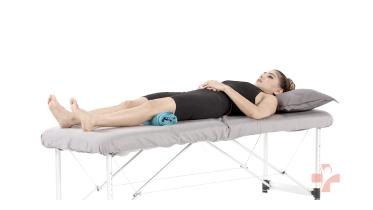 Quad sets (towel under knee)
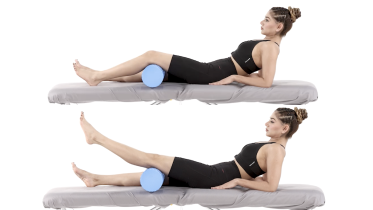 Short arc quads
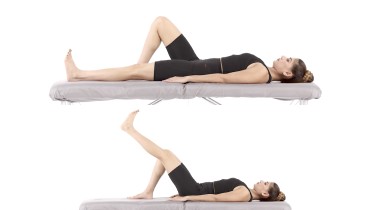 Straight leg raise
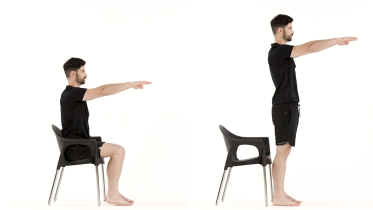 Sit to stand
What comes after an assessment is single leg stance, tandem stance and step ups, progressed with support until you are steady, usually alongside the balance and falls prevention program and not in place of it. For how much to do as you build up, our guide to the pain monitoring model explains the next-morning rule.
When to see a physio (physical therapist)
Book an assessment for any knee that has given way more than once, for a knee that feels as though it might, and for a knee that gave way at all if you are over 65 or have fallen in the past year. There is a lot a clinician can settle quickly here: how strong the thigh actually is compared with the other side, whether the ligaments are doing their job, whether the joint line is tender, whether the kneecap tracks properly and whether your balance is part of the picture.
Go the same day instead if the knee keeps giving way, if it gave way after a recent injury, if it is also very painful or swollen, or if it holds a reconstructed ligament or a repaired meniscus. A replaced knee that has started giving way goes to your physio or surgical team within the next few days, and the same day on any of the triggers in the warning signs below. Anyone still growing needs the knee examined before starting exercises. Knee clicking and cracking covers the noise that often comes with it, knee pain on stairs covers the place it most often happens, and knee pain by body area lists the rest. Every warning sign below carries its own timing, from calling an ambulance to an appointment in the next few days.
Related exercise programs
Warning signs
Get emergency help now
- Emergency: the whole knee, not just the kneecap, felt as though it slid or shifted right out of place at the moment of injury, even if it went back straight away, or the knee now feels loose or wobbly in more than one direction. Go to an emergency department straight away. Do not drive yourself: ask someone to drive you or call an ambulance. A knee that comes out of place and goes back can tear several ligaments at the same time and can damage the artery or the nerve behind the knee. That damage is not always obvious at first, and the knee can look almost normal, so it is checked in hospital on the day rather than worked out at home.
- Emergency: the knee has moved out of place, looks misshapen or is pointing at an odd angle, or you have tingling or no feeling in the knee, leg or toes, or your foot turns cold, pale or blue. Go to an emergency department straight away. Do not drive yourself: ask someone to drive you or call an ambulance.
- Emergency: you felt a sudden pop or tearing feeling just above or below your kneecap, you can see or feel a dip there, the kneecap seems to have moved up toward the thigh or to sag lower than usual, or you suddenly cannot straighten your knee or lift your leg out straight. Stop exercising and go to an emergency department straight away, even if you can still walk, as this can be a torn tendon at the front of the knee, either below the kneecap (patellar tendon) or above it (quadriceps tendon). Do not drive yourself. A repair usually does better if it is done soon after the injury.
- Emergency: the knee became very swollen very quickly, within a few hours of a twist, fall or blow, or you felt a pop or snap. Go to an emergency department straight away. Do not drive yourself: ask someone to drive you or call an ambulance.
- Emergency: you have had a knee replacement and, after a fall or a knock, you cannot put weight on the leg, your knee or thigh is very painful, or the leg looks out of shape or shorter than the other. Go to an emergency department straight away, and do not drive yourself. If you cannot get up, call emergency services. A broken bone around a knee replacement is rare, but it needs treatment in hospital. If a smaller fall or knock leaves the knee newly painful, swollen or bruised, even if you can still walk on it and the leg looks normal, stop the exercises, go back to your crutches or sticks and keep your full weight off that leg, and get it checked by your surgical team the same day. A break in the bone around a new knee is not always obvious at first, and walking normally on one can move the broken ends apart.
- Emergency: the kneecap has slipped out of place, even if it went back by itself. If it is still out of place, go to an emergency department straight away, and do not drive yourself. If it went back by itself, get medical advice the same day.
- Emergency: you are still growing and have pain that wakes you at night, pain at rest that keeps getting worse, or a lump or swelling around the knee or thigh that keeps growing. If you also have a rash that does not fade when you press it, call emergency services or go to an emergency department.
Get help today
- Same day: the knee keeps giving way under you, or it gave way after a recent injury, or it gives way and is also very painful or swollen. Get medical advice the same day. If it only happens now and then, with no recent injury and no swelling, it is not an emergency, but book an assessment with a physio or doctor in the next few days. Until it has been checked, leave out the exercises you do standing on one leg, hold the rail on stairs and take care on uneven ground, because a knee that gives way without warning is how people fall.
- Same day: the knee is locked, which means it is stuck bent and you cannot fully straighten it, even after gently trying to move it, or you cannot bend or straighten the leg at all. Get assessed the same day by a doctor, at urgent care or at an emergency department. A torn piece of meniscus can get caught in the joint and block it, and when a tear like this can be repaired, it should be done as early as possible. A knee that catches for a moment and then frees itself can happen with a meniscus tear. That is not the same as a locked knee, but tell your physio or doctor about it.
- Same day: you cannot walk or put weight on the leg, whether or not there was a fall or injury, or you have very bad knee pain after a fall or injury, or very bad knee pain that came on suddenly with no injury at all. Get medical advice the same day.
- Same day: the knee swells up with no clear reason, especially if you take medicine to thin your blood. Get medical advice the same day.
- Same day: since your knee ligament was reconstructed, your knee gives way, or you feel a pop, a shift or a twist inside it, and it swells up within a few hours or is very painful. Keep your weight off it and contact your surgical team, or get assessed the same day at urgent care or an emergency department. A fall or a twist can damage the new ligament (graft) or a meniscus repair. If the knee looks out of shape, or your foot turns numb, cold or pale, go to an emergency department straight away, and do not drive yourself. If the knee only feels a little unsteady now and then, with no swelling or pain, it is not an emergency, but tell your physio or surgeon in the next few days.
- Same day: since an operation on your meniscus, the knee locks, catches or gives way again, or you feel a pop or a shift inside it, or it swells up or becomes much more painful after a twist, a kneel or a deep bend. Keep your weight off it and contact your surgical team, or get assessed the same day at urgent care or an emergency department. A repair can come apart before the tear has healed, and a trimmed meniscus can tear again. If the knee is only a little achy after a busy day, with no swelling and no catching, it is not an emergency, but tell your physio or surgeon in the next few days.
- Same day: since your operation, your wound is oozing, leaking or has pus coming out of it, or its edges start to come apart, or your knee is tender, swollen, painful or red and it is not getting better or is getting worse, or you have a high temperature or feel hot and cold or shivery. Redness can be harder to see on brown or black skin. Contact your surgical team the same day, or get urgent medical advice if you cannot reach them. These can be signs of an infection in the wound or the knee joint. If you feel very unwell, go to an emergency department. If you have a very high or very low temperature, shivering you cannot control, you are breathing very fast or finding it hard to breathe, you are confused or your speech is slurred, your skin, lips or tongue look blue, gray, pale or blotchy (on brown or black skin this can be easier to see on the palms of the hands or soles of the feet), or you have a rash that does not fade when you press it, call emergency services, as this can be sepsis.
- Same day: the knee is hot, red and swollen, or you have knee pain with a high temperature or feel hot, cold or shivery. Get medical advice the same day, and go to an emergency department if you feel very unwell. This can be a sign of infection in the joint, which needs treatment quickly.
- Same day: a calf or thigh that is newly swollen or getting more swollen, warm, tender, red or darker than usual, has swollen veins that are sore to touch, or has a throbbing or cramping pain that does not fit your injury or condition, or that feels different from normal muscle soreness after exercise. This can be a sign of a blood clot (deep vein thrombosis), especially after surgery, an injury, time in a cast or boot, a long trip or a spell of being much less mobile than usual. Get medical advice the same day. If you are also short of breath or have chest pain, call emergency services.
- Same day: a leg or foot that is getting weaker, for example your foot drags, catches on the ground or slaps down when you walk (foot drop). Get medical advice the same day. If the weakness is getting worse by the hour, go to an emergency department.
- Same day: you are a teenager who is still growing and you have a limp, or pain in the hip, groin or thigh as well as the knee. Get an urgent appointment with a doctor the same day, and stay off sport and these exercises until you have been checked. If you cannot put weight on the leg, have a high temperature or feel very unwell, go to an emergency department. Some hip problems in growing teenagers, such as a slipped growth plate at the top of the thigh bone (slipped capital femoral epiphysis), are felt in the knee and need checking quickly.
- Same day: pain at night or at rest that keeps getting worse. If you are being treated for cancer now, contact your cancer team the same day.
Book an appointment
- Within a day or two: you are still growing and have pain that wakes you at night, pain at rest that keeps getting worse, or a lump or swelling around the knee or thigh that keeps growing. See a doctor within a day or two. Ask for an urgent appointment rather than the next routine one, and say what the pain does at night and whether a lump is getting bigger. Do the same if the pain comes with looking pale, unusual tiredness, fevers with no clear cause, bruising or bleeding easily, or weight loss. Bone pain that is worse at night, or a new lump, needs checking to rule out rarer causes such as a bone tumor or a blood cancer (leukemia).
- Within a day or two: pain at night or at rest that keeps getting worse. If you have had cancer, now or in the past, see your doctor sooner, within a day or two, and mention it, even if the pain is not getting worse. Do the same if you have knee pain and are losing weight without trying, even if it does not hurt at night.
- Within a few days: pain at night or at rest that keeps getting worse. See your doctor within a few days.
- Within a few days: you have had a fall, even if you were not hurt, or you keep tripping, stumbling or feeling that your legs might give way. Book an appointment with your doctor within a few days and ask about a falls assessment. Tell them about every fall, even the ones where you were not hurt.
Common questions
What does knee giving way mean?
It means the knee stopped supporting you for a moment, either because the thigh muscle let go or because something inside the joint interrupted the movement. The word covers several different events, which is why it is worth describing what happened rather than naming it. Did the knee bend under you as you put weight on it, did something catch and then free itself, or did the whole joint feel as though it shifted sideways? The first is the common version, the second points toward something mechanical inside the joint, and the third needs a hospital assessment the same day. In a population-based study of 2,351 adults, buckling was associated with knee pain and with quadriceps weakness, and over half of the people reporting it had no osteoarthritis on x-ray (Felson and colleagues, 2007).
What causes a knee to give way?
The commonest associated finding is a weak or inhibited thigh muscle, which is also the one you can do something about. Swelling in the joint makes that worse: injecting fluid into healthy knees reduced the activity of the muscles on the inner and outer side of the thigh during a single leg landing (Palmieri-Smith and colleagues, 2007). Mechanical causes sit alongside it, including a torn meniscus that catches in the joint, which the NHS lists as causing a knee that gives way when you try to stand. Ligament injuries are the structural version, and OrthoInfo describes a cruciate ligament injury as a pop with the knee giving out from under you and swelling within 24 hours. A kneecap that slips out of its groove gets called giving way too, and it is treated differently again.
Why does my knee give way when walking?
Walking looks undemanding, but each step asks one leg to accept your whole body weight with the knee slightly bent, which is the position a weak thigh controls worst. Add a moment of inattention, an uneven paving slab or a swollen knee, and the thigh switches off briefly and the leg folds. That is also why it so often happens on stairs or stepping off a curb rather than on flat ground at a steady pace. The practical answer is the same whatever the surface: get it assessed, and until then hold the rail on stairs, take care on uneven ground and leave out single leg exercises. A knee that gives way repeatedly while walking is a same-day call, not something to live with.
Why does a knee give way in older people?
Mostly for the same reasons as in anyone else, but the consequences are worse, so it is taken more seriously. Thigh strength falls with age and with every period of being less active, arthritic knees hurt and produce fluid, and both of those make the muscle harder to switch on. The Multicenter Osteoarthritis Study asked 2,120 people about both, and found that buckling and the sensation of instability without buckling were each linked to fear of falling, poor balance confidence, cutting back on activity out of worry about the knee, and worse physical function, with the strongest associations in those who had both symptoms (Nguyen and colleagues, 2014). That fear is not irrational: it is the reason a falls assessment is worth asking for rather than waiting to be offered.
What exercises help a knee that buckles?
Thigh strengthening first, and from positions where the knee cannot drop you. Quad sets, short arc quads, the straight leg raise and a two-legged sit to stand are the usual starting points, and all four are on this page with their typical doses. Single leg balance work, step ups and tandem standing are what comes next, but they wait until the knee has been assessed, because a knee that gives way without warning is how people fall and those exercises put you on one leg on purpose. After that, balance and strength work together is the combination with a program of its own on this site. If you have had an operation on the knee, follow the plan from your surgeon and physio instead.
References
- Felson DT, Niu J, McClennan C, Sack B, Aliabadi P, Hunter DJ, Guermazi A, Englund M. Knee buckling: prevalence, risk factors, and associated limitations in function. Annals of Internal Medicine. 2007;147(8):534-540. https://doi.org/10.7326/0003-4819-147-8-200710160-00005
- Nguyen US, Felson DT, Niu J, White DK, Segal NA, Lewis CE, Rasmussen M, Nevitt MC. The impact of knee instability with and without buckling on balance confidence, fear of falling and physical function: the Multicenter Osteoarthritis Study. Osteoarthritis and Cartilage. 2014;22(4):527-534. https://doi.org/10.1016/j.joca.2014.01.008
- Segal NA, Nevitt MC, Welborn RD, Nguyen US, Niu J, Lewis CE, Felson DT, Frey-Law L. The association between antagonist hamstring coactivation and episodes of knee joint shifting and buckling. Osteoarthritis and Cartilage. 2015;23(7):1112-1121. https://doi.org/10.1016/j.joca.2015.02.773
- Palmieri-Smith RM, Kreinbrink J, Ashton-Miller JA, Wojtys EM. Quadriceps inhibition induced by an experimental knee joint effusion affects knee joint mechanics during a single-legged drop landing. American Journal of Sports Medicine. 2007;35(8):1269-1275. https://doi.org/10.1177/0363546506296417
- Rice DA, McNair PJ. Quadriceps arthrogenic muscle inhibition: neural mechanisms and treatment perspectives. Seminars in Arthritis and Rheumatism. 2010;40(3):250-266. https://doi.org/10.1016/j.semarthrit.2009.10.001
- NHS. Knee pain. Page last reviewed 21 December 2023. https://www.nhs.uk/symptoms/knee-pain/
- NHS. Meniscus tear (knee cartilage damage). Page last reviewed 2 September 2026. https://www.nhs.uk/conditions/meniscus-tear/
- NHS. Dislocated kneecap. Page last reviewed 10 March 2026. https://www.nhs.uk/conditions/dislocated-kneecap/
- NHS. Complications of ACL (anterior cruciate ligament) surgery. Page last reviewed 17 July 2025. https://www.nhs.uk/tests-and-treatments/acl-anterior-cruciate-ligament-surgery/complications/
- NHS. Complications of a knee replacement. Page last reviewed 9 September 2026. https://www.nhs.uk/tests-and-treatments/knee-replacement/complications/
- American Academy of Orthopaedic Surgeons. Anterior Cruciate Ligament (ACL) Injuries. OrthoInfo. https://www.orthoinfo.org/en/diseases--conditions/anterior-cruciate-ligament-acl-injuries/
- American Academy of Orthopaedic Surgeons. Meniscus Tears. OrthoInfo. https://www.orthoinfo.org/en/diseases--conditions/meniscus-tears/
- American Academy of Orthopaedic Surgeons. Total Knee Replacement. OrthoInfo. https://www.orthoinfo.org/en/treatment/total-knee-replacement/
- American Academy of Orthopaedic Surgeons. Fracture After Total Knee Replacement. OrthoInfo. https://www.orthoinfo.org/en/diseases--conditions/fracture-after-total-knee-replacement/
- American Academy of Orthopaedic Surgeons. Infection After Joint Replacement. OrthoInfo. https://www.orthoinfo.org/en/diseases--conditions/joint-replacement-infection/
- Lum ZC, Shieh AK, Dorr LD. Why total knees fail, a modern perspective review. World Journal of Orthopedics. 2018;9(4):60-64. https://doi.org/10.5312/wjo.v9.i4.60
- National Institute for Health and Care Excellence. Osteoarthritis in over 16s: diagnosis and management (NG226). 2022. https://www.nice.org.uk/guidance/ng226
- Royal Australian and New Zealand College of Obstetricians and Gynaecologists (RANZCOG). Exercise during pregnancy (C-Obs 62). Developed July 2016, reviewed March 2020. https://ranzcog.edu.au/wp-content/uploads/2022/05/Exercise-during-pregnancy.pdf
- Pelvic, Obstetric and Gynaecological Physiotherapy (POGP). Supine lying during pregnancy. Good practice statement. Journal of Pelvic, Obstetric and Gynaecological Physiotherapy. 2018;122:77-83. https://thepogp.co.uk/_userfiles/pages/files/journals/122/gps7unb278sdc9.pdf
Written and checked by the PocketPhysio editorial team. Last updated 2026-10-21.
This page is general education, not a diagnosis or a personal treatment plan. See a physiotherapist or doctor for advice about your own situation.