
Knee clicking and cracking: what the noise means
Warning signs, and when to get help
Why does my knee click?
Because a knee is a stack of surfaces that slide over each other, and sliding surfaces make noise. Tendons and the sheets of tissue around the kneecap pass over bony edges and can snap across them. Joint surfaces that have been pressed together separate again as the load moves, and you can sometimes hear that happen. Air pockets form and collapse inside the fluid. A knee built out of those parts, moved several thousand times a day, is going to click sometimes.
Most of the noise sits at the front, around the kneecap, which is where the clinical word crepitus usually gets used. Patients use a wider set of words. Clicking, cracking, popping, creaking, grinding and snapping all turn up describing the same knee, and no one of them points reliably at one structure, which is why nobody can tell you what is making your noise without examining the leg.
One experiment gets quoted a lot, so here it is with its caution attached. Researchers put ten finger joints under traction inside an MRI scanner and filmed them at the moment they cracked. The crack happened as a cavity formed when the surfaces pulled apart, not as a bubble collapsed (Kawchuk and colleagues, 2015). Those were knuckles, not knees, and nothing in that study says what makes a knee click. What it does say is that a pop coming out of a joint is not in itself the sound of something being damaged.
Is knee clicking and cracking bad for your knee?
On its own, no, as far as anyone can currently show. The NHS is direct about it: in the same list where it asks you to get advice the same day for a knee that locks, gives way or painfully clicks, it says painless clicking is normal. That is a useful sentence to have in writing if somebody has told you otherwise.
So the noise is a very weak signal. It does not tell you how worn the joint is, how strong the leg is or how much the knee will hurt tomorrow. It cannot be used to track whether you are getting better either, because a knee often gets stronger and more comfortable while carrying on making exactly the same sound.
One honest qualification goes with that, and the next section sets it out. Noise is more common in knees that hurt than in knees that do not, and in one large cohort people who reported it often went on to develop symptomatic knee arthritis more often than people who never noticed it. That does not make the noise harmful. It does make it a reason to look at the knee instead of ignoring it.
What the research actually shows
Three studies carry most of the weight here, and each one has a limit.
The one that keeps people honest is from the Osteoarthritis Initiative. Among 3,495 participants who did not have symptomatic knee osteoarthritis at the start, the odds of developing it over the follow-up rose steadily with how often they reported crepitus: adjusted odds ratios of 1.5, 1.8, 2.2 and 3.0 for rarely, sometimes, often and always, compared with never (Lo and colleagues, 2018). It is still not a forecast for your own knee. Most of the new cases came from people who already had arthritic change on x-ray without frequent pain, so the noise was largely flagging knees that were already partway there. The authors also note that kneecap arthritis was not systematically assessed, which matters when the kneecap is where most of the noise comes from.
The second study makes the opposite point just as firmly. Comparing 165 women who had kneecap pain with 158 who were pain free, crepitus was much commoner in the painful group, with an odds ratio of 4.19. Within the painful group it had no relationship at all with self-reported function, with physical activity level, with worst pain in the past month, with pain climbing stairs or with pain squatting (de Oliveira Silva and colleagues, 2018). So the noise travels with the problem and tells you nothing about how bad the problem is.
The third study asked people what they thought the noise meant. Eleven adults with kneecap pain were interviewed. They searched for an explanation, read it as a sign of aging early, felt it as something negative, took on what friends, family and clinicians had told them, and changed how they moved to stop the knee making the sound (Robertson and colleagues, 2017). Eleven people is eleven people, so take it as a description of what patients say rather than as a count of how common it is. It describes something recognizable: the knee gets used less to keep it quiet, and a knee used less does not get stronger.
Does knee cracking cause arthritis?
Nothing available shows that the noise damages the joint, and nothing shows that cracking your knee deliberately brings arthritis on. The crepitus finding above is an association in a group followed over time, not an experiment, so it cannot say which way the arrow points. The far likelier reading is that a joint with early change in it makes more noise, not that the noise wore it down.
The pattern worth paying attention to is the one osteoarthritis makes, and the noise is not part of it. NICE lets a clinician diagnose it without any imaging in people aged 45 or over who have joint pain brought on by activity and either no morning joint-related stiffness at all or morning stiffness that lasts no longer than 30 minutes (NG226, recommendation 1.1.1). If that describes your knee, the noise is beside the point and the knee osteoarthritis program is where to start. If it does not, a clicking knee with no pain and no stiffness needs nothing done about it.
A noise that has recently appeared at the back of the knee belongs in a different place. The NHS lists clicking in the knee among the symptoms of a Baker's cyst, alongside a soft lump behind the joint, tightness, aching and difficulty bending, often worse after walking. Baker's cyst covers that one.
When clicking needs checking: pain, swelling, catching or giving way
Read this section twice. It is the only part of the noise question that changes what you do today.
A click that hurts when you bend or straighten the knee needs medical advice the same day. So does a knee that keeps giving way under you, a knee that swells up with no clear reason, and a knee that is locked, meaning it is stuck bent and will not fully straighten even when you relax it and try gently. All four are written out in full, with what to do, in the warning signs at the foot of this page.
Catching is the one patients find hardest to describe. A knee that interrupts itself for a moment and then frees off is worth mentioning at an appointment, and it is not the same as a locked knee. OrthoInfo lists catching or locking of the knee, a sense of the knee giving way and an inability to move the knee through its full range among the common symptoms of a meniscus tear. That cluster is what a clinician is listening for, not the sound itself. Swelling, locking and giving way sorts those three symptoms by urgency and explains what counts as truly locked.
One thing not to do: do not try to reproduce the click to show someone, and do not keep testing it through the day. A clinician has tests for this, and the examination findings they look for are not something to perform on yourself at home.
Clicking when you walk, bend, squat or climb stairs
The activity changes which part of the knee is loaded, and it changes the odds a bit, but it does not change the rule. Painless noise in any of those positions is still painless noise.
What the activity does tell you is where to read next. If the knee hurts as well as clicks when you get low, knee pain when squatting covers that pattern and the depth to work at. If bending is the problem, knee pain when bending deals with it. If stairs are where you notice it, knee pain on stairs explains why the kneecap takes the brunt there, and patellofemoral pain is the program for kneecap pain itself. A noise that arrives with swelling after activity belongs on swollen knee instead.
Clicking or clunking in a knee that has been replaced
A replaced knee is metal and plastic moving against each other, so some people notice a click or a clunk when the parts engage. OrthoInfo says so plainly: most people feel or hear some clicking of the metal and plastic as the knee bends or as they walk, and it calls that normal. If yours has started making a noise that does not hurt and nothing else about the knee has changed, raise it at your next appointment. It is not an emergency. A click that hurts is a different finding, and it goes to the same-day route in the warning signs below whether the knee has been replaced or not.
What does need reporting promptly is a replaced knee that has become painful, swollen, hot, stiffer, or unstable when you stand or walk. The NHS names difficulty bending, pain, stiffness and instability among the ongoing problems that can follow a knee replacement, and it asks for urgent advice if the knee is red, tender, swollen or painful and not improving, or if you have a high temperature or feel hot, cold or shivery. Warning signs to call your surgeon about sets all of those out in order of speed, and your own surgical team's instructions come first.
What to do about a noisy knee
Nothing, if there is no pain, no swelling, no catching and no giving way. That is a real answer and not a brush-off, and it is the one most people need.
What helps is the opposite of what most people do with a noisy knee, which is to stop using it in the position that makes the sound. Avoiding the noise is how a knee loses range and strength, and it is the change in behavior the interview study above described (Robertson and colleagues, 2017). So keep squatting to pick things up, keep using stairs, and stop monitoring the sound. If you want a rule for how much to do, judge it by the next morning and not by the noise: the pain monitoring model explains it.
If the knee does hurt as well, then the pain is the thing to treat, and treating it looks the same whether the joint is noisy or silent. Thigh and hip strength, a sensible build-up, and time.
Exercises for a noisy knee
None of these is aimed at the click. They are the standard starting points for the pain that sometimes comes with it, worked up from the easiest position: a thigh contraction with no movement, then small-range knee work, then shallow weight-bearing, then a step.
Expect a working ache in the thigh. Expect the knee to carry on clicking while you do them, including during the squat and the step up, and do not treat that as a sign to stop. A reason to stop would be pain that climbs set by set, a knee that swells by the next morning, or a joint that catches during the movement.
Check these before you start. If the knee has been operated on, follow the plan from your surgeon and physio instead of this one, and anyone still growing should be assessed before starting. Check with your doctor first if you have a heart or lung condition or blood pressure that is not under control, and if you have high blood pressure, breathe steadily through every hold and never hold your breath.
Hold a counter or a sturdy chair back for the standing exercises until you are steady, and if you feel dizzy or lightheaded as you rise in the sit to stand, sit back down and wait for it to pass, getting medical advice the same day if it does not settle within a minute or two or keeps happening. If you have had a hip replacement, get the go-ahead from your surgeon or physio before the mini squats, the step up and sit to stand, because standing up from a low seat bends the hip past a right angle and many surgeons set a limit on that for the first months.
If you are pregnant and past the first three months, ask your physio before exercising flat on your back, because the quad sets and the short arc quads are done lying down. Leave the step up out until the knee has been checked if it has been giving way, because it is the one exercise here that puts you on one leg and the warning signs below ask you to leave single leg work alone until then.
Exercises that can help
Nothing here is aimed at the noise, because the noise is not the problem. These are the thigh and hip exercises that help the pain a noisy knee sometimes comes with, and they are the same whether the knee is silent or loud. Quad sets are often 10 repetitions with a 5 to 10 second hold, several times a day, and short arc quads often 2 to 3 sets of 10 to 15 with a 3 to 5 second hold at the top, once or twice a day. Mini squats often start at 2 to 3 sets of 10 to 15, once a day, step ups at 2 to 3 sets of 8 to 12 on each leg using a step height you can control, and sit to stand at 2 to 3 sets of 5 to 10, once a day or on most days. Leave the step up out altogether, however it is going, if this knee has been giving way under you, because it is the one exercise here that puts you on one leg and the warning signs below ask you to leave single leg work alone until the knee has been checked. Keep the squat shallow, judge it by how the knee feels the next morning rather than by how much it clicks, and let your physio adjust the numbers.
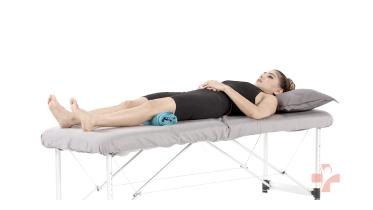 Quad sets (towel under knee)
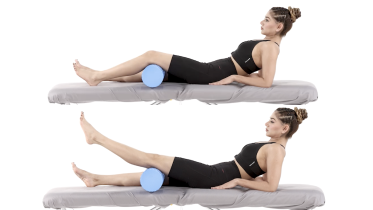 Short arc quads
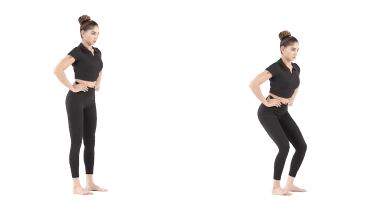 Mini squat
 Step up
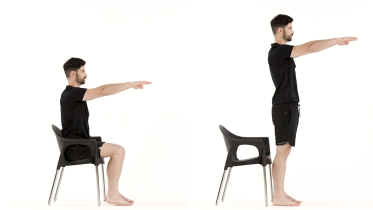 Sit to stand
When to see a physio (physical therapist)
Get the knee looked at if the noise has arrived along with pain, swelling, catching or a sense that the knee might let you down, if it is putting you off activities you would otherwise do, or if it has worried you enough that you have been avoiding movement. That last reason is a good one on its own. A physio can test the kneecap, press the joint line, check how far the knee straightens, watch you squat and tell you which, if any, of it matters.
Go the same day instead if the click hurts, if the knee locks or keeps giving way, or if it is hot, red and swollen. Anyone still growing needs the knee examined before starting exercises. Knee pain by body area lists the other knee pages here, and every warning sign below carries its own timing.
Related exercise programs
Warning signs
Get emergency help now
- Emergency: the knee became very swollen very quickly, within a few hours of a twist, fall or blow, or you felt a pop or snap. Go to an emergency department straight away. Do not drive yourself: ask someone to drive you or call an ambulance.
- Emergency: the knee has moved out of place, looks misshapen or is pointing at an odd angle, or you have tingling or no feeling in the knee, leg or toes, or your foot turns cold, pale or blue. Go to an emergency department straight away. Do not drive yourself: ask someone to drive you or call an ambulance.
- Emergency: you felt a sudden pop or tearing feeling just above or below your kneecap, you can see or feel a dip there, the kneecap seems to have moved up toward the thigh or to sag lower than usual, or you suddenly cannot straighten your knee or lift your leg out straight. Stop exercising and go to an emergency department straight away, even if you can still walk, as this can be a torn tendon at the front of the knee, either below the kneecap (patellar tendon) or above it (quadriceps tendon). Do not drive yourself. A repair usually does better if it is done soon after the injury.
- Emergency: the kneecap has slipped out of place, even if it went back by itself. If it is still out of place, go to an emergency department straight away, and do not drive yourself. If it went back by itself, get medical advice the same day.
- Emergency: you are still growing and have pain that wakes you at night, pain at rest that keeps getting worse, or a lump or swelling around the knee or thigh that keeps growing. If you also have a rash that does not fade when you press it, call emergency services or go to an emergency department.
Get help today
- Same day: the knee clicks painfully when you bend or straighten it. Get medical advice the same day. Painless clicking on its own is common.
- Same day: the knee is locked, which means it is stuck bent and you cannot fully straighten it, even after gently trying to move it, or you cannot bend or straighten the leg at all. Get assessed the same day by a doctor, at urgent care or at an emergency department. A torn piece of meniscus can get caught in the joint and block it, and when a tear like this can be repaired, it should be done as early as possible. A knee that catches for a moment and then frees itself can happen with a meniscus tear. That is not the same as a locked knee, but tell your physio or doctor about it.
- Same day: the knee keeps giving way under you, or it gave way after a recent injury, or it gives way and is also very painful or swollen. Get medical advice the same day. If it only happens now and then, with no recent injury and no swelling, it is not an emergency, but book an assessment with a physio or doctor in the next few days. Until it has been checked, leave out the exercises you do standing on one leg, hold the rail on stairs and take care on uneven ground, because a knee that gives way without warning is how people fall.
- Same day: the knee swells up with no clear reason, especially if you take medicine to thin your blood. Get medical advice the same day.
- Same day: the knee is hot, red and swollen, or you have knee pain with a high temperature or feel hot, cold or shivery. Get medical advice the same day, and go to an emergency department if you feel very unwell. This can be a sign of infection in the joint, which needs treatment quickly.
- Same day: you are a teenager who is still growing and you have a limp, or pain in the hip, groin or thigh as well as the knee. Get an urgent appointment with a doctor the same day, and stay off sport and these exercises until you have been checked. If you cannot put weight on the leg, have a high temperature or feel very unwell, go to an emergency department. Some hip problems in growing teenagers, such as a slipped growth plate at the top of the thigh bone (slipped capital femoral epiphysis), are felt in the knee and need checking quickly.
- Same day: pain at night or at rest that keeps getting worse. If you are being treated for cancer now, contact your cancer team the same day.
Book an appointment
- Within a day or two: you are still growing and have pain that wakes you at night, pain at rest that keeps getting worse, or a lump or swelling around the knee or thigh that keeps growing. See a doctor within a day or two. Ask for an urgent appointment rather than the next routine one, and say what the pain does at night and whether a lump is getting bigger. Do the same if the pain comes with looking pale, unusual tiredness, fevers with no clear cause, bruising or bleeding easily, or weight loss. Bone pain that is worse at night, or a new lump, needs checking to rule out rarer causes such as a bone tumor or a blood cancer (leukemia).
- Within a day or two: pain at night or at rest that keeps getting worse. If you have had cancer, now or in the past, see your doctor sooner, within a day or two, and mention it, even if the pain is not getting worse. Do the same if you have knee pain and are losing weight without trying, even if it does not hurt at night.
- Within a few days: pain at night or at rest that keeps getting worse. See your doctor within a few days.
Common questions
Why does my knee click when I walk?
Usually because something soft is moving over something firm as the knee bends and straightens, and a walk puts the joint through that cycle a thousand times an hour. Tendons and the sheets of tissue around the kneecap can slide across bone with a small snap, and surfaces inside the joint can separate with a click as the load shifts. None of that means the joint is wearing out, and a noise that has been there for years without pain is very unlikely to be new damage. What is worth reporting is a change: a noise that has recently appeared alongside pain, swelling or a knee that catches. On its own, clicking while you walk is not something the NHS asks you to act on, and it lists painless clicking as normal.
Why does my knee click when I bend and straighten it?
Because that movement is where the kneecap engages its groove and where the soft tissue at the front of the knee is dragged across bone, so the click usually comes from the front. Noise at a particular angle, every single time, with no pain, is the ordinary version. A click that hurts is the one the NHS treats differently: it asks for advice from 111 the same day for a knee that locks, gives way or painfully clicks, while naming painless clicking as normal. A click that comes with a feeling of something catching, or with the knee not straightening all the way, is also worth an assessment rather than a wait.
Why does my knee click when I walk up stairs?
Stairs ask the kneecap to take several times your body weight through a small area, so the front of the knee is loaded hardest exactly where most noise is generated. That is also why stairs are where kneecap pain shows up first. The noise and the pain are separate things, though, which is the finding worth knowing: in 165 women with kneecap pain and 158 without, crepitus had no relationship with how much pain they got climbing stairs, or squatting, or with their function at all (de Oliveira Silva and colleagues, 2018). If stairs hurt rather than just click, our page on knee pain on stairs covers that, and the exercises on this page are the usual starting point either way.
What does knee clicking with pain mean?
It means the noise has stopped being the interesting part. A click that hurts when you bend or straighten the knee is on the NHS list for advice the same day, and the reason is that a painful click can come with something mechanical inside the joint, such as a torn meniscus, which OrthoInfo lists as causing catching or locking and a sense of the knee giving way. Pain in the same movement as the noise, swelling that follows activity, catching, or a knee that will not fully straighten are the four things to mention when you are seen. Do not try to work out which structure it is by listening to it, and do not test the noise repeatedly to see whether it still hurts.
Why does my knee pop out of place?
That is a different thing from a click, and it usually means the kneecap rather than the knee. A kneecap that slips sideways out of its groove normally buckles the knee, hurts a great deal at the front and swells afterward, and it needs checking even if it went back in on its own, because a piece of cartilage or bone can be chipped off as it moves. The NHS asks you to get a doctor to look at a kneecap that dislocated and went back by itself, usually with an x-ray, and to go to an emergency department, without driving yourself, if the knee has changed shape, swelled very quickly or you felt a pop or snap. Our patellar dislocation page covers what comes after. A knee that feels as though the whole joint shifted, rather than the kneecap, is a hospital assessment on the day.
References
- NHS. Knee pain. Page last reviewed 21 December 2023. https://www.nhs.uk/symptoms/knee-pain/
- NHS. Baker's cyst. Page last reviewed 26 June 2025. https://www.nhs.uk/conditions/bakers-cyst/
- NHS. Dislocated kneecap. Page last reviewed 10 March 2026. https://www.nhs.uk/conditions/dislocated-kneecap/
- NHS. Complications of a knee replacement. Page last reviewed 9 September 2026. https://www.nhs.uk/tests-and-treatments/knee-replacement/complications/
- Lo GH, Strayhorn MT, Driban JB, Price LL, Eaton CB, McAlindon TE. Subjective crepitus as a risk factor for incident symptomatic knee osteoarthritis: data from the Osteoarthritis Initiative. Arthritis Care and Research. 2018;70(1):53-60. https://doi.org/10.1002/acr.23246
- de Oliveira Silva D, Pazzinatto MF, Priore LBD, Ferreira AS, Briani RV, Ferrari D, Bazett-Jones D, Azevedo FM. Knee crepitus is prevalent in women with patellofemoral pain, but is not related with function, physical activity and pain. Physical Therapy in Sport. 2018;33:7-11. https://doi.org/10.1016/j.ptsp.2018.06.002
- Robertson CJ, Hurley M, Jones F. People's beliefs about the meaning of crepitus in patellofemoral pain and the impact of these beliefs on their behaviour: a qualitative study. Musculoskeletal Science and Practice. 2017;28:59-64. https://doi.org/10.1016/j.msksp.2017.01.012
- Kawchuk GN, Fryer J, Jaremko JL, Zeng H, Rowe L, Thompson R. Real-time visualization of joint cavitation. PLoS One. 2015;10(4):e0119470. https://doi.org/10.1371/journal.pone.0119470
- National Institute for Health and Care Excellence. Osteoarthritis in over 16s: diagnosis and management (NG226). 2022. https://www.nice.org.uk/guidance/ng226
- American Academy of Orthopaedic Surgeons. Meniscus Tears. OrthoInfo. https://www.orthoinfo.org/en/diseases--conditions/meniscus-tears/
- American Academy of Orthopaedic Surgeons. Total Knee Replacement. OrthoInfo. https://www.orthoinfo.org/en/treatment/total-knee-replacement/
Written and checked by the PocketPhysio editorial team. Last updated 2026-10-21.
This page is general education, not a diagnosis or a personal treatment plan. See a physiotherapist or doctor for advice about your own situation.