
Baker's cyst exercises and physiotherapy
What is a Baker's cyst?
A Baker's cyst, also called a popliteal cyst, is a fluid-filled lump at the back of the knee (NHS). It forms in a small sac of fluid (bursa) that sits between the calf muscle and one of the hamstring tendons. Unlike most of these sacs, it is joined to the knee joint by a small opening. When the knee makes extra fluid, some of it is pushed into the sac and it swells (Herman and Marzo, 2014).
The NHS lists a soft lump behind the knee, often easier to see when you stand, along with knee or leg pain, tightness or stiffness, trouble bending the knee and clicking. Symptoms may be worse after walking. Cysts are a common finding on knee scans, seen on up to 38% of MRI scans of painful knees, but symptoms from the cyst itself are uncommon and may depend on its size (Frush and Noyes, 2015).
Why it happens, and how this page differs from the knee pages
In adults, a Baker's cyst rarely appears on its own. It usually comes with another problem inside the knee, most often knee osteoarthritis, a meniscus tear or rheumatoid arthritis (Herman and Marzo, 2014). The NHS also lists a knee injury and gout.
So the cyst is usually a side effect of a knee problem rather than the whole story. If you already know you have osteoarthritis or a meniscus tear, the program on that page is written for you and is backed by trials. This page is for the extra things a cyst brings: a tight feeling behind the knee, trouble with a full bend, and the need to tell a burst cyst from a blood clot.
The advice here is written for adults. If a child has a lump behind the knee, a doctor should check it before they start any exercise program.
How a Baker's cyst is treated
Treatment aims at the knee problem underneath. The NHS lists painkillers, physiotherapy, a steroid injection into the knee, draining fluid from the cyst and surgery to repair damage inside the knee, and notes that surgery to remove the cyst itself is rare. Frush and Noyes (2015) advise at least 6 weeks of non-surgical treatment first, with physiotherapy that works on knee movement. They also note that a steroid injection into the knee has been found to shrink cysts and ease symptoms.
If surgery is needed, the problem inside the knee is usually dealt with first, and taking out the cyst itself is kept for cysts that keep causing trouble (Frush and Noyes, 2015). That still does not make surgery a first step. For knee osteoarthritis and wear-related meniscus tears, guidelines advise against keyhole surgery for nearly all people (Siemieniuk and colleagues, 2017), as the meniscus tear page explains.
For self-care, the NHS suggests resting the knee, an ice pack wrapped in a towel for around 10 minutes, raising the leg, and paracetamol (acetaminophen) or ibuprofen. Recovery can take a few months to a few years (NHS).
Why exercise is used
Evidence here is thin. No trial has tested an exercise program for a Baker's cyst on its own. Exercise is used because it is a core treatment for the knee problems that usually cause the cyst, and the knee osteoarthritis and meniscus tear pages set out that evidence.
The program keeps the knee bending and straightening and builds strength in the thigh, hip and calf. The later stages bring back stairs and control on one leg. The idea is that a calmer knee makes less extra fluid to feed the cyst, though a cyst can still ache after the knee problem has been treated (Frush and Noyes, 2015).
How to use the stages
Start with the stage that fits how your knee is today, or stage 1 if in doubt. Move up once the current stage feels easy and the knee is no worse the next morning. Treat those signs as a rough guide from common practice. They are not fixed rules.
You will find a typical starting dose on each exercise page. For the strength exercises, many programs use 2 to 3 sets of 8 to 15 repetitions, once a day or on a few days each week, and start with fewer for sit to stand and step ups. The gentle stage 1 work, such as quad sets and heel slides, is often done 2 or 3 times a day. Your physio will change the exercises and these numbers to fit your knee.
Stage 1 should stay comfortable. From stage 2, some mild discomfort while you exercise is usually fine, as long as it has gone soon after you stop and the knee is no worse the next morning. A tighter, bigger lump or more swelling the next day means the load was too much. Drop back a step, such as a smaller bend or a lower step, rather than stopping altogether.
The exercise program
Stage 1: Keep the knee moving and the thigh working
Start here if the back of your knee feels tight, swollen or sore, or if exercise is new to you. Everything is done lying down or sitting, so the muscle at the front of your thigh (quadriceps) can work without the knee taking your body weight. Keep this stage comfortable, and slide the heel only as far as feels easy, because a full bend often squeezes the lump and feels tight. Ankle pumps get the calf muscle moving, which is useful if you are sitting or resting more than usual. They do not treat calf swelling: if your calf becomes newly swollen, warm or painful, stop and follow the warning signs on this page.
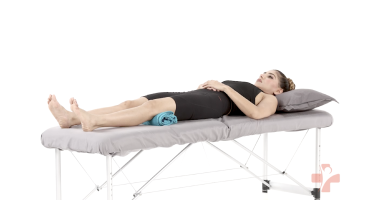 Quad sets (towel under knee)
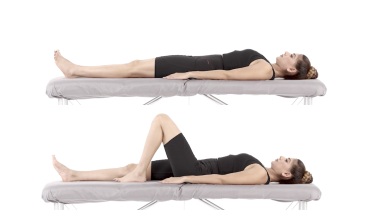 Heel slides
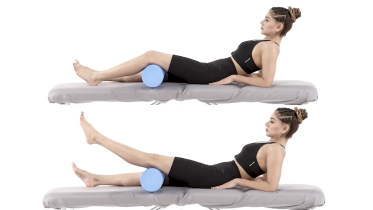 Short arc quads
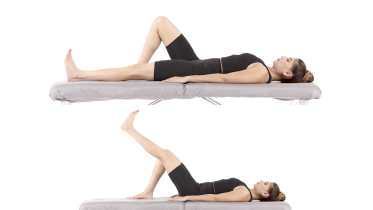 Straight leg raise
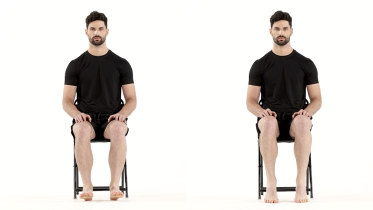 Ankle pumps
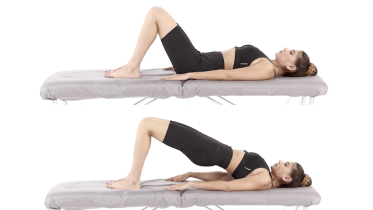 Glute bridge
Stage 2: Strength on your feet
Move on once stage 1 is easy and the knee settles well afterward. The band adds load to the knee extension, and sit to stand trains the movement you use every time you get out of a chair. Keep the mini squat shallow at first, with your kneecap pointing over your second toe. The hamstring curl bends the knee against gravity, so stop short if the back of the knee feels tight. Calf raises work the calf muscles that sit beside the cyst; stop them and get checked if the calf becomes newly swollen, warm or painful.
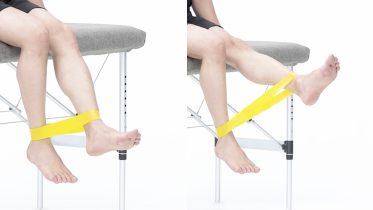 Seated knee extension with band
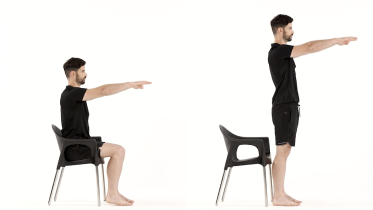 Sit to stand
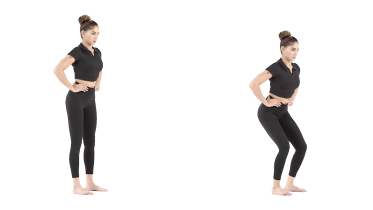 Mini squat
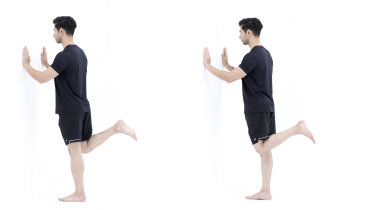 Standing hamstring curl
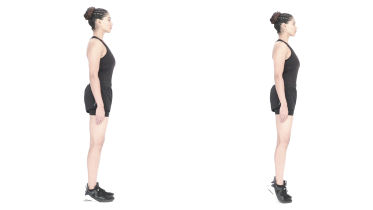 Calf raises
Stage 3: Stairs, balance and one leg at a time
When stage 2 feels easy and the knee is no worse the next morning. Step ups practice stairs, so start with a low step about the height of one stair. The ball against the wall supports your back while you squat a little deeper, but only as deep as the back of the knee allows. Side lying hip abduction works the side of the hip, which helps control the knee. For single leg stance, stand by a kitchen counter so you can grab it if you wobble.
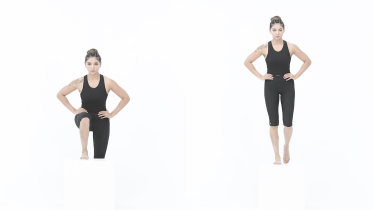 Step up
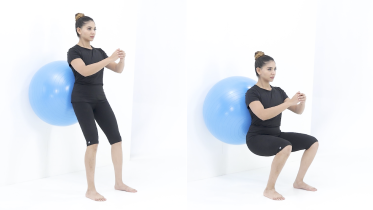 Ball wall squat
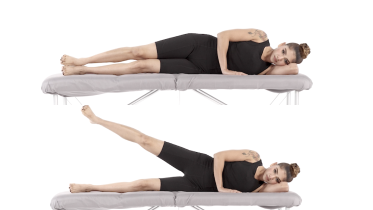 Side lying hip abduction
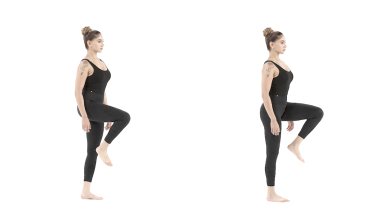 Single leg stance
What to change while your knee settles
Pain from a cyst often comes at the very end of a full bend or a full straighten (Frush and Noyes, 2015), so many people find full squats, kneeling and sitting back on their heels uncomfortable. Many physios hold these back and bring them in slowly through the stages. No trial has tested this. It is simply how many physios work. Keep bending and straightening the knee as far as is comfortable, though, because avoiding movement altogether can leave the knee stiff (Frush and Noyes, 2015).
Walking can make the symptoms worse (NHS), so build up your walking in small steps and cut back if the back of the knee is tighter the next morning.
When to see a physio or doctor
See a doctor if you have a lump behind your knee that has not been checked, as the NHS advises for any lump you cannot identify. See a physio or doctor if the pain is stopping you walking, sleeping or doing daily tasks, or if the knee is not improving after several weeks of regular exercise. If you cannot tell which stage suits you, a physio can help you choose at the start.
If you have a heart or lung condition, or your blood pressure is not under control, ask your doctor before starting. Had a fall recently, or feel unsteady? Keep a kitchen counter within reach for the standing exercises. If you have had knee surgery, follow the program your surgeon and physio gave you. Pregnant? Ask your midwife, doctor or physio first.
For physiotherapists
This is a starting program for patients with a symptomatic popliteal cyst. It sends them to the knee osteoarthritis and meniscus tear programs for the underlying condition. The cyst is a distension of the gastrocnemio-semimembranosus bursa, which communicates with the joint through a capsular opening behind the medial femoral condyle. A valve-like mechanism in the presence of effusion is the usual explanation for cyst formation in adults (Herman and Marzo, 2014). In children, cysts are less often linked to joint disease and are often incidental (Herman and Marzo, 2014).
Rupture can present as pseudothrombophlebitis. Clinical signs alone do not separate it from a DVT, so refer the same day for any new calf swelling, warmth, tenderness or bruising. Frush and Noyes (2015) also describe compartment syndrome from bleeding after rupture, often in patients started on anticoagulants for suspected DVT, and rare compression of the popliteal vessels or tibial nerve. Calf pain out of proportion, or calf pain and swelling that keep escalating, needs emergency assessment. Ultrasound and MRI are both accurate for confirming a cyst (Herman and Marzo, 2014).
Frush and Noyes (2015) report cysts on up to 38% of MRIs of symptomatic knees, with symptoms that may relate to cyst size. They advise at least 6 weeks of nonoperative care with an emphasis on knee flexibility, since pain at terminal flexion and extension can otherwise leave the knee stiff. When surgery is indicated, they address the intra-articular lesion first; read that alongside the guideline against arthroscopy for degenerative knee disease (Siemieniuk and colleagues, 2017). Posterior knee pain can persist after the intra-articular lesion is treated. There is no trial evidence for a cyst-specific exercise program, so progress load on the underlying condition and on how the effusion responds.
See a doctor promptly if
- Same day: a calf or thigh that is newly swollen, warm, tender, red or darker than usual, has swollen veins that are sore to touch, or has a throbbing or cramping pain that does not fit your injury or condition, or that feels different from normal muscle soreness after exercise. This can be a sign of a blood clot (deep vein thrombosis), especially after surgery, an injury, time in a cast or boot, a long trip or a spell of being much less mobile than usual. Get medical advice the same day. If you are also short of breath or have chest pain, call emergency services.
- Emergency: sudden, severe pain in your calf that is much worse than you would expect or keeps getting worse, especially if you take medicine to thin your blood. It may come with a tight, swollen calf, pain that gets worse when the muscle is stretched, numbness, pins and needles or weakness. Call emergency services or go to an emergency department straight away, and do not drive yourself. Rarely, bleeding from a burst cyst builds up pressure inside the calf (compartment syndrome), which needs urgent surgery.
- Same day: pain or swelling in your calf or leg that suddenly gets worse, or new bruising on your leg, even if you know you have a Baker's cyst. Get medical advice the same day. A burst cyst and a blood clot can look exactly the same, and a doctor may need a scan to tell them apart. Do not assume it is the cyst.
- Same day: new numbness, pins and needles or weakness in your calf or foot. Get medical advice the same day, as a large cyst can rarely press on a nerve. If your foot turns cold, pale or blue compared with the other side, go to an emergency department straight away, and do not drive yourself.
- Same day: the knee is hot, red and swollen, or you have knee pain with a high temperature or feel hot, cold or shivery. Get medical advice the same day, and go to an emergency department if you feel very unwell. This can be a sign of infection in the joint, which needs treatment quickly.
- Same day: you cannot put weight on the leg after a fall or injury. Get medical advice the same day. If the knee has changed shape, swelled up very quickly or you felt a pop or snap, or your foot turns cold, pale or blue or you have tingling or no feeling in the leg or foot, go to an emergency department straight away, and do not drive yourself.
- Same day: the knee locks and you cannot straighten it. Get medical advice the same day.
- Same day: the knee swells up quickly and a lot, with no clear reason, especially if you take medicine to thin your blood. Get medical advice the same day.
- Within a few days: a lump behind your knee that no doctor has checked, or a lump that is getting bigger or feels hard. See your doctor within a few days. Most lumps here are Baker's cysts, but other problems can look similar, so it is worth confirming what it is.
- Within a few days: pain at night or at rest that keeps getting worse. See your doctor within a few days. If you have had cancer, now or in the past, see your doctor sooner, within a day or two, and mention it, even if the pain is not getting worse. Do the same if you have knee pain and are losing weight without trying, even if it does not hurt at night. If you are being treated for cancer now, contact your cancer team the same day.
Common questions
Will a Baker's cyst go away on its own?
It can, but it is often slow. The NHS says recovery can take anything from a few months to a few years. Because the cyst is usually fed by extra fluid from a problem inside the knee, it tends to settle when that problem settles. A review by Frush and Noyes (2015) notes that a cyst can still cause pain behind the knee even after surgery for the problem inside the joint.
Can I exercise with a Baker's cyst?
Usually yes. The NHS lists physiotherapy among the treatments, and gentle exercise keeps the knee moving and the thigh strong. There are no trials of exercise for the cyst itself, so the program here follows the advice for the knee problems that usually cause it. If an exercise makes the back of the knee much tighter or more swollen the next day, drop back a step.
What happens if a Baker's cyst bursts?
The fluid leaks down into the calf. The NHS says the symptoms get worse for a while, and the swelling can take weeks to go down. Doctors call this a pseudothrombophlebitis, because it looks like a blood clot in the leg (Herman and Marzo, 2014). Any new calf swelling, warmth or bruising needs medical advice the same day, so a clot can be ruled out.
Should a Baker's cyst be drained?
Not usually as a first step. The NHS lists draining the fluid, a steroid injection into the knee and surgery to repair damage inside the knee among the options, and says surgery to remove the cyst itself is rare. If surgery is needed, it is usually aimed at the problem inside the knee first, and removing the cyst itself is saved for cysts that keep causing trouble (Frush and Noyes, 2015). For knee osteoarthritis and wear-related meniscus tears, guidelines advise against keyhole surgery for nearly all people, so exercise comes first. Your doctor will talk through which option fits your knee.
How can I tell a Baker's cyst from a blood clot?
You cannot tell reliably at home. A burst or leaking cyst and a blood clot can both cause a swollen, painful, warm calf. If your calf or leg is newly swollen or painful, get medical advice the same day, and call emergency services if you are also short of breath or have chest pain.
References
- NHS. Baker's cyst. Page last reviewed 26 June 2025. https://www.nhs.uk/conditions/bakers-cyst/
- Herman AM, Marzo JM. Popliteal cysts: a current review. Orthopedics. 2014;37(8):e678-e684. https://doi.org/10.3928/01477447-20140728-52
- Frush TJ, Noyes FR. Baker's cyst: diagnostic and surgical considerations. Sports Health. 2015;7(4):359-365. https://doi.org/10.1177/1941738113520130
- Siemieniuk RAC, Harris IA, Agoritsas T, et al. Arthroscopic surgery for degenerative knee arthritis and meniscal tears: a clinical practice guideline. BMJ. 2017;357:j1982. https://doi.org/10.1136/bmj.j1982
- NHS. Deep vein thrombosis (DVT). Page last reviewed 30 April 2026. https://www.nhs.uk/conditions/deep-vein-thrombosis-dvt/
Written and checked by the PocketPhysio editorial team. Last updated 2026-09-28.
This page is general education, not a diagnosis or a personal treatment plan. See a physiotherapist or doctor for advice about your own situation.