Short arc quads
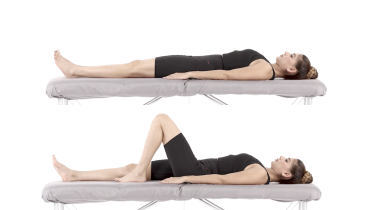
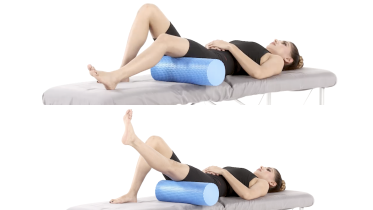
Short arc quads strengthen the front of the thigh (quadriceps) through the last part of straightening the knee. You rest your knees over a roller and lift one heel until the leg is straight. It is commonly used early in knee rehab and after knee surgery.
How to do the short arc quads
- Lean back on your forearms on a bed, as in the video, with both legs out in front. If that strains your back or shoulders, lie flat with a pillow under your head.
- Place a foam roller across the bed under both knees. A firm rolled towel or blanket works if you do not have one. Let your legs rest comfortably over it, knees slightly bent and heels on the bed.
- On your affected leg, tighten the front of your thigh and lift your heel off the bed until the knee is fully straight. The back of the knee stays resting on the roller.
- Hold the straight position for 3 to 5 seconds. Keep breathing.
- Lower the heel slowly back to the bed and relax.
- If your program includes both legs, repeat with the other leg.
What you should feel
Work in the front of the thigh, strongest when the knee is fully straight.
Common mistakes
- Lifting the back of the knee off the roller, which turns it into a leg raise.
- Stopping short of fully straight. That last bit is the point of the exercise.
- Letting the heel drop instead of lowering it.
- Holding your breath during the hold.
How often
Many programs use 2 to 3 sets of 10 to 15 with a 3 to 5 second hold at the top, once or twice a day. After surgery, the plan from your surgeon and physio comes first, and your physio will adjust the numbers as you go.
From the clinic
This is the exercise for a knee that will not finish straightening. The thigh muscle struggles most in the last part of the way to straight, and that is the part the roller hands to you: the knee starts slightly bent, so every repetition finishes in the range that is hardest to hold. Walking on a knee that stays a little bent is tiring, and the leg often feels as though it might let go, which is why full straightening gets chased early after a knee replacement, an ACL reconstruction or a spell in a brace.
The size of the roller changes the exercise. A bigger roller starts the knee more bent and asks more of the thigh, while a small towel roll keeps the movement short. If the knee will not go fully straight yet, lift as far as you can and hold there.
Rest one hand on the roller while you lift. If the roller shifts, or the back of the knee comes away from it, the hip has taken over and the knee is going along for the ride, which is the commonest way this exercise ends up doing nothing at all. Your heel should be the only thing that rises. Put the other hand on the front of the thigh and you get the rest of the answer: the muscle goes firm and the kneecap slides up a little when the work is landing where it should.
A working ache at the front of the thigh, with a tight pull behind the knee as the leg reaches straight, is what to expect. That pull is usually stiffness rather than harm, and it often eases off over a set. Sharp pain, or a knee that is puffier by evening than it was that morning, means the amount was too much for now: go back to the easier end of what your physio gave you, and tell them.
Physios often use it as a step between quad sets and straight leg raises, for a knee that still bends when you try to lift the whole leg.
Take the roller out when you finish. After knee surgery, do not rest for long with a pillow or roll under the knee, because the knee can stiffen in a bent position.
Before you start
- After a knee fracture or knee surgery, including a knee replacement, follow your surgeon's or physio's plan, and start this exercise only when they have cleared you.
When to stop and get help
- Knee pain increases sharply during the set.
- Your calf or thigh is getting more swollen, or becomes warm, tender, red or darker than usual, or has a new throbbing or cramping pain. This can be a blood clot, especially after an operation, an injury, time in a cast, boot or brace, or a spell of being much less mobile than usual, and after an operation it can also be an infection. Stop and contact your medical team or get medical advice the same day. If you are also short of breath or have chest pain, call emergency services.
- Your wound becomes more red, hot, swollen or painful, or starts to leak. Contact your medical team the same day.
Reviewed by the PocketPhysio by VirtueLife expert physiotherapy team. Last reviewed 2026-09-25.
This page is general education, not a diagnosis or a personal treatment plan. If you have pain, an injury or a health condition, see a physiotherapist or doctor before starting new exercises.