Seated knee extension with band
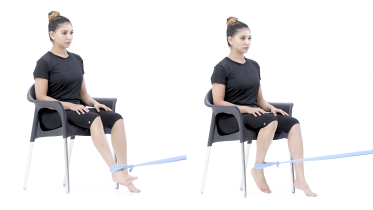
This seated knee extension uses a loop band around both ankles for resistance. One leg stays still and holds the band down while the other straightens against it, then bends back under control. It works the big muscle group on the front of your thigh (quadriceps). Think of it as the plain seated knee extension with a bit more load.
How to do the seated knee extension with band
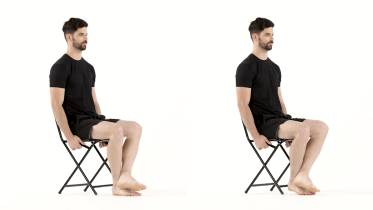
- Sit up straight on a treatment table, tall bed or high chair so both lower legs hang down, with your thighs supported and your hands resting on the edge beside you.
- Slip a light loop band around both ankles. Smooth it flat against your skin so it does not roll into a cord.
- Keep one leg still, hanging straight down. This is the anchor leg, and it holds the lower end of the band in place.
- Slowly straighten the knee of your working leg, lifting the foot forward and up against the band until the leg is straight, or as close to straight as you can control.
- Pause briefly at the top with your thigh muscles firm, then bend the knee slowly back down, letting the band shorten under control.
- Finish your reps, then switch so the other leg works, if your program includes both.
What you should feel
Effort along the front of your working thigh, building as the knee straightens and the band stretches. The anchor leg works a little too, just to stay put.
Common mistakes
- Letting the anchor leg drift forward with the band, so the tension disappears.
- Leaning back or lifting the thigh off the seat to raise the foot higher.
- Relaxing at the top so the band pulls the foot back down fast.
- Choosing a band so strong that the knee cannot get near straight.
How often
Programs commonly begin with a light band and 2 sets of 10 to 15 slow reps on each leg, building toward 3 sets. Your physio will adjust this.
Stop and check with your physio if
- Sharp pain at the front of the knee or behind the kneecap.
- The knee swells, or aches clearly more by that evening or the following day.
- Your calf or thigh is getting more swollen, or becomes warm, tender, red or darker than usual, or has a new throbbing or cramping pain. This can be a blood clot, especially after an operation, an injury, time in a cast, boot or brace, or a spell of being much less mobile than usual, and after an operation it can also be an infection. Stop and contact your medical team or get medical advice the same day. If you are also short of breath or have chest pain, call emergency services.
From the clinic
The voice guide with this video describes pulling the heel back to bend the knee against the band, which is a hamstring exercise. The video shows the opposite movement, the knee straightening against the band, and these steps follow the video. If your physio wants you to bend the knee against resistance, see the seated hamstring curl with band.
Take the band away and you have the seated knee extension. Start there if the band feels like too much. Check the band for nicks or thin spots before each session, since a band that splits can whip against your leg. After an ACL reconstruction or other knee ligament surgery, follow your surgeon's and physio's plan before you use a band. Many ACL programs hold back on straightening the knee against a band or weight at the ankle in the early months, or allow it only through part of the range, to protect the new ligament.
Written and checked by the PocketPhysio editorial team. Last updated 2026-09-26.
This page is general education, not a diagnosis or a personal treatment plan. If you have pain, an injury or a health condition, see a physiotherapist or doctor before starting new exercises.