
Meniscus tear exercises and physiotherapy
What is a meniscus tear?
The meniscus is a rubbery pad of cartilage that sits between your thigh bone and your shin bone. Each knee has two, one on the inner side and one on the outer side. A tear can cause pain and tenderness around the knee, swelling and stiffness, trouble bending or straightening the knee, and a clicking or crunching feeling as it moves (NHS). Some people also find the knee gives way when they stand.
There are two main kinds, and which one you have changes the advice. A degenerative tear builds up slowly as the meniscus ages. The ESSKA consensus describes it as a slowly developing tear in a person over 35, without a significant injury (Beaufils and colleagues, 2017). OrthoInfo notes that an awkward twist getting up from a chair can be enough to tear an aging meniscus.
A traumatic tear comes with a clear injury and sudden knee pain (Kopf and colleagues, 2020). It often happens in sport, from a twist or a change of direction on a bent knee, and it often comes with other damage inside the knee, such as a torn anterior cruciate ligament (ACL) (OrthoInfo).
Degenerative tears are very common, and many cause no pain at all. In a study that scanned the right knee of 991 people aged 50 to 90, 61% of those with a meniscus tear had not had any knee pain, aching or stiffness in the previous month (Englund and colleagues, 2008). So a tear on a scan does not always explain the pain. That is one reason physios treat the whole knee instead of chasing the tear.
Degenerative or injury tear: which advice fits you?
If you are middle-aged or older and the pain came on gradually, or after an everyday twist, your tear is most likely degenerative. The program on this page is written mainly for you, and exercise is a first-line treatment.
If you are younger and the pain started with a clear injury in sport or a fall, get the knee assessed early by a physio, sports doctor or orthopedic surgeon. Do not wait months to see whether it settles. The ESSKA consensus on injury tears says keeping the meniscus should be the first choice when possible, and that when a repair is needed, it should be done as early as possible, because early repairs appear to do better (Kopf and colleagues, 2020). Once you have been assessed, and if non-surgical care is advised, the program below is a reasonable starting point.
If you have had surgery on your meniscus, follow the program from your surgeon and physio. This page does not cover rehab after meniscus surgery.
This page is for adults. A child or teenager with a knee injury should be assessed by a doctor or physio before starting any exercise program. If you are pregnant, check with your midwife, doctor or physio before you start.
Why does exercise help a degenerative meniscus tear?
In a Norwegian trial of 140 adults aged about 36 to 60 with a degenerative tear on the inner side of the knee, a 12 week supervised exercise program gave knee results similar to keyhole surgery to trim the meniscus (arthroscopic partial meniscectomy) after 2 years. The exercise group also had stronger thigh muscles at 3 months (Kise and colleagues, 2016). A Dutch trial of 321 people aged 45 to 70 found physical therapy was not worse than surgery for knee function over 2 years (van de Graaf and colleagues, 2018). At 10 years, the Norwegian trial still found similar results in both groups, including similar changes on X-ray (Berg and colleagues, 2025).
Guidelines point the same way. A BMJ guideline panel made a strong recommendation against arthroscopic surgery in nearly all people with degenerative knee disease, whether or not the knee clicks or catches, and named a knee that truly cannot straighten as the only possible exception (Siemieniuk and colleagues, 2017). The European knee society ESSKA agrees that trimming the meniscus should not be offered as the first treatment. It suggests 3 to 6 months of non-surgical care first, such as physiotherapy or home exercise, with anti-inflammatory medicine or an injection if needed (Beaufils and colleagues, 2017).
Exercise does not settle every knee. In the Norwegian and Dutch trials, 19% and 29% of the people in the exercise groups went on to have surgery within the 2 years. Both trials left out people whose knee was locked, and the evidence for exercise after an injury tear in younger people is much thinner.
How to use this program
Pick the stage that matches your knee today. If you are not sure, start at stage 1, and move up when the current stage feels easy and your knee is no worse the next morning. These signs are a rough guide from common practice, not fixed rules.
Each exercise page gives a typical starting dose. As a rough guide, many programs use 2 to 3 sets of 6 to 15 repetitions for the strength exercises, with fewer sets at first for the harder stage 3 exercises, done once a day or a few days a week. Some gentle stage 1 exercises, such as quad sets and heel slides, are often done 2 or 3 times a day, and wall sit holds usually start at 10 to 30 seconds. In the trials, a physio supervised the exercise 2 to 3 times a week for 12 weeks (Kise and colleagues, 2016) or twice a week for 8 weeks (van de Graaf and colleagues, 2018). Your physio will adjust the exercises and the numbers to suit your knee.
If your knee was injured recently, keep stage 1 pain free. After that, mild discomfort during the exercises is usually fine if it settles soon after you finish and the knee is no worse the next morning. Sharp pain along the side of the joint, a knee that catches during an exercise, or more swelling the next day means the load was too much. Drop back a step, such as a shallower squat or a lower step, rather than stopping altogether. If the knee locks and will not straighten, stop and see the warning signs below.
The exercise program
Stage 1: Get the thigh working and the knee moving
For a knee that is sore, swollen or recently injured, and for anyone new to exercise. These are done lying or sitting, so the knee is not carrying your body weight yet while the big muscle at the front of your thigh (quadriceps) starts working again. Heel slides bring back bending, so slide only as far as is comfortable and do not force the last part of the bend. Keep this stage pain free if the knee was injured recently.
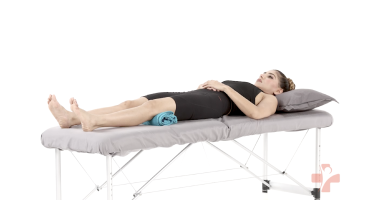 Quad sets (towel under knee)
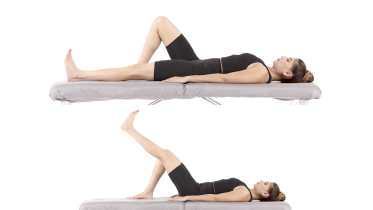 Straight leg raise
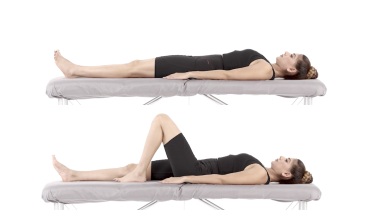 Heel slides
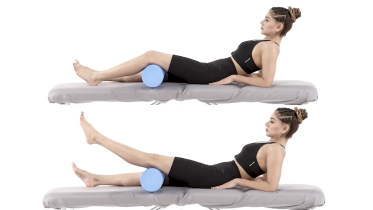 Short arc quads
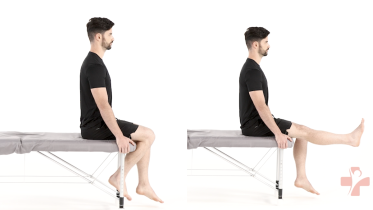 Seated knee extension
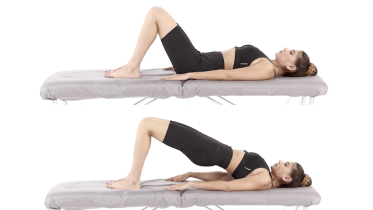 Glute bridge
Stage 2: Build strength standing up
When stage 1 feels easy and your knee settles well afterward. The band makes the seated knee extension harder, and the squats train the knee with your weight on it, so only bend as deep as feels comfortable and controlled, with your kneecap pointing over your second toe. The ball and the wall support your back while you get used to squatting. Use a low step for the step up, about the height of one stair, and do the single leg stance next to a kitchen counter you can hold.
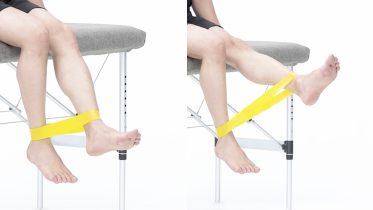 Seated knee extension with band
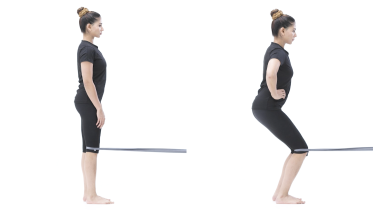 Terminal knee extension with band
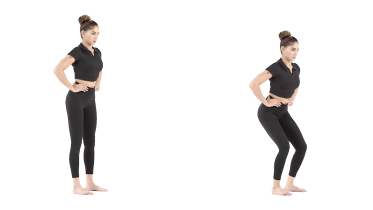 Mini squat
 Ball wall squat
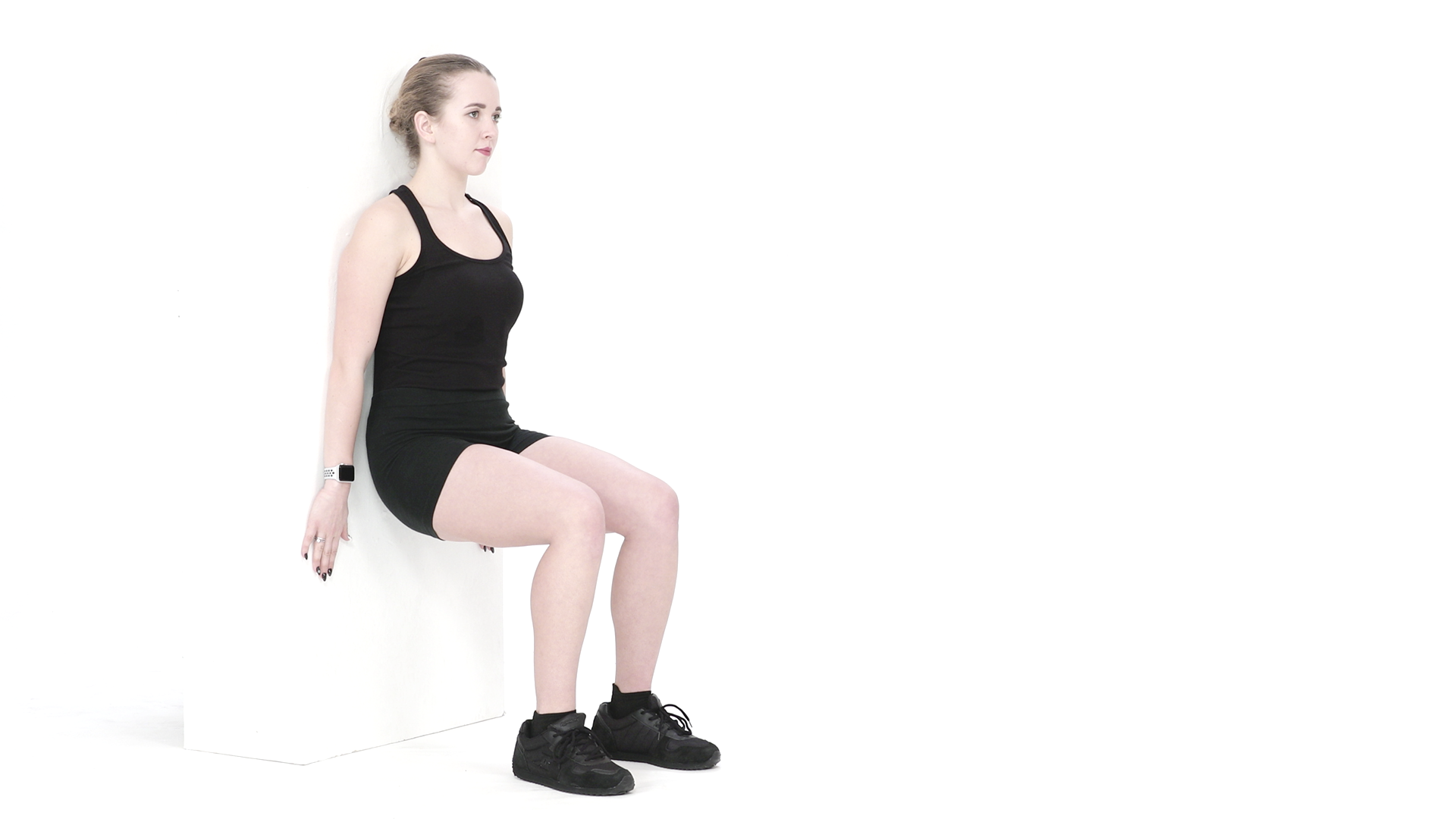 Wall sit
 Step up
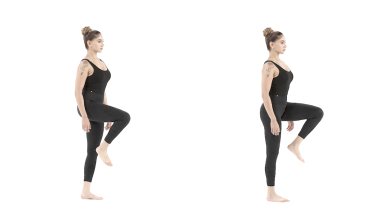 Single leg stance
Stage 3: Single leg strength and balance
When stage 2 feels easy and the knee is no worse the next morning. The Norwegian trial described above included balance and control work (neuromuscular exercise), and these exercises train the knee to stay steady on one leg. Start the split squat and the lunge onto the pad with a short range, and keep a counter or wall within reach for the clock reach and the lunge. If you play a sport with twisting and jumping, your physio can plan the last steps back to it.
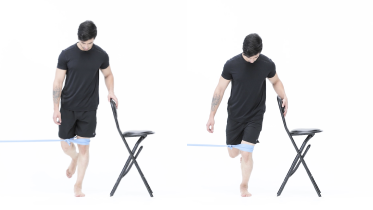 Single leg mini squat with band
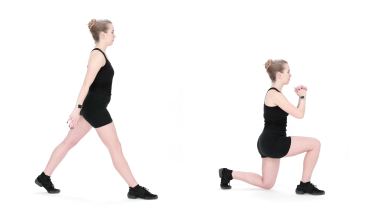 Split squat
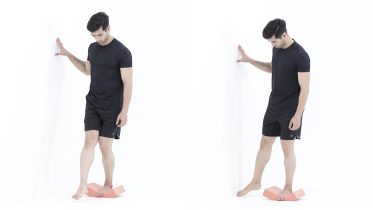 Single leg clock reach
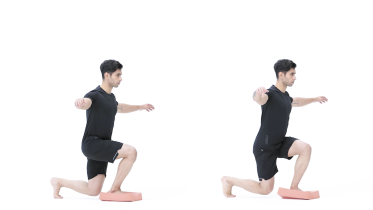 Balance pad lunge
What to change while your knee settles
In the first few days after a flare or an injury, the NHS advises stopping exercise and resting the knee when you can, without stopping moving it completely. After a few days, try some gentle movements. An ice pack wrapped in a towel, for up to 20 minutes every 2 to 3 hours, can ease the pain. The NHS also advises against carrying anything heavy at this stage.
After that, keep active and cut back only on the things that flare the knee. Many physios hold back deep squats, kneeling, and twisting on a bent knee until the knee has calmed down, then bring them back in small steps through the stages. That is common practice, not a tested rule.
When is surgery worth discussing?
For a degenerative tear, the ESSKA consensus suggests surgery may be considered if pain or catching persists after about 3 months despite non-surgical care, and earlier for people with considerable catching or locking (Beaufils and colleagues, 2017). That earlier option rests on expert opinion, and ESSKA itself notes that catching and locking symptoms are hard to define. The BMJ panel went further and advised against arthroscopy in nearly all cases, whether or not the knee catches, with a true locked knee as the only possible exception (Siemieniuk and colleagues, 2017). The two groups differ on how much catching matters, so this is a conversation to have with a knee surgeon if the exercises have not helped.
For an injury tear in a younger person, the question is often whether the tear can be repaired, and timing matters because early repairs appear to do better (Kopf and colleagues, 2020). If that is you, book an assessment soon instead of waiting it out.
When to see a physio or doctor
See a physio or doctor if knee pain is stopping you doing normal activities or affecting your sleep, if it is getting worse or keeps coming back, if it has not improved after looking after it at home, or if your knee is stiff for more than 30 minutes after waking up (NHS). It is also worth getting help at the start if you are not sure which stage suits you.
Book an assessment in the next few days if your knee pain started with a clear twisting injury and you are young and active, even if it seems to be settling. Some signs need help faster, from an emergency visit to an appointment within a few days. They are listed under the warning signs below.
Check with your doctor before you start if you have a heart or lung condition, or blood pressure that is not under control. If you have fallen recently or feel unsteady, do the standing exercises next to a kitchen counter.
For physiotherapists
This page gives patients a starting framework for a degenerative meniscus tear, and for a traumatic tear once it has been assessed and non-operative care chosen. It does not cover postoperative rehab. Kise and colleagues (2016) included adults aged 35.7 to 59.9 with an MRI-verified degenerative medial tear, 96% without definitive radiographic osteoarthritis, and excluded acute trauma, locked knee and ligament injury. Their program ran for 12 weeks, 24 to 36 supervised sessions of progressive neuromuscular and strength exercise, and KOOS4 at 2 years did not differ between groups. The ESCAPE program was 16 sessions over 8 weeks, focused on coordination and closed kinetic chain strength (van de Graaf and colleagues, 2018).
The ESSKA degenerative consensus defines the lesion as slowly developing, typically a horizontal cleavage in a patient over 35 without significant trauma. It does not recommend MRI in the first-line work-up of middle-aged or older patients with knee pain, and advises weight-bearing radiographs first (Beaufils and colleagues, 2017). The BMJ panel's one possible exception, a true locked knee, means a patient who is objectively unable to fully extend the knee (Siemieniuk and colleagues, 2017), so test passive extension against the other side before you start the program. Incidental tears are common on MRI in people aged 50 to 90 (Englund and colleagues, 2008), which is worth explaining to patients who arrive with a scan report.
For traumatic tears, the 2019 ESSKA consensus puts meniscus preservation first, recommends repair as early as possible when repair is indicated, and recommends prompt repair of a nonreducible bucket-handle tear. It also states that small lateral tears of 10 mm or less can be left alone, though this is graded expert opinion and rests mostly on stable tears left in situ at ACL reconstruction, and that MRI should be decided by a musculoskeletal specialist when arthroscopy is being considered (Kopf and colleagues, 2020). In a young patient with a traumatic mechanism, a block to extension or a rapid effusion, refer for early orthopedic assessment rather than starting a home program.
See a doctor promptly if
- Emergency: the knee has moved out of place, looks misshapen or is pointing at an odd angle, or you have tingling or no feeling in the knee, leg or toes, or your foot turns cold, pale or blue. Go to an emergency department straight away. Do not drive yourself: ask someone to drive you or call an ambulance.
- Same day: the knee is locked, which means it is stuck bent and you cannot fully straighten it, even after gently trying to move it, or you cannot bend or straighten the leg at all. Get assessed the same day by a doctor, at urgent care or at an emergency department. A torn piece of meniscus can get caught in the joint and block it, and when a tear like this can be repaired, it should be done as early as possible. A knee that catches for a moment and then frees itself can happen with a meniscus tear. That is not the same as a locked knee, but tell your physio or doctor about it.
- Emergency: the knee became very swollen very quickly, within a few hours of a twist, fall or blow, or you felt a pop or snap. Go to an emergency department straight away. Do not drive yourself: ask someone to drive you or call an ambulance. Swelling from a meniscus tear often builds up more slowly, over a few hours to 2 or 3 days, and a meniscus tear from sport often comes with other damage inside the knee, such as a torn ligament (the ACL), so fast swelling needs checking.
- Same day: you felt the kneecap slip out of place and it went back by itself. Get assessed the same day.
- Same day: the knee swells up quickly and a lot with no clear reason, especially if you take medicine to thin your blood. Get medical advice the same day.
- Same day: you cannot walk or put weight on the leg, or you have very bad knee pain after a fall or injury. Get medical advice the same day.
- Same day: the knee keeps giving way under you, or it gave way after a recent injury, or it gives way and is also very painful or swollen. Get medical advice the same day. If it only happens now and then, with no recent injury and no swelling, it is not an emergency, but book an assessment with a physio or doctor in the next few days.
- Same day: the knee is hot, red and swollen, or you have knee pain with a high temperature or feel hot, cold or shivery. Get medical advice the same day, and go to an emergency department if you feel very unwell. This can be a sign of infection in the joint, which needs treatment quickly.
- Same day: a calf or thigh that is newly swollen, warm, tender, red or darker than usual, has swollen veins that are sore to touch, or has a throbbing or cramping pain that does not fit your injury or condition, or that feels different from normal muscle soreness after exercise. This can be a sign of a blood clot (deep vein thrombosis), especially after surgery, an injury, time in a cast or boot, a long trip or a spell of being much less mobile than usual. Get medical advice the same day. If you are also short of breath or have chest pain, call emergency services.
- Within a few days: pain at night or at rest that keeps getting worse. See your doctor within a few days. If you have had cancer, now or in the past, see your doctor sooner, within a day or two, and mention it, even if the pain is not getting worse. Do the same if you have knee pain and are losing weight without trying, even if it does not hurt at night. If you are being treated for cancer now, contact your cancer team the same day.
Common questions
Can a torn meniscus heal on its own?
Some can. The NHS says a meniscus tear can get better on its own without treatment, but it can take a while. OrthoInfo explains that the outer third of the meniscus has a rich blood supply, so a tear there may heal by itself. With a degenerative tear, the usual aim is a knee that hurts less and is stronger. The tear may still show on a scan, and that is fine.
Do I need surgery for a torn meniscus?
Most middle-aged people with a degenerative tear do not need it at first. A BMJ guideline panel made a strong recommendation against keyhole surgery for nearly all people with degenerative knee disease, including degenerative tears (Siemieniuk and colleagues, 2017). The ESSKA consensus says trimming the meniscus should not be the first treatment (Beaufils and colleagues, 2017). Surgery is more likely to be discussed early for a locked knee, or for a younger person whose tear came from an injury and may be repairable (Kopf and colleagues, 2020).
How long does a meniscus tear take to heal without surgery?
There is no fixed time, and the research does not give a firm answer. The exercise programs in the trials ran for 8 to 12 weeks (Kise and colleagues, 2016; van de Graaf and colleagues, 2018). For a degenerative tear, the ESSKA consensus suggests 3 to 6 months of non-surgical care before surgery is considered. So if your tear is degenerative, give the exercises at least 3 months before you judge them. It is different for a younger person whose tear came from an injury: get it assessed early, and do not wait months (Kopf and colleagues, 2020).
Can I walk with a torn meniscus?
Usually yes, if you can put weight on the leg. The NHS advises stopping exercise and resting the knee when you can in the first few days, but not stopping moving it completely: after a few days, try some gentle movements. Walk as far as the knee tolerates, and cut back if it is more swollen or sore the next morning. If you cannot walk or put weight on the leg after an injury, get it checked the same day.
What exercises should I avoid with a torn meniscus?
You rarely need to stop exercising, but some movements tend to flare an irritable knee. The usual ones are deep squats, kneeling, and twisting or pivoting on a bent knee, and many physios hold these back until the knee has settled. That comes from common practice. Trials have not tested it. The program brings deeper bending back gradually, and your physio will tell you when you are ready for more.
Do I need an MRI for a meniscus tear?
Not always. For middle-aged and older people with knee pain, the ESSKA consensus says an MRI is usually not needed as a first step, and that an X-ray taken standing is the first scan to use. Meniscus tears also show up often on MRI in people with no knee pain at all (Englund and colleagues, 2008). For a younger person after an injury, a knee specialist may ask for an MRI if surgery is being considered (Kopf and colleagues, 2020).
References
- Kise NJ, Risberg MA, Stensrud S, Ranstam J, Engebretsen L, Roos EM. Exercise therapy versus arthroscopic partial meniscectomy for degenerative meniscal tear in middle aged patients: randomised controlled trial with two year follow-up. BMJ. 2016;354:i3740. https://doi.org/10.1136/bmj.i3740
- Siemieniuk RAC, Harris IA, Agoritsas T, et al. Arthroscopic surgery for degenerative knee arthritis and meniscal tears: a clinical practice guideline. BMJ. 2017;357:j1982. https://doi.org/10.1136/bmj.j1982
- Beaufils P, Becker R, Kopf S, et al. Surgical management of degenerative meniscus lesions: the 2016 ESSKA meniscus consensus. Knee Surgery, Sports Traumatology, Arthroscopy. 2017;25(2):335-346. https://doi.org/10.1007/s00167-016-4407-4
- Kopf S, Beaufils P, Hirschmann MT, et al. Management of traumatic meniscus tears: the 2019 ESSKA meniscus consensus. Knee Surgery, Sports Traumatology, Arthroscopy. 2020;28(4):1177-1194. https://doi.org/10.1007/s00167-020-05847-3
- van de Graaf VA, Noorduyn JCA, Willigenburg NW, et al. Effect of early surgery vs physical therapy on knee function among patients with nonobstructive meniscal tears: the ESCAPE randomized clinical trial. JAMA. 2018;320(13):1328-1337. https://doi.org/10.1001/jama.2018.13308
- Berg B, Roos EM, Englund M, et al. Arthroscopic partial meniscectomy versus exercise therapy for degenerative meniscal tears: 10-year follow-up of the OMEX randomised controlled trial. British Journal of Sports Medicine. 2025;59(2):91-98. https://doi.org/10.1136/bjsports-2024-108644
- Englund M, Guermazi A, Gale D, et al. Incidental meniscal findings on knee MRI in middle-aged and elderly persons. New England Journal of Medicine. 2008;359(11):1108-1115. https://doi.org/10.1056/NEJMoa0800777
- NHS. Meniscus tear (knee cartilage damage). Page last reviewed 2 September 2026. https://www.nhs.uk/conditions/meniscus-tear/
- NHS. Knee pain. Page last reviewed 21 December 2023. https://www.nhs.uk/symptoms/knee-pain/
- NHS. Deep vein thrombosis (DVT). Page last reviewed 30 April 2026. https://www.nhs.uk/conditions/deep-vein-thrombosis-dvt/
- American Academy of Orthopaedic Surgeons. Meniscus Tears. OrthoInfo. https://www.orthoinfo.org/en/diseases--conditions/meniscus-tears/
Written and checked by the PocketPhysio editorial team. Last updated 2026-09-28.
This page is general education, not a diagnosis or a personal treatment plan. See a physiotherapist or doctor for advice about your own situation.