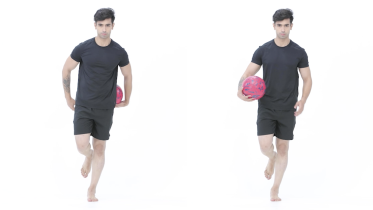
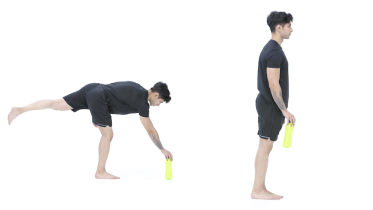
Single leg clock reach
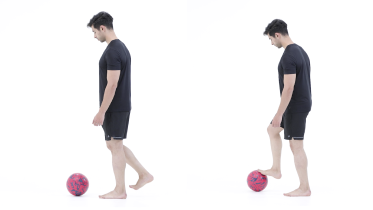
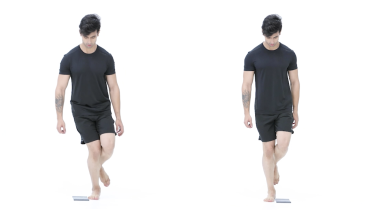
The single leg clock reach is a balance exercise. You stand on one leg on a soft foam pad and tap the floor around you with the other foot, as if pointing at the numbers on a clock face. Each reach shifts your weight a little, and the standing leg has to keep working to hold you steady. Physios tend to add it once standing still on one leg has become easy.
How to do the single leg clock reach
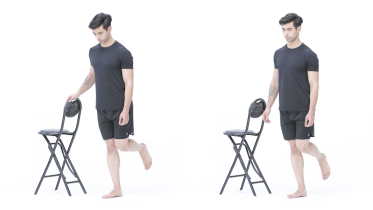
- Set a foam balance pad down beside a wall or kitchen counter, on a floor where it will not slip. You want to be able to rest one hand on the support.
- Stand on the center of the pad with the leg you are working on. Keep your hand on the wall while you settle.
- Stand tall with the standing knee soft rather than locked. Tighten the muscles of your thigh and buttock and look straight ahead.
- With the free foot, lightly touch the floor with your toes at different points around you, like the hands of a clock: in front, out to the side, behind, and, as in the video, across behind the standing leg. Bring the foot back near the pad between touches.
- In the video he keeps his hand on the wall the whole time, and that is the way to begin. The voice guide asks you to try letting go: do that only once you feel steady, and keep the hand close to the wall.
- Step off the pad, rest, and repeat standing on the other leg if your program includes both sides.
What you should feel
Busy little corrections in the foot and ankle of the standing leg, with effort in the buttock and front of the thigh on that side. Reaching farther makes it harder.
Common mistakes
- Putting real weight on the tapping foot, so it becomes a two-footed stance.
- Letting the standing knee roll inward as you reach across or behind.
- Reaching so far that the hip drops or the trunk tips over to one side.
- Letting go of the wall before you are steady.
How often
Many programs start with 5 to 10 taps in each direction, 2 to 3 rounds on each leg, once a day. Your physio will adjust this.
Stop and check with your physio if
- You feel lightheaded, or the room seems to spin. If you faint while exercising, call emergency services, even if you feel fine again quickly.
- Your ankle or knee gives way, or you get sharp pain in either.
- You lose your balance and need the wall to catch yourself.
From the clinic
Set up beside a wall or counter every time, and check that the pad cannot slide. Clear away rugs and anything else the tapping foot could catch on. Anyone who has had a fall in the last 12 months, feels shaky when walking, or takes a medicine that causes dizziness should hold the wall for the whole exercise and practice with another adult nearby. Ask your doctor or physio about a falls assessment too.
There is an order to this. Standing still on one leg on the floor comes first (single leg stance), then balancing on a wobble cushion, and the clock reach adds movement on top of that. Start with small touches close to the pad and reach farther only when the standing leg stays quiet.
If you have had a hip replacement, get the go-ahead from your surgeon or physio before you try the clock reach. Reaching the foot across in front of or behind the standing leg takes that leg across the middle of your body, and many surgeons ask you to avoid that for the first months after some operations. Until you are cleared, keep every touch on the same side of your body as the moving leg.
Written and checked by the PocketPhysio editorial team. Last updated 2026-09-26.
This page is general education, not a diagnosis or a personal treatment plan. If you have pain, an injury or a health condition, see a physiotherapist or doctor before starting new exercises.